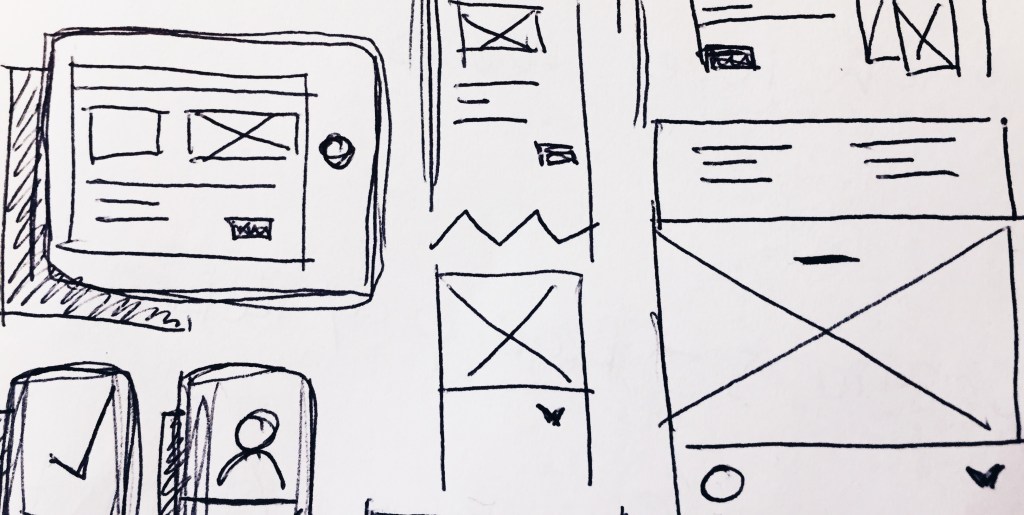
Sketch diagrams are powerful tools for visualizing complex programs and systems. This simple technique literally gets people on the same page.
Mapping out a service or product ecosystem can be a complicated endeavour. There is the entire field of systemic design that focuses on tools and strategies to engage users for starters. There are approaches like synthesis mapping and service design canvases that can help us walk through the various aspects of a system to find points of leverage, threat, and opportunity.
Nearly all of these methods and tools require user orientation and training — sometimes a little, sometimes a lot. However, in many of our engagements, particularly in healthcare, we find the time (and attention) is so limited it becomes difficult to engage participants using methods that require considerable instruction.
It’s here that we introduce a technique and tool called the system sketch map.
Sketch mapping

A sketch map is a multimedia system map that is created by using any form of representation such as blocks and arrows, stick figures, or elaborate illustration and can be developed at any moment. A sketch map gets participants past the challenge of having to learn a technique or representation convention and can be particularly useful for those participants who feel unskilled at drawing or visualizing their thoughts.
This works well with professionals who may find themselves uneasy about using visual media or do not consider themselves ‘creative’. (Note: Everyone can draw. It’s important to emphasize that this is not an art project).
The exercise works like this:
Begin with the instructions: Draw your system.
That’s it.
Some guidelines:
- Any visual formalism can be used. One can even combine visual approaches together.
- Emphasize the simplest media possible: Pens and paper (or crayons), sticky notes (or stickers) are among the best tools because they are flexible, colourful, and can be combined easily. These are also inexpensive and easy to obtain.
- Large format paper (e.g., newsprint) or whiteboards are best to use as a canvas to facilitate group participation
- Group participation is key
- There are no right or wrong ways to do this. Whatever participants wish to include in that system is all that matters.
- Give participants a time frame (usually 30 – 50 minutes works best) and try and ensure there are between 4 and 6 people in the group.
- Emphasize DOing over THINKing. It’s easy for groups to try and do this ‘right’ and analyze everything. The use of simple, inexpensive materials allows people to create ‘do-overs’ easily, erase material, revise and recreate things.
- Lastly, strive for ‘good enough’ and ‘coherent’ over ‘excellent’ and ‘complete’ (which are highly relative in this context).
What is interesting is that the participants define what their system is and what goes in it. In making these choices it becomes evident what they see as most essential, important, or relevant.:
A completed sketch map then allows everyone (the facilitator and participants) afterward to ‘interrogate’ the map (not the map makers) and ask questions like “does this choice of colour mean anything?“, “is the distance between these two things represent some kind of scale?“, “what might be missing from all of this?”
This interactive discussion process allows everyone to explore what gets placed at different positions, sizes, in different colours, and what gets included and left out of the map. It allows for the use of symbolism (conscious or not), metaphor, and representation without having to shape or bias the participants toward using a particular way of visualizing the system.
What it is, is what it is.
This simple technique can yield enormous insights into the assumptions, structures, relationships, actors, and core components associated with a system and do so within one or two hours and with a small budget.
For more information about sketch mapping and how it can help you with your work or just for more on innovation methods, tools, and strategies, feel free to contact us. We’d love to hear from you and can help.
Photo by Danae Paparis on Unsplash and Kaleidico on Unsplash
 English
 Afrikaans
 Shqip
Shqip አማርኛ
አማርኛ العربية
 Հայերեն
 Azərbaycan dili
 Euskara
 Беларуская мова
 বাংলা
বাংলা Bosanski
 Български
 Català
 Cebuano
 Chichewa
 简体中文
简体中文 繁體中文
繁體中文 Corsu
Corsu Hrvatski
 Čeština
 Dansk
Dansk Nederlands
 Esperanto
 Eesti
Eesti Filipino
 Suomi
Suomi Français
 Frysk
Frysk Galego
 ქართული
 Deutsch
 Ελληνικά
 ગુજરાતી
 Kreyol ayisyen
 Harshen Hausa
 Ōlelo Hawaiʻi
 עִבְרִית
 हिन्दी
 Hmong
Hmong Magyar
 Íslenska
 Igbo
Igbo Bahasa Indonesia
 Gaeilge
 Italiano
 日本語
日本語 Basa Jawa
 ಕನ್ನಡ
ಕನ್ನಡ Қазақ тілі
 ភាសាខ្មែរ
 한국어
한국어 كوردی
كوردی Кыргызча
 ພາສາລາວ
 Latin
Latin Latviešu valoda
 Lietuvių kalba
 Lëtzebuergesch
 Македонски јазик
 Malagasy
 Bahasa Melayu
 മലയാളം
 Maltese
 Te Reo Māori
 मराठी
मराठी Монгол
 ဗမာစာ
ဗမာစာ नेपाली
 Norsk bokmål
 پښتو
پښتو فارسی
فارسی Polski
 Português
 ਪੰਜਾਬੀ
 Română
 Русский
 Samoan
 Gàidhlig
 Српски језик
 Sesotho
 Shona
Shona سنڌي
سنڌي සිංහල
සිංහල Slovenčina
 Slovenščina
 Afsoomaali
 Español
 Basa Sunda
 Kiswahili
 Svenska
 Тоҷикӣ
 தமிழ்
தமிழ் తెలుగు
 ไทย
ไทย Türkçe
 Українська
 اردو
اردو O‘zbekcha
 Tiếng Việt
 Cymraeg
 isiXhosa
 יידיש
יידיש Yorùbá
 Zulu
Zulu