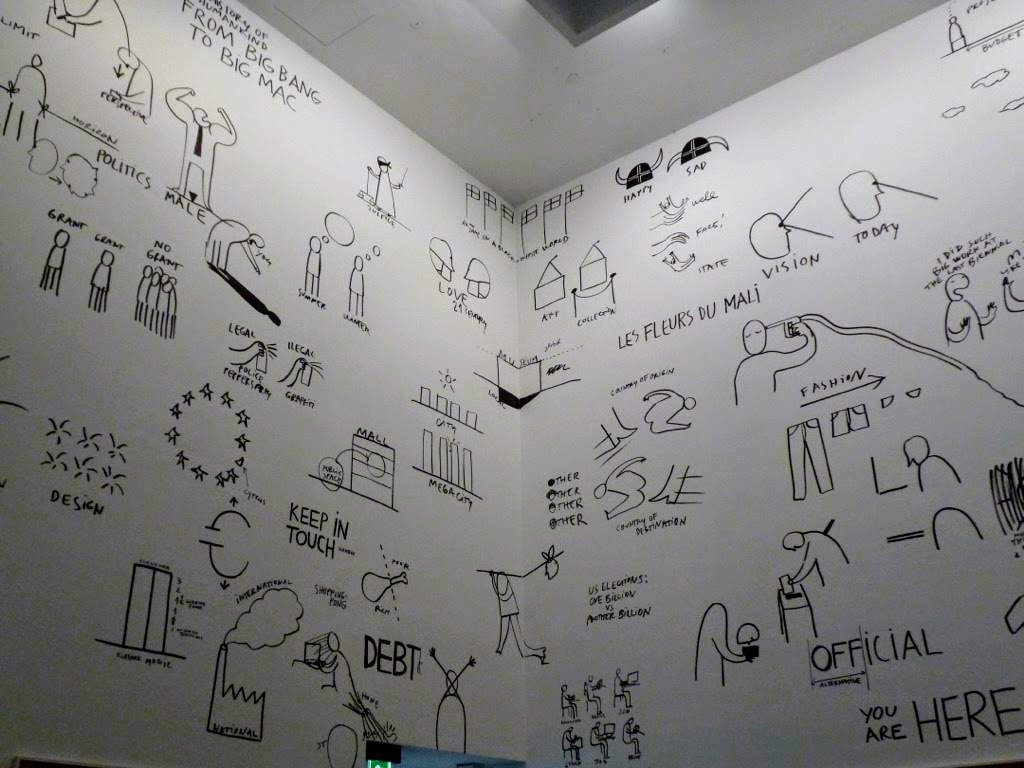
Service and product design involves creating something, envisioning it’s use, consideration of its effects, and hopefully seeing it achieve a goal. When we are creating or planning our project we need to consider all of that on top of the many ideas we have about what that product or service ought to involve. That is a lot to hold in our heads at one time.
This is why designers often rely on visual thinking and communication to help illustrate these ideas as systems. The benefits of this approach are many and include:
- Providing a way to communicate your thoughts in multiple dimensions. Time, space, sequence, and effects are all different considerations for service design and visualizing that allows us to see these all in one space. Our language is linear, visualizing allows for linear and non-linear effects.
- It creates a space for everyone to participate. Whether you are a skilled visual communicator or someone who hasn’t drawn anything by hand in 20 years, nearly everyone can draw. Visual thinking tools can provide a means to literally get people working on the same page. Simple methods like the Sketch Map are easy to employ and get everyone sharing ideas together.
- Visual language – such as that illustrated by XPlane in their useful guide to visual thinking transcends spoken words and allows us to communicate even when our shared spoken language isn’t strong.
- Visual thinking allows us to use metaphors, express complex emotions, and connect physical and emotional things together during a service journey in a way that is difficult to convey through oral or written language.
- Visuals provide an artifact that can be interrogated, explored, and reviewed from many different perspectives allowing people to point to objects, relationships, and structures and ask about their purpose, illustration, and meaning without requiring much technical understanding of the problem-domain (allowing outside and alternative perspectives to meaningfully contribute).
- It also provides a means to generate a shared understanding of the system boundaries, components, and purposes that guide your development of the service. It gets people on the same page metaphorically and literally.
Visual communicator Angelika Skotnicka provides a strong case for why we want to consider visual thinking and how it is done from the perspective of graphic recording.
Consider ways to bring in visual thinking to your project planning, service design, evaluation, and strategy development. It is low-risk, high-reward and is an engaging, low-cost, and often enjoyable way to generate enormous insight quickly and effectively.
Want to learn more? Contact us and we can help you bring your ideas to light visually and more.
 English
 Afrikaans
 Shqip
Shqip አማርኛ
አማርኛ العربية
 Հայերեն
 Azərbaycan dili
 Euskara
 Беларуская мова
 বাংলা
বাংলা Bosanski
 Български
 Català
 Cebuano
 Chichewa
 简体中文
简体中文 繁體中文
繁體中文 Corsu
Corsu Hrvatski
 Čeština
 Dansk
Dansk Nederlands
 Esperanto
 Eesti
Eesti Filipino
 Suomi
Suomi Français
 Frysk
Frysk Galego
 ქართული
 Deutsch
 Ελληνικά
 ગુજરાતી
 Kreyol ayisyen
 Harshen Hausa
 Ōlelo Hawaiʻi
 עִבְרִית
 हिन्दी
 Hmong
Hmong Magyar
 Íslenska
 Igbo
Igbo Bahasa Indonesia
 Gaeilge
 Italiano
 日本語
日本語 Basa Jawa
 ಕನ್ನಡ
ಕನ್ನಡ Қазақ тілі
 ភាសាខ្មែរ
 한국어
한국어 كوردی
كوردی Кыргызча
 ພາສາລາວ
 Latin
Latin Latviešu valoda
 Lietuvių kalba
 Lëtzebuergesch
 Македонски јазик
 Malagasy
 Bahasa Melayu
 മലയാളം
 Maltese
 Te Reo Māori
 मराठी
मराठी Монгол
 ဗမာစာ
ဗမာစာ नेपाली
 Norsk bokmål
 پښتو
پښتو فارسی
فارسی Polski
 Português
 ਪੰਜਾਬੀ
 Română
 Русский
 Samoan
 Gàidhlig
 Српски језик
 Sesotho
 Shona
Shona سنڌي
سنڌي සිංහල
සිංහල Slovenčina
 Slovenščina
 Afsoomaali
 Español
 Basa Sunda
 Kiswahili
 Svenska
 Тоҷикӣ
 தமிழ்
தமிழ் తెలుగు
 ไทย
ไทย Türkçe
 Українська
 اردو
اردو O‘zbekcha
 Tiếng Việt
 Cymraeg
 isiXhosa
 יידיש
יידיש Yorùbá
 Zulu
Zulu