It has always been clear to me: Monitoring and Evaluation depends to a large extent on how development or government programmes are planned and designed. That is why good M&E is strongly linked with good planning and design. In a way, programme design is a natural extension of our skill set in M&E.
That is why this blog post looks closer at the rapidly evolving landscape of options for innovative programme design.
DRIVERS OF INNOVATION
In my view, we have recently seen such a push for innovation in programme design for three reasons:
- Disillusion with linear models: Linear planning tools such as logical frameworks and linear theories of change are ineffective in a more complex, complicated or chaotic context. If you are not yet convinced, look at Ben Ramalingam’s comprehensive critique of current planning models (1).
- Complexity and wicked problems: Genuine progress toward sustainable development is increasingly complex: solutions are not simple or obvious, those who would benefit are the ones who most lack power, those who can make a difference are disengaged, and political barriers are too often overlooked. Look for example at the Manifesto ‘Doing Development Differently’ manifesto from 2014. That is why programme design must increasingly cope with ‘wicked’ problems: problems that are difficult to define clearly, are deeply interconnected, and driven by many factors and unforeseen events.
- Data revolution: The world has been – and still is – undergoing a data revolution with far-reaching consequences for programme design: We now live in a world where 90 percent of the data out there today has been created in the last two years alone. Every minute, more than 270,000 tweets get published worldwide, Google receives no less than 4 million search queries, and over 200 million emails are sent.(2)
CHALLENGES TO INNOVATION
Despite this push, development organizations and governments have mostly kept more innovative programme designs contained in ‘innovation labs’ and small pilot projects. There are significant challenges to innovative programme design. Three reasons stand out in my view:
- Mind set: Many of these innovations require ‘unlearning’ of the traditional, linear design approach based on a chain of results.
- Rules and regulations: Many of these innovations may be difficult to carry out within the current rules and regulations for programme design and implementation.
- Donor requirements: Testing these innovations may require flexibility by the donor.
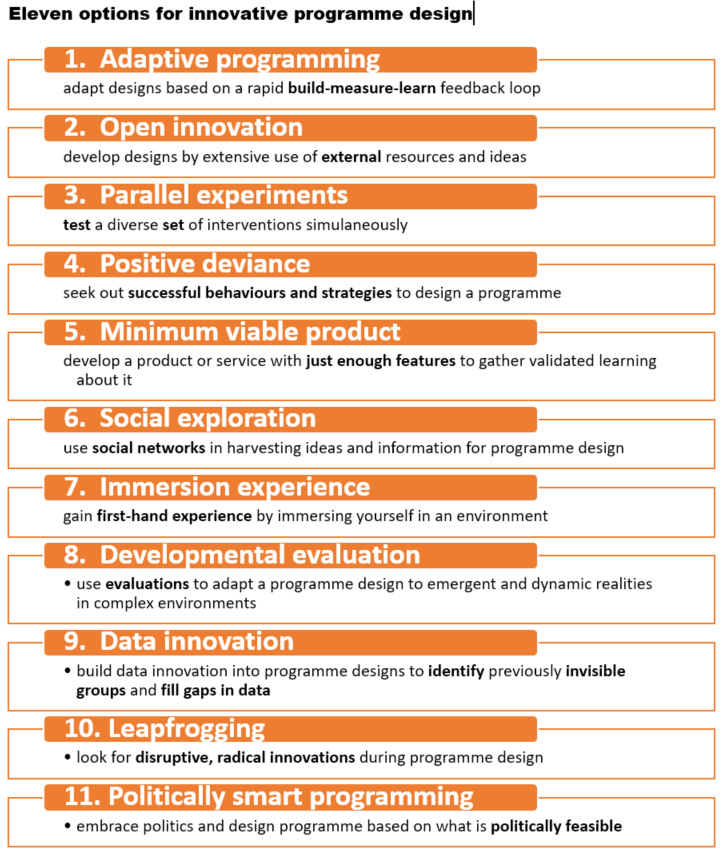
ELEVEN OPTIONS FOR INNOVATIVE PROGRAMME DESIGN
In my view, there are eleven concrete options for innovative programme design in complex, complicated or chaotic settings to consider for governments and development organisations:
Sources:
(1) Aid on the edge of chaos: rethinking international cooperation in a complex world, Ramalingam 2013
(2) Can big data help us make emergency services better? David Svab/Brett Romero, 20/04/2016
The post Innovative programme design appeared first on Thomas Winderl.
 English
 Afrikaans
 Shqip
Shqip አማርኛ
አማርኛ العربية
 Հայերեն
 Azərbaycan dili
 Euskara
 Беларуская мова
 বাংলা
বাংলা Bosanski
 Български
 Català
 Cebuano
 Chichewa
 简体中文
简体中文 繁體中文
繁體中文 Corsu
Corsu Hrvatski
 Čeština
 Dansk
Dansk Nederlands
 Esperanto
 Eesti
Eesti Filipino
 Suomi
Suomi Français
 Frysk
Frysk Galego
 ქართული
 Deutsch
 Ελληνικά
 ગુજરાતી
 Kreyol ayisyen
 Harshen Hausa
 Ōlelo Hawaiʻi
 עִבְרִית
 हिन्दी
 Hmong
Hmong Magyar
 Íslenska
 Igbo
Igbo Bahasa Indonesia
 Gaeilge
 Italiano
 日本語
日本語 Basa Jawa
 ಕನ್ನಡ
ಕನ್ನಡ Қазақ тілі
 ភាសាខ្មែរ
 한국어
한국어 كوردی
كوردی Кыргызча
 ພາສາລາວ
 Latin
Latin Latviešu valoda
 Lietuvių kalba
 Lëtzebuergesch
 Македонски јазик
 Malagasy
 Bahasa Melayu
 മലയാളം
 Maltese
 Te Reo Māori
 मराठी
मराठी Монгол
 ဗမာစာ
ဗမာစာ नेपाली
 Norsk bokmål
 پښتو
پښتو فارسی
فارسی Polski
 Português
 ਪੰਜਾਬੀ
 Română
 Русский
 Samoan
 Gàidhlig
 Српски језик
 Sesotho
 Shona
Shona سنڌي
سنڌي සිංහල
සිංහල Slovenčina
 Slovenščina
 Afsoomaali
 Español
 Basa Sunda
 Kiswahili
 Svenska
 Тоҷикӣ
 தமிழ்
தமிழ் తెలుగు
 ไทย
ไทย Türkçe
 Українська
 اردو
اردو O‘zbekcha
 Tiếng Việt
 Cymraeg
 isiXhosa
 יידיש
יידיש Yorùbá
 Zulu
Zulu