A recent study in the American Journal of Evaluation showed how three simple visual design principles could be applied to logic models to make them more effective and understandable. This article summarizes the findings of that study so you can improve your logic model.
What are logic models?
Logic models are widely used in evaluation to visually summarize how a program is expected to work: what resources will be used, what activities will be undertaken, and how those activities will cause desired outcomes. These are often a staple in our evaluation work, whether we are starting with a logic model that has already been created, or we are creating one for the program from scratch.
Why visual design?
Visualizing information effectively is important for evaluators because we are “communicators and knowledge brokers” at our core. The way we visualize and present information affects how it is used, and who is able to use it. Therefore, logic models could be made more useful and understandable by improving their visual design. The goal of the study was to make a logic model better by applying visual design principles. A good visualization:
-
Is clear, useful, and memorable;
-
Supports audience understanding;
-
Is easy to mentally process; and
-
Is organized into memorable chunks.
These visualization principles, along with the relevant research on data visualization and visual design, were used to make some simple (yet effective) improvements to the basic logic model.
Visual improvements to the logic model
The original logic model looked like this:
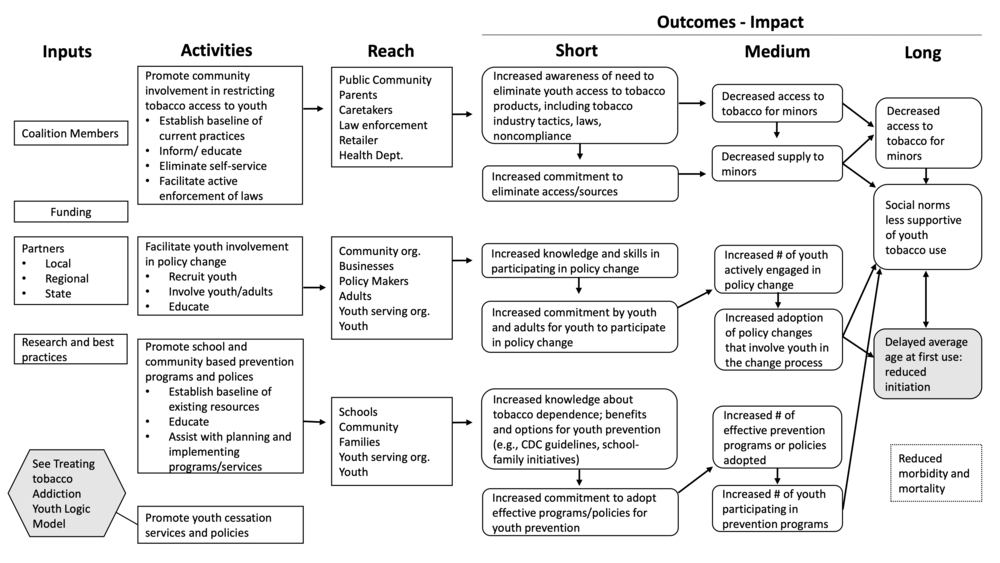
This is a fairly standard logic model that evaluators are used to seeing. It outlines the program’s inputs, activities, reach, and outcomes, and shows the interconnections between them.
This logic model was revised by incorporating the following visualization best practices:
-
Colour: Colour was used to group similar items together (i.e., each column was a different colour)
-
Proximity: Elements that were connected to each other were moved closer together, which reduced the emphasis on arrows
-
Reducing ink: unimportant elements were de-emphasized or removed to keep the focus on the most important elements. For example, by removing the black borders around boxes.
After making these improvements, the revised logic model looked like this:
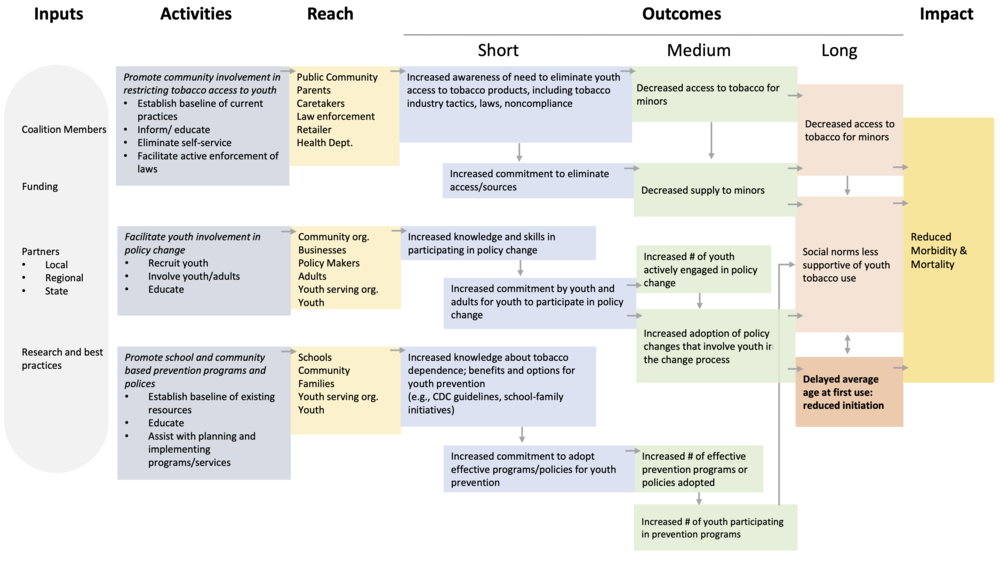
The revised logic model was easier to understand
After testing these logic models with a survey of the general U.S. population, the researchers found that the revised logic model was:
-
Faster to review
-
Interpreted more accurately
-
Easier to understand
-
More aesthetically pleasing
-
Perceived as more credible
With relatively simple visual changes, which can be implemented in Microsoft Word or PowerPoint, the researchers were able to improve their audience’s understanding of the logic model. We can leverage these 3 design tweaks (colour, proximity, and reducing ink) to help our audiences read our logic models faster and more accurately.
Notes on study methodology
The original study (linked below) has more detail about how exactly the research was conducted, but in short:
-
A survey was conducted with the general U.S. public.
-
Respondent were shown one of six possible variations of the logic model, which were combinations of:
-
Original vs. revised logic model
-
With vs. without a written narrative
-
Greyscale vs. colour logic model
-
-
Respondents were then asked a series of questions about the logic model they were shown, including their understanding of the program, the effort it took to understand, their perception of the credibility, and the aesthetic qualities.
-
Responses to the different types of logic models were compared to determine if the visual design elements helped improve the original logic model (and it did!).
The full study can be found here:
Jones, N. D., Azzam, T., Wanzer, D. L., Skousen, D., Knight, C., & Sabarre, N. (2019). Enhancing the Effectiveness of Logic Models. American Journal of Evaluation, 1098214018824417. https://doi.org/10.1177/1098214018824417
Sign up for our newsletter
We’ll let you know about our new content, and curate the best new evaluation resources from around the web!
We respect your privacy.
Thank you!
 English
 Afrikaans
 Shqip
Shqip አማርኛ
አማርኛ العربية
 Հայերեն
 Azərbaycan dili
 Euskara
 Беларуская мова
 বাংলা
বাংলা Bosanski
 Български
 Català
 Cebuano
 Chichewa
 简体中文
简体中文 繁體中文
繁體中文 Corsu
Corsu Hrvatski
 Čeština
 Dansk
Dansk Nederlands
 Esperanto
 Eesti
Eesti Filipino
 Suomi
Suomi Français
 Frysk
Frysk Galego
 ქართული
 Deutsch
 Ελληνικά
 ગુજરાતી
 Kreyol ayisyen
 Harshen Hausa
 Ōlelo Hawaiʻi
 עִבְרִית
 हिन्दी
 Hmong
Hmong Magyar
 Íslenska
 Igbo
Igbo Bahasa Indonesia
 Gaeilge
 Italiano
 日本語
日本語 Basa Jawa
 ಕನ್ನಡ
ಕನ್ನಡ Қазақ тілі
 ភាសាខ្មែរ
 한국어
한국어 كوردی
كوردی Кыргызча
 ພາສາລາວ
 Latin
Latin Latviešu valoda
 Lietuvių kalba
 Lëtzebuergesch
 Македонски јазик
 Malagasy
 Bahasa Melayu
 മലയാളം
 Maltese
 Te Reo Māori
 मराठी
मराठी Монгол
 ဗမာစာ
ဗမာစာ नेपाली
 Norsk bokmål
 پښتو
پښتو فارسی
فارسی Polski
 Português
 ਪੰਜਾਬੀ
 Română
 Русский
 Samoan
 Gàidhlig
 Српски језик
 Sesotho
 Shona
Shona سنڌي
سنڌي සිංහල
සිංහල Slovenčina
 Slovenščina
 Afsoomaali
 Español
 Basa Sunda
 Kiswahili
 Svenska
 Тоҷикӣ
 தமிழ்
தமிழ் తెలుగు
 ไทย
ไทย Türkçe
 Українська
 اردو
اردو O‘zbekcha
 Tiếng Việt
 Cymraeg
 isiXhosa
 יידיש
יידיש Yorùbá
 Zulu
Zulu