Sensemaking is a social process that helps us make sense of data, information, and knowledge in a time of complexity. It’s used often in innovation contexts when we are fitting data to a unique situation.
The RSA (the Royal Society for the encouragement of Arts, Manufactures and Commerce) a UK-based charity and think-tank has recently updated and revised its collective sense-making framework which provides a clear example of ways to consider change-making and leading in times of crisis.
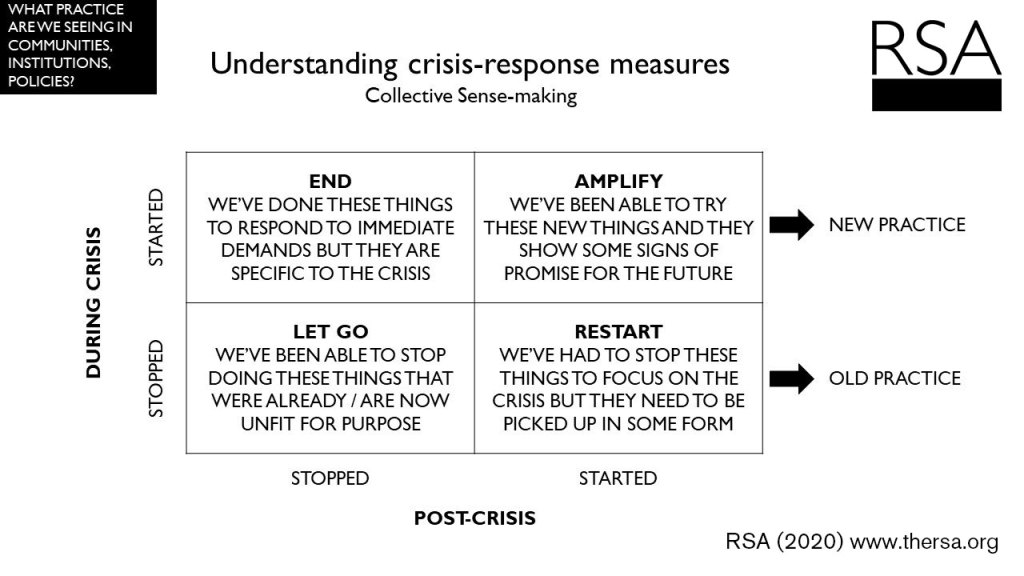
The 2×2 framework, presented below, helps to frame activities that may have stopped or started during a crisis and what activities we may wish to amplify, end, abandon, and re-start.
Developmental Thinking
What the RSA framework embodies is what we call developmental thinking. This is the kind of thinking embedded in Developmental Evaluation, design and innovation. This thinking is about taking information and feedback from the activities in the system and making adaptive, strategic decisions to keep the organization developing (evolving) through learning.
Learning is about taking action based on new information and in some cases — such as those in complex situations with lots of change and activity — this learning must come from sensemaking. It tells us when to stop, start, pause, and wind-down activities.
The RSA proposes conducting this sensemaking over time through a process that is akin to developmental design and developmental evaluation through the crisis which, in the case of events like COVID-19, might be protracted and evolve. As noted below, it also recognizes that sensemaking is tied to systems thinking where events (the most visible parts of a system) are actually built upon larger sets of behaviours, structures, and paradigms.
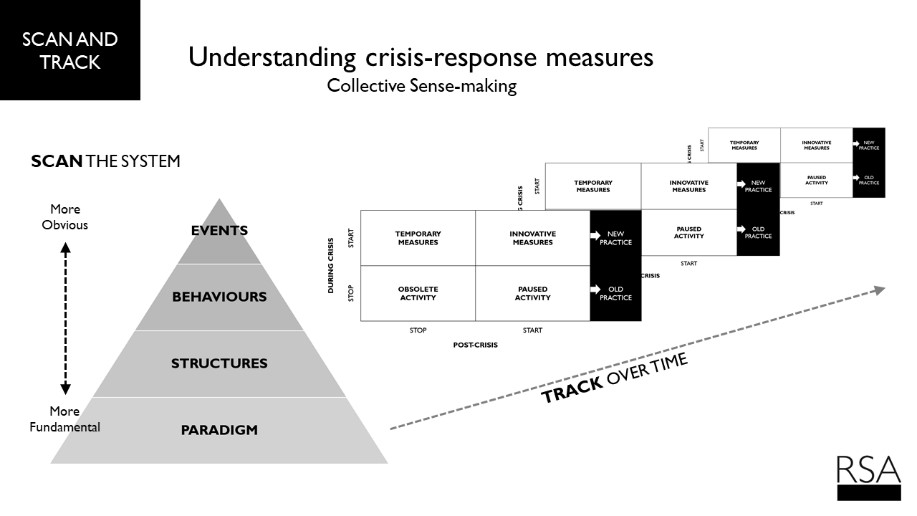
To make use of this requires a monitoring and evaluation system tied to an overall developmental, design-driven process. It’s not difficult, but it does require substantial mindframe shifts and organizational supports. Yet, the payoff is that your organization is adaptive and working with what’s happening and what’s emerging, rather than stuck trying to make what used to work come alive in an environment that has not only changed, but might be different altogether.
If your organization needs help in reshaping your work to make the most of what you have and pivot to what’s needed next, contact us. This is what we do.
 English
 Afrikaans
 Shqip
Shqip አማርኛ
አማርኛ العربية
 Հայերեն
 Azərbaycan dili
 Euskara
 Беларуская мова
 বাংলা
বাংলা Bosanski
 Български
 Català
 Cebuano
 Chichewa
 简体中文
简体中文 繁體中文
繁體中文 Corsu
Corsu Hrvatski
 Čeština
 Dansk
Dansk Nederlands
 Esperanto
 Eesti
Eesti Filipino
 Suomi
Suomi Français
 Frysk
Frysk Galego
 ქართული
 Deutsch
 Ελληνικά
 ગુજરાતી
 Kreyol ayisyen
 Harshen Hausa
 Ōlelo Hawaiʻi
 עִבְרִית
 हिन्दी
 Hmong
Hmong Magyar
 Íslenska
 Igbo
Igbo Bahasa Indonesia
 Gaeilge
 Italiano
 日本語
日本語 Basa Jawa
 ಕನ್ನಡ
ಕನ್ನಡ Қазақ тілі
 ភាសាខ្មែរ
 한국어
한국어 كوردی
كوردی Кыргызча
 ພາສາລາວ
 Latin
Latin Latviešu valoda
 Lietuvių kalba
 Lëtzebuergesch
 Македонски јазик
 Malagasy
 Bahasa Melayu
 മലയാളം
 Maltese
 Te Reo Māori
 मराठी
मराठी Монгол
 ဗမာစာ
ဗမာစာ नेपाली
 Norsk bokmål
 پښتو
پښتو فارسی
فارسی Polski
 Português
 ਪੰਜਾਬੀ
 Română
 Русский
 Samoan
 Gàidhlig
 Српски језик
 Sesotho
 Shona
Shona سنڌي
سنڌي සිංහල
සිංහල Slovenčina
 Slovenščina
 Afsoomaali
 Español
 Basa Sunda
 Kiswahili
 Svenska
 Тоҷикӣ
 தமிழ்
தமிழ் తెలుగు
 ไทย
ไทย Türkçe
 Українська
 اردو
اردو O‘zbekcha
 Tiếng Việt
 Cymraeg
 isiXhosa
 יידיש
יידיש Yorùbá
 Zulu
Zulu