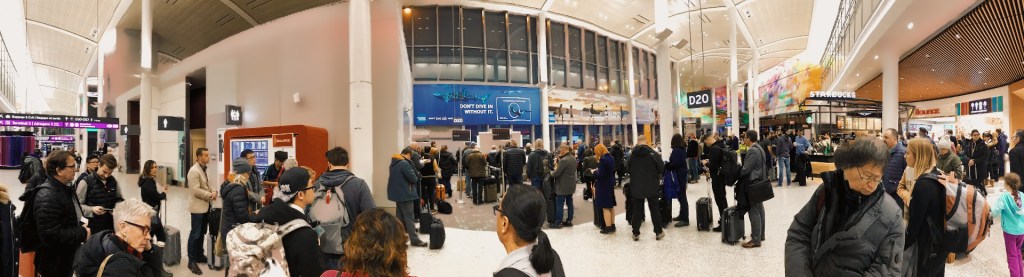
This simple technique is among the most powerful at eliciting a lot of information. When we look at an existing service, it may be easy to describe what people do to deliver, manage, and receive the service in simple terms. For example, an exchange between a bank teller and a client might be described as simply as a person walking up to a desk, asking for money, inserting their bank card, receiving money from the teller, and leaving.
An Activity Analysis would break this down even further. It would involve tracking the experience of the client. It would denote what the client did from the moment she entered the bank, what she saw, what she smelled or experienced, her feelings or thoughts, and the steps she took toward the desk.
You might ask how long she took, whether she stopped en route to the desk, knew where it was (did she ask for directions?) or did she wait in line and for how long.
We can also track what the teller was doing up to and including the moment of engagement with the client. What tasks was she doing? Where was her focus? What is she thinking or feeling?
This is a micro-method version of A Day in the Life, which is another method that helps us understand what our service clients do and use.
How to do it
Activity Analysis can be done as a group, facilitated by a leader to help organize and manage the activity. It’s a great way to get people talking about all that is going on with the actors, the environment, and the tasks. By opening up the discussion and walking through each step in the journey through the service with each actor, everything that shapes the environmental conditions, and the tasks that are performed, you’ll reveal an enormous amount of data about what actually transpires with even the simplest transaction.
This can be used to seed further questions like:
- What infrastructure is needed to support the interaction?
- What would be ideal?
- How might this interaction look different?
- What other variables could affect the journey and the outcome?
- What could be done or introduced to make this better?
Activity analysis is something that can be done in small groups over the course of 20 to 60 minutes, depending on the complexity of the task and the amount of knowledge the participants have of the task or activity.
This simple analysis can reveal information about flows, resources, outcomes, and processes that are in place to support your service and help you see what’s not only in place, but what is possible, too.
This can be a great way to bring people together as well as lead your service design and evaluation efforts. If you want to implement this approach in your organization and need help, reach out to us. We’d welcome hearing from you.
 English
 Afrikaans
 Shqip
Shqip አማርኛ
አማርኛ العربية
 Հայերեն
 Azərbaycan dili
 Euskara
 Беларуская мова
 বাংলা
বাংলা Bosanski
 Български
 Català
 Cebuano
 Chichewa
 简体中文
简体中文 繁體中文
繁體中文 Corsu
Corsu Hrvatski
 Čeština
 Dansk
Dansk Nederlands
 Esperanto
 Eesti
Eesti Filipino
 Suomi
Suomi Français
 Frysk
Frysk Galego
 ქართული
 Deutsch
 Ελληνικά
 ગુજરાતી
 Kreyol ayisyen
 Harshen Hausa
 Ōlelo Hawaiʻi
 עִבְרִית
 हिन्दी
 Hmong
Hmong Magyar
 Íslenska
 Igbo
Igbo Bahasa Indonesia
 Gaeilge
 Italiano
 日本語
日本語 Basa Jawa
 ಕನ್ನಡ
ಕನ್ನಡ Қазақ тілі
 ភាសាខ្មែរ
 한국어
한국어 كوردی
كوردی Кыргызча
 ພາສາລາວ
 Latin
Latin Latviešu valoda
 Lietuvių kalba
 Lëtzebuergesch
 Македонски јазик
 Malagasy
 Bahasa Melayu
 മലയാളം
 Maltese
 Te Reo Māori
 मराठी
मराठी Монгол
 ဗမာစာ
ဗမာစာ नेपाली
 Norsk bokmål
 پښتو
پښتو فارسی
فارسی Polski
 Português
 ਪੰਜਾਬੀ
 Română
 Русский
 Samoan
 Gàidhlig
 Српски језик
 Sesotho
 Shona
Shona سنڌي
سنڌي සිංහල
සිංහල Slovenčina
 Slovenščina
 Afsoomaali
 Español
 Basa Sunda
 Kiswahili
 Svenska
 Тоҷикӣ
 தமிழ்
தமிழ் తెలుగు
 ไทย
ไทย Türkçe
 Українська
 اردو
اردو O‘zbekcha
 Tiếng Việt
 Cymraeg
 isiXhosa
 יידיש
יידיש Yorùbá
 Zulu
Zulu