Want to make sure that your data gets used to inform decisions?
Get your stakeholders involved in the sense-making process!
Are you familiar with data placemats?
Here’s how they work:
- Design Data Placemats
- Facilitate an Interpretation Meeting
- Include those Insights in the Final Report or Slideshow
Step 1: Design Data Placemats
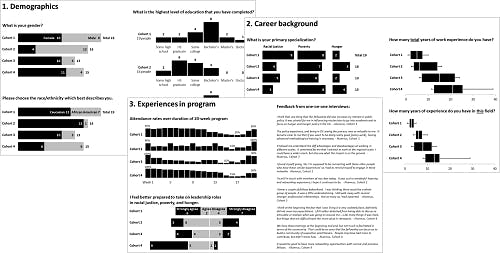
First, we analyze the data and display key findings in data placemats. You might display survey responses, for example.
These placemats should include traditional graphs. That means the graph titles contain the topic area, not the takeaway finding, and there’s no color contrast. Imagine a bar chart where every bar is the same color, so that nothing stands out. It’s up to the viewer to figure out the “so what?” for themselves.
We can make data placemats in any software program. You know I’m a champion for everyday software. PowerPoint’s my top choice for data placemats because it’s easy to arrange multiple graphs on the slide.
Your placemats might look like this, with one page per survey topic.
Step 2: Facilitate an Interpretation Meeting
Next, we gather people together, either virtually or in-person.
During the meeting, we’re facilitators, not lecturers.
It’s a conversation, not a presentation.
We ask questions like:
- “What surprises you about the data?”
- “What factors might explain the patterns we’re seeing?”
- “What additional questions do you have?”
The goal is to get attendees to verbalize the takeaway findings in their own words. We listen, listen, listen.
Step 3: Include those Insights in the Final Report or Slideshow
Finally, we go back to our offices and create a final deliverable for the project, like a report or slideshow (if needed).
The final version should include storytelling graphs, which means the graphs have the takeaway findings in the graph titles, and include color contrast. Imagine a bar chart where everything’s grayed-out except for the one important bar in a darker color.
The interpretation meeting becomes a data collection event; we quote the meeting attendees and include that qualitative data in the final report.
This process not only gets stakeholders involved in the process–making it more likely that they’ll use the findings–but makes the final report or slideshow even richer.
Learn More
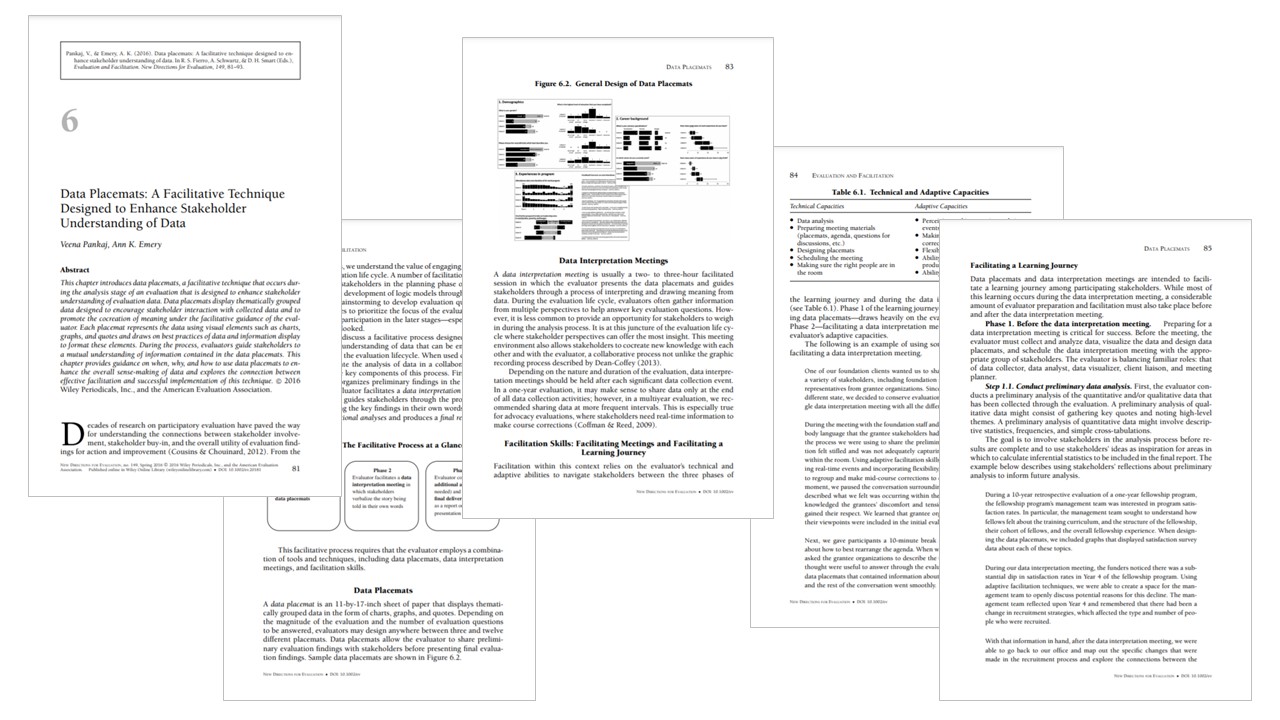
I learned this technique years ago from Veena Pankaj. Veena and I published an article about placemats together that you read can here: https://onlinelibrary.wiley.com/doi/pdf/10.1002/ev.20181
Your Turn
Have you used data placemats in your project? Comment and share tips of your own!
 English
 Afrikaans
 Shqip
Shqip አማርኛ
አማርኛ العربية
 Հայերեն
 Azərbaycan dili
 Euskara
 Беларуская мова
 বাংলা
বাংলা Bosanski
 Български
 Català
 Cebuano
 Chichewa
 简体中文
简体中文 繁體中文
繁體中文 Corsu
Corsu Hrvatski
 Čeština
 Dansk
Dansk Nederlands
 Esperanto
 Eesti
Eesti Filipino
 Suomi
Suomi Français
 Frysk
Frysk Galego
 ქართული
 Deutsch
 Ελληνικά
 ગુજરાતી
 Kreyol ayisyen
 Harshen Hausa
 Ōlelo Hawaiʻi
 עִבְרִית
 हिन्दी
 Hmong
Hmong Magyar
 Íslenska
 Igbo
Igbo Bahasa Indonesia
 Gaeilge
 Italiano
 日本語
日本語 Basa Jawa
 ಕನ್ನಡ
ಕನ್ನಡ Қазақ тілі
 ភាសាខ្មែរ
 한국어
한국어 كوردی
كوردی Кыргызча
 ພາສາລາວ
 Latin
Latin Latviešu valoda
 Lietuvių kalba
 Lëtzebuergesch
 Македонски јазик
 Malagasy
 Bahasa Melayu
 മലയാളം
 Maltese
 Te Reo Māori
 मराठी
मराठी Монгол
 ဗမာစာ
ဗမာစာ नेपाली
 Norsk bokmål
 پښتو
پښتو فارسی
فارسی Polski
 Português
 ਪੰਜਾਬੀ
 Română
 Русский
 Samoan
 Gàidhlig
 Српски језик
 Sesotho
 Shona
Shona سنڌي
سنڌي සිංහල
සිංහල Slovenčina
 Slovenščina
 Afsoomaali
 Español
 Basa Sunda
 Kiswahili
 Svenska
 Тоҷикӣ
 தமிழ்
தமிழ் తెలుగు
 ไทย
ไทย Türkçe
 Українська
 اردو
اردو O‘zbekcha
 Tiếng Việt
 Cymraeg
 isiXhosa
 יידיש
יידיש Yorùbá
 Zulu
Zulu