
What if innovation was like epidemiology? What if we wanted to understand the source, scope, scale, and spread of an idea or product?
That’s one way that we think about the innovation process.
Innovation – like a virus — is similar to infectious disease epidemiology. Both of these areas look at the development of something, its effects, its spread, and how it scales over time. Both innovation and epidemiology require evaluation as well.
Viral Innovation
The parallels between infectious disease epidemiology and innovation are many. The first of these parallels is between a virus and an innovation.
A virus develops and mutates as it has more exposure to hosts. A virus ‘learns’ from what it does and adapts to fit a changing context. Innovation does the same thing only with an idea, product, or service. For innovators, the aim is for healthy development and the creation and distribution of the product or service. This is what research and development and marketing is all about.
Innovation and epidemiology are also both interested in the spread and scale of things. If an innovation works well in a context we might want it to spread to other contexts. Innovators often want their products to scale as far and as wide as possible. Sometimes innovations scale and sometimes they don’t.
The way we know this is through conducting detailed, systematic monitoring and evaluation.
Epidemiology, like innovation, is driven by evidence from the laboratory and the real world together.
Stages of Development
At Cense, we also look to another parallel between the two areas: research and development.
Innovation develops in four stages that are similar to phases of research trials.
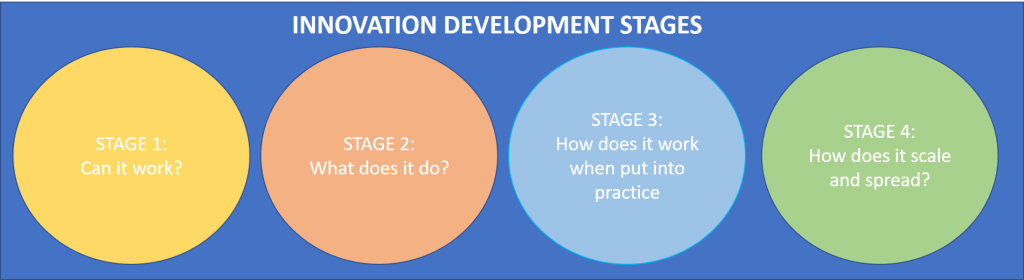
The role of design and evaluation is different for each stage. At Stages 1 and 2 the emphasis is on working with innovators to align their intentions with their design to explore what it (the innovation) does and how it does it. This is where design thinking and strategy are most prominent.
At Stages 3 and 4, the aim is to build an evidence base and strategy to spread and scale the innovation. At these stages, the focus is on marketing, distribution, and amplification. Evaluation in these stages focuses on the larger impact and the means by which the innovation is implemented and adopted for use across contexts.
Like an epidemiologist, its important to collect data to support moving the innovation from each stage. It’s also important to explore what kind of effects — positive and harmful – are generated at each stage.
At Cense, we work with our clients to design the right evaluation and strategy for each stage of development. There are no ‘one-size fits all’ approaches to innovation. Much like with a virus, an innovator must know what their innovation does and what will change at each stage and scale of its development.
What is key is designing data collection and strategy that is fit for purpose.
Viruses aim to spread and survive just like innovations. By thinking like an epidemiologist you can help your innovation to survive and thrive like the best kind of virus.
Photo by Bill Oxford on Unsplash
The post Innovation Like An Epidemiologist appeared first on Cense.
 English
 Afrikaans
 Shqip
Shqip አማርኛ
አማርኛ العربية
 Հայերեն
 Azərbaycan dili
 Euskara
 Беларуская мова
 বাংলা
বাংলা Bosanski
 Български
 Català
 Cebuano
 Chichewa
 简体中文
简体中文 繁體中文
繁體中文 Corsu
Corsu Hrvatski
 Čeština
 Dansk
Dansk Nederlands
 Esperanto
 Eesti
Eesti Filipino
 Suomi
Suomi Français
 Frysk
Frysk Galego
 ქართული
 Deutsch
 Ελληνικά
 ગુજરાતી
 Kreyol ayisyen
 Harshen Hausa
 Ōlelo Hawaiʻi
 עִבְרִית
 हिन्दी
 Hmong
Hmong Magyar
 Íslenska
 Igbo
Igbo Bahasa Indonesia
 Gaeilge
 Italiano
 日本語
日本語 Basa Jawa
 ಕನ್ನಡ
ಕನ್ನಡ Қазақ тілі
 ភាសាខ្មែរ
 한국어
한국어 كوردی
كوردی Кыргызча
 ພາສາລາວ
 Latin
Latin Latviešu valoda
 Lietuvių kalba
 Lëtzebuergesch
 Македонски јазик
 Malagasy
 Bahasa Melayu
 മലയാളം
 Maltese
 Te Reo Māori
 मराठी
मराठी Монгол
 ဗမာစာ
ဗမာစာ नेपाली
 Norsk bokmål
 پښتو
پښتو فارسی
فارسی Polski
 Português
 ਪੰਜਾਬੀ
 Română
 Русский
 Samoan
 Gàidhlig
 Српски језик
 Sesotho
 Shona
Shona سنڌي
سنڌي සිංහල
සිංහල Slovenčina
 Slovenščina
 Afsoomaali
 Español
 Basa Sunda
 Kiswahili
 Svenska
 Тоҷикӣ
 தமிழ்
தமிழ் తెలుగు
 ไทย
ไทย Türkçe
 Українська
 اردو
اردو O‘zbekcha
 Tiếng Việt
 Cymraeg
 isiXhosa
 יידיש
יידיש Yorùbá
 Zulu
Zulu