Over at our sister site Censemaking we wrapped up a series called Design for Humans. The focus of the series was on different considerations that we must make in the process of designing useful, impactful things for the world around us.
Strangely enough, we often don’t do a good job at designing for humans with our services and products. In the process of innovating, we make many assumptions about how the innovation will be received and the impact it will make.
There are reasons why real substantive change is actually very difficult to generate. Humans are difficult to work with and to influence and the more we can design for how humans actually live, think, work, and play the more likely our change-making efforts will yield positive results.
Deeper Research
One of the ways to do better design for humans is to conduct detailed research. This goes beyond a few focus groups or observations toward more fuller engagement with different audiences. Strangely, many of us actually don’t really know what we want. We think we know what we want or that we know how to articulate what we want.
Research in this context involves the time, care, and attention to who people see themselves and who they act as. This is about our imagined reality and our lived one. (The two intersect and diverge through our days and life).
Many of our purchases are based on decisions that involve aspiration, comfort, fear, convenience, ethics, and utility in different combinations. These are both our own and the ones that we adopt from others depending on our situation. Individual decisions are very often tied to collective ones. If we do not understand the different groups we are affiliated with or aspire toward being a part of, we lose much of what is known about what drives a decision.
If we do not take the time to understand who it is that we are speaking with or seeking to influence — their individual set of values, beliefs, and experiences — then we will create a ‘mass’ for a ‘mass market’ that is unlikely to be receptive.
Luck and Science
A great deal of impactful design is based on a dance between luck and science. Viral marketing campaigns are more brilliant in retrospect than in advance. As Tendayi Viki and Mitch Joel recently spoke about in their conversation on innovation, most great innovations look absurd in advance and clever in retrospect.
This means great design is about framing the ridiculous.
It also means ensuring that, practically speaking, we must consider the very way we humans think, feel, and live — which is often ridiculous to the outsider. Great campaigns and products tap into this.
They also are about luck. Designing for luck through great observation, research, testing (prototyping), and ongoing evaluation ensures that what we put into the world has the potential to succeed in making some positive difference, not necessarily that it will no matter how good it is.
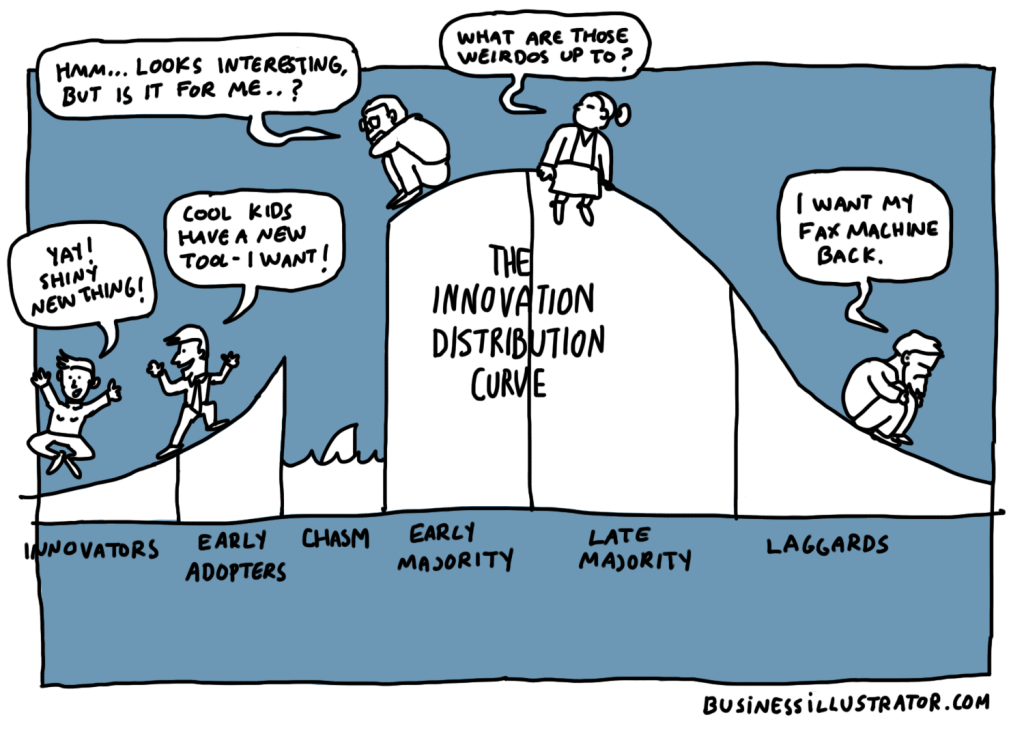
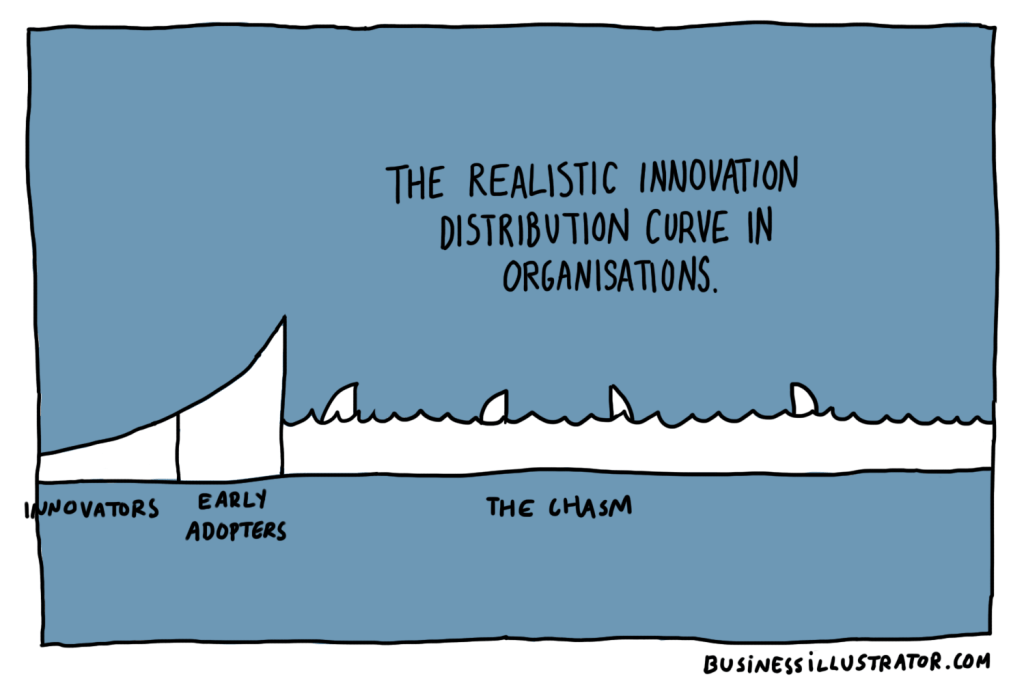
Whether its luck, perception or something else we find ourselves recognizing that the gap between what we think is valuable and useful and what others think (or are willing to consider) is large. The Chasm illustrated above is real and rather than engage in a futile effort to design around it, we need to recognize that there are sharks in those waters.
That’s what they did in the film Jaws. When we design for that, we design for humans (and sharks).
If you’re looking to create something more human in your work and need help, contact us and we can help make sure you don’t get eaten by the sharks you’re swimming with.
Images by Business Illustrator used under license.
The post Designing for Humans: Considerations for Innovators appeared first on Cense.
 English
 Afrikaans
 Shqip
Shqip አማርኛ
አማርኛ العربية
 Հայերեն
 Azərbaycan dili
 Euskara
 Беларуская мова
 বাংলা
বাংলা Bosanski
 Български
 Català
 Cebuano
 Chichewa
 简体中文
简体中文 繁體中文
繁體中文 Corsu
Corsu Hrvatski
 Čeština
 Dansk
Dansk Nederlands
 Esperanto
 Eesti
Eesti Filipino
 Suomi
Suomi Français
 Frysk
Frysk Galego
 ქართული
 Deutsch
 Ελληνικά
 ગુજરાતી
 Kreyol ayisyen
 Harshen Hausa
 Ōlelo Hawaiʻi
 עִבְרִית
 हिन्दी
 Hmong
Hmong Magyar
 Íslenska
 Igbo
Igbo Bahasa Indonesia
 Gaeilge
 Italiano
 日本語
日本語 Basa Jawa
 ಕನ್ನಡ
ಕನ್ನಡ Қазақ тілі
 ភាសាខ្មែរ
 한국어
한국어 كوردی
كوردی Кыргызча
 ພາສາລາວ
 Latin
Latin Latviešu valoda
 Lietuvių kalba
 Lëtzebuergesch
 Македонски јазик
 Malagasy
 Bahasa Melayu
 മലയാളം
 Maltese
 Te Reo Māori
 मराठी
मराठी Монгол
 ဗမာစာ
ဗမာစာ नेपाली
 Norsk bokmål
 پښتو
پښتو فارسی
فارسی Polski
 Português
 ਪੰਜਾਬੀ
 Română
 Русский
 Samoan
 Gàidhlig
 Српски језик
 Sesotho
 Shona
Shona سنڌي
سنڌي සිංහල
සිංහල Slovenčina
 Slovenščina
 Afsoomaali
 Español
 Basa Sunda
 Kiswahili
 Svenska
 Тоҷикӣ
 தமிழ்
தமிழ் తెలుగు
 ไทย
ไทย Türkçe
 Українська
 اردو
اردو O‘zbekcha
 Tiếng Việt
 Cymraeg
 isiXhosa
 יידיש
יידיש Yorùbá
 Zulu
Zulu