
What does it mean to take Design Thinking and actually apply it in the world?
This was the subject of a series of webinars hosted by the Tamarack Institute for Community Engagement. The webinars featured Co-CEO Liz Weaver speaking with Cense Ltd. President Cameron Norman.
In this first in a series of posts, we outline the key steps in applying design thinking in practice by looking back at this series and begin with the idea of designing for what’s next.
A Framework for Change
The series was set up by a look at designing for what’s next. In this discussion, Cameron Norman introduces the Design Helix – a multi-stage framework for putting design thinking into action.
The Design Helix (below) is based on our two decades of experience designing products, services, and systems at Cense and reflects the literature on design and design thinking. It’s a framework – a means of thinking about design — and not a prescription.
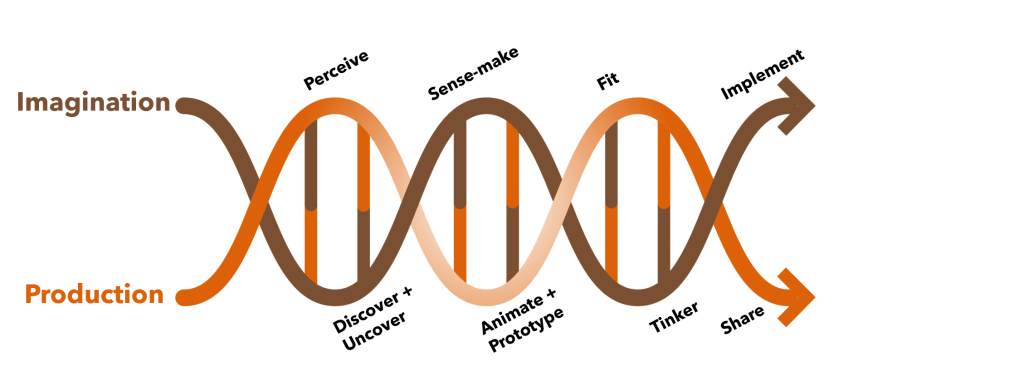
This multi-stage framework is designed like a helix partly to reflect the very fact that most of what humans engage with is created (designed). Design is at the DNA core of what we humans generate into the world — for good or otherwise.
The helix has two major strands that are tied together by activities that go in sequence but may have greater or lesser roles as one progresses through them. The framework is meant to guide design and provide a means to account for the key aspects of the design process. It is not prescriptive in the methods that articulate this design practice. Many different methods can be used to support this work.
Designs are rarely ‘one and done’ and are iterative, thus the helix actually winds its way around and connects multiple iterations together as illustrated in the image below.

Designing What’s Next introduced attendees to this design helix and what it means in practice. The helix will be further discussed and elaborated in a second series that we’ll cover in future posts. A recording of the conversation is below.
We will look at this process in greater detail in future posts as we walk through this series on applying design thinking and reviewing the Design Helix.
For more information on this approach and to apply it to your work, contact us. This is the approach we take with our clients and train those working alongside us.
The post Design Thinking Practice: Designing for What’s Next appeared first on Cense Ltd. .
 English
 Afrikaans
 Shqip
Shqip አማርኛ
አማርኛ العربية
 Հայերեն
 Azərbaycan dili
 Euskara
 Беларуская мова
 বাংলা
বাংলা Bosanski
 Български
 Català
 Cebuano
 Chichewa
 简体中文
简体中文 繁體中文
繁體中文 Corsu
Corsu Hrvatski
 Čeština
 Dansk
Dansk Nederlands
 Esperanto
 Eesti
Eesti Filipino
 Suomi
Suomi Français
 Frysk
Frysk Galego
 ქართული
 Deutsch
 Ελληνικά
 ગુજરાતી
 Kreyol ayisyen
 Harshen Hausa
 Ōlelo Hawaiʻi
 עִבְרִית
 हिन्दी
 Hmong
Hmong Magyar
 Íslenska
 Igbo
Igbo Bahasa Indonesia
 Gaeilge
 Italiano
 日本語
日本語 Basa Jawa
 ಕನ್ನಡ
ಕನ್ನಡ Қазақ тілі
 ភាសាខ្មែរ
 한국어
한국어 كوردی
كوردی Кыргызча
 ພາສາລາວ
 Latin
Latin Latviešu valoda
 Lietuvių kalba
 Lëtzebuergesch
 Македонски јазик
 Malagasy
 Bahasa Melayu
 മലയാളം
 Maltese
 Te Reo Māori
 मराठी
मराठी Монгол
 ဗမာစာ
ဗမာစာ नेपाली
 Norsk bokmål
 پښتو
پښتو فارسی
فارسی Polski
 Português
 ਪੰਜਾਬੀ
 Română
 Русский
 Samoan
 Gàidhlig
 Српски језик
 Sesotho
 Shona
Shona سنڌي
سنڌي සිංහල
සිංහල Slovenčina
 Slovenščina
 Afsoomaali
 Español
 Basa Sunda
 Kiswahili
 Svenska
 Тоҷикӣ
 தமிழ்
தமிழ் తెలుగు
 ไทย
ไทย Türkçe
 Українська
 اردو
اردو O‘zbekcha
 Tiếng Việt
 Cymraeg
 isiXhosa
 יידיש
יידיש Yorùbá
 Zulu
Zulu