In our previous article, ‘Finding the Right Sample Size (the Easy Way)’, we discuss the importance of determining the so-called “correct sample size”. Our recommendation for most applications was to use an online sample size calculator (check out our calculator HERE).
However, for those interested in calculating sample sizes by hand, or getting a better understanding of the math behind many of these sample size calculators, we outline the formulae used to calculate sample sizes.
Estimating sample sizes (The Hard Way)
Sample sizes can be estimated using statistical formulae by hand. While not recommended, it is important to have a basic understanding of how sample sizes are being estimated when using a tool.
First, some definitions.
-
Margin of error: The margin of error is how much you can expect your results to differ from the population of interest. Measured as a percentage, a smaller margin of error increases the chance that your results will be close to that of the population. Both 5% and 10% are commonly used margins of error. However, lower margin of errors will increase your sample sizes.
-
Confidence level: The confidence level is a percentage the represents how confident you can be that the true percentage of a population (i.e., a measured value, such as participant responses to a survey question) falls within the margin of error. This value is usually 95%, but 90% and 99% are also common. Larger confidence levels will increase your sample sizes.
-
z-score: A z-score is a value that determines how far a measured value is from the population value. z-scores can be determined from the confidence level using z-score tables (see Z Score Table for more information).
-
Population proportion: The population proportion is the percentage of the population that has a specific characteristic. This proportion is usually determined from previous studies or research. Although, when unsure, using 50% works as an estimate. That is, 50% of the population falls below a specific point and 50% falls above a specific point.
Calculating an estimated sample size
The following outlines the specifics of Cochran’s sample size formula. Using the unlimited formula based on your own estimates of the z-score (based on your confidence level), population proportion, and margin of error, you can get an estimate of a sample size required for a population of unlimited size. However, this is not realistic as populations are finite. Therefore, you can take the sample size estimate from the unlimited population formula and insert it into the finite population formula. This considers the size of the population of interest and provides a better estimate of the sample size based on your needs.
Unlimited population:
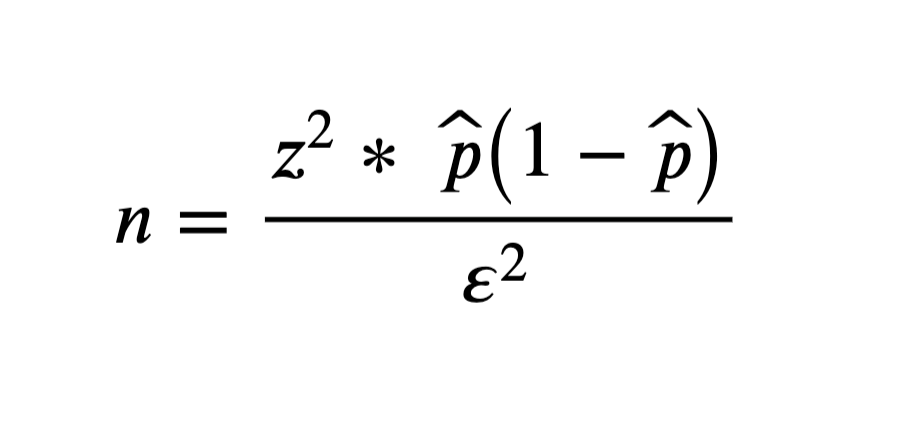
where:
-
n is the sample size
-
z is the z-score
-
p̂ is the population proportion
-
ε is the margin of error (confidence interval)
Example for unlimited population:
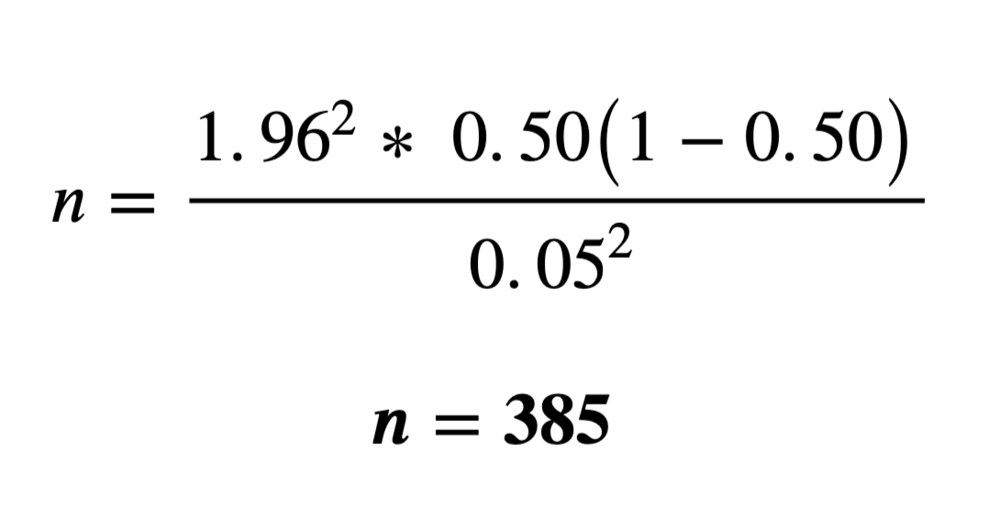
where:
-
z = 1.96 (Based on a 5% margin of error. Data are assumed two-tailed (i.e., a margin of error of 2.5% on each end of a normal distribution curve), thus a value of 0.9750 will be looked up within the z-score table.)
-
p̂ = 50% or 0.50 (This value is often pulled from previous research/ literature. If unsure, use 50%.)
-
ε = 5% or 0.05 (Same value used to get the z-score estimate but provided as a decimal/ percentage.)
Finite population:
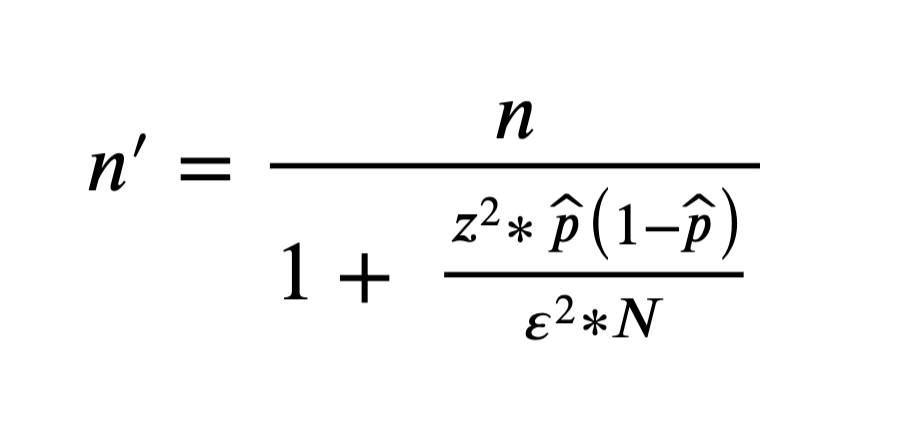
where:
-
n is the sample size
-
z is the z-score
-
p̂ is the population proportion
-
ε is the margin of error
-
N is the population size
Example for a finite population:
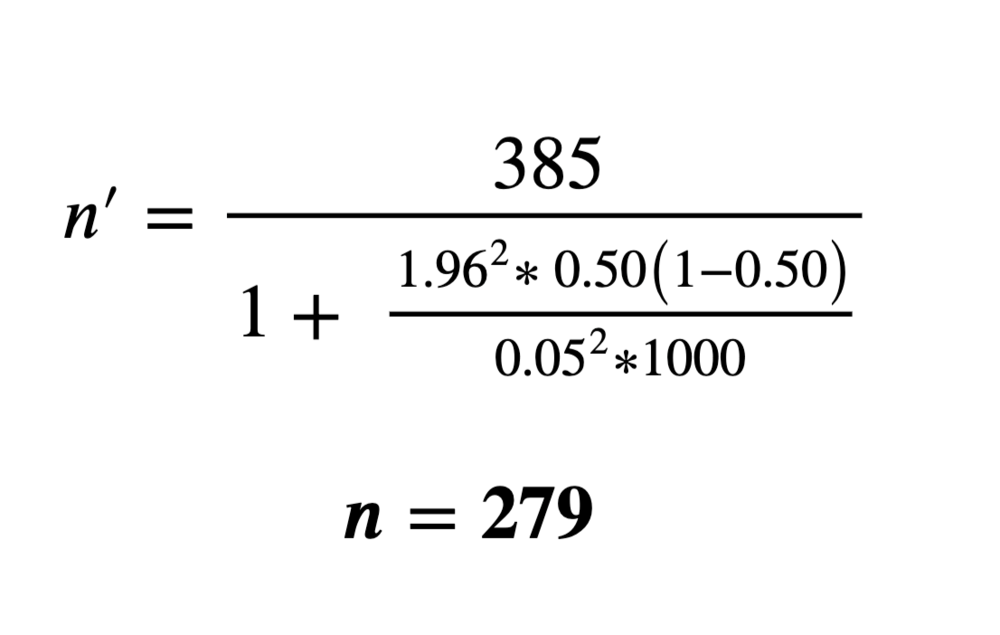
where:
-
n = 385 (Value calculated using the infinite population formula.)
-
z = 1.96 (Based on a 5% margin of error. Data are assumed two-tailed (i.e., a margin of error of 2.5% on each end of a normal distribution curve), thus a value of 0.9750 will be looked up within the z-score table.)
-
p̂ = 50% or 0.50 (This value is often pulled from previous research/ literature. If unsure, use 50%.)
-
ε = 5% or 0.05 (Same value used to get the z-score estimate but provided as a decimal/ percentage.)
-
N = 1000 (This value is inserted if known and is often pulled from research/ literature or some prior background knowledge about the population of interest.)
With the above formulae and examples, you will be able to calculate sample sizes on your own.
We would still suggest using an online calculator to do the heavy lifting, but having a better understanding of the math behind sample size calculation never hurts!
Sign up for our newsletter
We’ll let you know about our new content, and curate the best new evaluation resources from around the web!
We respect your privacy.
Thank you!
 English
 Afrikaans
 Shqip
Shqip አማርኛ
አማርኛ العربية
 Հայերեն
 Azərbaycan dili
 Euskara
 Беларуская мова
 বাংলা
বাংলা Bosanski
 Български
 Català
 Cebuano
 Chichewa
 简体中文
简体中文 繁體中文
繁體中文 Corsu
Corsu Hrvatski
 Čeština
 Dansk
Dansk Nederlands
 Esperanto
 Eesti
Eesti Filipino
 Suomi
Suomi Français
 Frysk
Frysk Galego
 ქართული
 Deutsch
 Ελληνικά
 ગુજરાતી
 Kreyol ayisyen
 Harshen Hausa
 Ōlelo Hawaiʻi
 עִבְרִית
 हिन्दी
 Hmong
Hmong Magyar
 Íslenska
 Igbo
Igbo Bahasa Indonesia
 Gaeilge
 Italiano
 日本語
日本語 Basa Jawa
 ಕನ್ನಡ
ಕನ್ನಡ Қазақ тілі
 ភាសាខ្មែរ
 한국어
한국어 كوردی
كوردی Кыргызча
 ພາສາລາວ
 Latin
Latin Latviešu valoda
 Lietuvių kalba
 Lëtzebuergesch
 Македонски јазик
 Malagasy
 Bahasa Melayu
 മലയാളം
 Maltese
 Te Reo Māori
 मराठी
मराठी Монгол
 ဗမာစာ
ဗမာစာ नेपाली
 Norsk bokmål
 پښتو
پښتو فارسی
فارسی Polski
 Português
 ਪੰਜਾਬੀ
 Română
 Русский
 Samoan
 Gàidhlig
 Српски језик
 Sesotho
 Shona
Shona سنڌي
سنڌي සිංහල
සිංහල Slovenčina
 Slovenščina
 Afsoomaali
 Español
 Basa Sunda
 Kiswahili
 Svenska
 Тоҷикӣ
 தமிழ்
தமிழ் తెలుగు
 ไทย
ไทย Türkçe
 Українська
 اردو
اردو O‘zbekcha
 Tiếng Việt
 Cymraeg
 isiXhosa
 יידיש
יידיש Yorùbá
 Zulu
Zulu