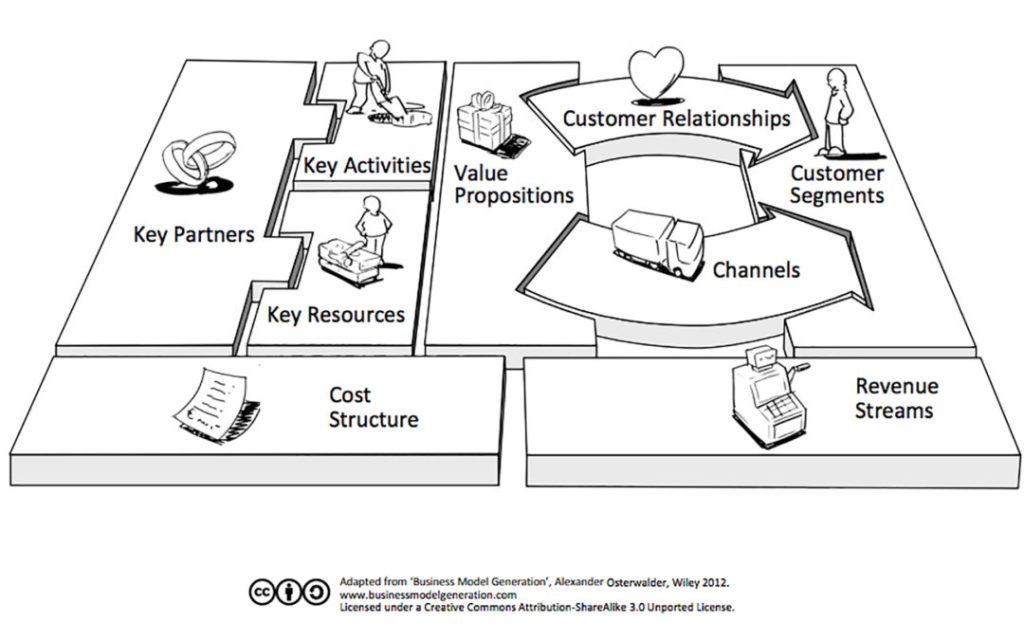
You might have noticed that the world seems to be awash in canvases these days. The canvas model owes much of its popularity to the work of Alex Osterwalder and Yves Pigneur and their Business Model Canvas.
A canvas is a form of system mapping that visualizes critical aspects of a system and organizes them. A canvas uses visual conventions like boxes and arrows to lay out key assumptions, resources, actors, and value claims.
Three examples of popular canvases include:
Andi Roberts has pulled together a massive list of fifty different types of canvases that cover issues ranging from value chain analysis, ethics, and strategy, to project management and more.
Some popular canvases like the Business Model Canvas are even pre-loaded as templates in visual thinking tools like Miro and Mural.
There is even a tool called Canvasizer that can help you create your own personalized canvas.
But how do we use these in practice?
Canvas Application
Most of these canvases rely on a similar structure. The simple form of using 8-12 boxes organized in an essentially linear format. This is a strength and weakness of the approach. The reason? It reduces complexity and interdependence, favouring a simplified organizational approach.
The simplification makes it attractive to people and relatively easy to use. The difficulty is the risk of oversimplifying the situation and confusing the model with reality.
It is for both of these reasons that we use canvases with caution. Canvases can be helpful in the following circumstances:
- When a project team is unsure where to start. A canvas reduces complexity and can help people start getting things on the page. Just getting started can be an enormously powerful reason to use canvases. Too often, organizations pause because they do not know where to begin. This can nudge that process forward.
- When the research hasn’t been entirely done or organized while the need to move forward is high in its absence. Sometimes, there are holes in the research (what we know about a situation) and plotting key themes or issues on a canvas can help us to hypothesize more clearly what else we need, know, or ought to consider.
- In times when there isn’t a budget to support in-depth research and sense-making. Canvases can help us to anticipate what a situation has present and available. In the absence of data, we can imagine what might be needed. This isn’t faking data and should be used when research is used to guide, not to prove or validate.
- When the number of anticipated themes and key variables for consideration is relatively tiny. Massive systems with many variables don’t fit well, but in many situations, we are not dealing with large, massive, complicated systems — they are small and complex. There are a few key categories and for these, canvases can work well.
- When there’s coaching time available. Canvases shouldn’t be used for client work without sense-making and coaching. We see many people confuse the map and model with the landscape and reality.. Plotting out data on a canvas is relatively simple and can be done with little time. What takes time is making sense of what it means and how it can inform strategy. Designing a strategy from a canvas takes time, care, and attention. Doing this is where the value of a canvas comes in.
Canvases are useful. Find or create one, and you can focus your team on what’s most important, organize it, and help foster the kind of conversations needed to assess what to do and how we might do it in the future. Canvases are design tools, and if you consider their advantages and limitations, you can become a great organizational designer.
We use canvases and many other tools. If you want some help setting this up, applying it, or learning other tools and methods, let’s have a coffee and talk about your needs and how we can help.
The post Using Canvases appeared first on Cense Ltd. .
 English
 Afrikaans
 Shqip
Shqip አማርኛ
አማርኛ العربية
 Հայերեն
 Azərbaycan dili
 Euskara
 Беларуская мова
 বাংলা
বাংলা Bosanski
 Български
 Català
 Cebuano
 Chichewa
 简体中文
简体中文 繁體中文
繁體中文 Corsu
Corsu Hrvatski
 Čeština
 Dansk
Dansk Nederlands
 Esperanto
 Eesti
Eesti Filipino
 Suomi
Suomi Français
 Frysk
Frysk Galego
 ქართული
 Deutsch
 Ελληνικά
 ગુજરાતી
 Kreyol ayisyen
 Harshen Hausa
 Ōlelo Hawaiʻi
 עִבְרִית
 हिन्दी
 Hmong
Hmong Magyar
 Íslenska
 Igbo
Igbo Bahasa Indonesia
 Gaeilge
 Italiano
 日本語
日本語 Basa Jawa
 ಕನ್ನಡ
ಕನ್ನಡ Қазақ тілі
 ភាសាខ្មែរ
 한국어
한국어 كوردی
كوردی Кыргызча
 ພາສາລາວ
 Latin
Latin Latviešu valoda
 Lietuvių kalba
 Lëtzebuergesch
 Македонски јазик
 Malagasy
 Bahasa Melayu
 മലയാളം
 Maltese
 Te Reo Māori
 मराठी
मराठी Монгол
 ဗမာစာ
ဗမာစာ नेपाली
 Norsk bokmål
 پښتو
پښتو فارسی
فارسی Polski
 Português
 ਪੰਜਾਬੀ
 Română
 Русский
 Samoan
 Gàidhlig
 Српски језик
 Sesotho
 Shona
Shona سنڌي
سنڌي සිංහල
සිංහල Slovenčina
 Slovenščina
 Afsoomaali
 Español
 Basa Sunda
 Kiswahili
 Svenska
 Тоҷикӣ
 தமிழ்
தமிழ் తెలుగు
 ไทย
ไทย Türkçe
 Українська
 اردو
اردو O‘zbekcha
 Tiếng Việt
 Cymraeg
 isiXhosa
 יידיש
יידיש Yorùbá
 Zulu
Zulu