
Over at our sister site (Censemaking), we are publishing a series on Principles-Focused Evaluation. The series is looking at the basic building blocks that underpin the approach and will describe how to use it.
We will be posting some additional materials here at a later date.
But before one starts out using principles, it’s essential to understand what they are and why they matter.
Principles in Practice
When we look at principles in practice we first need to look at the definition of the term.
As we can see from above, principles are guides for conduct. They are touchstones that can inform planning and action in the face of uncertainty. If we were sure about causes and consequences, we could rely on rules. When we are uncertain, principles will have to do.
Principles are also evaluable.
Michael Quinn Patton has riffed on this role of principles in his GUIDE Framework for Principles-focused Evaluation.
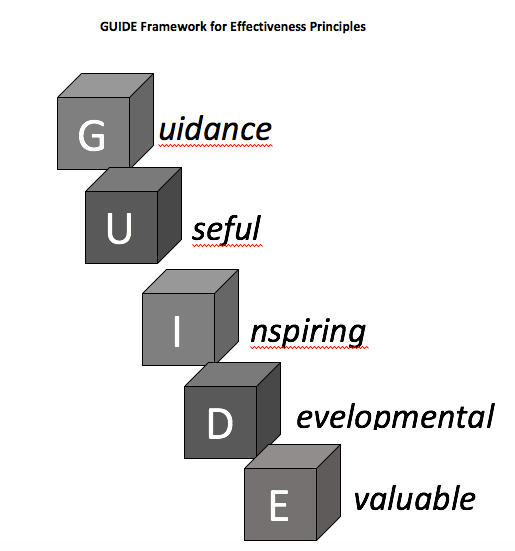
As Patton writes on Principles-Focused Evaluation,
Principles-focused evaluation examines (1) whether principles are clear, meaningful, and actionable, and if so, (2) whether they are actually being followed and, if so, (3) whether they are leading to desired results. Principles are derived from experience, expertise, values, and research.
Principles, Values and Strategy
Principles reflect our values. Values are about what has meaning for us, what we invest in, and subsequently, what has value. That is why we can evaluate good principles.
The first step in developing principles is determining what you value.
The second step is determining your values. Values are the beliefs we hold that guide our actions and shape our identity.
Thirdly, connect the two; this is strategy.
Drawing on the GUIDE framework above, consider reflecting on what you value, your values, and how (or if) they are connected. We work with many organizations with a gap between their stated values and desires and their actions. Much of our work is on closing this gap with our clients. The reasons are often that we let our environment shape our actions without connecting them to values or value.
We find many clients do things with low value yet are a product of legacy systems in place to accomplish something else. By clarifying our values and determining what has value, we can change this by design.
This is what strategic design is all about.
So now you know why principles, strategy, and design are all related.
If this is something that you want help in doing, let’s talk. This is what we do.
Photo by Amrit Sangar on Unsplash
The post Principles: Evaluation, Strategy and More appeared first on Cense Ltd. .
 English
 Afrikaans
 Shqip
Shqip አማርኛ
አማርኛ العربية
 Հայերեն
 Azərbaycan dili
 Euskara
 Беларуская мова
 বাংলা
বাংলা Bosanski
 Български
 Català
 Cebuano
 Chichewa
 简体中文
简体中文 繁體中文
繁體中文 Corsu
Corsu Hrvatski
 Čeština
 Dansk
Dansk Nederlands
 Esperanto
 Eesti
Eesti Filipino
 Suomi
Suomi Français
 Frysk
Frysk Galego
 ქართული
 Deutsch
 Ελληνικά
 ગુજરાતી
 Kreyol ayisyen
 Harshen Hausa
 Ōlelo Hawaiʻi
 עִבְרִית
 हिन्दी
 Hmong
Hmong Magyar
 Íslenska
 Igbo
Igbo Bahasa Indonesia
 Gaeilge
 Italiano
 日本語
日本語 Basa Jawa
 ಕನ್ನಡ
ಕನ್ನಡ Қазақ тілі
 ភាសាខ្មែរ
 한국어
한국어 كوردی
كوردی Кыргызча
 ພາສາລາວ
 Latin
Latin Latviešu valoda
 Lietuvių kalba
 Lëtzebuergesch
 Македонски јазик
 Malagasy
 Bahasa Melayu
 മലയാളം
 Maltese
 Te Reo Māori
 मराठी
मराठी Монгол
 ဗမာစာ
ဗမာစာ नेपाली
 Norsk bokmål
 پښتو
پښتو فارسی
فارسی Polski
 Português
 ਪੰਜਾਬੀ
 Română
 Русский
 Samoan
 Gàidhlig
 Српски језик
 Sesotho
 Shona
Shona سنڌي
سنڌي සිංහල
සිංහල Slovenčina
 Slovenščina
 Afsoomaali
 Español
 Basa Sunda
 Kiswahili
 Svenska
 Тоҷикӣ
 தமிழ்
தமிழ் తెలుగు
 ไทย
ไทย Türkçe
 Українська
 اردو
اردو O‘zbekcha
 Tiếng Việt
 Cymraeg
 isiXhosa
 יידיש
יידיש Yorùbá
 Zulu
Zulu