This article is rated as:
As we approach the end of 2023, it’s more than likely that you’ll find yourself reflecting on the past year. As evaluators, our roles not only involve mastering methodologies and data analysis, but also a profound commitment to self-reflection, a core competency acknowledged by the Canadian Evaluation Society. In my recent presentation at the Canadian Evaluation Society, British Columbia Chapter (CESBC) annual conference, the transformative power of self-reflecting as an evaluator took center stage as I reflected on my journey of moving from an emerging evaluator to a more seasoned one.
This article explores the insights I shared during the CESBC presentation, emphasizing the pivotal role of reflection in the evaluation process.
Understanding Self-Reflection in Evaluation:
As evaluators, our main goal is to evaluate programs and projects, to uncover insights and evidence essential for informed decision-making. Yet, the transition from theoretical understanding (knowing what should be done) to practical implementation (actually doing it) in the field of evaluation frequently includes challenges. My personal experience aligns with this struggle, having embarked on my first-ever evaluation project 6 years ago without the benefit of formal education or training, or even knowing what evaluation is! In this journey (of which I know I’m not alone!) self-reflection emerges as a powerful tool, bridging the gap between theoretical knowledge and effective execution.
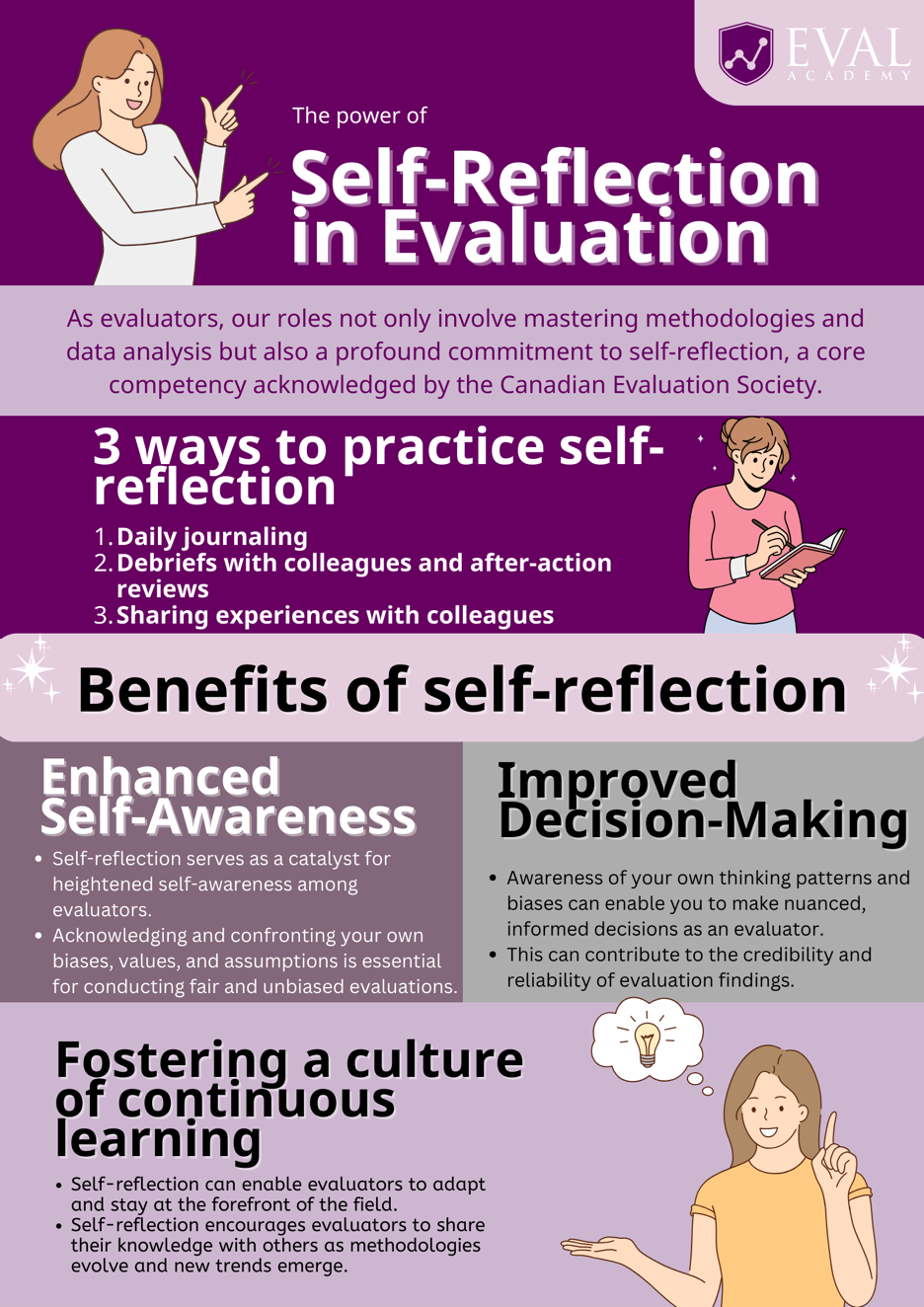
For me, I’ve found that self-reflection can occur in multiple forms in my role as an evaluator. Here are some of the ways that I’ve practiced reflection:
-
Daily journaling to write down what went well for the day, challenges, and ideas to improve my practice. This can provide a tangible record of growth, serving as a valuable resource for future projects.
-
Debriefs with colleagues and practicing after-action review processes at the end of an evaluation.
-
Contributing to Eval Academy by writing articles and creating content focused on lessons learnt from my own practice.
-
Reading the experiences of my colleagues through their contributions to Eval Academy.
Below, I’ve included some of the benefits I’ve witnessed by integrating self-reflection into my practice as an evaluator:
1. Enhanced Self-Awareness:
Self-reflection serves as a catalyst for heightened self-awareness among evaluators. Acknowledging and confronting your own biases, values, and assumptions becomes essential for conducting fair and unbiased evaluations. This foundational step lays the groundwork for excellence in evaluation.
2. Improved Decision-Making:
I’ve found that making time for self-reflection has allowed me to be better equipped to make decisions. Evaluations can be complex processes with multiple partners and competing priorities. Awareness of my own thinking patterns and biases enables me as an evaluator to make nuanced, informed decisions. This, in turn, can contribute to the credibility and reliability of evaluation findings.
3. Fostering a Culture of Continuous Learning:
As evaluation methodologies evolve and new trends emerge, self-reflection positions evaluators to adapt and stay at the forefront of the field and share their knowledge with others to foster a culture of continuous learning in the field.
My CESBC presentation on the power of self-reflecting as an evaluator is a call to action for evaluators at all career stages. By embracing self-reflection, evaluators can enhance self-awareness, improve decision-making, and contribute to a culture of continuous learning. The journey from theory to action becomes more seamless, ensuring that evaluations not only assess external programs but also turn the evaluative lens inward for a comprehensive and impactful professional journey.
As the field of evaluation continues to evolve, the lessons from my CESBC presentation and platforms like Eval Academy encourage evaluators to embrace self-reflection as an integral part of their professional toolkit, fostering a community that thrives on continuous learning and collective wisdom.
 English
 Afrikaans
 Shqip
Shqip አማርኛ
አማርኛ العربية
 Հայերեն
 Azərbaycan dili
 Euskara
 Беларуская мова
 বাংলা
বাংলা Bosanski
 Български
 Català
 Cebuano
 Chichewa
 简体中文
简体中文 繁體中文
繁體中文 Corsu
Corsu Hrvatski
 Čeština
 Dansk
Dansk Nederlands
 Esperanto
 Eesti
Eesti Filipino
 Suomi
Suomi Français
 Frysk
Frysk Galego
 ქართული
 Deutsch
 Ελληνικά
 ગુજરાતી
 Kreyol ayisyen
 Harshen Hausa
 Ōlelo Hawaiʻi
 עִבְרִית
 हिन्दी
 Hmong
Hmong Magyar
 Íslenska
 Igbo
Igbo Bahasa Indonesia
 Gaeilge
 Italiano
 日本語
日本語 Basa Jawa
 ಕನ್ನಡ
ಕನ್ನಡ Қазақ тілі
 ភាសាខ្មែរ
 한국어
한국어 كوردی
كوردی Кыргызча
 ພາສາລາວ
 Latin
Latin Latviešu valoda
 Lietuvių kalba
 Lëtzebuergesch
 Македонски јазик
 Malagasy
 Bahasa Melayu
 മലയാളം
 Maltese
 Te Reo Māori
 मराठी
मराठी Монгол
 ဗမာစာ
ဗမာစာ नेपाली
 Norsk bokmål
 پښتو
پښتو فارسی
فارسی Polski
 Português
 ਪੰਜਾਬੀ
 Română
 Русский
 Samoan
 Gàidhlig
 Српски језик
 Sesotho
 Shona
Shona سنڌي
سنڌي සිංහල
සිංහල Slovenčina
 Slovenščina
 Afsoomaali
 Español
 Basa Sunda
 Kiswahili
 Svenska
 Тоҷикӣ
 தமிழ்
தமிழ் తెలుగు
 ไทย
ไทย Türkçe
 Українська
 اردو
اردو O‘zbekcha
 Tiếng Việt
 Cymraeg
 isiXhosa
 יידיש
יידיש Yorùbá
 Zulu
Zulu