This article is rated as:
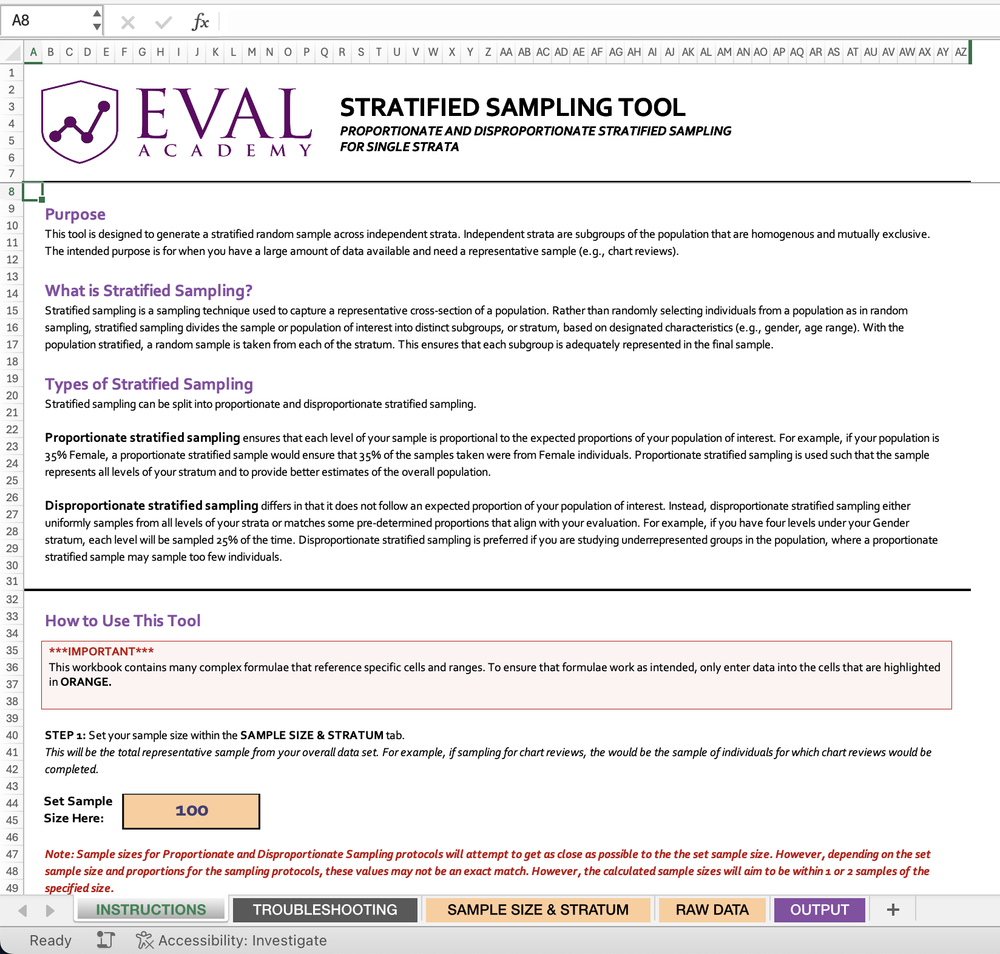
Eval Academy just released a new template, “Stratified Sampling Tool”!
Who’s it for?
The Stratified Sampling Tool is designed for researchers, evaluators, and data analysts who need to collect representative samples from large datasets. Anyone dealing with diverse populations and needing to ensure fair representation across different subgroups will find this tool invaluable.
What’s the purpose?
In the world of data analysis and evaluation, getting a truly representative sample can be challenging. This is where the Stratified Sampling Tool comes in handy.
The primary purpose of the Stratified Sampling Tool is to generate a stratified random sample across independent strata. But what does that mean in practice?
-
Representative Sampling: It helps you capture a representative cross-section of a population, ensuring that all subgroups are adequately represented in your final sample.
-
Flexibility: The tool supports both proportionate and disproportionate stratified sampling, allowing you to tailor your approach based on your specific needs.
-
Precision: By dividing the population into homogeneous subgroups, it increases the precision of your sample, leading to more accurate results.
-
Studying Underrepresented Groups: With disproportionate sampling, you can focus on underrepresented groups that might be overlooked in simple random sampling.
-
Efficiency: It’s especially useful when you have a large amount of data available and need a manageable, yet representative sample.
What is Stratified Sampling?
Stratified sampling is a sampling technique used to capture a representative cross-section of a population. Rather than randomly selecting individuals from a population as in random sampling, stratified sampling divides the sample or population of interest into distinct subgroups, or stratum, based on designated characteristics (e.g., gender, age range). With the population stratified, a random sample is taken from each of the stratum. This ensures that each subgroup is adequately represented in the final sample.
What’s included?
Our Stratified Sampling Tool includes 2 Excel files:
-
Stratified Sampling Tool for Single Strata – Sample Data Version (a non-editable example to show you how the tool is supposed to work)
-
Stratified Sampling Tool for Multiple Stratum – Data Input Version
The Stratified Sampling Tool file comes with an instructions tab for how to input your data and use the tool. Step-by-step instructions are included.
Learn more: related articles and links
You can learn more about sampling in evaluation on Eval Academy by checking out the following links:
 English
 Afrikaans
 Shqip
Shqip አማርኛ
አማርኛ العربية
 Հայերեն
 Azərbaycan dili
 Euskara
 Беларуская мова
 বাংলা
বাংলা Bosanski
 Български
 Català
 Cebuano
 Chichewa
 简体中文
简体中文 繁體中文
繁體中文 Corsu
Corsu Hrvatski
 Čeština
 Dansk
Dansk Nederlands
 Esperanto
 Eesti
Eesti Filipino
 Suomi
Suomi Français
 Frysk
Frysk Galego
 ქართული
 Deutsch
 Ελληνικά
 ગુજરાતી
 Kreyol ayisyen
 Harshen Hausa
 Ōlelo Hawaiʻi
 עִבְרִית
 हिन्दी
 Hmong
Hmong Magyar
 Íslenska
 Igbo
Igbo Bahasa Indonesia
 Gaeilge
 Italiano
 日本語
日本語 Basa Jawa
 ಕನ್ನಡ
ಕನ್ನಡ Қазақ тілі
 ភាសាខ្មែរ
 한국어
한국어 كوردی
كوردی Кыргызча
 ພາສາລາວ
 Latin
Latin Latviešu valoda
 Lietuvių kalba
 Lëtzebuergesch
 Македонски јазик
 Malagasy
 Bahasa Melayu
 മലയാളം
 Maltese
 Te Reo Māori
 मराठी
मराठी Монгол
 ဗမာစာ
ဗမာစာ नेपाली
 Norsk bokmål
 پښتو
پښتو فارسی
فارسی Polski
 Português
 ਪੰਜਾਬੀ
 Română
 Русский
 Samoan
 Gàidhlig
 Српски језик
 Sesotho
 Shona
Shona سنڌي
سنڌي සිංහල
සිංහල Slovenčina
 Slovenščina
 Afsoomaali
 Español
 Basa Sunda
 Kiswahili
 Svenska
 Тоҷикӣ
 தமிழ்
தமிழ் తెలుగు
 ไทย
ไทย Türkçe
 Українська
 اردو
اردو O‘zbekcha
 Tiếng Việt
 Cymraeg
 isiXhosa
 יידיש
יידיש Yorùbá
 Zulu
Zulu