Sarah Dunifon is Founder and Principal Evaluator of Improved Insights LLC, an educational evaluation firm focused on STEM and youth-based programming. She is based in Cleveland, Ohio and is a fellow board member of the Ohio Program Evaluators Group.
We hope you enjoy our post below.
It’s not usually too hard to find data for things that are measurable. We know we can do surveys, or count the number of attendees, or track patterns over time.
Qualitative data though – the context for those numbers – often takes a little more work to track down. Of course, we can always do interviews and focus groups with stakeholders to learn about their experiences, our usual go-to’s.
However, if you think of qualitative data for what it is – simply put, another information source – you’ll find that so many other forms of it are hiding in plain sight.
Think about the chatbox in your last Zoom session – you may not have realized it, but that’s a source of qualitative data! Other sources you may have readily available include the phone call logs that your teachers keep when they call families or even the observations you did of an event (online, drive-up, or fully in-person).
If you need more, there are lots of ways of collecting qualitative data, and many of them are even more prevalent now in our almost fully virtual world.
This makes our lives a lot easier, as we prepare to write our annual reports, apply for grants, or share the impact that our program had during this unusual year.
Like I mentioned in my last post, sharing the context for our quantitative findings can make those reports tell a much richer story.
Yet it’s not always intuitive to know how to turn a whole bunch of text into these powerful programmatic insights.
So when you find these sources of qualitative data, what do you do with them?
We can actually find patterns in our data by assigning thematic codes to different words, phrases, or even images. Sometimes, you start with a set of codes that have to do with your program goals, or the research concepts underlying your program.
Other times, you just code as you go. If you start to see a lot of mentions of a particular topic, that topic can become a code.
Coding can take many forms, and there is fancy software that can help you do it, but sometimes all you need is a notebook and some markers or a color-coded spreadsheet.
Below you can see some sample data about an after-school program focused on science and animals that we’ve color-coded according to the themes we saw.
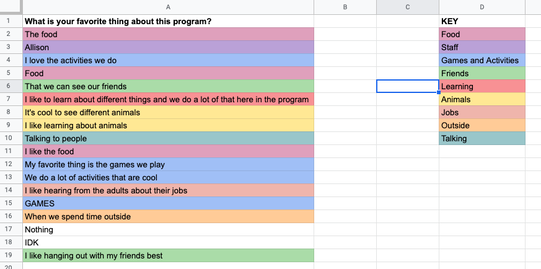
Coding allows us to see what’s happening across the dataset and pull out themes or key insights that we need to highlight.
Sharing your qualitative data analysis can be an important addition to your data story when demonstrating the impact of your work. It can add relevance, personality, and context to quantitative data by illustrating individual effects.
By reviewing our datasets systematically, we can also find some incredible quotes – the kind you would never attempt to paraphrase if you were writing a paper because they were so perfectly worded — and let our stakeholders’ words shine.
You can feature key quotations by offsetting them or putting them in a different color in your report to highlight individual experiences and catch readers’ attention.
Another popular way to display qualitative data is in a word cloud.
Word clouds are visual representations of keywords that come up frequently in a set of qualitative data. Typically, the bigger the word, the more frequently it appeared in a data set.
There are plenty of critiques of word clouds in the data visualization space and rightly so – word clouds can often obscure meaning rather than clarify it. So if you are going to use them, here are three things you should know:
1. Give the data a good cleaning to remove anything that you don’t want represented in the visual.
Here, we’d recommend removing any responses that do not give value (e.g., “idk,” “I’m not sure,” “Nothing,” etc.) as well as any text surrounding the main themes (e.g., “I like the […],” “I love […],” “my favorite thing is […],” etc.).
2. Consider the messages or key points you see in the data that you wish to convey visually. If it is possible to condense themes further or pull out important words, now is the time to do so.
This might mean collapsing phrases as best as possible to a single word, or perhaps a few words of important meaning.
3. Make sure to keep the essence of the data – meanings can be misconstrued when collapsing phrases into single words or shorter phrases.
If you’re finding this is happening, perhaps a word cloud is not the best way to display your data.
However, with data cleaning and basic analysis, the word cloud can change drastically.
Take a look here at three versions of the same word cloud we generated on WordItOut using the data we shared earlier. The first was created with original – or “raw” – data, the second with cleaned data, and the third with some basic analysis and condensing.
Notice how the prominent words change with each version, and how the meaning and key messages can shift.
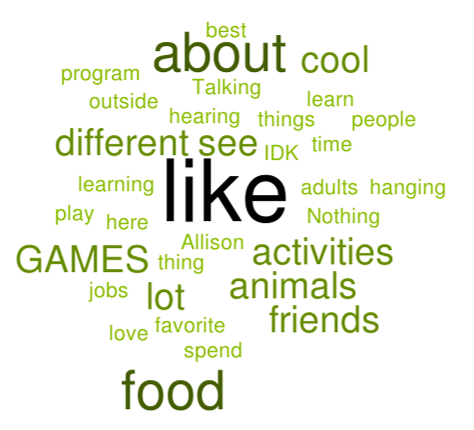
Word Cloud 1 – Original Data
|
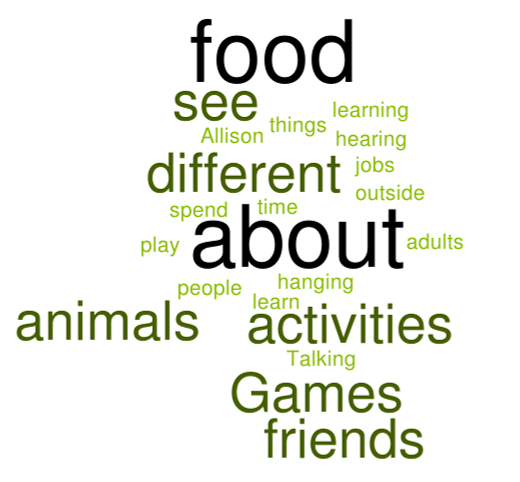
Word Cloud 2 – Cleaned Data
|
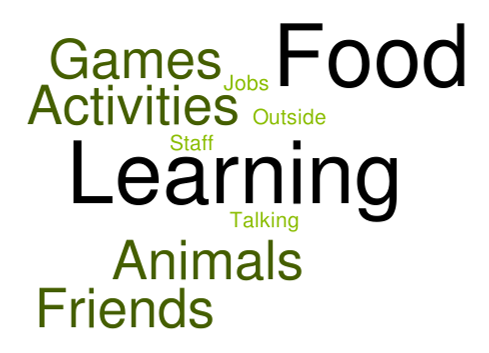
Word Cloud 3 – Basic Analysis
|
However, word clouds aren’t your only option. Data visualization experts like Stephanie Evergreen, Storytelling with Data, and Depict Data Studio all have great resources on different qualitative data displays.
The case is clear – with some simple analysis and visualization, qualitative data can be a powerful addition to your data story.
 English
 Afrikaans
 Shqip
Shqip አማርኛ
አማርኛ العربية
 Հայերեն
 Azərbaycan dili
 Euskara
 Беларуская мова
 বাংলা
বাংলা Bosanski
 Български
 Català
 Cebuano
 Chichewa
 简体中文
简体中文 繁體中文
繁體中文 Corsu
Corsu Hrvatski
 Čeština
 Dansk
Dansk Nederlands
 Esperanto
 Eesti
Eesti Filipino
 Suomi
Suomi Français
 Frysk
Frysk Galego
 ქართული
 Deutsch
 Ελληνικά
 ગુજરાતી
 Kreyol ayisyen
 Harshen Hausa
 Ōlelo Hawaiʻi
 עִבְרִית
 हिन्दी
 Hmong
Hmong Magyar
 Íslenska
 Igbo
Igbo Bahasa Indonesia
 Gaeilge
 Italiano
 日本語
日本語 Basa Jawa
 ಕನ್ನಡ
ಕನ್ನಡ Қазақ тілі
 ភាសាខ្មែរ
 한국어
한국어 كوردی
كوردی Кыргызча
 ພາສາລາວ
 Latin
Latin Latviešu valoda
 Lietuvių kalba
 Lëtzebuergesch
 Македонски јазик
 Malagasy
 Bahasa Melayu
 മലയാളം
 Maltese
 Te Reo Māori
 मराठी
मराठी Монгол
 ဗမာစာ
ဗမာစာ नेपाली
 Norsk bokmål
 پښتو
پښتو فارسی
فارسی Polski
 Português
 ਪੰਜਾਬੀ
 Română
 Русский
 Samoan
 Gàidhlig
 Српски језик
 Sesotho
 Shona
Shona سنڌي
سنڌي සිංහල
සිංහල Slovenčina
 Slovenščina
 Afsoomaali
 Español
 Basa Sunda
 Kiswahili
 Svenska
 Тоҷикӣ
 தமிழ்
தமிழ் తెలుగు
 ไทย
ไทย Türkçe
 Українська
 اردو
اردو O‘zbekcha
 Tiếng Việt
 Cymraeg
 isiXhosa
 יידיש
יידיש Yorùbá
 Zulu
Zulu