As a reminder, the Every Student Succeeds Act (ESSA), our country’s primary federal education legislation, requires that programs and interventions purchased with federal education dollars must have be evidenced-based.
Most people know these federal dollars better as “Title I,” or the provision of the Act that allocates funds for schools and districts with large percentages of students from low-income families, although there are other funding streams as well.
Title I has always been a great way for small, community-based, and/or minority-owned organizations to work with schools in service of students and families who can benefit most from their support.
And now, those who have not been formally evaluated cannot qualify for these funds.
Not only is that a hit to their financial lifeline, but it both reduces their access to the kids and families they serve and their ability to effectively serve them.
That’s why I love working with small organizations who are new to evaluation work – to help them use data to tell their story and show why they qualify for the use of those funds. I’ve always seen it as an equity strategy.
In the fall, I was captivated by the keynote speaker at the Crane Center’s 2020 Symposium on Children, Dr. Iheoma Iruka. Here’s what Dr. Iruka said that stopped me in my tracks: “Whose evidence is it?”
She talked about the long history of maltreatment and discrimination in the collection of evidence, especially in medicine, and particularly for marginalized and minoritized communities.
Often, the organizations that could (and still can) afford the time, resources, and expertise to conduct rigorous evaluations did not represent or look out for the best interests of the people they were studying — and many did the exact opposite.
It made me realize that “evidence-based” can be a loaded term — one that brings up a lot of pain and distrust for many groups of people.
Yet this term is here to stay for now, as most federal agencies have some requirement that their funds get spent on activities and interventions that can demonstrate their impact.
Now, this awful history is not my area of expertise, but it is one that I am trying to learn more about, for my own professional and personal growth.
However, here’s what I can say: we don’t have to rely on the research and evidence that exists in the world.
By developing our own base of evidence, we can ensure that all students and families are treated well and represented fairly and equitably in evaluations and program delivery.
And that starts with organizations doing the good work with kids and families ensuring that they, too, have a spot on those lists of evidence-based interventions.
I know that’s easier said than done.
But don’t worry – it doesn’t have to be! I’ve got two great (read: FREE) opportunities for your organization to begin its evidence-based journey!
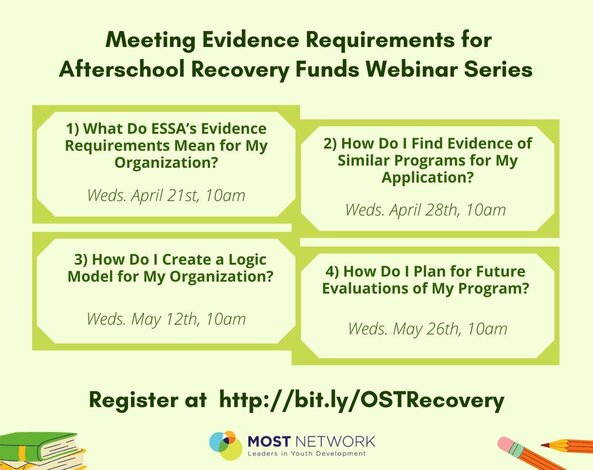
Starting tomorrow – and continuing through May, I’ll be hosting a workshop series on this exact topic, sponsored by the Maryland Out of School Time (MOST) Network! The first session — an ESSA overview — is tomorrow (4/21) at 10 AM EST. See the image below for the full schedule.
 English
 Afrikaans
 Shqip
Shqip አማርኛ
አማርኛ العربية
 Հայերեն
 Azərbaycan dili
 Euskara
 Беларуская мова
 বাংলা
বাংলা Bosanski
 Български
 Català
 Cebuano
 Chichewa
 简体中文
简体中文 繁體中文
繁體中文 Corsu
Corsu Hrvatski
 Čeština
 Dansk
Dansk Nederlands
 Esperanto
 Eesti
Eesti Filipino
 Suomi
Suomi Français
 Frysk
Frysk Galego
 ქართული
 Deutsch
 Ελληνικά
 ગુજરાતી
 Kreyol ayisyen
 Harshen Hausa
 Ōlelo Hawaiʻi
 עִבְרִית
 हिन्दी
 Hmong
Hmong Magyar
 Íslenska
 Igbo
Igbo Bahasa Indonesia
 Gaeilge
 Italiano
 日本語
日本語 Basa Jawa
 ಕನ್ನಡ
ಕನ್ನಡ Қазақ тілі
 ភាសាខ្មែរ
 한국어
한국어 كوردی
كوردی Кыргызча
 ພາສາລາວ
 Latin
Latin Latviešu valoda
 Lietuvių kalba
 Lëtzebuergesch
 Македонски јазик
 Malagasy
 Bahasa Melayu
 മലയാളം
 Maltese
 Te Reo Māori
 मराठी
मराठी Монгол
 ဗမာစာ
ဗမာစာ नेपाली
 Norsk bokmål
 پښتو
پښتو فارسی
فارسی Polski
 Português
 ਪੰਜਾਬੀ
 Română
 Русский
 Samoan
 Gàidhlig
 Српски језик
 Sesotho
 Shona
Shona سنڌي
سنڌي සිංහල
සිංහල Slovenčina
 Slovenščina
 Afsoomaali
 Español
 Basa Sunda
 Kiswahili
 Svenska
 Тоҷикӣ
 தமிழ்
தமிழ் తెలుగు
 ไทย
ไทย Türkçe
 Українська
 اردو
اردو O‘zbekcha
 Tiếng Việt
 Cymraeg
 isiXhosa
 יידיש
יידיש Yorùbá
 Zulu
Zulu