This blog post is a modified segment of my dissertation, done under the supervision of Dr. Tiffany Berry at Claremont Graduate University. You can read the full dissertation on the Open Science Framework here. The rest of the blog posts in this series on my dissertation are linked below:
- Factors that promote use: A conceptual framework
- Defining evidence use
- Overview of my dissertation study: sample, recruitment, & measures
- Question 1: To what extent are interpersonal and research factors related to use?
- Question 2: To what extent do interpersonal factors relate to use beyond research factors?
- Question 3: How do researchers and evaluators differ in use, interpersonal factors, and research factors?
To answer this research question, I examined correlations between self-reported interpersonal (i.e., relationships, communication, cooperative interdependence, commitment to use, stakeholder involvement) and research/evaluation factors (i.e., relevance, rigor) with use (i.e., instrumental, conceptual, and process use). These correlations are shown in the figure below.
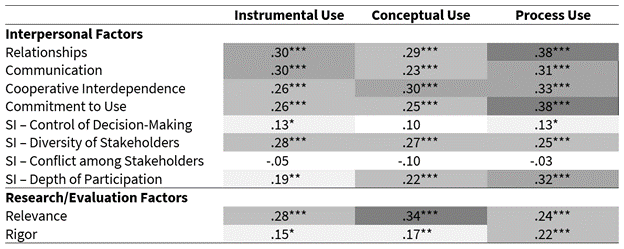
Overall, all of the interpersonal factors except for two items in the stakeholder involvement scale were moderately correlated with use, with correlations ranging from r = .19 to r = .38. Both research relevance and rigor were correlated with use, albeit relevance (rs between .24-.34) was more strongly correlated with instrumental and conceptual use than was rigor (rs between .15-.22).
These findings support two prior hypotheses I had coming into this research study:
- Interpersonal factors are perhaps more important for process use than for instrumental and conceptual use.
- Relevance is more strongly correlated with use than rigor, although this was only found for instrumental and conceptual use.
I also examined some demographic factors to see how they related to use. Partnerships that have been together longer had greater instrumental (r = .20), conceptual (r = .20), and process (r = .25) use, and also reported greater rigor (r = .16) and less conflict among partners (r = -.20). Partnerships with more members reported greater instrumental (r = .14) and conceptual (r = .15) use, lower quality relationships (r = -.18), lower commitment to use (r = -.17), and less conflict among partners (r = -.20). Interestingly, those reporting using an RCT reported higher levels of process use (d = .47), instrumental use (d = .39), and conceptual use (d = .45).
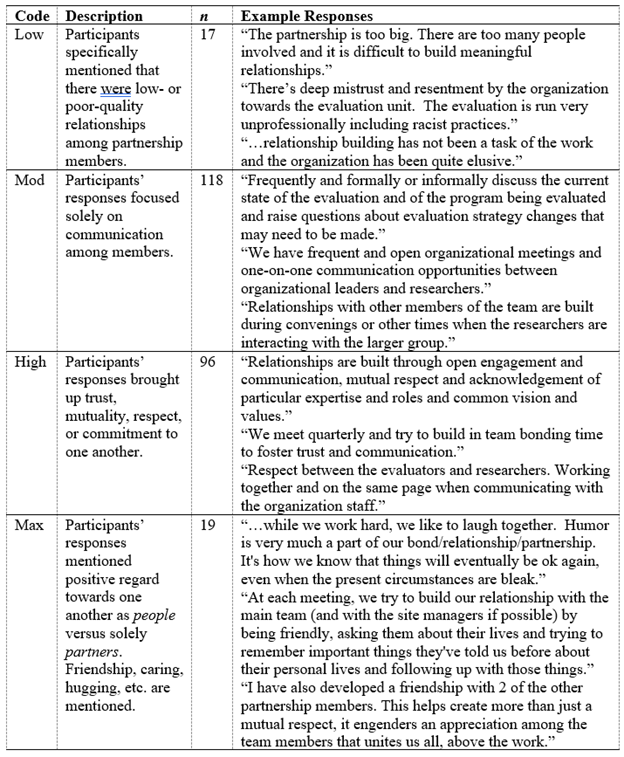
Lastly, I asked participants to respond to an open-ended question about the quality of relationships among members. These responses were coded into four levels of relationship quality, which you can see in the table below. Although not statistically significant, there was a slight increase in use across the four levels of relationship quality.
 English
 Afrikaans
 Shqip
Shqip አማርኛ
አማርኛ العربية
 Հայերեն
 Azərbaycan dili
 Euskara
 Беларуская мова
 বাংলা
বাংলা Bosanski
 Български
 Català
 Cebuano
 Chichewa
 简体中文
简体中文 繁體中文
繁體中文 Corsu
Corsu Hrvatski
 Čeština
 Dansk
Dansk Nederlands
 Esperanto
 Eesti
Eesti Filipino
 Suomi
Suomi Français
 Frysk
Frysk Galego
 ქართული
 Deutsch
 Ελληνικά
 ગુજરાતી
 Kreyol ayisyen
 Harshen Hausa
 Ōlelo Hawaiʻi
 עִבְרִית
 हिन्दी
 Hmong
Hmong Magyar
 Íslenska
 Igbo
Igbo Bahasa Indonesia
 Gaeilge
 Italiano
 日本語
日本語 Basa Jawa
 ಕನ್ನಡ
ಕನ್ನಡ Қазақ тілі
 ភាសាខ្មែរ
 한국어
한국어 كوردی
كوردی Кыргызча
 ພາສາລາວ
 Latin
Latin Latviešu valoda
 Lietuvių kalba
 Lëtzebuergesch
 Македонски јазик
 Malagasy
 Bahasa Melayu
 മലയാളം
 Maltese
 Te Reo Māori
 मराठी
मराठी Монгол
 ဗမာစာ
ဗမာစာ नेपाली
 Norsk bokmål
 پښتو
پښتو فارسی
فارسی Polski
 Português
 ਪੰਜਾਬੀ
 Română
 Русский
 Samoan
 Gàidhlig
 Српски језик
 Sesotho
 Shona
Shona سنڌي
سنڌي සිංහල
සිංහල Slovenčina
 Slovenščina
 Afsoomaali
 Español
 Basa Sunda
 Kiswahili
 Svenska
 Тоҷикӣ
 தமிழ்
தமிழ் తెలుగు
 ไทย
ไทย Türkçe
 Українська
 اردو
اردو O‘zbekcha
 Tiếng Việt
 Cymraeg
 isiXhosa
 יידיש
יידיש Yorùbá
 Zulu
Zulu