Over the coming year I hope to spend a little time on this blog showcasing some of the interesting work created by members of my Information Design Academy.
In today’s post we’ll look at something created by Celestyna Galicki that we started calling a Shadow Logic Model. Most of the words (and the Shadow Logic Model design) are Celestyna’s. I only added a few quick observations (and the cartoons).
Who is Celestyna Galicki?
Celestyna is an evaluator currently working in an evaluation capacity building role in local government in New Zealand. You can learn more by visiting Celestyna’s LinkedIn profile.
So just what is a Shadow Logic Model? [Celestyna]
This term describes a situation when the programme’s official logic model does not work (outputs do not lead to outcomes) but there is an unofficial logic model that works and produces outcomes that are important and valuable for someone. “Someone” can be the intended beneficiaries of the official logic model, the funder of the programme, people implementing the programme, the local community etc.
We are not talking about corruption here – money is spent as intended and all funded activities take place. If a shadow logic model is in place, most people involved in the program, and sometimes also the funder, know about it – they want to continue the programme because they find the benefits of the shadow logic model important enough. However, funding structures, political considerations, public opinion and other factors require them to pretend that they implement the official logic model if they want to continue.
How do you discover a shadow logic model? [Celestyna]
There is palpable awkwardness at first when workshopping logic models and evaluation with teams that have a shadow logic model. Discovering the shadow logic model is one of the skills academia did not teach me and I had to develop it with practice.
The way I usually approach this as an evaluator is to acknowledge the “unintended positive outcomes” and their value and evidence alongside the intended outcomes.
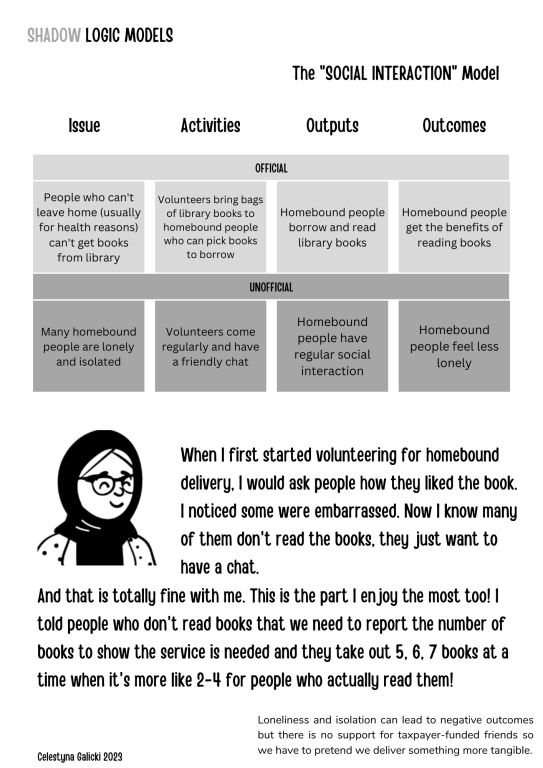
One of Celestyna’s Shadow Logic Models [Celestyna]
A few quick observations from Chris
I love this concept and Celestyna’s design. Let’s take a second to break down the design.
- First off there is a simple official logic model. This logic model is then mirrored with an unofficial logic model.
- A volunteer story illustrated with a simple cartoon figure humanizes the program and really sets the model within the appropriate context. The shadow logic model could have existed without this piece but I don’t think it would be nearly as compelling.
- At the bottom there is a single sentence takeaway which does a good job of ending the design with a quick “so what?”
What value exists in finding and constructing shadow logic models? [Celestyna]
The outcomes of official and shadow logic models provide important insights into what is and is not considered valuable by those who make decisions.
Common shadow outcomes include:
- social contact and friendship for those lonely and isolated (as in the example in the illustration)
- relationship building / relationship repair between the community and authorities or funders, signalling that the authorities care about something and take it seriously
- outcomes valued by indigenous or migrant communities that do not fit into Western frameworks, e.g. mana enhancement
- the benefits of basic services such as free transport or free food provided as part of the programme
- improving the reputation of a place/neighbourhood etc.
So what do you think? Could you see yourself creating something like this for your own program?
Let us know in the comments 
 English
 Afrikaans
 Shqip
Shqip አማርኛ
አማርኛ العربية
 Հայերեն
 Azərbaycan dili
 Euskara
 Беларуская мова
 বাংলা
বাংলা Bosanski
 Български
 Català
 Cebuano
 Chichewa
 简体中文
简体中文 繁體中文
繁體中文 Corsu
Corsu Hrvatski
 Čeština
 Dansk
Dansk Nederlands
 Esperanto
 Eesti
Eesti Filipino
 Suomi
Suomi Français
 Frysk
Frysk Galego
 ქართული
 Deutsch
 Ελληνικά
 ગુજરાતી
 Kreyol ayisyen
 Harshen Hausa
 Ōlelo Hawaiʻi
 עִבְרִית
 हिन्दी
 Hmong
Hmong Magyar
 Íslenska
 Igbo
Igbo Bahasa Indonesia
 Gaeilge
 Italiano
 日本語
日本語 Basa Jawa
 ಕನ್ನಡ
ಕನ್ನಡ Қазақ тілі
 ភាសាខ្មែរ
 한국어
한국어 كوردی
كوردی Кыргызча
 ພາສາລາວ
 Latin
Latin Latviešu valoda
 Lietuvių kalba
 Lëtzebuergesch
 Македонски јазик
 Malagasy
 Bahasa Melayu
 മലയാളം
 Maltese
 Te Reo Māori
 मराठी
मराठी Монгол
 ဗမာစာ
ဗမာစာ नेपाली
 Norsk bokmål
 پښتو
پښتو فارسی
فارسی Polski
 Português
 ਪੰਜਾਬੀ
 Română
 Русский
 Samoan
 Gàidhlig
 Српски језик
 Sesotho
 Shona
Shona سنڌي
سنڌي සිංහල
සිංහල Slovenčina
 Slovenščina
 Afsoomaali
 Español
 Basa Sunda
 Kiswahili
 Svenska
 Тоҷикӣ
 தமிழ்
தமிழ் తెలుగు
 ไทย
ไทย Türkçe
 Українська
 اردو
اردو O‘zbekcha
 Tiếng Việt
 Cymraeg
 isiXhosa
 יידיש
יידיש Yorùbá
 Zulu
Zulu