• Skip to main content
  • Skip to footer
  • Home

The May 13 Group

the next day for evaluation

  • Get Involved
  • Our Work
  • About Us
You are here: Home / Archives for allblogs / communityevaluationsolutions

communityevaluationsolutions

Feb 12 2021

Picture This

One of the things I have noticed from working with nonprofits and community coalitions is that most people do not consider themselves “data people.”

Instead, they are typically visual learners. And they are doers. They want to make something happen in their community. Maybe that resonates with you.

I know as a community psychologist and evaluator, that data is important. Otherwise, how do you know you are making a difference?

At CES we do our best to create curiosity and engagement with data in a variety of way including dashboards, graphs, success stories, short videos, and infographics.

Last week, I spoke as part of speaker’s series for SAMSHA’s Service Members, Veterans and their Families Technical Assistance (SMVF TA) Center. We talked about all of these ways of using evaluation information. Today I want to share some tips about one of my favorite ways of using data, infographics. Here are ten tips to get you started.

  1. Who is you intended audience? Like all good evaluation reporting techniques, you should start with the evaluation user in mind. What do they most need to know?
  2. What story do you need to tell them?
  3. Choose a few data points (2 or 3) that tell your story.
  4. Don’t forget to cite your data sources. In this age of distrust in data and science, it’s important.
  5. Choose your brand colors, but don’t overdo it.
  6. Choose icons and pictures that help tell your visual story. In my talk the other day, we looked at an infographic that used 20 dog tags to depict the number of veterans who die by suicide every day.
  7. Use words, but minimally. The pictures and your select data points should be the star.
  8. Include an action you want them to take (e.g. get involved, donate resources, call their congressional representative etc.).
  9. Consider people who may be color blind or have some other visual disability when choosing your colors or font sizes.
  10. Make sure you share with some of your folks and get their feedback on your infographic, then make adjustments.

You can use your infographic in newsletters, on your website, on your social media sites, in your annual reports…..so many ways!

Hope this is helpful. Let me know how you use infographics in your work.

Written by cplysy · Categorized: communityevaluationsolutions

Jan 21 2021

Evaluation Cookies

My husband and a good friend got together and bought me Christina Tossi’s baking class for Christmas. Christina is the founder of Milk Bar in New York City. The class is INTENSE! Thirty days of lessons, baking, then developing your own recipes. The lessons are great and Christina is a lot of fun. But boy, coming up with your own recipes is a PROCESS! You first develop a flavor story, brainstorm possible ingredients and “mixings” and then start testing your cookies.

I have a secret.

I am just not that patient. Sure, I can follow a recipe and I am a pretty good cook and baker. But the “prototyping” process, although fun and interesting, is a little tedious. Trying different combinations of flavors, testing them out and taking note of what works and what doesn’t.

It occurred to me that you might feel the same way about evaluation. And just because I love the whole nerdy process, doesn’t mean you do.

The thing I find that turns nonprofit and foundation leaders into fans is focusing on evaluation use.

Yes, evaluation is all about asking actionable questions, designing a method to answer those questions and then assessing whether what you did made a difference.

The thing people often forget is the next step. What does your evaluation findings suggest you do?

Hopefully you are looking at your data quarterly, but if not, at least yearly as a minimum. The end of your fiscal year is a good time for an annual review. It’s a great time to review your community level data and your evaluation results. During your end-of-the year review ask these 10 questions:

  1. What went well?
  2. What can we do better?
  3. Did we reach our intended audience?
  4. Did we engage those most affected by the problem?
  5. Did we engage the right partners?
  6. Did the people most affected by the problem drive the work?
  7. Did we identify barriers and/or policies that need to be addressed?
  8. What do we need to keep doing?
  9. What is not really worth our effort or is not aligned with our strategy?
  10. What needs to change?

Follow this process, and just like creating a new recipe, you will develop something fabulous.

Isn’t that what we all want? And have a cookie.

Take care friends.

Ann

Written by cplysy · Categorized: communityevaluationsolutions

Nov 10 2020

Evaluators as Change Agents: Evaluating Community Coalitions

Hi everyone!

A few weeks ago, I was privileged to speak with the West Michigan Evaluators Network (WMEN) about evaluating coalitions and collaboratives. I started from the framework and opinion that evaluators can and should be social change agents. After all, my company’s (Community Evaluation Solutions) tagline is Partnering for Social Change. I believe that evaluators are not (just) objective observers of the programs and communities we serve. Rather, I believe that coalitions can be a powerful catalyst for change, and that evaluators can help them achieve their goals.

As evaluators we have the great opportunity to work for social change by partnering with community coalitions.

What are coalitions and collaboratives? (Note, I use these terms interchangeably).

So just why are coalitions so important? Coalitions at their best:

Coalitions are a formal arrangement for cooperation and collaboration between sectors of the community, in which each group retains its identity but agree to work together toward a common goal.

– Fran Butterfoss

  • Engage community members from all sectors, but most especially those who are most affected by the public health and social problem of interest (those with low income, are marginalized in some way, and people of color).
  • Bring together fragmented systems and help maximize resources;
  • Build community capacity for solving community problems;
  • Increase civic engagement; and
  • Organize community members, help them leverage their collective voice and maximize political power to help create long-term, systemic change.

Coalitions are MOST effective when they address community-wide problems using a public health approach to address systems level change.

Coalitions, while they have their strengths and benefits, are fraught with challenges. So, a word of warning – coalitions involve people and those people represent their organizations and themselves. They may have a hard time setting aside their perspectives for the good of the coalition or community. Structure (by-laws, committees, effective meetings) are important, but many coalition members want to skip this important work. Conflict is inevitable, and dare I say, necessary? Perhaps the most important challenge is coalition leadership. A good leader is a must for all effective coalitions. An effective coalition leader can inspire the group, bring them all together, and engage them in the work.

Coalition Development

Just like any other group, coalitions cycle in and out of stages and evaluation questions should change to reflect these stages.

During the formation stage, be mindful of the community’s context and history. Ask who is engaged and maybe more importantly, who is not engaged? Are by-laws and committees established? Are meetings effective? Does the coalition know what collaboration even is? I once worked with a new coalition and every time something needed to be done, they whipped their heads around to look at the coalition director. In that situation, we had to do some training on what it really means to collaborate before we could move on to the work.

During the maintenance stage, everyone has settled into their roles (hopefully) and fences mended (again, hopefully). Evaluation questions at this stage may include, are members satisfied with how the coalition is functioning? Are meetings effective? Is membership (still) representative of the community? Is implementation effective? Is there evidence of short-term outcomes?

Finally, after some years, the coalition reaches some level of stability. Evaluation questions at the institutionalization stage should include a focus on long-term outcomes and sustainability. Has the coalition grown in its organizational, leadership and evaluation capacity? As the coalition cycles through these stages, the evaluation plan should as well.

At times you may be called on to be a trainer, a strategy or program developer, a conflict manager and sometimes an evaluator. I promise, evaluating coalitions is often rewarding and most certainly, never boring.

Send me an email to connect with me to talk all things evaluation and community coalitions at aprice@communityevaluationsolutions.com and let me know if you want me to add you to my contact list. I am on Twitter at @annwprice or on FaceBook at @CommunityEvaluationSolutions.

Written by cplysy · Categorized: communityevaluationsolutions

Oct 07 2020

How is Making Bread Related to Evaluating Communities?

by Ann Price

Two loaves of Sourdoughbread

You may or may not have heard about the COVID bread craze. Just to set the record straight, I didn’t start baking bread out of some fear that the store shelves would be stripped of all carbs. I just happen to like to cook and since we couldn’t go anywhere, I found solace in the kitchen. I started by learning how to make no-knead breads. Then one day, I took the plunge into the world of sourdough breadmaking.

When I attempted my first starter, I failed miserably. For three weeks I tried to feed the starter. But no matter what I did, the yeast colony would not grow. Frustrated, I started all over. During this time, I questioned if this was a good use of my time and precious flour. I fretted and fussed. I wanted to quit. I got advice and encouragement from my older sister, and kept going. Don’t give up she said. Look at your starter, not the instructions. Finally, after 3 weeks, I had a healthy starter.

Getting your starter going is only the half of it. Then you have to learn to bake it. My first few attempts were, well, less than stellar. My starter was still young and some loaves didn’t rise well. Some loaves were too doughy. Some were overcooked. More than one was dense and heavy.

I know, by now you are wondering what the heck baking bread has to do with evaluation or community change?

Just like learning to bake bread, real community change takes time.

First, you need to build the evaluation capacity of your organization, staff coalition, or community. You also need the right recipe. You need to understand your local data and root causes; have the right partners; develop a strategy that address the root causes; and design and implement your strategy. Finally, you need an actionable evaluation plan that will yield the powerful evidence you need to demonstrate that you are making a difference.

It’s a process; a complicated, messy process. But just like learning to make bread, so worth it. Nothing tops the smell of fresh baked bread or enjoying it once baked. And nothing tops an effective community coalition.

Helping communities build their evaluation capacity brings me a special kind of joy. Curious about your nonprofit, foundation or community coalition’s evaluation capacity? I have a free capacity assessment for you.

And just in case you want to give sourdough breadmaking a try, here is my go-to, almost always works, favorite recipe.

Take care and be well-

Ann

P.S. Let me know if you need and sourdough starter.

P.S.S. Or an evaluator. I bake bread and help communities.

Written by cplysy · Categorized: communityevaluationsolutions

Sep 15 2020

How to Overcome your FEAR of Evaluation

What are you most afraid of?

For me, it definitely heights.

For my husband, its bees or anything that buzzes or remotely sounds like a bee.

For some nonprofit and community leaders, what they fear most is evaluation. Sometimes, there are good reasons for that fear. Some nonprofit leaders have told me about their bad experiences with evaluation (evaluation reports that were too long, didn’t answer their questions, made no sense to them, or were not actionable).

Here are some common objections I have heard from some community leaders about their reluctance to participate in evaluation.

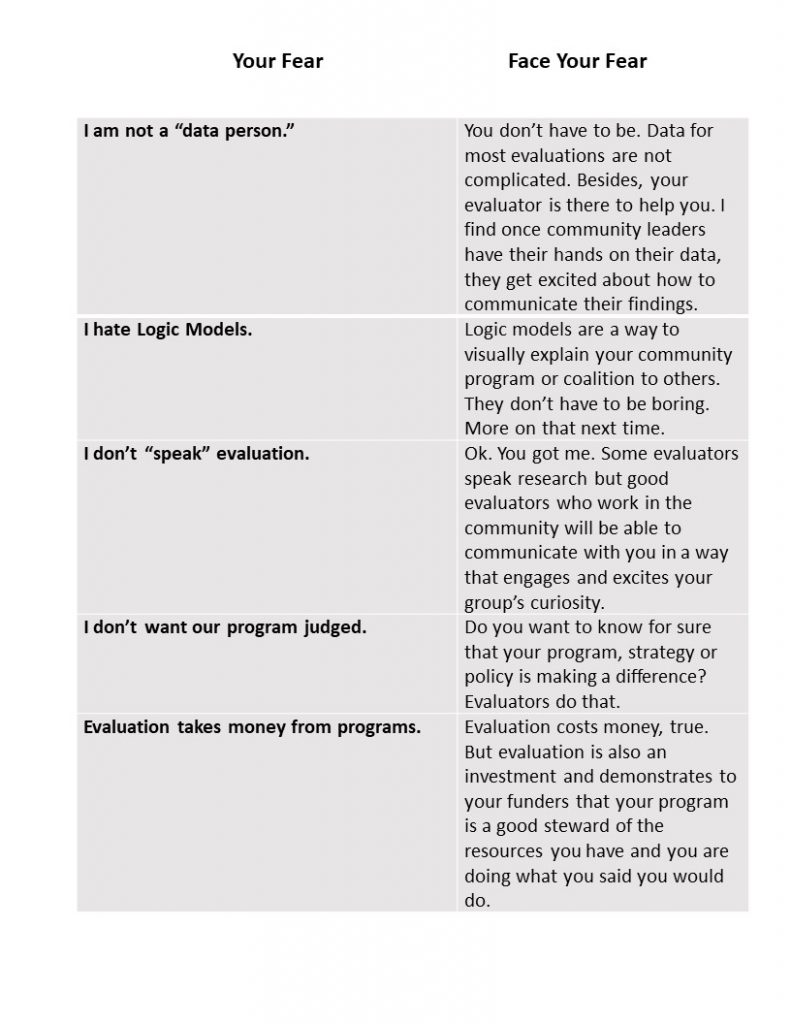
  • I am not a “data person.”
  • I hate Logic Models.
  • I don’t “speak” evaluation.
  • I don’t want to have our program judged.
  • Evaluation takes money from programs.

A profound fear of evaluation is often at the core of these objections.

Let’s go through these together objections one by one.

Ready to face your fears? Click here.

Written by cplysy · Categorized: communityevaluationsolutions

  • Go to page 1
  • Go to page 2
  • Go to page 3
  • Interim pages omitted …
  • Go to page 6
  • Go to Next Page »

Footer

Follow our Work

The easiest way to stay connected to our work is to join our newsletter. You’ll get updates on projects, learn about new events, and hear stories from those evaluators whom the field continues to actively exclude and erase.

Get Updates

Want to take further action or join a pod? Click here to learn more.

Copyright © 2026 · The May 13 Group · Log in

en English
af Afrikaanssq Shqipam አማርኛar العربيةhy Հայերենaz Azərbaycan dilieu Euskarabe Беларуская моваbn বাংলাbs Bosanskibg Българскиca Catalàceb Cebuanony Chichewazh-CN 简体中文zh-TW 繁體中文co Corsuhr Hrvatskics Čeština‎da Dansknl Nederlandsen Englisheo Esperantoet Eestitl Filipinofi Suomifr Françaisfy Fryskgl Galegoka ქართულიde Deutschel Ελληνικάgu ગુજરાતીht Kreyol ayisyenha Harshen Hausahaw Ōlelo Hawaiʻiiw עִבְרִיתhi हिन्दीhmn Hmonghu Magyaris Íslenskaig Igboid Bahasa Indonesiaga Gaeilgeit Italianoja 日本語jw Basa Jawakn ಕನ್ನಡkk Қазақ тіліkm ភាសាខ្មែរko 한국어ku كوردی‎ky Кыргызчаlo ພາສາລາວla Latinlv Latviešu valodalt Lietuvių kalbalb Lëtzebuergeschmk Македонски јазикmg Malagasyms Bahasa Melayuml മലയാളംmt Maltesemi Te Reo Māorimr मराठीmn Монголmy ဗမာစာne नेपालीno Norsk bokmålps پښتوfa فارسیpl Polskipt Portuguêspa ਪੰਜਾਬੀro Românăru Русскийsm Samoangd Gàidhligsr Српски језикst Sesothosn Shonasd سنڌيsi සිංහලsk Slovenčinasl Slovenščinaso Afsoomaalies Españolsu Basa Sundasw Kiswahilisv Svenskatg Тоҷикӣta தமிழ்te తెలుగుth ไทยtr Türkçeuk Українськаur اردوuz O‘zbekchavi Tiếng Việtcy Cymraegxh isiXhosayi יידישyo Yorùbázu Zulu