• Skip to main content
  • Skip to footer
  • Home

The May 13 Group

the next day for evaluation

  • Get Involved
  • Our Work
  • About Us
You are here: Home / Archives for allblogs / drbethsnow

drbethsnow

May 28 2023

AEA Conference 2022

Preconference Workshop: Transformative Mixed Methods: Supporting Equity & Justice by Donna Mertens

A key reason that I decided to take this pre-conference workshop was because I wanted to learn from Donna Mertens. I really like her writing and wanted to have a chance to learn from her in person. She did not disappoint! While I didn’t find there was much about mixed methods, per se, there was a lot about transformation, equity, and justice. Here are some things I learned/re-learned:

  • In France there is a law against the government collecting data on race. It comes from WWII when government data on Jewish people facilitated the ability to send Jewish people to concentration camps.
  • Ethics is the start of every decision we make in evaluation.
  • If you are not challenging oppressive structures, you are complicit in the status quo.
  • You can challenge your client/commissioner – e.g., if they ask for a survey for a summative evaluation, you can ask them if that’s really going to be transformative.
  • mixed methods – what is the synergy between the quant and the qual? what do you gain by bringing quant and qual in dialogue with each other?
  • transformative paradigm
    • axiology (i.e., nature of ethics & values) – culturally responsive, promotes social/environmental/economic justice and human rights, address inequities, reciprocity (what do you leave the community so they can sustain the change when the evaluator leaves?), resilience, interconnectedness (living & non-living), relationships
    • ontology (i.e., nature of reality) – reality is multi-faceted, historically situated, consequences of privilege
    • epistemology (i.e., the nature of knowledge & relationship between knower and that which would be known) – interactive, trust, coalition building
    • methodology (i.e., nature of systematic inquiry) – transformative, dialogic, culturally responsive, mixed methods, policy change as part of methodology
  • transformative mixed methods design:
    • Build relationships
      • often historical experiences of research/evaluation that are extractive and oppressive; researchers need to earn trust
      • identifying existing community actions groups and understand the history of their efforts; identify formal & informal leaders; identifying community needs/gaps/strengths/assets
    • Contextual analysis
      • cultural, historical, political, environmental, legislative, power mapping
      • policy analysis (what’s written and unwritten; what’s written by not enacted)
    • Pilot interventions
      • collect data, make mid-course corrections
    • Implement intevetnion
      • collect data for proces evaluation
      • collect data on unintended/unanticipated outcomes
    • Determine effectiveness
      • outcome evalaution
    • Use findings for transformative purposes
      • include in contract the importance of working with the community – from relationship building at the start all the way through to sharing the findings at the end
      • if the community is involved throughout the evaluation, they will already know the findings and will not need to wait for the final report to find out (also, reporting findings along the way will make sure you are reporting data back to community in a reasonable time)
  • You can say that you’ll work with an expected goal of reducing inequities and increased justice and that you’ll work in respective ways; you can’t guarantee that you’ll make things better and can’t guarantee you won’t cause harm, because we don’t know what will happen
  • http://transformativeresearchandevaluation.com/

Opening Plenary: Re(Shaping) Evaluation: Decolonization, New Actors, & Digital Data. Edgar Villanueva interviewed by Nicky Bowman.

Villaneuva wrote the book Decolonizing Wealth. I will admit that I have this book in my big pile of books to read, but hadn’t got around to reading it! After hearing this keynote, I’m even more excited to read it. Here are some things he said during the keynote that resonated with me:

  • we learned the names of the colonizers’ ships (the Nina, the Pinta, the Santa Maria, the Mayflower), but not the names of the Indigenous lands and people
  • colonization is like a virus that wipes out anything that is not like the dominant culture
  • the US is working on Truth & Reconciliation legislation re: Indian Boarding Schools
  • none of us has ever lived in a world that wasn’t actively being colonized. It can be violent and it can be subtle.
  • we can’t collectively heal without acknowledging how we got here
  • we need to change 4 things:
    1. people: more diversity of perspectives in leadership
    2. resources: who has them and who makes decisions about them. who has the microphone.
    3. stories: need to shift away from the deficit mindset, see the strengths
    4. rules: spoken & unspoken policies, need more equitable policies, but also need to become aware of and change the unspoken rules that limit our work

Concurrent Session: Walking the talk: Bringing Ontological Thinking into Evaluation Practice by Jennifer Billman and Eric Einspruch

Journal article: Framing Evaluation in Reality: An Introduction to Ontologically Integrative Evaluation

Thursday Plenary: Co-creation of Strategic Evaluations to Shift Power Moderator: Ayesha Boyce Speakers: Elizabeth Taylor-Schiro/Biidabinikwe, Gabriela Garcia, Melanie Kawano-Chiu, and Subarna Mathes 

Here are some things that the panelists said that resonated with me:

  • Ayesha Boyce:
    • equity is context-specific
  • Gabriela Garcia:
    • equity is not enough. The next step is collective liberation
    • At Beyond, they use a culturally-responsive evaluation framework, start all evaluations in a visioning session, ensure the evaluation is grounded in community values
  • Elizabeth Taylor-Schiro/Biidabinikwe:
    • communities striving for collective liberation don’t have power and that’s the problem. Power is needed to draw on their strengths, move toward sustainability and self-determination
    • it should be the community leading the evaluation, supported by evaluators, rather than ‘co-creating’ the evaluation
  • Melanie Kawano-Chiu:
    • whoever funds the evaluation gets to make the most decisions – that’s a bias we hold
    • ableism = there is a “norm” and if you fall outside of it, you aren’t good enough
    • “Nothing about us without us” comes from the South African disability community
    • Disability Rights Advocacy Fund formed after the UN Convention on Rights of People with Disabilities
  • Subarna Mathes:
    • if rigour = degree of confidence that the program has led to an outcome [different than rigour in the post-positivist sense]
    • we need to push against the view of rigour that is narrowly defined, that prioritizes a worldview of “one reality” or “objectivity”

Concurrent session: Interactive tool to promote responsible use and understanding of culturally responsive and equity-focused evaluation by Blanca Guillen-Woods, Felisa Gonzales, Katrina Bledsoe, Kantahyanee Murray

  • https://slp4i.com/the-eval-matrix/ is an online tool that helps you to choose from various different equity-focused/culturally-responsive evaluation approaches
  • 7 key principles, 3 focus areas (individual, interpersonal, structural levels)
  • This tool is really cool and I’m definitely going to share it with my students, as they often ask how to choose an approach (or approaches) when designing an evaluation

Concurrent Session: Design Sprint: How Researchers Can Share Power with Communities Involved in Evaluations by Gloriela Iguina-Colón and Brit Henderson

These presenters took us through a workshop on power sharing. Here are some things that they talked about that resonated with me:

  • power is often thought of in the sense of authority, control – power over other people or things
  • MLK descrbied power as “Power properly understood is nothing but the ability to achieve purpose. It is the strength required to bring about social, political, and economic change.”
  • can have power with (collaborate with others to find common ground), power to (believe in people’s ability to shape their own lives), and power within [which I didn’t catch the meaning of in my notes so I just Googled it and found this: “the sense of confidence, dignity and self-esteem that comes from gaining awareness of one’s situation and realizing the possibility of doing something about it.”]
  • power levers:
    • resources
    • access
    • opportunities
  • power sharing = recognizing the power levers that you have and actively choosing to leverage these to build collective strength
  • positionality – “how our social identities and experiences influence the choices we make in the research process and how those factors shape the way others see us and give us power and/or insight in a specific research context.”
    • consider experiences (interactions with the topic; lived experience of the topic), social identities (it’s context-dependent which are valued or not valued), perspectives (about the topic; understanding systems of oppression); identifying these can provide helpful insights (e.g., when you share an identity with participants) and biases (e.g., when you don’t share an identity (or an intersection of identities) and have assumptions/biases)
      • in addition to individual positionality, think about team positionality
  • reflectivity – “an attitude of attending systematically to the context of knowledge construction, especially to the effect of the researcher, at every step of the research practice.
    • examination, attitude, process related to the topic; not just about identifying these things, but also what insights this will give me and where I might have knowledge gaps
  • opportunity spaces: “points in the [evaluation] process during which you can apply power levers to facilitate meaningful participation among and share decision-making power with
    • each of the steps of the evaluation process is an opportunity for meaningful participation: evaluation design, data collection, data analysis, interpretation of results, and dissemination
  • facilitation – provide enough structure so everyone can be heard; be mindful of different views of evaluation
  • when considering the key people/groups in an evaluation, ask:
    • who has the most power/privilege in this context?
    • who will be most impacted by the evaluation?

Concurrent Session: Ethics for Evaluation: Can We Go Beyond Doing No Harm to Tackle Bad and Do Good? by Penny Hawkins, Donna Mertens, and Tessie Catsambas

  • Ethics for Evaluation: Beyond “doing no harm” to “tackling bad” and “doing good”. Edited By Rob D. van den Berg, Penny Hawkins, Nicoletta Stame

Concurrent Session: Equitable Evaluation Discussion Guide by Maggie Jones, Natasha Arora, and Elena Kuo

  • Centre for Community Health & Evaluation at Kaiser Permenated (Seattle) [Seemed quite similar to CHEOS)
  • equity-focused conversation about the evaluation design with someone from their organization who is not part of the project to get a different perspective
  • they created a guide that includes pre-work before the meeting, them a meeting where you do a consultation with reviewers
  • helped them to think from multiple angles (not just “what’s in the RFP?”)
  • helped them to discuss assumptions and implications
  • articulate what they can and cannot do to address equity
    • might not be able to do something in the current evaluation, but if you don’t identify ideas, won’t ever do them – so may be something to put in the next proposal if it’s too late to do it in this proposal
  • they tell funders that the EDI reviews is part of their process (i.e., we will develop the plan, put it through the EDI review and may come back to the funder with new ideas)
  • ultimately would like to have a systematic follow up process where people will document what they do (trying to document changes that happened due to the EDI review process) to build evidence if this process makes a difference

Concurrent Session: Identifying Gaps in the Research on Professionalizing Evaluation: What Do We Need? by Amanda Sutter, Esther Nolton, Rebecca Teasdale, Rachael Kenney, Dana Wanzer

Concurrent Session: Creative Practices for Evaluators by Chantal Hoff & Susan Putnins

  • reminded me a lot of Jennica & May from ANDImplementation

Concurrent Session: Who Are We? Studies on Evaluators’ Values, Ethics and Ontologies by John M. LaVelle, Michael Morris, Clayton Stephenson, Scott I Donaldson, Justin Hacket, Paidamoyo Chikate, Jennifer Billman

  • VOPEs have ethics, standards, and competencies, but we as evaluator interpret them through our own lenses
  • values = a set of goals and motivations that serve as a guiding group of principles, affect decisions/attitudes/behaviours, come from many sources, influence our practice

Concurrent Session: Mapping Distinctions in the Implementation of Learning Health System (LHS) by Anna Perry & Dough Easterling

  • from National Academy of Medicine, but concept is too high level and ambiguous to guide the actual work of becoming a LHS
  • in the US, electronic health records adopted in early 2000s, Afforable Care Act required the use of data to inform the health system
  • Academci Helath Centres not early adopters of LHS because they were focused on research to build knowledge vs. continuous improvement type stuff
  • hypothesis is that LHS is supposed to improve patient care, patient outcomes, and staff satisfaction (since they are more engaged)

Concurrent Session: Who are We? Studies of Evaluator Beliefs, Identify, and Ethics by Rachel Kenney, Bianca Montrosse-Moorhead, Amanda Sutter, Christina Peterson, Rachel Ladd, Betty Onyura, Abigail Fisher, Qian Wu, Shrutikaa Rajkumar, Sarick Chapagain, Judith Nassuna, Latika Nirula

  • Ladd & Peterson discussed consensual qualitative analysis
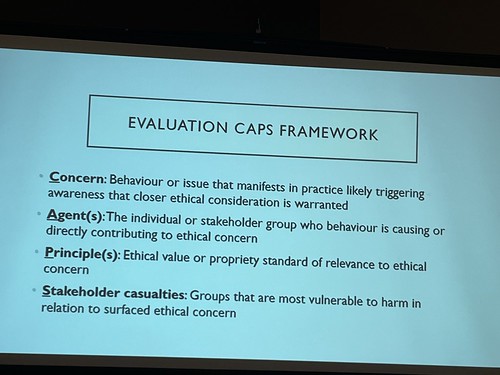
  • Tin Vo presented on behalf of Betty Onyura, who was not able to attend. Talked about how the commodification of evaluation work is in tension with trying to support equity and social justice
Untitled
  • an audience member suggested the word “constituent” instead of “stakeholder” [as a lot of us are trying to find a word to replace “stakeholder”]

Concurrent Session: Playing with Uncertainty: Leaning into Improv for Effective Evaluation by Daniel Tsin, Libby Smith, and Tiffany Tovey

  • improv as reflection-in-action
  • improv as a mindset – every idea matters
  • thinking on your feet, using a different part of your brain, building on ideas, chance to be brave – can all be useful in evaluation
  • activity: Zip Zap Zop – toss a ball and say “zip,” “zap”, “zop” in that order and when someone drops the ball, we all cheer “woop!”
    • a chance to experience failure and turn it into a celebration
    • shared experience of a group
    • a plan for when we messed up
    • have to pay attention the whole time – not planning what to do, but being present, acknowledging what is being said/done
    • facilitator is not in control
  • activity: Yes, and…
    • “and” is generative, while “but” feels more like you are shutting someone down
    • you will notice “but” in every day life when you could have used an “and”
    • sometimes you want to be generative and sometimes you want to prioritize (e.g., don’t want to keep “and”ing when building a program ToC and end up with trying to do everything).
  • Adrienne Marie Brown’s Emergent Strategy

Concurrent Session: What Should I Do? Examining Uncertainty, Decisions Points, and Pushback in Evaluation Practice by Rebecca Tesadale, Tiffany Tovey, Grettel Arias Orozco, Julianne Zemaitis, Onyinyechukwu Onwuka, Cherie Avent, Christina Peterson, Allison Ricket, Mandy White, Kelli Schoen, Daniel Kloepfer, Natalie Wilson

  • evaluations require interpersonal skills, but it’s not taught in evaluation courses or in evaluation texts
  • it’s a human tendency to be defensive and as a conversation proceeds, defensiveness will increase as what a person hears can become a distortion of what the message was
  • Kahlke, 2014 – Generic Qualitative Approaches: Pitfalls and Benefits of Methodological Mixology
  • Braun & Clarke, 2022
  • evaluators are always dealing with uncertainty
  • different people have different level of tolerance for uncertainty (and an evaluator’s tolerance might be different than that of the people they work with)
  • aspects of uncertainty”
    • probability – quant representation about the amount of uncertainty
    • ambiguity – different ways to interpret findings
    • vagueness – how detailed the language is
  • take with client before you start – what is the stake of the decision? What is their tolerance for university how certain do they need to be? This can inform choice of methods, etc.
  • uncertainty can be leveraged to drive transformational change by creating dialogue about the unknown and asking more interesting questions about the unknown (e.g., if data is not available, ask why there is no data)

My post conference “to do” list

  • read Decolonizing Wealth
  • read all the various articles that I took note of
  • order System Evaluation Theory: A Blueprint for Practitioners Evaluating Complex Interventions Operating and Functioning as Systems by Ralph Renger (I chatted with Ralph at the book fair, but they didn’t have any books to buy at the book fair – just a chance to talk to authors)

Written by cplysy · Categorized: drbethsnow

May 04 2023

Comment on Recap of the 2019 Canadian Evaluation Society conference by Dr. Awuor PONGE

What a wonderful summary here, Dr. Snow. I just landed on this one this morning and I’m wondering why I had not seen it earlier. It is ‘detailed’ and gives a clear picture of the Conference, such that even those who did not attend, will not feel like they missed anything. Good work!

Written by cplysy · Categorized: drbethsnow

Nov 29 2022

Webinar: Introduction to Thematic Analysis: Understanding, conceptualising, and designing (reflexive) TA for quality research

Date: 29 November 2022

Offered by NVivo

Presenters: Virginia Braun and Victoria Clarke

Summary

“The process is not the purpose” – this quote really resonated for me, as did their note of “fitting method to purpose”. They aren’t trying to say that everyone should do reflexive TA. They are saying that you should know what type of TA you are using and to chose it purposely for what you are trying to achieve. And then do the analysis in a thoughtful way, a way that aligns (your ontology/epistemology should be consistent with your methods). I quite enjoyed this webinar and I think I’ve check out their book!

Detailed Notes

Resources:

  • Article on “Using Thematic Analysis in Psychology” in Qualitative Research in Psychology. Highly cited 145K+ citations on Google Scholar. They noted that some of those citations are critiques, which has helped to evolve their thinking.
  • Book Thematic Analysis: A Practical Guide (2022) (Sage)
  • Toward good practice in thematic analysis: Avoiding coom problems and be(com)ing a knowing researcher.
  • thematic analysis is an approach, not a single method, more like a family of things
  • family differences:
    • paradigmatic differences – what are we (conceptually) doing here? (e.g., describing/uncovering a single reality, c0-creating knowledge, etc.)
    • what paradigm are we operating in?
      • post-positivist – “small q” (using not numbers, but still using post-positivist understanding of the world)
      • non-positivist – “big Q” or “fully qualitative”
      • view of subjectivity – a threat (as understood in postpositivism, subjective seen as leading to bias) or a resource (as understood in Big Q)?
    • research practice differences:
      • conceptual (discovery vs production)
      • practical (identifying themes vs. developing analysis; themes inputs or outputs )
        • in reflexive TA they don’t talk about “emerging themes”, since they aren’t thinking that the knowledge is being discovered, it’s being produced
      • what is a theme?
        • united by focus/topic?
        • united by shared core concept?
  • Braun & Clarke’s way of clustering these approaches:
    • coding reliability
    • codebook versions (e.g., framework analysis)
    • reflexive versions (Braun & Clarke’s version is one of the most well-known of these)
    • other versions
  • Findlay’s differentiation
    • scientifically descriptive
    • artfully interpretative
  • TA is about developing, analyzing, an interpreting patterns across a qual dataset, involves systematic processes of data coding to develop themes
    • methods, not methodology (but you do still have a worldview/paradigm you are operating in when you choose and use a method)
    • focus on patterns of meaning aka themes across a dataset (but what’s s pattern?)
    • processes of coding –> themes
    • reporting ‘themes’
  • Reflexive TA
    • conceptualizing of analysis. Research Question + Research + Data are embedded within our disciplinary training & scholarly knowledge, sociocultural meanings, and values
    • Big Q/artfully interpretative
    • research subjectivity value –> reflexivity is essential
    • coding is open and organic (codes as analytic ‘entity’)
    • themes as analytic ‘output’
    • multiple ways to do reflexive TA (theoretical alignments, etc.)
    • six phase process to do reflexive TA:
      • familiarization
      • coding
      • generating/constructing (initial) themes
      • theme development and review
      • refining, defining, and naming themes
      • writing/stopping (it’s never “complete”, so you need to pick a point to end)
      • NB. The process is not the purpose, nor a guarantor of quality.,
      • NB. It’s not a linear process. Can go back to any phase at any time. Open & recursive.
  • Take home message: there is a diversity of TA; understand what type of TA you are using!
  • Common problems in published TA:
    • misunderstanding/misrepresenting (lack of diversity)
      • e.g., saying they are doing TA when they aren’t; aren’t adequately rationalize why TA is used; “swimming (unknowingly) into the waters of positivism”
      • e.g., saying there is no guidance for TA (when there’s lots in the literature)
      • e.g., a paper saying it’s reflexive TA but then says used reflexivity to “manage their bias”
      • inadequate description (e.g., just saying “followed the 6 phases of…” but not how you did it)
      • too many themes – thin/fragmented
      • deploying theoretically incoherent quality standards (e.g., saying intercoder reliability, which is not a coherent strategy for reflexive TA (would be appropriate for a coding relatability version of TA)
    • mismatches:
      • conceptual
      • methodology (practice based)
      • reporting
      • quality criteria
    • Become a more knowing practitioner:
      • don’t treat TA as a single method
      • talk about what version of TA you used
      • make choices thoughtfully & appropriately and show you made choices
      • engage in conceptual and design thinking
    • conceptual thinking
      • research values (awareness)
        • ontological
        • epistemological assumptions
      • design thinking: design coherence/methodological integrity (Levit et al, 2017)
    • 10 fundamentals of reflexive TA (for conceptualization & design coherence) (Braun & Clarke, 2022 paper – go read it!)
      • coding quality doesn’t depend on a multiple coders
      • analysis can’t be accurate or objective, but can be weaker/stronger
      • good quality coding/themes come from depth of engaging and distancing (the value of time!)
      • assumptions underpinning analysis need to be acknowledged – they don’t like “saturation” (they wrote a paper on this – a lot of qualitative approaches use this concept, but their paper talks about underlying assumptions of it)
    • 5 key challenges
      • fitting method to purpose (claims and practice)
      • working in a time and using reflexive TA coherently
      • time (tensions and pressures)
      • reporting (challenges in style, length, and from reviewers & editors)
      • choosing appropriate quality criteria (e.g., in health, often COREQ is often seen as the way to go, but it has assumptions embedded in it)
    • quality and being a reflexive (TA) practitioner:
      • you are not a robot of a mechanic
      • you are an adventurer
        • values-led
        • reflexive
        • active
        • positioned
        • thoughtFULL (aka, don’t just think of this as “rules to follow”)
    • Q&A:
      • content analysis vs. TA – there are different versions of content analysis, just as there are different versions of TA. They wrote a paper comparing TA to content analysis, grounded theory, and something else.
    • Twitter: @ginnybraun @drviciclark

Written by cplysy · Categorized: drbethsnow

Oct 25 2022

AEA Coffee Break: Five Core Processes for Enhancing the Quality of Qualitative Evaluation 

Presenter: Jennifer Jewiss

Date: 25 October 2022

The presenter had reflective questions for the audience, so I figured I’d put mine here, along with my notes from the webinar.

Reflective questions 1: When I think of qualitative approaches to evaluation, the following words come to mind:

  • open
  • emergent
  • unexpected
  • nuance
  • deep
  • devalued by some
  • harder than people think

They put together a book on qualitative methods in evaluation with chapters authored by many evaluators, then identified themes of what makes up quality in qualitative inquiry:

  1. acknowledging who you are and what you bring to the work (you)
    • positionality
    • how do facets of your identity, history, etc. intersect
    • how does it enrich and limit your work as an evaluator?
      • what blind spots do you have? what learning do you need to do?
  2. building and maintaining trusting relationships (us)
    • throughout the entire evaluation
  3. employing sound & explicit methodology (process
    • a wide array of things that can be done in qualitative inquiry
  4. staying true to the data (what we find)
    • hearing and representing the voices and perspectives of participants
    • be really conscious of what you might be bringing to bear on the data (our own priorities, biases, desires) – monitor that to “keep it in its proper place”
  5. fostering learning (what we learn)
    • helping everyone involved learn, including ourselves
    • open-ended learning helps people to surface that tacit knowledge
  • these things are not unique to qualitative
  • a cycle, not linear. They wanted a spiral/dynamic diagram, but publisher suggested a cycle would be more clear

Reflective question 2: how might one use this model to information qualitative evaluation practice?

  • presenter suggested that each of these elements could be a prompt for reflective writing or reflective art (drawing, collages, etc.)

Written by cplysy · Categorized: drbethsnow

Apr 15 2022

Webinar Notes: Using Evaluation in Context: Multicultural Validity and Cultural Competence in Evaluation

Date: 14 April 2022

Hosted by: AEA, Government Accountability Office

Speakers: Karen Kirkhart, Kathryn Newcomer, Giovanni Dazzo, Nicole Bowman, Terell Lasane (moderator)

This was a really great webinar. I furiously took notes of as many of the insightful things the panelists were talking about. The notes are imperfect (I tried to catch some direct quotes inside quotation marks, but some of this is paraphrased – any errors are my own! If you are really interested in this topic, you can check out a recording of the webinar here and there are a bunch of resources that the speakers shared at the end of this posting.

Karen Kirkhart:

  • multicultural validity is a “call to broaden the kinds of evidence that are considered in validity conversations”
  • limited views of “validity” promotes social injustice – it silences
  • 5 intersections sources of intersecting validity evidence
    1. methodological validity – the stuff we usually think of re: quant and qual (insufficient as the only source of evidence)
    2. theoretical evidence – “insights from social sciences and humanities and professions”, Indigenous wisdom; program theories (examine these for bias towards deficits and disadvantage)
    3. relational evidence – “how people relate to one another, to our planet, to the universe”; “how power is exercised in relationships”; collaborative and participatory approaches ‘ position relationships as positive, but this is not always true. e.g., “inclusion” can “twist” into a settler invitation to assimilate
    4. experiential evidence grounds our understanding in the lives of the community members; “calls evaluators to spend time with communities, upon being invited”
    5. consequential evidence – brings accountability to our work; examine what happens or fails to happen as a result” if “evaluation does not move the needle towards social justice, what does that tell us about our accuracy and adequacy of our prior understandings?”

Kathryn Newcomer:

  • multicultural validity is a lens through which we should view our claims (e.g., claims of
  • “evidence-based policy making” has been embraced in OECD trails and a focus on RCTs as being the way to demonstrate evidence
  • likes the term “impactees” rather than “beneficiaries” (because you don’t know if they are benefiting!)
  • concerned with standards used in various registries to judge research
  • working on an advanced set of evidence standards – broadening view of causation, context, equity
  • fit methods to the questions
  • 3 books influential in her thinking of cultural humility and in understanding racism, sexism, and classism (Stamped from the Beginning by Ibram X. Kendi, White Trash: 400 Years of Untold History of Class in America by Nancy Isenberg; Invisible Women: Data Bias in a World Designed for Men by Caroline Criado Perez)

Giovanni Dazzo

  • evaluations often based on the opinions of what is “rigourous” according to the funder and the evaluator, but not necessarily on the people who the program is supposed to serve
  • we as evaluators often term sticky note activities as “participatory”, but is that what the community consider to be the ways they participate
  • if we enact oppressive ways of “participating”, we are robbing people of their identities
  • how can our practices restore our humanity as evaluators?
  • “an expertise that privileges distance (another word for “objectivity”)”
  • co-constructed a reflective framework
  • “the extractive nature of inquiry” vs. a way to restore
  • “restorative validity”
  • seek to heal and restore rather than to “prove a point”

Nicole Bowman

  • storytelling as valid and impactful
  • scientific and policy and academic humility to add to the idea of cultural humility
  • we must understanding history in our context to walk together in a good way
  • our experiences matter, how we got here today
  • Braiding Sweetgrass by Robin Wall Kimmerer
    • braiding requires tension – “tension is respected and expected”
    • the more tension in the knot, the stronger it is – intersectionalities
  • think of the 575 tribes as a nation state
  • refers to self as a “blue collar scholar”
  • “we have to get upriver”
  • not much has changed despite many years of reports, etc.
  • lets bring some wisdom into that work, instead of just “evidence”
  • learn about sovereign nations
  • build capacity, competency, and skills on how to work nation-to-nation
  • how do you make RFP policies so that we can build things differently and start piloting and testing things to look for better outcomes
  • who owns the data – how we publish
  • if we are trying to learn how to do things differently together, we need to dedicate more time and resources to do that
  • think about who is here and who is not here

Q&A

  • KK:
    • There is not one “evaluation community” – only a small proportion of those are members of evolution associations
    • much evaluation is done by outside contractors
    • social impact investing” not part of evaluation community, do a lot of evaluation work
    • lots of people have not had training in evaluation, let alone training in culturally responsive evaluation, cultural humility
    • some foundations (like Kellogg) and organizations like CREA that have been doing this stuff for a long time
    • the Urban Institute – lots of free materials you can download
    • cultural humility is so important – you can never fully understand another community/culture, you don’t just do a training on cultural humility/responsiveness and say you are done
  • KK
    • cultural competence is a stance – it’s infused across the AEA competencies, not a single “competency”
    • cultural competence implies an “end point” – that term may have outliving its usefulness
  • NB
    • legal political aspects – Tribal Nations are the only groups within “cultural responsive” that have this status
  • KK
    • there’s been work on cultural responsive evaluation for a long time (e.g., growth of TIGs, diversity work in AEA)
    • intersectionality theory has had a huge impact – “it messes everything up. which is a good thing”
    • things that disrupt and shakes us up is a
    • within society at large, the pandemic has raised awareness of inequities and the anger and outrage of the murder of Black citizens
    • and recognition that historic “solutions” have not been working
  • TL
    • if you codify things into law, it changes society
    • The “evidence act”
    • current administration released something talking about the importance of Indigenous wisdom
  • NB
  • younger generations do not see disciplinary and other lanes, “everything is related”; they don’t see boundaries they see opportunities, “putting together this beautiful quilt”
  • e.g., government TIG reaches out to Indigenous TIG all the time
  • we need to braid this together
  • TL:
    • I teach and our discussions show that students are thinking critically about how evaluations have not met the mandate because they are not considering cultural
  • KN:
    • qualitative and mixed methods are more and more becoming the body of research and evaluation, we may have reached a tipping point
    • many of the standards of evidence are “canonized” with positivist notions of “validity”, but more qualitative researchers are coming to the fore to challenge this; KN’s new standards are in a manuscript she’s
  • GD:
    • “we are more concerned with being ‘scientific enough’ than te are about being relevant”
    • demonstrated to where the money flows – to quant research – so those researchers hold more power and control
    • in participatory, community-based, it is assumed that “participation is good” , but as KK mentioned, it’s not always so
    • we have to ask why people are being asked to participate, are they being compensated? do they have time? often funders give excuses as to why “we can’t pay individuals”
    • processes often silence minoritized or under-resources communities
    • people often showcase the “participatory method” as the end goal, as opposed to how the method promotes mutual understanding, without that we don’t get to relational evidence, liberation
  • NB
    • there’s an Indigenous data sovereignty network
    • they are publishing in the data science literature too
    • data = power
    • “I need courageous, compassionate, and curious people”
    • mostly white males and females fill these positions that have the power and priveldge
    • we have to talk about power and privilege and capitalism, uncomfortable things
    • red, white, yellow, black are all the colours on our medicine wheel, all working together
    • we have no business making policy on things we know nothing about
    • we are all learning different things – e.g., “I don’t have experience in LGBT+, but have been invited into the work because I know Native stuff and they know that I will come in a humble way”
    • you can learn about communities based on what they are posting in social media
    • we learn, unlearn, and relearn together
  • GD
    • we have to think of where the money is going
    • evaluation work is contract based
    • we’ve broadened our thinking about how we do evaluation funding. Learning about how communities do things rather than funding projects for evaluators to go in and say “tell us everything you know”
  • KN
    • book on inclusive engagement
    • we think “engagement” is saying “we are having a meeting on Wed at 7 pm so we can tell you what we are going to do to you” – that’s not engagement
    • what are communities getting from this?
    • need to think of inclusion at design stage, not just at evaluator
    • evaluators come into projects too late to do a lot of this work sometimes
    • the term “rigour” is interesting – has a specific ontological assumption that there is a truth that evaluations have to find; probably not how to think about it. tends to compete with ideas of multicultural sensitivities. A very rigid view of rigour
  • KK
    • rigiour is often invoked against multicultural sensitivities. – my answer is that nothing is more rigiour than triangulating multiple sources of data
  • NB
    • if your “rigour” is working why are Native people still experiencing such high levels of ditabets, suicide, lower rates of graduation at high school, universities – your rigour is not working, since we are not getting the outcomes
  • “lets go beyond “do not harm” and be a good relative”
  • TL:
    • when you get a “significant” result in an evaluation saying there’s a , people often don’t ask “does it work well for everyone? does it work well in different contexts”
  • DG:
    • there are courses on decolonizing methodologies
    • where is the money going?

Resources

There were a tonne of resources suggested during the workshop. Here are some that I’m planning on checking out:

  • Center for Culturally Responsive Evaluation and Assessment
  • Braiding Sweetgrass by Robin Wall Kimmerer
  • Red Earth, White Lies by Vine Deloria, Jr
  • White Privilege and the Decolonization Work Needed in Evaluation to Support Indigenous Sovereignty and Self-Determination by Kate McKegg
  • Bowman, N.R. (2020). Nation-to-Nation in Evaluation: Utilizing an Indigenous Evaluation Model to Frame Systems and Government Evaluation: https://onlinelibrary.wiley.com/doi/abs/10.1002/ev.20411 
  • Bowman, N.R. (2018).  Looking Backward but Moving Forward: Honoring the Sacred and Asserting the Sovereign in Indigenous Evaluation: https://journals.sagepub.com/doi/abs/10.1177/1098214018790412. 
  • Russo Carroll, etal. (2020). The CARE Principles for Indigenous Data Governance: https://datascience.codata.org/articles/10.5334/dsj-2020-043/. 
  • SAMHSA: Native American Center for Excellence (n.d.): Steps for Conducting Research and Evaluation in Native Communities: https://www.samhsa.gov/sites/default/files/nace-steps-conducting-research-evaluation-native-communities.pdf
  • Mariella, Brown, and Carter (2009). Tribally Driven Participatory Research: https://digitalscholarship.unlv.edu/cgi/viewcontent.cgi?article=1058&context=jhdrp
  • Indigenous Research Methodologies by Bagele Chilisa
  • Johnston-Goodstar, K. (2012). Decolonizing evaluation: The necessity of evaluation advisory groups in Indigenous evaluation. New Directions for Evaluation, 136, 109-117.
  • Smith, L. T. (2012). Decolonizing methodologies: Research and Indigenous peoples (2nd ed.). New York: Zed Books.
  • Dean-Coffey, J., Casey, J., & Caldwell, L. D. (2014). Raising the bar – integrating cultural competence and cquity: Equitable evaluation. The Foundation Review, 6(2). https://doi.org/10.9707/1944-5660.1203
  • Kirkhart, K. E. (2016). Equity, privilege and validity: Traveling companions or strange bedfellows? In S. I. Donaldson & R. Picciotto (Eds.), Evaluation for an equitable society (pp. 109-131). Greenwich, CT: Information Age.
  • LaFrance, J., Nichols, R., & Kirkhart, K. E. (2012). Culture writes the script: On the centrality of context in Indigenous evaluation. In D. J. Rog, J. Fitzpatrick, & R. F. Conner (Eds.), Context: A framework for its influence on evaluation practice. New Directions for Evaluation, 135, 59-74.
  • Kirkhart, K. E. (2010). Eyes on the prize: Multicultural validity and evaluation theory. American Journal of Evaluation, 31(3), 400-413.
  • Johnson, E. C., Kirkhart, K. E., Madison, A. M., Noley, G. B.,  & Solano-Flores, G. (2008). The impact of narrow views of scientific rigor on evaluation practices for underrepresented groups. In N. L. Smith & P. Brandon (Eds.) Fundamental issues in evaluation. (pp. 197-218). New York: Guilford.
  • Stamped from the Beginning by Ibram X. Kendi
  • White Trash: 400 Years of Untold History of Class in America by Nancy Isenberg
  • Invisible Women: Data Bias in a World Designed for Men by Caroline Criado Perez

Written by cplysy · Categorized: drbethsnow

  • Go to page 1
  • Go to page 2
  • Go to page 3
  • Interim pages omitted …
  • Go to page 6
  • Go to Next Page »

Footer

Follow our Work

The easiest way to stay connected to our work is to join our newsletter. You’ll get updates on projects, learn about new events, and hear stories from those evaluators whom the field continues to actively exclude and erase.

Get Updates

Want to take further action or join a pod? Click here to learn more.

Copyright © 2026 · The May 13 Group · Log in

en English
af Afrikaanssq Shqipam አማርኛar العربيةhy Հայերենaz Azərbaycan dilieu Euskarabe Беларуская моваbn বাংলাbs Bosanskibg Българскиca Catalàceb Cebuanony Chichewazh-CN 简体中文zh-TW 繁體中文co Corsuhr Hrvatskics Čeština‎da Dansknl Nederlandsen Englisheo Esperantoet Eestitl Filipinofi Suomifr Françaisfy Fryskgl Galegoka ქართულიde Deutschel Ελληνικάgu ગુજરાતીht Kreyol ayisyenha Harshen Hausahaw Ōlelo Hawaiʻiiw עִבְרִיתhi हिन्दीhmn Hmonghu Magyaris Íslenskaig Igboid Bahasa Indonesiaga Gaeilgeit Italianoja 日本語jw Basa Jawakn ಕನ್ನಡkk Қазақ тіліkm ភាសាខ្មែរko 한국어ku كوردی‎ky Кыргызчаlo ພາສາລາວla Latinlv Latviešu valodalt Lietuvių kalbalb Lëtzebuergeschmk Македонски јазикmg Malagasyms Bahasa Melayuml മലയാളംmt Maltesemi Te Reo Māorimr मराठीmn Монголmy ဗမာစာne नेपालीno Norsk bokmålps پښتوfa فارسیpl Polskipt Portuguêspa ਪੰਜਾਬੀro Românăru Русскийsm Samoangd Gàidhligsr Српски језикst Sesothosn Shonasd سنڌيsi සිංහලsk Slovenčinasl Slovenščinaso Afsoomaalies Españolsu Basa Sundasw Kiswahilisv Svenskatg Тоҷикӣta தமிழ்te తెలుగుth ไทยtr Türkçeuk Українськаur اردوuz O‘zbekchavi Tiếng Việtcy Cymraegxh isiXhosayi יידישyo Yorùbázu Zulu