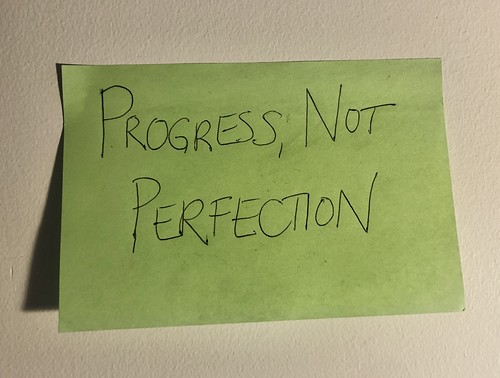
I can relate to that feeling, I literally have embroided this phrase on a hoop and hanged it on my wall. If it helps with motivation, as an emergent evaluator your posts on evaluation competences have helped me a lot in planning the next steps of my professional development. I’d love to see what comes next! Thanks for the hard work.
drbethsnow
I’m back to blogging
Over on my personal blog, I’ve decided to try blogging every day in the spirit of November as National Blog Posting Month (NaBloPoMo) – that was a thing years ago when blogs were more popular. The idea is to blog every single day during the month of November. That got me thinking that it had been a while since I blogged here… and it turns out that has been more than a year!
I remembered that I had been doing a series on evaluator competencies where I wrote one blog posting a week on each of the Canadian Evaluation Society (CES) evaluator competencies and that I had decided to take a “short break” when stuff was getting busy with the courses I was teaching. So “short” may have not been the right word there. In my defence, the world was turned rather upside down for most of that time, what with a global pandemic and reckoning on racism.
My other issue with actually getting things up on here is my battle with perfectionism. During these pandemic-y times I’ve been doing a fair bit of professional development 1As presentations and workshops have had to move online in response to the pandemic, it’s resulted in a lot of events that otherwise might have been just held locally being available anywhere in the world. And with a reckoning on racism bringing more attention to the work of BIPOC (Black, Indigenous, and people of colour) activists, scholars, and organizations, webinars on anti-racism and reconciliation have been amplified. and from the various webinars and online workshops I’ve attended, I’ve started many, many blog postings as a way to capture notes from these events. But then I think “Oh, I need to summarize this better/come up with a good conclusion/figure out what actions I should take from what I’ve learned/find a good Creative Commons licenced photo to go with this/provide links to the webinar recording/etc./etc.” and then it sits in my drafts folder for ever and ever.
So here’s my new plan. I’m going to re-start on my evaluator competency series – I’ll post once a week on that. And I’m going work through my drafts folder and actually get my notes from each of these events in a reasonable, but not perfect, shape, and post those too. Or I’ll decide that I didn’t get enough value from a given webinar or workshop and hit the “delete” button. I won’t blog every day – but I’m going to aim for two blog postings per week in addition to my evaluator competency one, for the month of November.
Footnotes [ + ]
| 1. | ↑ | As presentations and workshops have had to move online in response to the pandemic, it’s resulted in a lot of events that otherwise might have been just held locally being available anywhere in the world. And with a reckoning on racism bringing more attention to the work of BIPOC (Black, Indigenous, and people of colour) activists, scholars, and organizations, webinars on anti-racism and reconciliation have been amplified. |
Comment on Evaluator Competencies Series: Program Theory by Beth
We’ve just launched a new version of Dylomo software and there is now an “Export” button so that you can export the logic model as an image file!
Comment on Evaluator Competencies Series: Program Theory by Andre Cotterall
If I use the Dylomo software how do I print or export out the logic model to place in a document?
CES Webinar Notes: Retrospective Pretest Survey
These are my rough notes from today’s CES webinar.
Speaker: Evan Poncelet
- was asked “are retrospective post test (RPTs) legit?”, so it did some research on them
- you can’t always do a pre-test (e.g., evaluator brought on after program has started; providing a crisis service, you can’t ask someone to do a pre-test first)
- “response shift bias” – “you don’t know what you don’t know”. Respondents have a different understanding of the survey topic before and after an intervention. So they might rate their knowledge high before an intervention, then they learn more about the topic during the intervention and realize that they didn’t actually know as much as they thought they did. So afterwards, you rate your knowledge lower (or rate it as the same as before the intervention, but only because while you learned a lot of stuff, you also know more about the topics that you still don’t know). So you have a different internal standard before and after the intervention that you are judging yourself against.
- a brief history of RPTs
- emerge in the literature in 1950s (not much research on them – more “if you can’t do pre/post, do RPT”)
- 1963 – suggested as an alternative to pre/post or a supplement (if you do both pre test and an RPT, you can detect historical effects)
- 1970s-80s – suggested as a supplement to pre-test; research on RPTs (as a way to detect response shift bias)
- now – typically used in place of pre-test; common in proD workshops (e.g., a one-day workshop)
- what do they look like?
- e.g., give a survey after a webinar:
| Now | Before the Webinar |
|
| I’m confident in designing RPT | Agree Neutral Disagree |
Agree Neutral Disagree |
- But if you have the pre next to post on the same survey, very easy to give a socially desirable answer or to have answer affected by effort justification (i.e., people say there was an improvement to justify the time they spent taking part in the program)
- give separate surveys for pre and post (to reduce the social desirability bias)
- research shows that separate surveys does show reduced bias, more validity
- another option: perceived change:
| Now | Rate your improvement attributable to webinar |
|
| Your confidence in designing RPT |
Low Med High |
None A little Some A lot |
- research shows this option shows this is subject to social desirable bias
- not a lot of research (could probably use more research)
- advantages of RPTs
- addresses response shift bias
- provides a baseline (e.g., if missing pre-data)
- research supports validity and reliability (e.g., an objective test of skill is compared with results of these surveys)
- can be anonymous (don’t have to match pre- and post-surveys via an ID)
- convenient and feasible
- disadvantages of RPTs
- motivation biases (e.g., social desirability bias, effort justification bias, implicit theory of change (you expect a chance to happen, so you report a change has happened)
- can use a “lie scale” (e.g., include an item in your survey that has nothing to do with the intervention and see if people say they got better at that thing that wasn’t even in your intervention – detect people over inflating the effect of the workshop)
- memory recall (so be very specific in your questions – e.g., “since you began the program in September…”). If you have long interventions, may be really high to recall
- program attrition – missing data from dropouts (could actively try to collect data from the dropouts)
- methodological preferences of the audience (what will your audience consider credible. RPTs are not well known and some may not consider them a credible source)
Other Considerations
- triangulate data with other methods and sources (a good general principle!)
- do post-test first, followed by RPT (research shows this gives respondents an easier frame of reference – it’s easier to rate how they are now, and then think about before)
- type of information being collected:
- if you want to see absolute change (frequency, occurrence) – do traditional pre/post test (it can be hard to remember specific counts of things later)
- changes in perception (emotions, opinions, perceived knowledge) – do RPT
Slides and recording from this webinar will be posted (accessible to CES members only) at https://evaluationcanada.ca/webinars)
 English
 Afrikaans
 Shqip
Shqip አማርኛ
አማርኛ العربية
 Հայերեն
 Azərbaycan dili
 Euskara
 Беларуская мова
 বাংলা
বাংলা Bosanski
 Български
 Català
 Cebuano
 Chichewa
 简体中文
简体中文 繁體中文
繁體中文 Corsu
Corsu Hrvatski
 Čeština
 Dansk
Dansk Nederlands
 Esperanto
 Eesti
Eesti Filipino
 Suomi
Suomi Français
 Frysk
Frysk Galego
 ქართული
 Deutsch
 Ελληνικά
 ગુજરાતી
 Kreyol ayisyen
 Harshen Hausa
 Ōlelo Hawaiʻi
 עִבְרִית
 हिन्दी
 Hmong
Hmong Magyar
 Íslenska
 Igbo
Igbo Bahasa Indonesia
 Gaeilge
 Italiano
 日本語
日本語 Basa Jawa
 ಕನ್ನಡ
ಕನ್ನಡ Қазақ тілі
 ភាសាខ្មែរ
 한국어
한국어 كوردی
كوردی Кыргызча
 ພາສາລາວ
 Latin
Latin Latviešu valoda
 Lietuvių kalba
 Lëtzebuergesch
 Македонски јазик
 Malagasy
 Bahasa Melayu
 മലയാളം
 Maltese
 Te Reo Māori
 मराठी
मराठी Монгол
 ဗမာစာ
ဗမာစာ नेपाली
 Norsk bokmål
 پښتو
پښتو فارسی
فارسی Polski
 Português
 ਪੰਜਾਬੀ
 Română
 Русский
 Samoan
 Gàidhlig
 Српски језик
 Sesotho
 Shona
Shona سنڌي
سنڌي සිංහල
සිංහල Slovenčina
 Slovenščina
 Afsoomaali
 Español
 Basa Sunda
 Kiswahili
 Svenska
 Тоҷикӣ
 தமிழ்
தமிழ் తెలుగు
 ไทย
ไทย Türkçe
 Українська
 اردو
اردو O‘zbekcha
 Tiếng Việt
 Cymraeg
 isiXhosa
 יידיש
יידיש Yorùbá
 Zulu
Zulu