• Skip to main content
  • Skip to footer
  • Home

The May 13 Group

the next day for evaluation

  • Get Involved
  • Our Work
  • About Us
You are here: Home / Archives for allblogs

allblogs

Apr 06 2023

What is the difference between CX design and UX design? (Ep. 2)

What is the difference between Customer Experience Design and User Experience Design? That’s what I discuss in today’s vlog.

Links

  • Executive Order on Transforming Federal Customer Experience and Service Delivery to Rebuild Trust in Government
  • Digital.gov – User Experience (UX) vs. Customer Experience (CX): What’s the Dif?
  • Nielsen Norman Group – The Definition of User Experience (UX)
  • Nielsen Norman Group – User Experience vs. Customer Experience: What’s The Difference?

Transcript

So I found myself reading and executive order from the president of the United States of America. It was an executive order on federal customer experience. Which made me think, like what the heck is customer experience and how is it different from user experience design?

Well, You know, if you were to look at that executive order the answer is U X does not exist. Not at least in that executive order. It’s all about customer experience, it was mentioned 21 times, user experience was mentioned zero. I was trying to figure out, okay, well, I’ve seen the two terms used interchangeably. What do different people think about this?

So I came across this article on GSA, on digital.gov from the GSA office of citizen services and innovative technologies. And there they said, you know, well, it is not. UX and CX they’re not the same thing. They’re not different things either. And they’re not even just like overlapping terms. Instead, what they said is that UX is a subset of CX.

So user experience design is encapsulated within customer experience design. And I thought that was interesting, at least that’s the way they perceived it. So I decided to go back because I was under a different kind of. Running with a different definition of what user experience design is. I went back to this Nielsen Norman group post.

And they say UX encompasses all aspects. Of a person’s interaction with a customer its services and its products. Which of course sounds very much like customer experience. . Is explained by the GSA. But then I found another little article. This is also from the Nielsen Norman group. And they say that CX is UX over long periods of time. Now this one was the one that really made sense to me. Because. It’s an evolution. All definitions are wrong. Some are useful. Okay. That’s really about models. It’s a quote by George box.

But I think it applies here too. I think the definitions have changed a little bit. UX is often associated with kind of digital, like user experiences as something specific., customer experience tends to be more over time. And that’s it. Alright. I hope that helps. Talk soon. You can find the stuff I’ve been reading.

And the post down below or on my website. At fresh spectrum.com and I hope you have great day. See you later.

Written by cplysy · Categorized: freshspectrum

Apr 05 2023

How to Create Simple User Personas (Ep. 1)

How you design better websites, reports, presentations, toolkits, and all sorts of other things, really does start with the audience. But what does actually mean? In this vlog I’ll talk you through creating super simple user personas that can help you design better information products.

Transcript

All right. So in the research and evaluation world, there are tons and tons of websites and tool kits and reports and videos and presentations.

Now, if you were to ask the people who designed this stuff, if they thought about the audience while they were designing this stuff. The answer is yes, of course we did. I mean, we have teachers, we’re trying to reach politicians. We have some managers. It would just go on like that. They would just have like this laundry list. It could be just like a long bullet point list.

Of all the different people that they created, a report or video or website, whatever to help serve. The problem. It’s not really all that useful. Like when you think of a big group of an audience like that, it doesn’t really help you design. Because ultimately. Design is really about people and their experience.

So, yeah, I’m a user experience designer human centered designer. So of course. It’s always about people. It’s always about the user experience. But. Even just in general. If you can see your products, the things that you’re creating through the eyes of the person you’re serving. And you can get really specific about the person. You can understand how to start making it better.

Now, if we really want to start getting into this person’s head. One method that we can use is the user persona method. Now it doesn’t have to be really complicated or complex. You can find all sorts of things. If you hit up Google and ask about user personas or avatars or these kinds of things. Well, we can make it really simple.

So I like to call these simple user personas. Because, well, that makes sense. All right. Here we go. Here’s one. This is the overworked. Project manager. And on this card, I just have a little picture of a person. This is my overworked project manager. And it a little thing that they’re telling me, like if I were to talk to them.

And say, okay. Tell me about what you need. And they’re like, well, I’ve got 10 things on my plate. So tell me what I need to know. All right now, let’s go with another one. Here we go. This is the big boss. Now the big boss is telling me I’m interested, but super busy. So just give me the highlights.

Now the thing about these two people is they’re two different people. They have very similar needs, they want something short, like an executive summary presentation side doc, something like that. But, just seeing them as two different people can help you start thinking through your design a little bit.

Because they’re different. So if you can put like a real person behind it, it helps even more. The idea is that if you start creating these kinds of things, and then you go into a discussion with your team about how to make a report better, or a website better. You can pull out one of your little avatars and go.

Well, what would this person. Our overworked project manager. Think about this thing that we created. And you can see it creates a different conversation. And then if you were just to talk about the design without talking about the person. And that’s what we’re trying to do. We’re trying to better inform our designs by including people in them.

And user personas, even simple user personas, scribbled on a note card. Can do a lot to help with that. Alright, until next time. Talk to you later.

Written by cplysy · Categorized: freshspectrum

Apr 04 2023

I have a VLOG Now

Join me as I explore all sorts of topics related to both data and design. I’ll talk methods, define concepts, review tools, share inspiration, and hopefully provide some useful practical advice. So subscribe to this channel, write comments, ask questions, and let’s explore the wide world of data design together.

Transcript

Hi. My name is Chris, and this is my brand new vlog. About 13 years ago, I started a new website. I called fresh spectrum. Now why a person with the list would create a website called fresh spectrum is anybody’s guess.

?Now, over that time period, I have drawn thousands of cartoons. Like the ones you see up here on the wall. And I’ve also written hundreds and hundreds of blog posts. All around topics related to data and design.

So I’m both a program evaluator and an information designer professionally, but I really like exploring both of these topics.

?And here on YouTube in this vlog, which is a really hard word to say, I’m going to continue that work of exploring data and design. The stuff that happens in the middle and all around this area.

So if you like those topics, Hang around, hopefully I can make it enjoyable and interesting and answering some questions you might not even know you had, so stay tuned.

All right. See you later.

Written by cplysy · Categorized: freshspectrum

Mar 30 2023

So you want to be a CE: How to become a Credentialed Evaluator

This article is rated as:

I do some eval EA Traffic Light.jpg

Eval is my main role EA Traffic Light.jpg


In the first article of this installment, we covered what the Credentialed Evaluator (CE) designation is and is not, and talked a little bit about why you might get it. In this article, we will explore what you need to do to gain your CE designation. 

At Three Hive Consulting, we believe the designation has value, but recognize that getting your CE is a daunting task.


The How

Let’s dig in and explore how you actually obtain the designation. To be eligible to gain the CE designation, evaluators who are members of the CES must have:

  1. Evidence of a graduate-level degree or a graduate certificate or diploma in Program Evaluation.

  2. Two years of full-time evaluation-related work experience or the equivalent within the last 10 years.

  3. Demonstrated appropriate education or experience across the 5 domains of practice. (This last piece is where we’ll focus on the most).

When you’re ready to apply, we suggest getting all of your documents ready first, before applying and spending ~$500 on your application fee (and starting the clock on your three-year time limit). 

To demonstrate your education:

To demonstrate your education, you will be required to upload a copy of your certificate or graduate degree. Mine was hanging out in my parent’s house in a different province, and so obtaining ‘proof’ took a bit more coordination than most of you might need. 

To highlight your work experience:

You will need to provide a project CV and references who can attest to your two years (or 24 non-consecutive months) of evaluation experience. You will have to fill out a reference/sponsor declaration form for each reference and have them sign it. This sponsor form is available on the CES website without paying your application fee.

To showcase your competency:

Finally, to show your competency, you must prove that you have experience in 70% of each of the five domains. You can download the Competencies for Canadian Evaluation Practice from the CES website.

From the CES website, the 5 domains of practice are:

  1. Reflective Practice

    • Focusing on knowledge of evaluation theory and practice; adhering to standards, guidelines, and ethics; reflection, learning and self-awareness.

  2. Technical Practice

    • Focusing on the development, implementation, and completion of an evaluation.

  3. Situational Practice

    • Focusing on attending the context in evaluation.

  4. Management Practice

    • Focusing on the project management and facilitation aspects of an evaluation

  5. Interpersonal Practice

    • Focusing on the people-skills required to conduct an evaluation.

Each domain has 7-15 competencies within it and to gain the CE designation, a member must demonstrate competency in at least 70% of each domain by providing written examples of how they have achieved each competency.

A reviewer reads what you have written and assigns you a pass or fail for each competency. As such, we don’t recommend you only provide examples for 70% of the competencies in each domain, otherwise failing just one competency means you do not obtain your CE and you must revise and re-submit your application. I ended up filling out all of the competencies, although I’ve heard some suggestions to just fill out an extra one or two competencies per domain.

The trick with the competencies is that you only have 1,000 characters to demonstrate your experience in each competency.

To assist you with this process, we’ve created a competency template, which aligns with the new competencies released in 2019. The template walks you through the domains and competencies, pointing you to relevant resources where applicable. It also gives you a warning when you are nearing or over your 1,000-character limit.


Get the Template

The main takeaway from this how to apply section is that you can do a lot of the time-consuming preparation work on your CE before you pay and formally begin the application process.


So, what’s stopping you from applying?

We’ve covered the technical details, now let’s talk about what might be stopping you from sitting down and filling out your experience, paying the application fee, and submitting your application.

To help us understand what was helping or hindering others from obtaining their CE, we talked to some evaluators who were considering obtaining their CE and a few who already had theirs.

Barriers to obtaining a Credentialed Evaluator designation included:

  • Limited value-add to their career – few workplaces place explicit value on the CE designation, as such it’s a big commitment without much return on investment.

  • Low priority – without external stimulus, it can be hard to set time aside to write how you have achieved all 36 competencies. 

  • Expensive – the application fee is $485 and you must be a member of the CES, which is another $195.

  • Time-consuming – writing 36 concise 1,000-character descriptions of how you meet a competency takes time! A lot of time.

  • Unclear about the process and details – while the CES has a few webinars about the application process, the process still seems a bit obscure. How exactly does one demonstrate competency in just 1,000 characters? What does an adequate description look like?


Let us help you break down those barriers!

Stay motivated

Once you’ve decided that you want to obtain your CE designation, write down the reasons why you are applying and keep those reasons at the forefront during this process. It can be easy to lose motivation, so having a strong ‘why’ (perhaps even tying it into your performance or development goals) will help keep you motivated.

Connect with your evaluation community! There are likely other members in your CES Chapter who are also working on their CE, see if you can connect with them. Other Chapters may offer mentoring support so that you can be paired with a CE who can support you in the process.

I’m also a big fan of ‘treat yourself’. Set up external motivation and rewards. There’s nothing like taking yourself out for a fancy latte and pastry to work on your CE.

Be strategic with your time

Make sure to set aside dedicated time to work on your CE. Take it from me, it takes a lot longer if you continually jump in and out of writing up your competencies. I took the whole three years and wasted a lot of time re-writing the same competencies over and over again.

You can use our template to help keep you focused on what you have completed and what needs your attention.

Use your words sparingly

It can be tricky to include all of the relevant details of how you have demonstrated a competency in 1,000 characters. The good news is that you are encouraged to create a narrative throughout your competencies. This means that once you introduce a project, you don’t have to re-introduce it if you use it in another example.

Pick a few strong evaluation projects and use them to demonstrate the various competencies. Even better, once you’ve introduced a project, give it an acronym and save yourself a few characters of space.

Our template has a column that tracks which projects you reference for each competency so you can check that you’re creating a consistent narrative. It will help you to make sure that you aren’t re-using an example within a project.


Hopefully, by breaking down the process and providing you with a template to use, we’ve made the CE application process feel a little more attainable. Let us know how it works for you!

Written by cplysy · Categorized: evalacademy

Mar 30 2023

What’s the Difference: Bias versus Confounding?

This article is rated as:

I'm new to eval EA Traffic Light.jpg

I do some eval EA Traffic Light.jpg

Eval is my main role EA Traffic Light.jpg


In every research and evaluation project, it is important to identify and address sources of error that may impact the accuracy of your findings and the relevance of your recommendations.

Two common sources of error in evaluation are bias and confounding.

Here, we will look at what bias and confounding are (and are not), the differences between them, and important considerations to take to prepare for and address both in your next evaluation project.


What is bias?

In research and evaluation, bias refers to systematic error in the way data are collected, analyzed, or presented resulting in incorrect interpretation of the findings.

There are many types of bias that can occur in evaluation which fall into two broad categories: selection and information biases.

Selection bias

Selection bias refers to systematic differences between those who engage in a program and those who do not, or when only certain groups are given the opportunity to give their opinion. Specific types of selection bias include:

  • Sampling bias results when groups of individuals are over- or under-represented during the data collection process.

  • Allocation bias refers to scenarios when researchers or evaluators don’t appropriately randomize participants to experimental and control study groups. 

  • Attrition bias refers to systematic differences between participants who stay in a program and those who leave the program.

Information bias

On the other hand, information bias refers to systematic differences in the way data are collected from participants. For instance, if an evaluator sits in on a particular session to assess how an intervention is being delivered, facilitators and participants may alter their behaviour to ‘impress’ the evaluator without even realizing they are doing it. This is an example of one type of information bias called Observer Bias. Other types of information bias include:

  • Interviewer bias which occurs when an interviewer has preconceived ideas about the person they are interviewing which clouds or distorts their perception of the interviewee’s responses.

  • Recall bias occurs when participants do not accurately remember an experience and leave out or alter details when reporting about it. 

  • Non-Response bias is the skewing of results due to differences between respondents who answer specific questions and those who skip questions. 

  • Social Desirability bias refers to the tendency of participants to answer questions in a way that makes them or their actions seem more appropriate or desirable to the person asking the questions.


What is Confounding? 

Confounding refers to situations where there is a real relationship between a program or intervention and the outcome you are measuring, but it is affected by the presence of another factor called the confounder.

A straightforward way to think about this is to think of the synonym of confound, which is ‘confuse’. In other words, confounding variables confuse your findings.

Example 1
A classic and simple example of confounding is the relationship between increased ice cream sales and decreased rates of the common cold.

While it might appear that ice cream is protective against contracting the common cold, what really explains this association is the confounding variable of the weather.

Warmer weather is related to higher ice cream sales and lower common cold rates even though ice cream sales and common colds aren’t directly related to one another.

In this case, the weather confounds the association between ice cream sales and rates of the common cold. 

Example 2
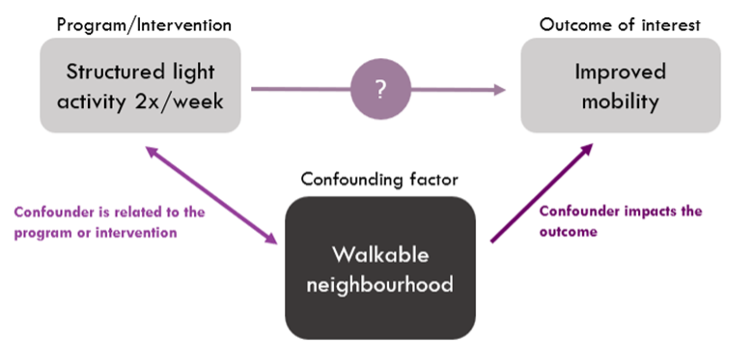
To understand confounding in the context of program evaluation, consider evaluating the impact of a new light activity program to increase mobility in older adults.

Although it is possible that the program is successful in improving mobility on its own, it is also possible that adults who live within walking distance of a favourite café may be more motivated to attend the program so they can maintain their mobility and continue walking to the café.

If their regular walks to the café (which occur outside of the structured activity sessions) also play a role in improving their mobility, the walkability of their neighbourhood may be confounding the association between the activity program and improvements in mobility. 

When confounding isn’t addressed, there are four primary ways that it can impact our results. The presence of a confounding variable may result in:

  • A spurious association: An apparent association despite no real association.

  • A hidden association: An apparent absence of association despite a real association existing.

  • Positive confounding: Enhancing (or overestimating) a true association.

  • Negative confounding: Masking (or underestimating) of a true association. 


What is the difference between bias and confounding?

In short, bias refers to systematic error in how we measure or report data, while confounding refers to real but misleading associations.

The ability to distinguish between biasing and confounding factors can be helpful in evaluating the true impact of a program or public health initiative on the desired outcome.

While neighbourhood walkability is a possible confounding variable in the example above, if only adults who live in walkable neighbourhoods were included in the light activity program, then this would be an example of sampling bias rather than confounding. What is important to note here is that you can often account for confounding, but not bias, in the way you analyze and report your findings. 

For instance, to account for how confounding may impact your results, you could compare the improvements in mobility between the ‘walkable neighbourhood’ and ‘non-walkable neighbourhood’ participants. This would allow you to estimate how much of an effect the activity program had compared to the impact of neighbourhood walkability on mobility. However, if your sample were biased to include only participants from walkable neighbourhoods, you would not be able to examine how living in a walkable area may affect mobility. In this case, you would need to report this bias and how it potentially skewed your results.


How can I predict and avoid bias and confounding in my next research or evaluation project?

I have found that the key step is to continually remind yourself and your team that the issue you are investigating is almost always part of a larger, more complex system than what your project can assess.

Throughout a project’s lifespan, there are practices that can help you and your team predict, identify, and overcome sources of bias and confounding to unveil accurate and actionable results. 

During project development and outcome operationalization

In these phases, ensure you are specific and clear in your definitions of variables and aims. For instance, if you aim to measure how a certain intervention impacts participants’ health, be clear about what health means for your evaluation.

It can also be useful to collect information about an outcome of interest in a few different ways (for example, through surveys and participant interviews) to reduce the chance that you are missing areas of bias or confounding.

For an evaluation within the healthcare field, some questions to consider when developing your measures could include:

  • What type of health outcome are you assessing? Are you looking at overall wellbeing, or something more specific such as blood glucose levels or scores on an anxiety screening test?

  • How will you measure the type of health you are interested in assessing? The way that we collect information about someone’s health can greatly impact the results of an analysis. Using objective measures that have been validated through repeated trials will increase the accuracy of your evaluation and allow you to compare the results to other similar programs.

  • Are there meaningful thresholds that indicate distinct levels of this type of health? Depending on the type of health outcome you are assessing and the measures you are using to assess it, small improvements in measures could be meaningful or arbitrary. It is best to select a threshold that is supported by existing literature before you begin your project to avoid biasing your results.

  • What are some possible unintended findings of this evaluation? It is always a good idea to discuss possible findings with your team and stakeholders. Sometimes, even after thorough discussion, we find that our results tell us something completely unexpected! Be open to these findings and plan for how you will present them in your report to stakeholders or clients.

During data analysis

Although more common in research, depending on the size and scope of your evaluation you may be able to ‘control’ for confounding variables through statistical modelling. ‘Controlling’ a variable means holding it constant while assessing the changes in the variable(s) of interest. The method you use to control your confounding variable(s) will depend on your analytic method, but in the right settings, it can allow you to look specifically at the independent impact of the program or intervention on your outcome of interest.

After analysis

It is also important to not just take the data at face value but to ask why an association may exist. Consider what other factors, including ones that you did not or could not measure, may have played a role in the observed outcome. For instance, was one group more likely to meaningfully engage in an intervention compared to another group? Is the sample who is accessing your program more likely to face hardships not addressed by your program that may impede their progress toward the target outcome? Talking through preliminary results with your team, stakeholders, and/or clients may help to explore hidden confounding or uncover biases that would otherwise go unnoticed.  

When reporting your findings

At this stage, it is always important to note the limitations of what you can conclude from the data collected. Often single sources of information are not enough to give us answers that span across diverse groups and populations, and that is okay! By reporting information about the demographic groups of participants, the program methods, and how outcomes were measured, you can more accurately draw conclusions from your findings without overgeneralizing the results.


Associations in programs and studies involving humans are often complex and involve more factors than we can assess in any single research or evaluation project.

Understanding how to identify sources of bias and confounding can help you and your team to draw more well-informed conclusions from your analyses and provide realistic and actionable recommendations for future projects. 

Written by cplysy · Categorized: evalacademy

  • « Go to Previous Page
  • Go to page 1
  • Interim pages omitted …
  • Go to page 94
  • Go to page 95
  • Go to page 96
  • Go to page 97
  • Go to page 98
  • Interim pages omitted …
  • Go to page 310
  • Go to Next Page »

Footer

Follow our Work

The easiest way to stay connected to our work is to join our newsletter. You’ll get updates on projects, learn about new events, and hear stories from those evaluators whom the field continues to actively exclude and erase.

Get Updates

Want to take further action or join a pod? Click here to learn more.

Copyright © 2026 · The May 13 Group · Log in

en English
af Afrikaanssq Shqipam አማርኛar العربيةhy Հայերենaz Azərbaycan dilieu Euskarabe Беларуская моваbn বাংলাbs Bosanskibg Българскиca Catalàceb Cebuanony Chichewazh-CN 简体中文zh-TW 繁體中文co Corsuhr Hrvatskics Čeština‎da Dansknl Nederlandsen Englisheo Esperantoet Eestitl Filipinofi Suomifr Françaisfy Fryskgl Galegoka ქართულიde Deutschel Ελληνικάgu ગુજરાતીht Kreyol ayisyenha Harshen Hausahaw Ōlelo Hawaiʻiiw עִבְרִיתhi हिन्दीhmn Hmonghu Magyaris Íslenskaig Igboid Bahasa Indonesiaga Gaeilgeit Italianoja 日本語jw Basa Jawakn ಕನ್ನಡkk Қазақ тіліkm ភាសាខ្មែរko 한국어ku كوردی‎ky Кыргызчаlo ພາສາລາວla Latinlv Latviešu valodalt Lietuvių kalbalb Lëtzebuergeschmk Македонски јазикmg Malagasyms Bahasa Melayuml മലയാളംmt Maltesemi Te Reo Māorimr मराठीmn Монголmy ဗမာစာne नेपालीno Norsk bokmålps پښتوfa فارسیpl Polskipt Portuguêspa ਪੰਜਾਬੀro Românăru Русскийsm Samoangd Gàidhligsr Српски језикst Sesothosn Shonasd سنڌيsi සිංහලsk Slovenčinasl Slovenščinaso Afsoomaalies Españolsu Basa Sundasw Kiswahilisv Svenskatg Тоҷикӣta தமிழ்te తెలుగుth ไทยtr Türkçeuk Українськаur اردوuz O‘zbekchavi Tiếng Việtcy Cymraegxh isiXhosayi יידישyo Yorùbázu Zulu