• Skip to main content
  • Skip to footer
  • Home

The May 13 Group

the next day for evaluation

  • Get Involved
  • Our Work
  • About Us
You are here: Home / Archives for cplysy

cplysy

Jul 29 2021

IRB 101: Risks to Research Participants

In my first post in this IRB 101 series, I described what IRBs are and why they exist.  IRBs exist to protect research participants.  In this second post, I focus on risks to research participants. 
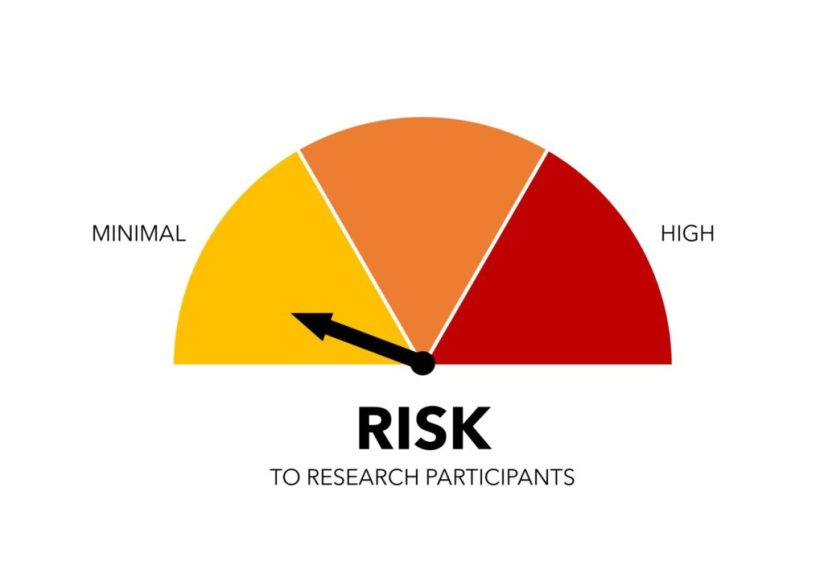
Risk Meter Pointing to Minimal Risk

What are risks to research participants?

Risk is the probability that harm will occur.  All research involves some level of risk to research participants (never say a study has no risk to research participants!).  Most visitor studies research and evaluation can be classified as minimal risk.  Minimal risk is defined in the Common Rule as: “probability and magnitude of harm or discomfort anticipated in the research are not greater in and of themselves than those ordinarily encountered in daily life or during the performance of routine physical or psychological examinations or tests.” Assessing whether your study is of minimal risk requires you to: (a) think about both the probability as well as the magnitude of harm; and (b) consider the probability and magnitude of harm against what a research participant may encounter in everyday life.

What types of risks might research participants face?

The Belmont Report defines types of potential risks to help researchers assess the risk level of their proposed study. Potential risk types include: physical, psychological, social, legal, and economic.  Below are the descriptions of these type of risks.  For visitor studies research and evaluation, risks typically fall within psychological and social risks. It is important to be aware of all types of risks though.

  • Psychological risks can include anxiety, sadness, regret and emotional distress, among others. Psychological risks exist in many different types of research in addition to behavioral studies.
  • Social risks exist whenever there is the possibility that participating in research or the revelation of data collected by investigators in the course of the research, if disclosed to individuals or entities outside of the research, could negatively impact others’ perceptions of the participant. Social risks can range from jeopardizing the individual’s reputation and social standing, to placing the individual at risk of political or social reprisals.
  • Physical risks may include pain, injury, and impairment of a sense such as touch or sight. These risks may be brief or extended, temporary or permanent, occur during participation in the research or arise after.
  • Legal risks include the exposure of activities of a research subject that could reasonably place the subjects at risk of criminal or civil liability.
  • Economic risks may exist if knowledge of one’s participation in research, for example, could make it difficult for a research participant to retain a job or to find a job, or if insurance premiums increase or loss of insurance is a result of the disclosure of research data

How do you weigh risks to research participants against study benefits?

The IRB’s official function is to weigh the risks to research participants against the benefits of the study. There is no clear formula to do so.  Risk assessment requires multiple perspectives and interpretations. That is why IRBs include multiple people with different expertise on a review panel. 

As researchers and evaluators, we are always aiming to minimize risks to research participants.  It is our duty under the principles of the Belmont Report.  From my perspective, visitor studies research and evaluation should always be of minimal risk to participants.  I don’t mean to diminish the importance of museum work. But, I cannot envision a study benefit that would rationalize researchers proposing a study of more than minimal risk.

The post IRB 101: Risks to Research Participants appeared first on RK&A.

Written by cplysy · Categorized: rka

Jul 28 2021

Mind Maps For Complex Projects

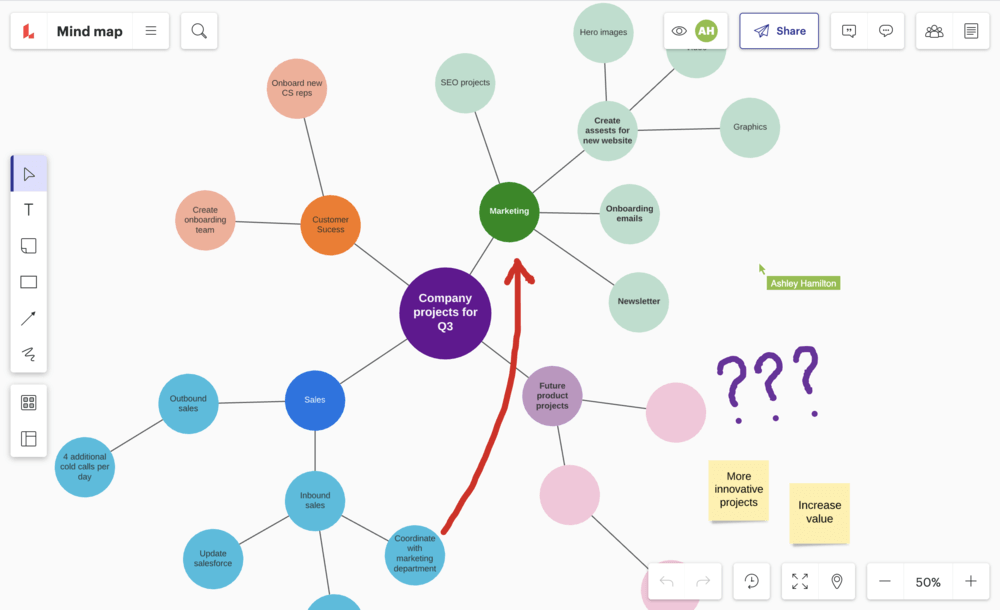
A mind map is a powerful, simple organizing tool that features a lot of information on a single page. We use mind maps and other visual tools to communicate relationships between ideas, people, project components and topics with our clients and partners. We present a short introduction to how and why you might want to use mind maps in your work.

A mind map is a visual representation of a project that links actors and actions together. This article focuses on using mind maps, not creating them.

Below is an example from software provider Lucidspark (which is a tool for creating mindmaps) that illustrates what a mind map is and how it can connect ideas and actions together.

Visualizing our Relationships

A search of Google (or any other search engine) will find thousands of visual examples of what a mind map is. There are few ‘essentials’ for mind mapping, which is among its most attractive features.

A complex project is one where there are many things happening at the same time, at different time scales, and involving many interdependencies and actors. That’s just a way of saying: there’s a lot going on.

It doesn’t matter how you organize your mind map only that it is useful. That means it provides information that you can make decisions with and act on. If it does that, it’s a good mind map.

Once we have that in place, the mind map allows us to examine the relationships between the nodes and topics to assess their fit. The expression ‘getting on the same page‘ reflects an ability for all of those looking at the document to have a similar representation of what’s on that page. The mind map allows us to verify relationships between entities, determine gaps or inaccuracies, and explore different ways of connecting things together.

There may not be a single ‘master’ map that is better than all, but there may be a map that is more useful than others.

How to Use Mind Maps

When we use this with clients and partners on projects we aim for the following:

  • To examine the assumptions involved in the project
  • To explore alternative relationships of fit and see if the map is the best representation of what we are looking at
  • To guide the project and keep the topics on track
  • To provide a building block for connecting ideas together (in ways that weren’t done previously)
  • To map out a system of relationships
  • To use colour and visuals to surface feelings, thoughts, and other emotional aspects of the project that might influence the strategy or outcomes

By creating a visual representation we see the whole project and the relationship context. Relationships are the key in any complex system. When we visualize these relationships it allows us to see how the actions in one relationship can affect others. Visual maps can aid us in anticipating possible effects.

(Note: We don’t use the term ‘unintended effects’ – just effects because in complex systems it’s too hard to predict cause and effect with any degree of accuracy).

We continually refer back to our maps to help ensure we are accounting for all relationships of importance throughout the project and not just those that have the most amount of activity within them. It’s incredibly difficult to track this in our heads or in something like a spreadsheet or text document.

Mind maps can be great tools to visualize a lot of information and get you and your collaborators on the same page when it comes to understanding what is going on in a complex system and program. Try it out — they are easy to create and simple to use.

If you want to use this approach to visualizing your programs and using this to help you innovate, contact us – we’d love to hear from you.

The post Mind Maps For Complex Projects appeared first on Cense.

Written by cplysy · Categorized: cameronnorman

Jul 27 2021

Evaluation Roundup – July 2021

Welcome to our monthly roundup of new and noteworthy evaluation news and resources – here is the latest.

Have something you’d like to see here? Tweet us @EvalAcademy!

New and Noteworthy — Reads

Research vs. Evaluation

Ah, the age-old topic! This blog post by Viable Insights reflects on an activity with a group they were working with where they reflected on what evaluation is compared to research. In this post they outline five distinguishing features: 1) Underlying motivation, 2) Outcome use, 3) Generalizability, 4) Conclusive goals, and 5) Collaboration. Do you agree?

Evaluation Guru – A New Video Series

The Asian Development Bank’s (ADB) Independent Evaluation Department (IED) recently started a new video series called Evaluation Guru. The series illustrates, how to design, implement and manage evaluations. In the first episode, Nathan Subramaniam (Director of Independent Evaluation Sector projects) walks people through Evaluating Private Sector Operations in an 11-minute whiteboard video.

Systems Diagrams: A Practical Guide

Bob Williams recently released a book that outlines six approaches to system diagrams, including: 1) Rich Picturing, 2) Influence Diagrams, 3) Causal Diagrams, 4) Cynefin, 5) Viable System Model (VSM) and 6) Cultural-Historical Activity Theory (CHAT). The book provides an overview of each system diagram, their purpose, examples of what they look like, and steps on how to draw them.

Telling Your Story of Change

Tamarack Institute recently posted an article that discusses Solutions Storytelling. In this article, the author argues that the work non-profits do “carries enormous potential to be shared with a broader audience in the form of insights, and stories that offer concrete solution and reflection to many of the conversations our society is having right now” – enter Solutions Storytelling. In short, Solutions Storytelling is about bringing the same attention and rigor to stories about responses to problems as is often done with the problem themselves. As evaluators, Solutions Storytelling might offer a new approach for how to present our findings.

New and Noteworthy — Events

Tensions: A Dialogue

Organized by: Robert Wood Johnson Foundation (RWJF) & Equitable Evaluation Initiative (EEI)

Date: August 4, 2021

Moderator: Marcia Cone, Director of Practice Engagement & Evolution at Equitable Evaluation Initiative

CDC Applied Research and Evaluation Fellowship

Organized by: Centers for Disease Control and Prevention (CDC)

Application Deadline: August 18, 2021

Next-level logic models for your ATE proposal and beyond

Organized by: EvaluATE

Date: August 18, 2021

Presenter: Lyssa Wilson Becho

Working with values: values literacy for evaluation

Organized by: Australian Evaluation Society

Dates: August 20 & August 27, 2021

Facilitator: Keryn Hassall

Developmental Evaluation

Organized by: Clear Horizon Academy

Start Date: August 27, 2021

Written by cplysy · Categorized: evalacademy

Jul 21 2021

Knowing Thyself: Colleagues, Coaches and Consultants

Self-knowledge is a great asset, however the reason we often hire an external consultant is because we know a part of ourself so well that it becomes difficult to see other parts of who we are.

We obviously have a bias toward the role of external consultants because that’s what we do, but we also recognize that part of role that we are often asked to play can be filled by different people or sometimes the same person playing many of them.

We refer to three C’s: Colleagues, coaches, and consultants. These are not mutually exclusive from one another and can be separate or combined. In each case, however, the role is focused on specific tasks that we want to highlight in helping you identify what best serves the particular situation or problem set you face.

Colleagues

Perhaps the most neglected role of the three are colleagues (or peers). A colleague is someone who works within the same field, department, team or organization as you and can provide feedback and perspective on the work you do and your performance. Because they know the work, they can speak to technical issues very well. However, because they are close to the work (and maybe you) they may include the same biases and limits to perspective as you do, too.

Colleagues offer the following:

  • Deep knowledge of the situation, context, and circumstances of the work. They know what you know and experience what you experience. There is little need to spend extra time empathizing with your situation.
  • This familiarity allows for more quick-to-start and nuanced conversations about issues.
  • Familiarity also allows for great compassion: it’s easy to talk with your peers about issues that might seem too far removed from others.
  • This familiarity also brings the same ‘blind spots’ and potential prejudices around actions, behaviours, policies, and possible outcomes. This can limit what is ‘seen’ and what is proposed.

Coaches

When you think of the highest performing athletes do you think about their coach? They all have one.

Athletes know the value of coaches because it’s only through that blend of expertise, motivational energy, and shared commitment through feedback that they can improve. The same is often true for organizations and individuals.

A good coach provides:

  • Someone on your team who is committed to the same project as you. Their success is yours.
  • Expertise in performance and how it relates to your specific industry or context.
  • A more intimate relationship in that they are focused on you (or your organization) and thus is more sensitive to its ‘moods’ and rhythms than someone who is more distant.
  • A coach has a separate role from who they support so, unlike with colleagues, there is less confusion and more clarity about what specific benefits a coach can and will provide without the potential for it to be conflated.

Consultants

A consultant is like a coach in that they bring an outside perspective – even more so.

A consultant is someone who is freed from the specific demands associated with the role, outcomes, and processes associated with your work and offers expertise and a different perspective on what you do. Many times we are so engrossed or familiar with what we are doing that we are unable to see new possibilities or consider alternative pathways for working.

Consultants provide many distinct benefits:

  • A consultant may not have specific domain expertise as your organization.
  • Alternatively, a consultant may have deep expertise in the domain you work in, but less in specific processes. They might also possess both. In every case, their value is in separation from the day-to-day activities of your work. This provides a more dispassionate view of your work. (Note: we don’t believe it’s necessarily more objective, just different — we all have biases).
  • Consultants can provide tactical and strategic advice much like a coach but without the closeness to their client and the same investment in the work. This isn’t to say that consultants care any less for the success of their clients, rather they are not part of the team and thus are not affected by the same fears of failure or concerns as a coach is.
  • Because consultants work at a distance they also are more likely to be versed in methods, tools, knowledge and practice skills that allow them to work well with groups who are unfamiliar to them (yet are similar in need or content expertise). This allows them to be bridge-builders within and across organizations and networks more easily.

The post Knowing Thyself: Colleagues, Coaches and Consultants appeared first on Cense.

Written by cplysy · Categorized: cameronnorman

Jul 21 2021

Try This: The RFP “YES” Checklist

Try this out and let me know how it goes. Last week, I posed 7 questions to consider before sending out a RFP to evaluate whether your organization’s process for securing consultants is equitable. Also occurring last week, I responded to a RFP. There were several reasons why I responded (knowing the person who sent […]

The post Try This: The RFP “YES” Checklist appeared first on Nicole Clark Consulting.

Written by cplysy · Categorized: nicoleclark

  • « Go to Previous Page
  • Go to page 1
  • Interim pages omitted …
  • Go to page 170
  • Go to page 171
  • Go to page 172
  • Go to page 173
  • Go to page 174
  • Interim pages omitted …
  • Go to page 304
  • Go to Next Page »

Footer

Follow our Work

The easiest way to stay connected to our work is to join our newsletter. You’ll get updates on projects, learn about new events, and hear stories from those evaluators whom the field continues to actively exclude and erase.

Get Updates

Want to take further action or join a pod? Click here to learn more.

Copyright © 2026 · The May 13 Group · Log in

en English
af Afrikaanssq Shqipam አማርኛar العربيةhy Հայերենaz Azərbaycan dilieu Euskarabe Беларуская моваbn বাংলাbs Bosanskibg Българскиca Catalàceb Cebuanony Chichewazh-CN 简体中文zh-TW 繁體中文co Corsuhr Hrvatskics Čeština‎da Dansknl Nederlandsen Englisheo Esperantoet Eestitl Filipinofi Suomifr Françaisfy Fryskgl Galegoka ქართულიde Deutschel Ελληνικάgu ગુજરાતીht Kreyol ayisyenha Harshen Hausahaw Ōlelo Hawaiʻiiw עִבְרִיתhi हिन्दीhmn Hmonghu Magyaris Íslenskaig Igboid Bahasa Indonesiaga Gaeilgeit Italianoja 日本語jw Basa Jawakn ಕನ್ನಡkk Қазақ тіліkm ភាសាខ្មែរko 한국어ku كوردی‎ky Кыргызчаlo ພາສາລາວla Latinlv Latviešu valodalt Lietuvių kalbalb Lëtzebuergeschmk Македонски јазикmg Malagasyms Bahasa Melayuml മലയാളംmt Maltesemi Te Reo Māorimr मराठीmn Монголmy ဗမာစာne नेपालीno Norsk bokmålps پښتوfa فارسیpl Polskipt Portuguêspa ਪੰਜਾਬੀro Românăru Русскийsm Samoangd Gàidhligsr Српски језикst Sesothosn Shonasd سنڌيsi සිංහලsk Slovenčinasl Slovenščinaso Afsoomaalies Españolsu Basa Sundasw Kiswahilisv Svenskatg Тоҷикӣta தமிழ்te తెలుగుth ไทยtr Türkçeuk Українськаur اردوuz O‘zbekchavi Tiếng Việtcy Cymraegxh isiXhosayi יידישyo Yorùbázu Zulu