• Skip to main content
  • Skip to footer
  • Home

The May 13 Group

the next day for evaluation

  • Get Involved
  • Our Work
  • About Us
You are here: Home / Archives for cplysy

cplysy

Apr 30 2020

Qué y Cómo desarrollar del pensamiento evaluativo (I)

M.Q Patton UFE

Si consideramos los actuales roles de la función de evaluación, aunque en la actual pandemia (a) se limite la evaluabilidad de las intervenciones clásicas a evaluar, (b) además de la propia evaluación de la respuesta frente a la pandemia y (c) de la generación y gestión de conocimiento relevante, (d) otro de los roles de la función de evaluación es el desarrollo de pensamiento evaluativo a todos los niveles posibles.

El pensamiento evaluativo (PE) es un enfoque disciplinado para la indagación y la práctica reflexiva que nos ayuda a emitir juicios sólidos, basados en evidencias, como un hábito.

El PE (1) no es aplicable sólo en/a la evaluación (o unidades de evaluación) sino en toda la organización y fases de la gestión, (2) tiene una dimensión de desarrollo de capacidades a nivel individual, organizacional y estructural

Un enfoque de PE tiene como objetivo cambiar la actitud (motivación, apropiación y comprensión), la aptitud (capacidades, medios y habilidades) e incentivos (oportunidades) en relación a (1) el pensamiento evaluativo en general y (2) la utilidad de la evaluación para la organización, siendo una herramienta que podría ser integrada en las tareas de todos los miembros de la organización.

¿Cómo asegurar un pensamiento evaluativo continuo en las organizaciones? Al ser el PE una disciplina, necesita de un enfoque específico de refuerzo de capacidades en toda la organización (no solo en las unidades de evaluación) sobre las disciplinas requeridas:

1.Refuerzo del liderazgo y motivaciones para el PE: Asegurar un liderazgo efectivo (centralizado y descentralizado) y desarrollar un cultura del aprendizaje (aprendizaje legitimado e incentivado)

2.Refuerzo de las capacidades y medios para el PE:

Desarrollo de capacidades que den oportunidad para desarrollar:

  1. La forma de “saber, conocer, plantear y priorizar” necesidades de información, conocimiento, aprendizaje y preguntas a responder (preguntas evaluativas) de la organización,
  2. La forma de buscar respuestas y la forma de utilizar las evidencias existentes,
  3. Fortaleciendo de la calidad del proceso, de las pregunta y evidencias existentes,
  4. Crear espacios y tiempos para el PE: (1) (in)formal,  (2) individual /colectivo

Algunos conductores podrían ser: (1) el PE como objetivo organizacional, (2) integrar explícitamente el PE dentro del ciclo de planificación, seguimiento y evaluación, (3) incluir la demanda de PE como requisito en los procesos de contratación, Términos de Referencia, medición de desempeño, (4) incluir el refuerzo del PE como objetivo de las evaluaciones.

De cara a la expansión del PE, el uso “durante el proceso evaluativo” es igual (o incluso más) importante que el uso de los resultados evaluativos: (1) aprender a aprender, (2) aprender a sobre las disciplinas del pensamiento evaluativo (3) desarrollo de redes (colaboración) y creación de una comprensión y motivación compartida sobre el PE

3.Refuerzo de los incentivos: (1) crear marcos de rendición de cuentas individuales y organizacionales para el PE (2) fomentar relaciones de confianza, transparencia, compartir, (4) invertir en infraestructura para el uso y la gestión del conocimiento


Written by cplysy · Categorized: TripleAD

Apr 29 2020

¿Podría el Covid-19 contribuir a unas Naciones (más) Unidas?

En el artículo ¿Es posible reformar Naciones Unidas?, aparecido en El País el 28 de abril, CRISTINA MANZANO nos habla de la necesidad de reformar un sistema de gobernanza global (Naciones Unidas), nacido en 1945, dado que no basta para hacer frente a los desafíos del siglo XXI.

El gran avance que supuso el nacimiento de la ONU solo fue posible después del mayor ejercicio de destrucción de la historia humana. ¿Podría ser el coronavirus —el mayor disruptor desde la II Guerra Mundial— el motor para adaptar la gobernanza global a las necesidades del siglo XXI?

La pregunta del millón es cómo lograr los incentivos para movilizar una transformación tan compleja en un momento tan difícil.

Un reciente ejercicio aspira a reactivar a estos últimos. La gobernanza global y el surgimiento de instituciones globales para el siglo XXI (Cambridge University Press) es un exhaustivo y ambicioso trabajo que parte de un profundo conocimiento del entramado institucional en sus diferentes niveles: económico, social, medioambiental y de seguridad. Sus autores, Augusto López-Claros, Arthur L. Dahl y Maja Groff  bucean en la historia del sistema y de las críticas recibidas desde su nacimiento.

La publicación revisa minuciosamente el papel de organismos, agencias e instituciones y plantean propuestas concretas de discusión, reforma y mejora, algunas rescatadas del propio diseño inicial de Naciones Unidas.

El libro da pistas para ganar legitimidad democrática. Legitimidad democrática significa también existencia de mayores espacios para la rendición de cuentas, transparencia…y mayor aprendizaje para la adaptación y la mejora continua.

He aquí algunas de esas pistas o apuestas -entre otr@s – por:

(1) acercar la organización a la ciudadanía mediante una Asamblea Parlamentaria Mundial que funcionaría de modo similar al Parlamento Europeo.

(2) la creación de una Cámara de la Sociedad Civil, de carácter consultivo, que reconozca la participación de los actores no gubernamentales. Los referentes son el Foro de ONG previo a la Cumbre del Milenio de 2000 y su papel en otros avances multilaterales como el Acuerdo de París, el Tratado sobre la Prohibición de Armas Nucleares o la puesta en marcha de la Corte Penal Internacional.

(3) la sustitución del Consejo de Seguridad por un Consejo de carácter ejecutivo,

(4) la creación de una Fuerza Internacional de Paz y de un Tribunal Internacional de Derechos Humanos, otro anticorrupción,

(5) la revisión de la arquitectura financiera global para luchar mejor contra la pobreza y la desigualdad,

(6) un enfoque integrado para mejorar y ampliar la capacidad de la gobernanza medioambiental


…pero me pregunto si ¿pensar que del Covid-19 sacaremos algo positivo (un aprendizaje, un acuerdo común, un cambio, una mejora…) no es más que otra rareza espacial?

Written by cplysy · Categorized: TripleAD

Apr 29 2020

Social and Emotional Learning is Imperative and in Museum Educators’ Wheelhouse

Just months ago (but what feels like an eternity ago), I was in an art museum observing museum educators lead a group of fifth-grade students on a museum visit.  One work of art they viewed highlighted inequities in the world by zooming in on areas where there is an abundance or absence of light across the globe at night.  Students’ emotions were clearly triggered.  Some called out “wow”; “what?”; and “that is so unfair.”  After experiencing several minutes of the media piece, the museum educators then guided a discussion about the work of art using simple questions from Harvard Project Zero’s Artful Thinking Routines: “what do you see?”; “what do you think?”; “what do you wonder”; etc.  These questions are tools museum educators, and not exclusively art museum educators, use regularly in their teaching.

Evaluators know the power of questions.  A good question can unlock so much knowledge.  And that is what happened for me when I was helping my daughter completing a Social and Emotional Learning (SEL) assignment given to her grade by the school counselor.  The counselor posed a few simple questions about how students are thinking and feeling in a Google Form.  This simple question is the one that really resonated: “What is a challenge you are going through right now?”

Google Form question

My daughter and I looked at the question together, and I read it aloud.  To paraphrase, my daughter told me (and her school counselor) how she misses her friends.  She explained that she is an only child, and because my husband and I are working at home, we cannot play with her all the time.  She also explained that, while she has a dog, he isn’t such a good playmate sometimes.  (TRUTH: he recently chewed the foot off a new doll, and she was very upset!)  Of course, her feelings gave me the feels, and are still doing so right now as I write this.  It also gave me data I could work with.  I needed to prioritize setting up more FaceTime calls with her friends (one this weekend that lasted 2 hours!) and other social and emotional activities.

In addition to thinking about my daughter’s needs, this experience made me think about all the inquiry-based museum teaching I have seen.  It seems to me museum educators are well-suited to share their inquiry-based teaching expertise in support of social and emotional learning.  Even pre-pandemic, I was seeing this need.  For example, at the National Art Education Association convention in March of 2019, a school district administrator told me how mental health is becoming a hot topic for schools, and that museums would be wise to discuss their ability to support children in this way.  And now mid-pandemic and beyond, social and emotional learning will be critical.  As Tim Walker wrote on the National Education Association blog: Social-Emotional Learning Should Be Priority During COVID-19 Crisis  I am looking forward to seeing what museums can do for our students, and for all of us, in our social and emotional well-being during this time since this expertise is certainly in their wheelhouse.

The post Social and Emotional Learning is Imperative and in Museum Educators’ Wheelhouse appeared first on RK&A.

Written by cplysy · Categorized: rka

Apr 28 2020

Evaluabilidad en tiempos de pandemia

Dados los retos que supone la situación actual para la práctica tradicional de la evaluación, empezamos una serie de posts sobre “evaluabilidad”. Entre las agencias internacionales de desarrollo parece haber un acuerdo generalizado sobre el significado del término “evaluabilidad”. La siguiente definición de la Organización para la Cooperación Económica y el Comité de Ayuda al Desarrollo-Desarrollo (OCDE-CAD) es ampliamente citada y utilizada:

“La medida en que una actividad o proyecto puede evaluarse de manera confiable y creíble” (OCDE-CAD 2010; p.21)

El documento de trabajo del DFID (Davies 2013) sobre la valoración de la evaluabilidad identificó las siguientes dimensiones de evaluabilidad:

• La evaluabilidad “en principio” analizará (1) la claridad de los fundamentos conceptuales y (2) el diseño de la intervención, incluida (a) la teoría subyacente del cambio y (b) cómo se ha traducido en el marco de resultados de la intervención.

• Evaluabilidad “en la práctica”, valorará cómo la teoría de intervención ha sido operativizada, ejecutada o traducida en la práctica dada (1) la disponibilidad de datos relevantes y (2) la capacidad de los sistemas de gestión capaces de proporcionarlos.

• La utilidad y practicidad de una valoración de evaluabilidad examinará la posible utilidad de una evaluación futura en relación con las áreas de evaluación y posibles preguntas de evaluación. Es en la practicidad, o cómo se puede llevar la evaluación a la práctica, donde habrá que rependar las estrategias en la situación actual.

La valoración de la evaluabilidad definirá el diseño, alcance, enfoque y metodología de la evaluación del programa

Referencias

Davies R (2013). Planning Evaluability Assessments: A Synthesis of the Literature with Recommendations. DFID Working Paper 40. Disponible en: https://www.gov.uk/government/uploads/system/uploads/attachment_data/file/248656/wp40-planning-eval-assessments.pdf

OECD-DAC (2010). Glossary of key terms in evaluation and results based management. Paris: OECD-DAC. Available at: http://www.oecd.org/development/peer-reviews/2754804.pdf

Written by cplysy · Categorized: TripleAD

Apr 28 2020

Post or Perish

So I received a little constructive feedback after last week’s post.

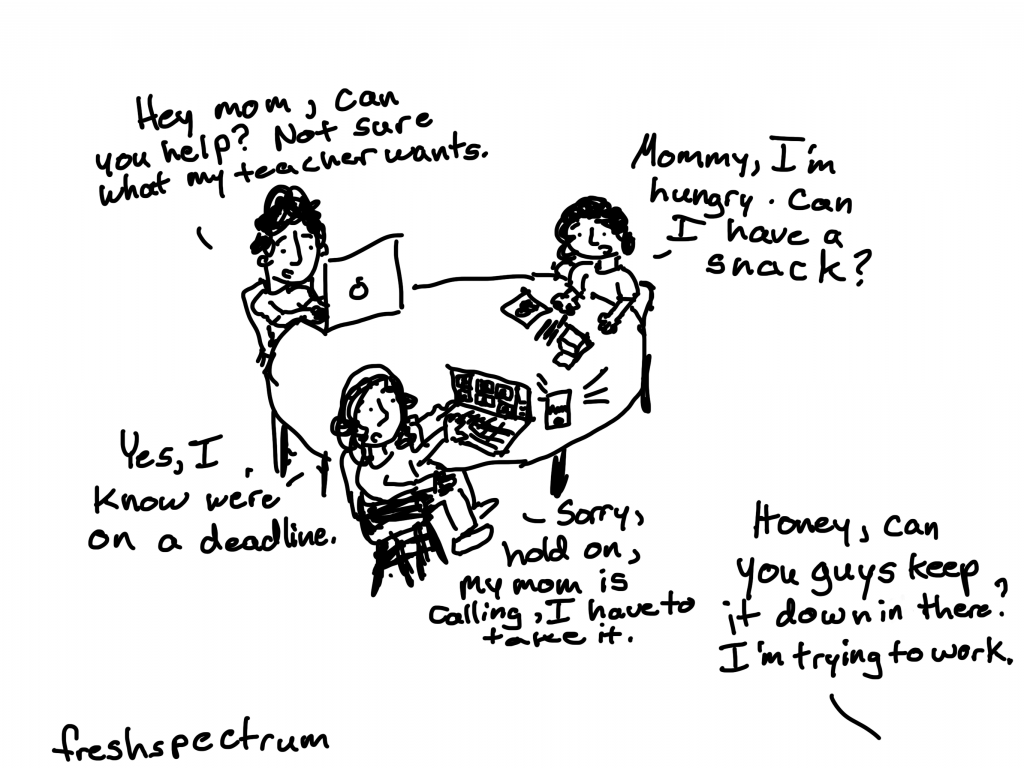
Just be mindful of the voices you aren’t hearing. For some with ill family members, homeschooling small children, navigating aging parents in place, on top of maintaining stable income — finding time to write is a bridge too far… and I speak from a privileged place.

Betsy Baum Block on Twitter

I’m in that group re: little ones at home (1 yr old). Trying to balance ongoing work demands with childcare is difficult. Working moms will likely be less heard.

Christina P. Gorga on Twitter

Being a working parent is tough enough under normal circumstances, and these are not normal circumstances.

So first things first.

It’s okay if you can’t post, publish, or present right now.

If it’s hard enough to get through the day, work through your must-do list, and get your family fed. Don’t worry about blogging.

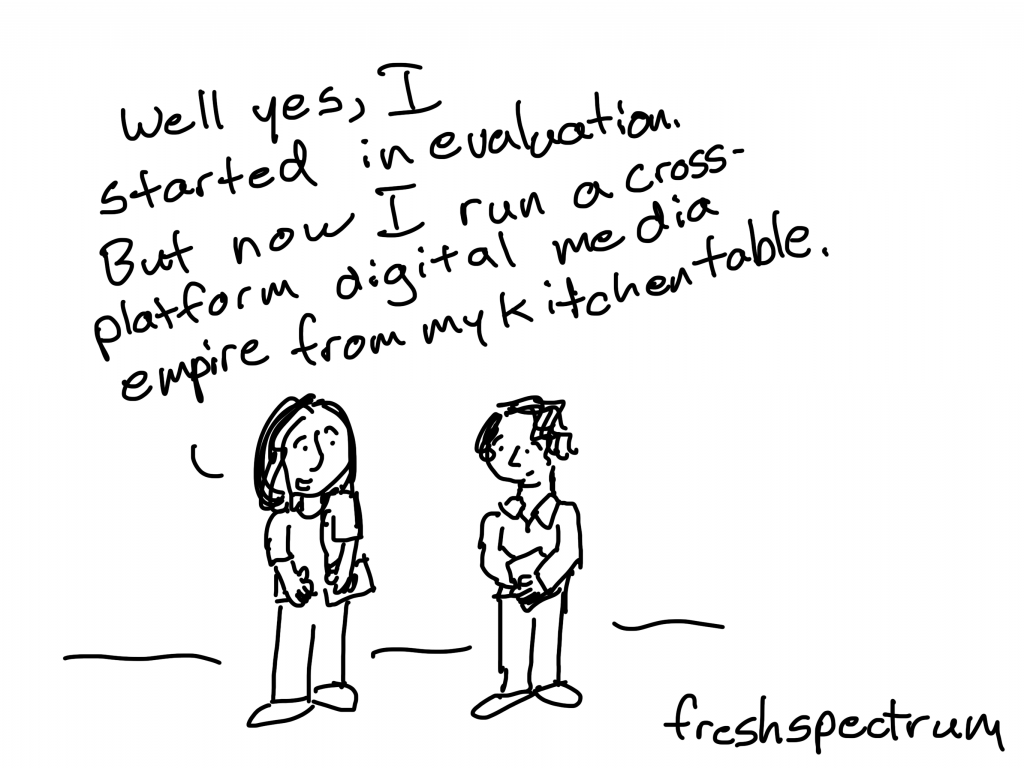
Through an email conversation with Betsy, I think we came up with a lower burden alternative. Something that might not be as good as building your own digital empire, but could at least keep you visible.

Professional Visibility.

Chris told me to blog in 2011. I didn’t listen until 2012.
Since taking Chris’ advice:

50 to 50,000 views a month
Started my own company
Added team
Spoke in ~30 states & ~10 countries
Partnered w/ dream orgs
Got reports off Dusty Shelves

… & it started w/ a blog.

Ann K Emery on Twitter

Before Ann was leading workshops around the world, she was blogging.

Before Stephanie wrote her first book, she was blogging.

Before Shiela and Kim coauthored their book, they were collaborating through their blog posts.

I stand by the advice I have given to individual evaluators for years. If you can blog, you should blog. It’s one of the clearest paths towards professional visibility that I know.

And the world needs to see more evaluators.

A different kind of publish or perish?

But not everyone can blog. At least not right now, maybe later, and maybe not later.

So therein lies a problem.

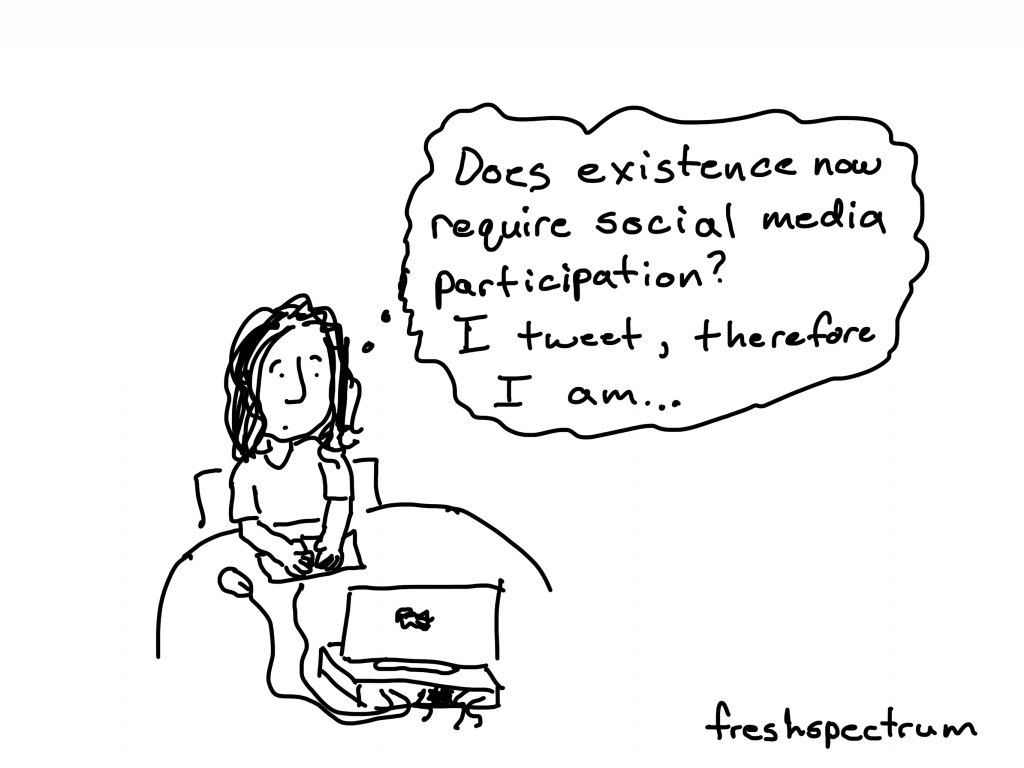
In our digital world, if you stop posting and participating, you risk disappearing from view. The digital world craves content. So much so that it gives a boost to people like me who have the advantage of a couple steady contracts, lots of practice, and a spouse committed to homeschooling our daughter.

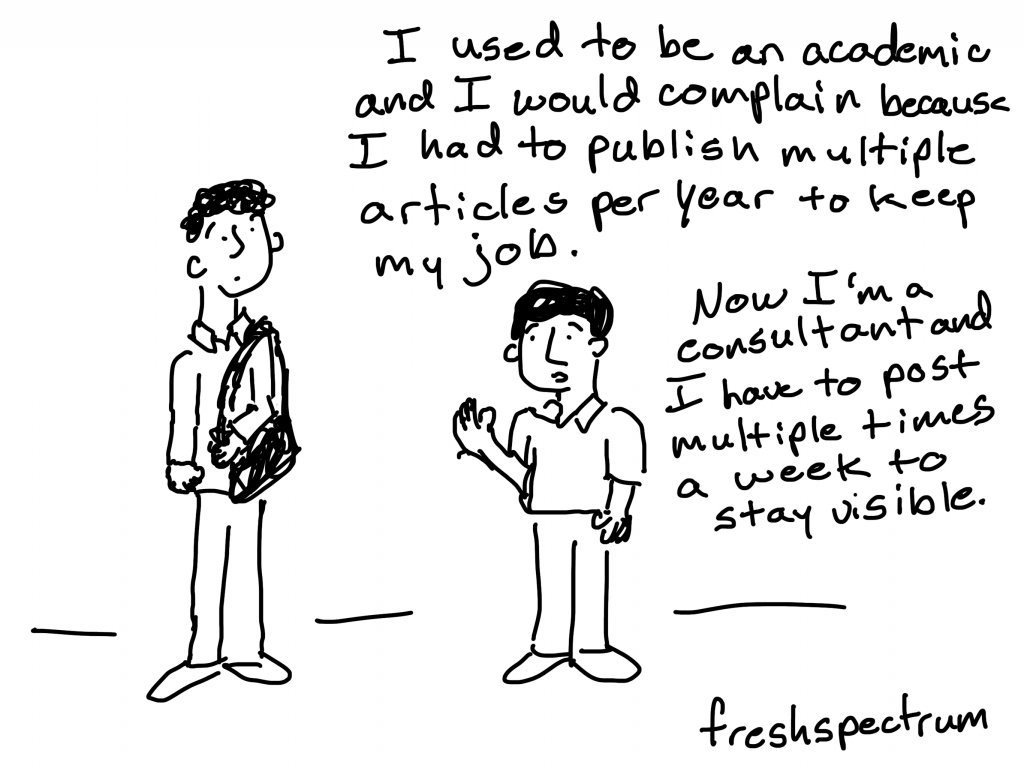
It’s publish or perish, but instead of academic administrators calling the shots, they’re being called by social media platform algorithms.

Today I wouldn’t get an academic job. It’s as simple as that. I don’t think I would be regarded as productive enough.

Peter W. Higgs

Announcing the FreshSpectrum Panel of Experts

Want to contribute to the web, but life experiences make you short on time?

Back in 2013 I wrote what I now call a panel post. And for a long time after, it was one of my top blog posts. I asked 22 bloggers a couple of questions, then compiled their answers into a single post.

It’s super simple, but it’s also incredibly effective.

Consider joining my panel of experts.

I’ll ask you a question a couple of times a month. You answer the question providing expertise from your unique point of view. If you can’t answer a particular question, for time reasons or just not feeling the question, that’s okay.

If you do answer, I’ll post your response in a cartoon illustrated panel post. I’ll reference your name and include a link back to your website (or wherever you want me to send traffic).

I’ll then share the post on social & email. It will also go out via Eval Central.

My hope, to spark increased digital participation from a wide group of evaluation experts. The experts who for all sorts of reasons, cannot spend enough time on social to reap the rewards.

So if you are interested, please join.

Join Ann K Emery on our next Eval Central UnWebinar

On Wednesday, April 29 at 1PM EDT/10AM PDT, we’ll be having our next Eval Central UnWebinar.

This week’s guest conversation facilitator: Ann K Emery

This week’s seed topic: Blogging as an Evaluator

Hope you can join!

Written by cplysy · Categorized: freshspectrum

  • « Go to Previous Page
  • Go to page 1
  • Interim pages omitted …
  • Go to page 266
  • Go to page 267
  • Go to page 268
  • Go to page 269
  • Go to page 270
  • Interim pages omitted …
  • Go to page 304
  • Go to Next Page »

Footer

Follow our Work

The easiest way to stay connected to our work is to join our newsletter. You’ll get updates on projects, learn about new events, and hear stories from those evaluators whom the field continues to actively exclude and erase.

Get Updates

Want to take further action or join a pod? Click here to learn more.

Copyright © 2026 · The May 13 Group · Log in

en English
af Afrikaanssq Shqipam አማርኛar العربيةhy Հայերենaz Azərbaycan dilieu Euskarabe Беларуская моваbn বাংলাbs Bosanskibg Българскиca Catalàceb Cebuanony Chichewazh-CN 简体中文zh-TW 繁體中文co Corsuhr Hrvatskics Čeština‎da Dansknl Nederlandsen Englisheo Esperantoet Eestitl Filipinofi Suomifr Françaisfy Fryskgl Galegoka ქართულიde Deutschel Ελληνικάgu ગુજરાતીht Kreyol ayisyenha Harshen Hausahaw Ōlelo Hawaiʻiiw עִבְרִיתhi हिन्दीhmn Hmonghu Magyaris Íslenskaig Igboid Bahasa Indonesiaga Gaeilgeit Italianoja 日本語jw Basa Jawakn ಕನ್ನಡkk Қазақ тіліkm ភាសាខ្មែរko 한국어ku كوردی‎ky Кыргызчаlo ພາສາລາວla Latinlv Latviešu valodalt Lietuvių kalbalb Lëtzebuergeschmk Македонски јазикmg Malagasyms Bahasa Melayuml മലയാളംmt Maltesemi Te Reo Māorimr मराठीmn Монголmy ဗမာစာne नेपालीno Norsk bokmålps پښتوfa فارسیpl Polskipt Portuguêspa ਪੰਜਾਬੀro Românăru Русскийsm Samoangd Gàidhligsr Српски језикst Sesothosn Shonasd سنڌيsi සිංහලsk Slovenčinasl Slovenščinaso Afsoomaalies Españolsu Basa Sundasw Kiswahilisv Svenskatg Тоҷикӣta தமிழ்te తెలుగుth ไทยtr Türkçeuk Українськаur اردوuz O‘zbekchavi Tiếng Việtcy Cymraegxh isiXhosayi יידישyo Yorùbázu Zulu