
• Skip to main content
  • Skip to footer
  • Home

The May 13 Group

the next day for evaluation

  • Get Involved
  • Our Work
  • About Us
You are here: Home / Archives for cplysy

cplysy

Feb 12 2019

I have a complex relationship with my back


Photo by  Charles 🇵🇭  on  Unsplash .

Photo by Charles 🇵🇭 on Unsplash.


I hurt my back last week.

This is not news. I’ve been hurting my back since 2013.

About six months after I finished grad school, toward the end of my work-day, I noticed that my lower back was feeling sore. I hadn’t done anything in particular to it and I assumed that when I got home I’d put some heat on it, rest, and feel better the next day, the way I always had before. Except that it didn’t feel better the next day. If anything it felt worse.

It was a couple of months of constant pain and stiffness before I accepted that resting and heat and gentle stretching on my own was not going to fix the problem. I sought out a massage therapist (made it worse at the time) and then a chiropractor (made it better) and finally a physiotherapist who assessed my whole body and how it moved and gently broke it to me that nothing was working the way it was meant to. All the parts that should be strong and hold me up were weak and shaky. All the parts that should be supple and flexible had become rigid and stiff to compensate. I’d spent my entire life up to that point working my body into a pattern of habits that was unsustainable, culminating in two-and-a-half years of grad school where I poured every waking hour into my studies and research, often sitting in the same chair without moving for hours at a time, working ten- to twelve-hour days and six or seven-day weeks, with the occasional exhausted flop of curling up in bed for a couple weeks in between major deadlines.

Oops.

So last week, when I started to feel a nagging stiffness and ache in my lower back as I tried to move around the house and get my day going, I thought I knew exactly what to do. I popped my ibuprofen, grabbed both a heat pad and an ice pack to see which worked best, tried to improve my posture throughout the day, and got in to see my RMT and chiro as soon as possible. I’ve been coping with this for over six years now (making incremental strides toward fewer and less severe flare-ups as I go) so I’ve been getting to be quite the expert in the way my body is now. What I’m not an expert in is the way I’d like my body to be.

Every time I hurt my back like this, I worry that this time it’ll be permanent. That the pain won’t gradually fade away and function return. And every time I get injured, it’s a little bit different. The things that worked the time before don’t work the same. At one point, a couple of quick adjustments from the chiropractor would bring immense relief. All I needed was to get a seized-up joint to release. This time it seemed to be an inflamed disc, something that massage and chiro can’t really touch, except to try to get the rest of my body to calm down while the disc sorts itself out.

After a couple of days of waking up in pain and struggling to stand first thing in the morning (the chiro tells me that the disc fills with fluid overnight, making it most painful in the morning and better throughout the day as I get blood flow through the area), I make a decision. I decide to accept this moment as a gift. The universe is once again offering me both opportunity and motivation to make a significant change in my life, and I’m going to take it.

I’ve been playing with the idea of evaluating my progress to recovery since the first twinge of pain. It’s impossible to avoid. I’m in a novel situation (new iteration of back pain) and I need to adapt. Therefore, I must evaluate. While I go about my day, I take stock of my physical experience, identifying indicators, running experiments, and assessing my progress toward restored well-being. The indicators are easy: how much pain do I feel, what type, and in association with which attempts to function? Walking around is fine and sitting isn’t too bad (until I try to stand up again), but reaching forward, bending down, and getting up and down are where it really hurts. After each of the interventions I try (heat, ice, lying flat on a hard surface, stretches, etc.), I go through a repertoire of movements and classify each experience under ‘worse’, ‘better’, or ‘no change’.

What I learn from this is that I can’t tell what’s really helping and what’s not. It keeps changing. One day ice is better than heat. The next day heat is better and ice is terrible. About midweek, I go grocery shopping (a few blocks of walking away) and by the time I come back, the pain is almost completely gone (though it reappears by the evening after I’ve been sitting for too long again). I’d been out on a walk the day before without so much relief and, when I wake up the next day in the same amount of pain as before, the walk I take that day doesn’t help nearly as much. Was it something about slowly pushing the grocery cart around while I picked up arugula and milk with Sarah McLachlan playing softly in the background that was the real solution? Who knows. There were too many variables to pin it down. My body is a complex system with pain as an emergent property.

At this point, I’ve tried the obvious things. I’ve consulted the experts. Now it’s time to change the way I’m thinking about what’s happening.

Since the first time I found myself wincing through a familiar movement, my strategy has been the same: identify the source of problem, intervene, return the system to previous state of comfort and function. Then, after the desired equilibrium has been restored, identify root causes of problem and implement preventative procedures (honestly, get a gym membership already, Carolyn). I’ve been pursuing that strategy for six years. I’ve had some modest successes in terms of reducing the overall number of days and hours per year I spend in debilitating physical agony (now there’s a metric), so I could chalk that up as a sign of success with room for improvement and continue to pursue the original strategy, placing renewed emphasis on the prevention component, which, despite six years of intention, I’ve barely moved the needle on. Or I could try something different, since I’m getting bored with fruitlessly nagging myself toward self-improvement while living under the threat of inevitable future pain.

There are several problems with trying to restore the system of my body to its previous state. For one, it’s impossible. If I accept my body as a complex, fluid system, then I’m not driving back down a road to correct a missed turn, I’m steering through rapids on a kayak. I can’t go back. Also, even if I could, my previous state was a precursor to my current state, with all its flaws already present if not actively raging. Better to keep moving forward. In this case, the entire strategy of intervene-stabilize-prevent is suspect. Not to mention ineffective, since I’ve demonstrated time and again that when I do return to “normal” (a new normal, at least), I’m terrible at the prevention side of things, shifting the pattern that put me here in the first place. And, no wonder, because at that point I’ve killed off the feedback loop (pain) that was giving me insight into the progress I was making, leaving nothing in its place to inform the next stage, and my only option then is to follow prescriptive advice about what I ought to be doing with my body and hope it takes. (It hasn’t. Still no gym membership.)

So instead of investing the bulk of my effort into restoring myself to a pain-free state, I have accepted pain as my indicator, not my outcome. My goal is not to be pain-free, my goal is to change my physical habits. Aside from a minimum of pain management tactics to keep myself functional enough to get by, I stopped experimenting with ways to make my back stop hurting and began experimenting with ways to introduce sustainable changes of habit in my daily life, trying to live the way I would want to be as if I were already pain-free. (The indicators for this are harder to come by and still emerging.)

This opened up a whole new horizon of opportunities. And since I’m already in a state of general disruption, interrupting old habits and substituting new ones has never been easier. I literally can’t sit the way that I normally would sink into without thinking, so I get to practice a new way of sitting (informed by my newly-renewed Alexander Technique practice, which is all about shifting sensorimotor habits). I can’t get up in the morning and go straight into emails for the next hour or more, so it’s a chance to stretch out while listening to a podcast or walk up to the pool for a swim instead. These are all things I’ve tried to implement before, with variable success and always as a struggle and a chore to remember and keep on top of myself to do it. The difference in what this feels like is subtle to measure and there are still too many factors to pin anything down with absolute certainty. That my back pain substantially subsided as of this morning could be a total coincidence and is most likely a partial one. It’s only been a week (less since I made this shift), I’m not going to claim miracle breakthroughs. It remains to be seen if new patterns settle or old ones re-emerge like acid reflux after midnight.

But, if nothing else, I’m enjoying the freedom of the cognitive shift. To have stopped waiting until I got better in order to get well, to have moved right on to the good stuff, the place where change happens.


UPDATE: I shared this post with my Alexander Technique instructor, Mark Vasak, and he was inspired to write his own commentary on it! I’m appreciating the feedback both as an extension on how I can think about my body and its movement as well as reinforcement for the analogy I see between what I am experiencing on an individual physical and psychological level, and how change works on a systems level. It’s fractal.

Also, pleased to report that my back is doing much better.
Written by cplysy · Categorized: carolyncamman

Jan 08 2019

Winter Doldrums and the New Year

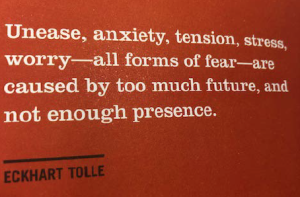
Screen Shot 2019-01-07 at 8.27.11 PMNot sure what the weather is like where you are, but here in Georgia, its raining. AGAIN! I think it has been raining for 6 weeks straight. We are on track to have the second rainiest season Georgia has ever had so I may not be exaggerating all that much.
Many years ago, my husband and I visited on of my sisters in Oregon. It was a rare week there; it was sunny and mild and oh-so green. Dan was just about to pack up and head to out west when my sister said, “Dan, there is a reason it is so green.” That is so true right? We cannot have green grass and healthy crops without rain and everyone knows that Oregon gets a lot of it.

Last year at this time I wrote about Seasons. So much in my personal life was changing. I had big decisions to make about the business too. No doubt, the same will be true in 2019. That is just the nature of life.

When I look at my vision board from last year (and no, you can’t see it), there are just a few major goals I realized. There is so much more I want to accomplish, both personally and professionally and the time seems to pass more quickly each day. Can you relate?

There is so much good work that needs to be done in the world.

Screen Shot 2019-01-07 at 8.27.33 PMSo, I resolve to get to work to make a difference. I hope to be kinder and healthier; to laugh more and take more time off. I hope to add more joy and less stress to any situation I am in. I want to help you and others do good work, the kind that really changes communities. Here are CES we are recommitting to our tag line, Partnering for Social Change. Won’t you join us?

Written by cplysy · Categorized: communityevaluationsolutions

Jan 06 2019

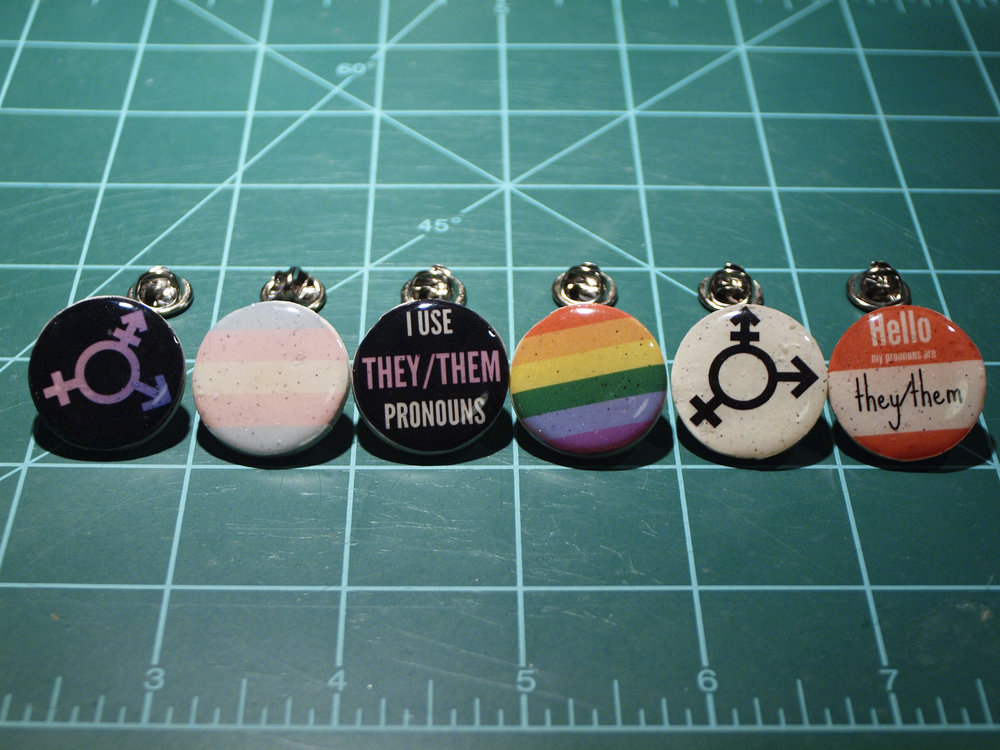
(Almost) Everything You Wanted to Know about Carolyn’s Pronouns

Pronouns are small little words to cause such a fuss, am I right?

In my ideal world, my pronouns would require no footnotes, no extra explanation, or citations. But as we don’t live in a gender utopia, at least a little explanation is required, if for nothing more than to move the conversation along productively.

I spent a long time debating with myself about whether to be ‘out’ with my pronouns as a professional. I was worried that it would be too disruptive, too exhausting, put too much attention on something that felt irrelevant to my work, and make people uneasy around me, even if only for the fear of messing up or offending me. I was afraid I’d end up disappointed and frustrated. I was thinking about my trans and gender-variant friends who are ‘out’ and dealing with all kinds of demoralizing reactions. And really it just felt like something private and personal that shouldn’t have to be the subject of public discussion.

source:  https://www.flickr.com/photos/qnr/27437761640

source: https://www.flickr.com/photos/qnr/27437761640

But you can’t change something without at least trying to interact with it. I’d been doing a ‘half in, half out’ approach for a few years already where I would carefully not misgender myself when writing my own bios and whatnot (often through linguistic gymnastics and impressively bad run-on sentences to avoid pronouns altogether, which frequently were then edited by well-meaning folk to do exactly what I’d been trying to avoid), but wouldn’t ask the same of other people. It was silly and sent mixed messages and didn’t get me what I wanted. So a couple of years ago I decided to go for it, awkwardness be damned.

What I learned is that talking about my pronouns is disruptive. It has to be. I try for it to be a useful kind of disruption, stirring up the earth a little to make it ready to receive something new. It can also be exhausting, having the same conversation on repeat and sitting with people in their uncertainty and discomfort while being unsure what to do with my uncertainty and discomfort. I try to balance the load by assuming the best about people’s capacity to deal with a little uncertainty instead of trying to manage it all for them. I’m learning how to shine just enough light on my pronouns to turn them into an opportunity for discovery without pointing a big blinding spotlight at them all the time. I’ve accepted that I may make some people uneasy, even to the point of being uncomfortable to work with me, but that I’ll also be welcoming people in by being open about who I am and, hopefully, inviting them to do the same.

So that’s why I talk about my pronouns. The rest of this is my attempt to answer the questions that have come up the most when I do that, those things you might want to know but aren’t sure if you can ask or don’t know how to ask. These are all based on real exchanges and experiences I’ve had.

As a caveat, I’m very deliberately writing this as a resource on my pronouns, not as a universal guide. While there may be overlaps between my answers to these questions and how others would answer them, there will be lots of variation as well. So I hope you find this instructive and insightful, but please remember to keep being kind, curious, and open to different experiences and different preferences around if and how to talk about things like this with other gender-variant people.

I’m also assuming that anyone reading this already embraces the idea that gender-variant people exist as part of the beautiful natural diversity of the world, so I don’t answer any questions about that. If you’re not sure about where you stand on that, I’ll also share some additional reading resources at the end.

Onward!


How do I use your pronouns?

Fantastic question! I use “they” as my third-person singular pronouns, so that means “they” and “them” and “their” in place of words like “he” and “him” and “his” or “she” and “her” and “hers”. (First- and second-person pronouns—the I’s, you’s, and we’s—are unchanged.) These are the pronouns you would use when speaking about me but not to me. For example, “I’d like you to meet my friend Carolyn. They’ve just flown in from Vancouver and, boy, are their arms tired!”

You can also treat the verbs the same as if you were referring to a plural “they”. So that would look like, “Carolyn is here and they have pie!”, as opposed to, “Roger is here and he has brownies!” (Notice that the first verb in the sentence is the same because it points to my name, not to the pronoun.)

Does that seem complicated? Don’t worry—if you are fluent English speaker, then you already know how to do this and you do it all the time without thinking about it. Singular they is what we use in situations when the gender of the subject is unknown to us: “Oh no, someone left their water bottle behind. I hope they come back for it.” The only difference in my situation is that we generally assume that if we know who we are speaking about, then by default we know their gender (oh look, it happened again). But, trust me, if I don’t know my gender, you definitely don’t, so singular they applies.

What if I don’t want to be grammatically incorrect?

Let’s be clear, I spent all of high school walking around with a dog-eared copy of Strunk & White in my backpack. Grammar is my thing. I’m gaga for good, clear communication, of which grammar is an essential component. I’m also a big nerd who will have delighted conversations with you about the merits and demerits of the Oxford comma. Grammar pedantry, on the other hand, is a buzzkill and works against effective, inclusive communication in a world of evolving and emerging ideas that we need to be able to talk about together.

I can sum up my answers to this question in a few brief points:

  1. The use of singular they in English is not grammatically incorrect. See above. (This applies at least as far back as Shakespeare.)

  2. Language evolves. It has too! Human knowledge and human experience do not stand still so human communication cannot either.

  3. People are more important than prescriptivist language rules.

If I sound a little terse here, it’s because in my experience this particular argument doesn’t always reflect a genuine concern about grammar so much as someone’s need for a palatable justification to avoid dealing with the deeper-seated discomforts they didn’t want to acknowledge. That’s why points 2 and (especially) 3 are there, since if it were only about grammar, point 1 should have been enough.

(That being said, I do understand that grammar usage is bound up in a lot of classism, ableism, racism, and other baggage and bullshit, and I get how this could be a real source of anxiety for some. Fortunately, we’ve got Shakespeare in our corner! It’s all good.)

When is it okay to use your pronouns? What if I out you?

Hey, right away, thank you for being aware of the fact that outing someone as trans or gender non-conforming can be dangerous, that people can lose their jobs, homes, health, friends, families, and lives around this. Cherish that instinct to be concerned and keep looking out.

For me though, you can always use my pronouns. I’ve considered and weighed the risks, and I’ve accepted them. I’m in a much better position than a lot of people to be publicly ‘out’ and I’ve made a choice to try using that position to make the world a little more open, understanding, and aware. That means being visible and I appreciate you helping me with that.

In fact, if you’re introducing me to someone for the first time (which is when this question is most likely to come up), I really, really, really appreciate you helping me start things off well. It’s easier and less awkward to start with setting the right expectations than it is to try to shift them after the fact.

However, if you genuinely feel that there’s a direct risk to my safety or the safety and well-being of others (including yourself!) by even implicitly raising the topic of gender variance, I trust your judgement. Go with your gut. People are also more important than pronouns.

What do I do if I use your pronouns and people ask me questions about you I don’t know the answer to? What do I tell them?

For starters you can direct them here. (That’s partly why I wrote this.) Another useful, multipurpose answer is, “I don’t know!” It’s okay not to know. I don’t always know either. None of us are experts here.

If the questions seem to go beyond simple curiosity and into interrogation, one thing I’ve learned about introducing people to my pronouns is that ‘less is more’ applies. I’m tucking this big essay here in a corner of my website as a resource, but I don’t open with the info dump. I stick “they/them” in the signature of my emails, I scribble it onto my name tag at conferences, I put it out there where people will see it, and I let them work out for themselves what to make of it. It’s less overwhelming and more normalizing that way. If I do call attention to it, I use a tone that is cheerful and matter-of-fact—“Hi, I’m Carolyn, I use they/them pronouns”—and avoid the lengthy, anxious explanations that start to sound more like I’m apologizing for being so weird and suggest that my identity and experiences are up for debate. Curiosity is grand, but the point I’m making here is that questions don’t always need answers and unanswered questions don’t need apologies and that’s okay.

How does this translate into [another culture/language]?

Such a good question. I don’t know! Gender and language are both deeply contextual and culturally-mediated, and different languages handle gender differently. The way my gender does (and does not) show up in my own linguistic context doesn’t necessarily translate to another one. If I had to describe my gender to you from within my own cultural frame of reference, the closest I can get is “the sound of dial-up internet in the 90s” or “incomprehensible error message”. In an English-speaking context, “they/them” was the best-fitting pronoun for that for me, but I’m open to suggestions for other contexts.

Gender itself is not the same across cultures and this variation is not neutral. The Euro-Western paradigm of gender that I’m steeped in and reacting to is also notoriously racist and colonialist, including in how Whiteness impacts whose non-binary identities are accepted and privileged and how they are understood and represented. I try always to be mindful of that when I’m navigating gender across different contexts and not rely uncritically on my own internalized framework (which I certainly have even if consciously I find it a silly and alienating way to conceptualize gender). When I am a guest in another space (literally or metaphysically), as a general practice I default to the cultural norms and expectations of that space, and keep myself open to dialogue and deeper understandings as I go.

What if I make a mistake?

Don’t panic. Mistakes happen. I make them too, with my own pronouns as well as with other people’s. You’re swimming against the current of your own habits and ingrained social expectations, so it happens.

The best thing to do is to acknowledge the mistake, correct it, and move on. If you catch yourself in the moment, correct it in the moment—“Whoops, scratch that, they are here to help us with our logic model.” If you realize it after the fact, acknowledge it to yourself, make a note of it, and keep trying. Sometimes people feel the need to draw me aside for a personal apology and check-in, and I can appreciate that and where that comes from, but the coolest thing for me is to know people are making an effort. Having someone handle the inevitable slip-up in a relaxed way, especially if it’s around other people, is awesome for me, because it models that learning to use unfamiliar pronouns is do-able, socially acceptable, and doesn’t have to be scary or dramatic.

If you find yourself getting stuck on it though, the best advice I can offer is to keep going, be kind to yourself, avoid attaching negative self-judgements to the process (the last thing I want people associating me and my pronouns with is feeling crappy about themselves), and think of it as an opportunity for reflection and self-discovery. We adapt our terms of reference for other people all the time—we understand that people don’t stay the same age as when we first met them, that we may learn to use new names with them over time (like when someone grows out of a childhood nickname, or changes their name through marriage or divorce). While habit plays a role in sustaining old patterns, another factor is whether we genuinely embrace and feel comfortable in the new pattern. If that seems like it could be a hold-up, try digging into that a little deeper. Exploring ideas of gender identity and gender expression can be valuable for everyone. Who isn’t refreshed by a good old-fashioned paradigm shift? It can also be helpful to connect with other people who are working through the same thing (my mother and sister help keep each other on track, for example). Doing things together is always easier than going it alone. Even if I’m the first person you meet who asks you to use different pronouns than you expected, I’m unlikely to be the last, so it’s all good practice.

If you do slip up around me, chances are that I won’t correct you. Not because it doesn’t matter to me, but because it’s just a lot to invest the time and energy in across all the people I interact with on a daily basis. I can’t micromanage it, so I put it out there and trust that together we’ll make it work in time. If I ever do check in with you about it, be assured it comes from a place of trusting you and wanting to work with you around it.

(Also going to re-iterate here that this is all advice specific to me which should not be assumed to be universally applicable.)

Aahhhhhh!!

Same! It’ll be okay.

Can I talk to you about gender stuff?

Yes, but promise me you’ll get to know me first and that we’ll talk about more than gender stuff and that you’ll talk about gender stuff with lots of other people too. I’m a multifaceted and fascinating individual. I have many thoughts and opinions on things beyond gender, like the Oxford comma, leopard slugs, Irish soda bread recipes, and the Alien film franchise. (And program evaluation!)


Other Cool Stuff To Read:

The following are some solid resources if you want to learn more about the weird and wonderful world of sex and gender diversity:

  • Sex Redefined [online article]

  • Evolution’s Rainbow [book]

  • Delusions of Gender [book]


Shout-out to everyone who has struggled and celebrated with me around my pronouns for the last few years. We learned so much together and I would not have been able to write this without you. Thank you.

Written by cplysy · Categorized: carolyncamman

Dec 17 2018

Comment on Wisdom from the Woods: Everything Looks Scarier in the Darkness by Evaluator as Acrobat: The Art of Flexibility – Elizabeth Grim

[…] we watched the sunset over the mountains was dissipating. I realized then that 1) I did not want to camp alone in near/sub-freezing temperatures and 2) I still had time to get off the mountain in daylight. I […]

Written by cplysy · Categorized: elizabethgrim

Dec 17 2018

Evaluator as Acrobat: The Art of Flexibility

Each day I spend on the trail, walking, running, or hiking teaches me something about myself and the universe. One of the most important lessons I have learned is the art of flexibility. Understanding how to navigate dynamic systems is a key part of successful evaluation capacity building projects.

Written by cplysy · Categorized: elizabethgrim

  • « Go to Previous Page
  • Go to page 1
  • Interim pages omitted …
  • Go to page 296
  • Go to page 297
  • Go to page 298
  • Go to page 299
  • Go to page 300
  • Interim pages omitted …
  • Go to page 304
  • Go to Next Page »

Footer

Follow our Work

The easiest way to stay connected to our work is to join our newsletter. You’ll get updates on projects, learn about new events, and hear stories from those evaluators whom the field continues to actively exclude and erase.

Get Updates

Want to take further action or join a pod? Click here to learn more.

Copyright © 2026 · The May 13 Group · Log in

en English
af Afrikaanssq Shqipam አማርኛar العربيةhy Հայերենaz Azərbaycan dilieu Euskarabe Беларуская моваbn বাংলাbs Bosanskibg Българскиca Catalàceb Cebuanony Chichewazh-CN 简体中文zh-TW 繁體中文co Corsuhr Hrvatskics Čeština‎da Dansknl Nederlandsen Englisheo Esperantoet Eestitl Filipinofi Suomifr Françaisfy Fryskgl Galegoka ქართულიde Deutschel Ελληνικάgu ગુજરાતીht Kreyol ayisyenha Harshen Hausahaw Ōlelo Hawaiʻiiw עִבְרִיתhi हिन्दीhmn Hmonghu Magyaris Íslenskaig Igboid Bahasa Indonesiaga Gaeilgeit Italianoja 日本語jw Basa Jawakn ಕನ್ನಡkk Қазақ тіліkm ភាសាខ្មែរko 한국어ku كوردی‎ky Кыргызчаlo ພາສາລາວla Latinlv Latviešu valodalt Lietuvių kalbalb Lëtzebuergeschmk Македонски јазикmg Malagasyms Bahasa Melayuml മലയാളംmt Maltesemi Te Reo Māorimr मराठीmn Монголmy ဗမာစာne नेपालीno Norsk bokmålps پښتوfa فارسیpl Polskipt Portuguêspa ਪੰਜਾਬੀro Românăru Русскийsm Samoangd Gàidhligsr Српски језикst Sesothosn Shonasd سنڌيsi සිංහලsk Slovenčinasl Slovenščinaso Afsoomaalies Españolsu Basa Sundasw Kiswahilisv Svenskatg Тоҷикӣta தமிழ்te తెలుగుth ไทยtr Türkçeuk Українськаur اردوuz O‘zbekchavi Tiếng Việtcy Cymraegxh isiXhosayi יידישyo Yorùbázu Zulu