• Skip to main content
  • Skip to footer
  • Home

The May 13 Group

the next day for evaluation

  • Get Involved
  • Our Work
  • About Us
You are here: Home / Archives for cplysy

cplysy

Apr 28 2023

Your information will be kept confidential: Confidentiality and Anonymity in Evaluation

This article is rated as:


How often have you said the phrase “your information will be kept confidential”?  “Confidential” and “anonymous” are words we use quite a bit in the evaluation world. But do you know what they actually mean? Let’s explore some of these concepts.  


Confidentiality

Confidentiality is when personally identifying information is collected but is not linked to the individual’s responses; in other words, the personally identifying information is kept separately. Confidentiality can be maintained through password-protected files and/or through proper record storage and destruction. Maintaining confidentiality is also a key consideration in reporting.

Anonymity

Anonymity is when the data collection process does not collect any personally identifiable information. Anonymity is when there is no opportunity to link responses back to a specific individual.

If you are interviewing an individual or conducting a focus group, your data collection cannot be anonymous. If you are sending out a link to an online survey that collects no identifying information, then you have anonymity.

Personally Identifying Information

Notice this phrase pops up in both of those definitions? This phrase, sometimes shortened to PII, unfortunately doesn’t have a standard definition. It means different things to different organizations, in different policies or legislation, and across different sectors.

Generally, it is understood to mean any singular datum or group of data that could identify an individual. It may be obvious that a name is personally identifying, but many other demographic or profile data depend on the context. For example, age can be identifying if you are collecting data from a sample with an average age of 50, but one participant is 87. Gender may be identifying if your sample is predominately one gender.

Combinations of data can also lead to identification. For example, perhaps in your sample, organizational role is not identifying – you have lots of program leads and coordinators, but if you include duration of time employed and role together you may identify that newly hired coordinator, or the program lead whose been in the organization longer than the rest.

Most countries or jurisdictions have policies or laws around the protection of personally identifying information. Here in Canada where Eval Academy is based we have PIDEDA: The Personal Information Protection and Electronic Documents Act. In the United States HIPAA (Health Insurance Portability and Accountability Act) is a well-known regulation.

Staff roles within an organization is a common one I come across that is potentially identifying.


Difference between legal confidentiality and ethical confidentiality

For an evaluation, the question of confidentiality or anonymity is ethical, not legal. It is our duty to put in extra effort to preserve confidentiality, having thought of the ethical risks of data breaches. This is not the same as lawyer-client confidentiality.


Disclosure

Some professions have bodies or policies that guide if and when confidential information can be disclosed: think psychologists, physicians, or lawyers. Unfortunately, as of yet, evaluators do not have this, and yet we are often working with vulnerable populations who may disclose a number of concerning matters to us.

Given that there are no official rules, what you do about disclosing information is ultimately up to you and your organization or client. It is prudent to anticipate potentially risky scenarios. Here are some scenarios you may want to consider:

If a participant shares or discloses a risk to themselves (e.g., plans of suicide): if you believe the situation is an emergency, you may choose to call emergency services, like 911, and disclose the information you have.

If a participant discloses non-emergent risks about problems with mental health or behaviour: you may wish to have a list of local resources available to you that you could share. Your resource list may include things like housing options, the food bank, a crisis line, and other mental health supports or social support agencies relevant to your population.

Of course, a person may disclose criminal activity or other abuses. You will need to rely upon your own discretion to determine if there is anybody at urgent risk and what to do in these situations.

In non-emergent cases, and depending on the resources available to you, seeking consent to disclose information is always a good choice:

“What I’d like to do is share [details, e.g., name and phone number] with [description of where it will be shared, e.g., our social worker], so that [describe intent]. Is that ok?”

If they decline, you should not disclose any details. If consent is given, when you disclose confidential information, ensure you are only sharing information relevant to the reason for disclosure, and ensure the disclosure is through confidential channels.

Check out our Tips for Conducting Interviews infographic and our posts about consent for extra guidance here.


How to maintain Confidentiality

Most organizations have a records storage and retention policy. It is your duty to be familiar with them regarding confidential information. A storage policy will guide you on how and where to store specific types of information. Importantly, you should also be aware of who else has access to that storage location and if they should have access to any confidential information.  A retention policy will likely categorize the type of record, how long it will be kept for, and how it will be destroyed. These policies can be referenced in your data collection introductions, for example:

“Information you share will be kept for [X years] on a password-protected server owned by [organization]. After [X years] we delete all copies.”

 Some other places to consider confidentiality:

  • Transcription: you could not include names in transcription, thus when the recording is deleted, the transcript has (less) personally identifying information

  • File naming: ensure you don’t name recordings, transcripts or notes using personally identifying information, e.g., “Beth Smith’s Interview”

  • In reporting: Using quotes can add such rich information to your reporting, but quotes should be considered from the lens of confidentiality, and where possible use Member Checking to ensure explicit consent


The key here is to be a good data steward, which includes ethical data collection, transparency in the use of data, sound data management (storage, retention, destruction) and reporting that maintains confidentiality.  


Let us know your tips for maintaining confidentiality below!

Written by cplysy · Categorized: evalacademy

Apr 28 2023

New Checklist: Information Request Checklist

This article is rated as:


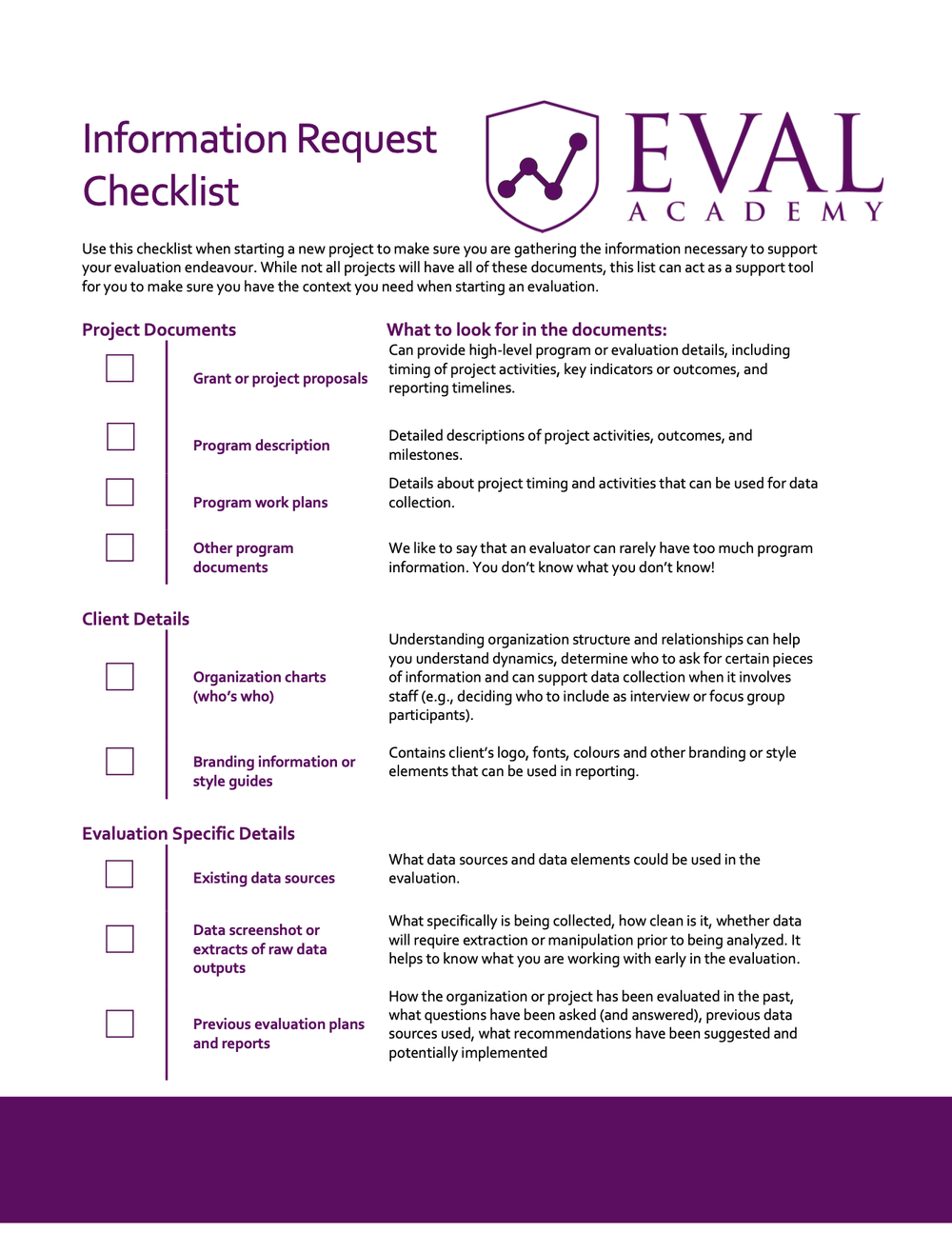
Eval Academy just released a new checklist, Information Request Checklist

Who’s it for?

Whether you’re new to evaluation or if evaluation is your main role, this checklist is for anyone who’s about to start a new evaluation project to make sure you’re gathering the information necessary to support your evaluation endeavour!


What’s the purpose?

While not all projects will have all of these documents available, this checklist can act as a supporting tool to make sure you have the context you need when starting an evaluation. Use this checklist prior to your Evaluation Kick-Off Meeting to gain as much detail as you can about the project. We like to say that an evaluator can rarely have too much program information. You don’t know what you don’t know!


What’s included?

A downloadable and printable checklist to help you gather information on the project, client details, and evaluation-specific details.


Learn more: related articles and links

You can learn more about planning an evaluation through the following links:

  • The Components of an Evaluation Plan

  • How to Kick Off Your Evaluation Kick-Off Meeting

  • Scoping an Evaluation: Begin with the Purpose


You can also find many other resources to support you in planning and implementing an evaluation. Some of our most popular resources include:

  • Evaluation Plan Template

  • Evaluation Kick-Off Meeting Agenda Template

  • Program Evaluation Scoping Guide

What do you think of our new checklist? Let us know in the comments below!

Written by cplysy · Categorized: evalacademy

Apr 28 2023

What is Descript?

Have you ever heard of/used Descript? If not, you have now. It’s one part transcription too, one part easy to use video editor. What’s not to love?

Links

You can check out the tool for yourself at descript.com.

Transcript

?Hey, so it’s Friday. So you know what that means? It’s Tool day. And today I wanted to talk about my new favorite video creation tool called descript.

Now, I don’t know about you. If you’ve ever tried to create video before. But it can be a pain. And then, you know, here’s my general feeling on technology. If something requires this few minutes, I have a higher interest, but pretty quickly, the longer something takes the lower my interest goes.

It’s kind of why I didn’t start cartooning until I had an iPad. Because it made it super easy. And then all of a sudden I started drawing cartoons. Well, the same thing goes with video. Like over time, it’s gotten a little bit better, a little bit better, a little bit easier. And with a tool like descript, which is what I’m using right now to record this. Video becomes even easier to go ahead and record and create.

So descript is different. Let’s start there. Descript basically when you record a video. It transcribes the video. And instead of just working with a timeline and cutting and trying to merge the other clips.

You just edit it. Like it’s a word document. And you erased different sections like that. It’s not always the smoothest transition and there’s stuff that you can do about that. But it’s way easier.

And way easier is better because way easier means I will actually do it. So let’s walk through my process. So I open up. The script. And I record a video. I just hit the record button. It asks me if I want like studio sound. If I want separate clips, there are a couple of things that I can. Do. In the setup options.

Then after it’s done it, auto transcribes and there’s this little button I can click to get rid of all the filler words. So the ums and the AHS, which I use a lot. They get to be erased automatically and replaced with like blank clips. Hopefully you don’t notice. Sometimes I do. But it’s good enough.

Then I listen and edit the transcript. So I’ll listen to myself. Talk. It’ll go through. I’ll erase anything. If I feel like I need to clip certain parts of the video. And then I’ll have a clean ish transcript. I don’t clean and fix everything because again, My goal here is speed and just conveying information and quickly and efficiently so that I keep doing this kind of stuff.

Then after that, I just export, the video and upload it into YouTube. And I paste a transcript to my blog. I’ve used descript for a couple other things too. I’ve used it to transcribe zoom recordings. It can be really helpful if you’re doing qualitative research, that kind of thing. To be able to just auto transcribe.

And it works pretty well. And I’ve also used descript to create a podcast. So it will. Take the audio. You can edit the audio and export as an audio file. Two not just video file. And it’s perfect for creating a nice, simple. Podcast. Now pricing. There are a few different levels. The nice thing about descript is you can start for free.

It doesn’t cost anything to record up to an hour. A month or really transcribe up to an hour each month. That’s not a lot of time, but it’s enough time to get you started and see if you like the tools or not. There’s a creator level right after that. And it cost 15 bucks a month. And that will give you 10 hours of content each month, along with some additional features not available in free.

And then finally there’s a pro. Version, which is $30. You also get. 20% off if you sign up for a year. And that gives you 30 hours. And unlimited all sorts of other things like HD and. Getting rid of the ums and AHS and that sort of thing. It, some of the features that go along with it. So that’s it.

That’s descript. I think he should check it out. You’ll find the link in the show notes. So that’s it. I have a great day, great weekend. Or whenever you watch this, have a great day and I’ll talk to you soon. Alright, bye.

Written by cplysy · Categorized: freshspectrum

Apr 28 2023

A Guide for Creating Effective Progress Reports

Writing reports can often feel like a tedious task. We’ve all been there – staring at a blank page, struggling to find the right words to convey our message. And if we’re bored while writing it, just imagine how other people will feel when they read it. Clearly, we’re doing something wrong. But reporting is […]

The post A Guide for Creating Effective Progress Reports appeared first on Dr. Thomas Winderl.

Written by cplysy · Categorized: thomaswinderl

Apr 27 2023

Data Dashboard FOMO

Does a data dashboard really have to support decision making to be useful?

Links

In the video I mention my workshop, if you’re interested, check it out here > diydatadesign.com.

Transcript

?So I teach a data design virtual workshop. It’s called DIY data design. And each week we get together and have conversations. So I’ll give a little presentation and then we’ll just chat about stuff. The last week we were talking about data dashboards. And one of the things that came up, it was interesting.

It was one of the participants was talking about how she has access to a set of dashboards. And she looks at them they’re about libraries and books and. Mostly because she’s interested. Not because she has any particular need for that data. Just because she’s interested and they have the data.

And when we were talking a little bit more. This idea came out about data dashboard FOMO. And. How sometimes. We need dashboards or we want dashboards, not because there’s any particular decision-making need. Just because we have this fear of missing out on data that we don’t know exist. And so you end up with this large, huge dashboard of like tons and tons of pages.

And he asked the question like why does anybody want to use this? What are they going to use this for? And the more I thought about it, the more I could see a counterpoint to that, the idea that. That there needs to be a use. So here’s a, here’s like a little story. So you have a person.

And they go, can I see the data? And they come up to the data person. And the data person says why. Now there might be all sorts of reasons why the data person is wondering why maybe they want to set up the dashboard in a way. That it could help facilitate decision-making. And, the person’s just like sheepishly just, interested.

And I think this happens often actually. Or maybe if, an organization is data savvy or you have people who are interested in understanding some of the data. That there is a world of data. Inside of organizations. That we don’t really know what exists. you don’t know what you don’t know. And for a lot of people, the way that they have to go and find that data is to go to a middleman. Somebody who knows enough about the data who has access, who can get the right information.

And they control the access point. And. It ends up becoming like a sort of gatekeeper. Even if unintentionally. I think there are two reasons that you might want to create that data dashboards. You don’t want is to use support decision-making so this is the idea that, okay, this is actionable data.

There is a very Clear reason. Why we have this data, why we’re sharing this data? Why this date is going from one place to the other. So the person can learn and make decisions about their work. This is the data as decision-making. Everybody can agree on, but there’s this other part that.

Dashboard is really. An access tool. It’s about taking something that is inaccessible. Because people don’t have the access rights or the skill or. The time to find a way to get to that data. So it becomes like this mysterious thing. And honestly, This person, the person that says why. They don’t know what. Necessarily might be interesting to know. And sometimes you just need to create a dashboard. You just need to create an interface. So that people who are interested. In an organization can find data that is available. And make their own decisions as to why they might want to see it.

And perhaps just following an interest. Perhaps, they just have some data dashboard FOMO. Yeah, that’s it for today? Hope you’re having a great week. We’ll talk soon. Alright, bye.

Written by cplysy · Categorized: freshspectrum

  • « Go to Previous Page
  • Go to page 1
  • Interim pages omitted …
  • Go to page 90
  • Go to page 91
  • Go to page 92
  • Go to page 93
  • Go to page 94
  • Interim pages omitted …
  • Go to page 304
  • Go to Next Page »

Footer

Follow our Work

The easiest way to stay connected to our work is to join our newsletter. You’ll get updates on projects, learn about new events, and hear stories from those evaluators whom the field continues to actively exclude and erase.

Get Updates

Want to take further action or join a pod? Click here to learn more.

Copyright © 2026 · The May 13 Group · Log in

en English
af Afrikaanssq Shqipam አማርኛar العربيةhy Հայերենaz Azərbaycan dilieu Euskarabe Беларуская моваbn বাংলাbs Bosanskibg Българскиca Catalàceb Cebuanony Chichewazh-CN 简体中文zh-TW 繁體中文co Corsuhr Hrvatskics Čeština‎da Dansknl Nederlandsen Englisheo Esperantoet Eestitl Filipinofi Suomifr Françaisfy Fryskgl Galegoka ქართულიde Deutschel Ελληνικάgu ગુજરાતીht Kreyol ayisyenha Harshen Hausahaw Ōlelo Hawaiʻiiw עִבְרִיתhi हिन्दीhmn Hmonghu Magyaris Íslenskaig Igboid Bahasa Indonesiaga Gaeilgeit Italianoja 日本語jw Basa Jawakn ಕನ್ನಡkk Қазақ тіліkm ភាសាខ្មែរko 한국어ku كوردی‎ky Кыргызчаlo ພາສາລາວla Latinlv Latviešu valodalt Lietuvių kalbalb Lëtzebuergeschmk Македонски јазикmg Malagasyms Bahasa Melayuml മലയാളംmt Maltesemi Te Reo Māorimr मराठीmn Монголmy ဗမာစာne नेपालीno Norsk bokmålps پښتوfa فارسیpl Polskipt Portuguêspa ਪੰਜਾਬੀro Românăru Русскийsm Samoangd Gàidhligsr Српски језикst Sesothosn Shonasd سنڌيsi සිංහලsk Slovenčinasl Slovenščinaso Afsoomaalies Españolsu Basa Sundasw Kiswahilisv Svenskatg Тоҷикӣta தமிழ்te తెలుగుth ไทยtr Türkçeuk Українськаur اردوuz O‘zbekchavi Tiếng Việtcy Cymraegxh isiXhosayi יידישyo Yorùbázu Zulu