• Skip to main content
  • Skip to footer
  • Home

The May 13 Group

the next day for evaluation

  • Get Involved
  • Our Work
  • About Us
You are here: Home / Archives for allblogs / cameronnorman

cameronnorman

Jan 30 2023

What Is Strategic Design, And Why Might I Need It

#image_title

Strategic Design is the application of design methods, principles, thinking, and approaches to an enterprise. It combines aspects of systems design, service design, and design thinking. Strategic Design focuses on aligning the organization’s resources, interests, and goals with what it does.

It ensures that your organization is fit for purpose.

Fit For Purpose

We use this expression a lot. It means ensuring two things:

  1. A clear purpose or direction.
  2. That what you do is aligned with that purpose or direction. That means having the right resources (e.g., personnel, technology, tools, location etc..) that are connected with a strategy to use those resources appropriately to accomplish goals connected to your purpose.

It sounds simple, but often we need help with both of these. Sometimes situations change, and what once made sense or worked well no longer does. Sometimes, we’ve changed, and our focus is different from what it was and our purpose.

Strategic Design involves connecting these two things and ensuring that your organization or initiative stays true to the fit and the purpose.

Designing For Purpose

Purpose is defined as:
“An anticipated outcome that is intended or guides your planned actions.”

“What something is used for”

“The quality of being determined to do or achieve something”

Each of these refers to an action-like quality. It’s tied to the things we do, the things we make, or the things we wish to be or become.

In each of these definitions, we can see where something might change. For example, our outcomes might change based on the circumstances or needs of those we serve. We might change our standards of quality or decide we want to do or be something different than we are.

Strategic Design begins by looking at these definitions and asking questions about them. It also involves considering future possibilities. Strategic Design incorporates elements of foresight into it to help us look at trends, patterns, threats and opportunities that are on the horizon or more likely to come to pass.

Designing for Fit
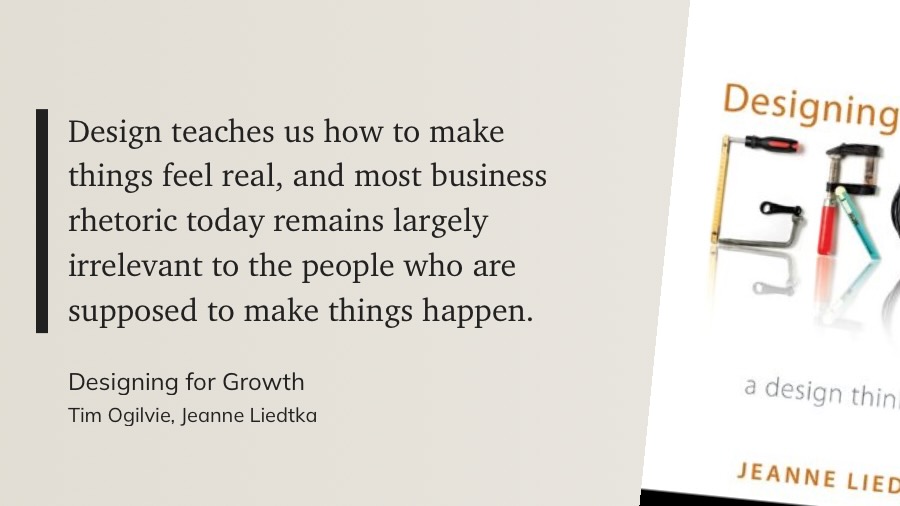
Liedtka & Ogilvy (Design for Growth)

We often find clients who believe that what they are doing aligns with the outcomes they seek, only to realize they need to set up differently to achieve that. It often happens with legacy programs or those operating in a highly dynamic space. Unless we constantly look at our programs and evaluate them, they may eventually lose their fit.

Strategic Design uses tools like evaluation and systems design to explore, with data, how the current or proposed offering (the ‘thing’).

Sometimes walking through a Theory of Change process can help articulate why something might work (for proposed projects)or currently works the way it does. Theory of Change is a process that helps explain why something is expected to achieve something else. It’s an excellent tool to help ensure logic, flow, and connection between your intent, your intervention (e.g., product, service, policy), and your outcomes.

Strategic Design uses all of these to make those connections and uses systems thinking to understand how your program, service, or policy fits within a situation. It allows us to design for the real world.

Doing Strategic Design

As a take-home, think of Strategic Design as involving the following steps:

  1. Figure out where ‘here’ is.
  2. Figure out what ‘there’ means and what it will take to get there.
  3. Create a support system to connect here to there consistently and effectively.

We do this by using approaches like Developmental Evaluation and Design-Driven Evaluation approaches that connect what we make with our outcomes and impact. Strategic Design without evaluation is really just strategic planning; it doesn’t ensure the fit and the purpose are retained when implemented.

Strategic Design isn’t done as a discrete part of the strategy process but is a living, breathing part of a strategy conversation.

Get talking and get designing.

If you want better conversations, better strategy, and better outcomes and don’t know where to begin (even after reading this 🙂 ), let’s talk. We can help you.

Image Credits: Photo by Andrew Neel on Unsplash

The post What Is Strategic Design, And Why Might I Need It appeared first on Cense Ltd. .
Written by cplysy · Categorized: cameronnorman

Jan 30 2023

What Is Strategic Design, And Why Might I Need It?

#image_title

Strategic Design is the application of design methods, principles, thinking, and approaches to an enterprise. It combines aspects of systems design, service design, and design thinking. Strategic Design focuses on aligning the organization’s resources, interests, and goals with what it does.

It ensures that your organization is fit for purpose.

Fit For Purpose

We use this expression a lot. It means ensuring two things:

  1. A clear purpose or direction.
  2. That what you do is aligned with that purpose or direction. That means having the right resources (e.g., personnel, technology, tools, location etc..) that are connected with a strategy to use those resources appropriately to accomplish goals connected to your purpose.

It sounds simple, but often we need help with both of these. Sometimes situations change, and what once made sense or worked well no longer does. Sometimes, we’ve changed, and our focus is different from what it was and our purpose.

Strategic Design involves connecting these two things and ensuring that your organization or initiative stays true to the fit and the purpose.

Designing For Purpose

Purpose is defined as:
“An anticipated outcome that is intended or guides your planned actions.”

“What something is used for”

“The quality of being determined to do or achieve something”

Each of these refers to an action-like quality. It’s tied to the things we do, the things we make, or the things we wish to be or become.

In each of these definitions, we can see where something might change. For example, our outcomes might change based on the circumstances or needs of those we serve. We might change our standards of quality or decide we want to do or be something different than we are.

Strategic Design begins by looking at these definitions and asking questions about them. It also involves considering future possibilities. Strategic Design incorporates elements of foresight into it to help us look at trends, patterns, threats and opportunities that are on the horizon or more likely to come to pass.

Designing for Fit

Liedtka & Ogilvy (Design for Growth)

We often find clients who believe that what they are doing aligns with the outcomes they seek, only to realize they need to set up differently to achieve that. It often happens with legacy programs or those operating in a highly dynamic space. Unless we constantly look at our programs and evaluate them, they may eventually lose their fit.

Strategic Design uses tools like evaluation and systems design to explore, with data, how the current or proposed offering (the ‘thing’).

Sometimes walking through a Theory of Change process can help articulate why something might work (for proposed projects)or currently works the way it does. Theory of Change is a process that helps explain why something is expected to achieve something else. It’s an excellent tool to help ensure logic, flow, and connection between your intent, your intervention (e.g., product, service, policy), and your outcomes.

Strategic Design uses all of these to make those connections and uses systems thinking to understand how your program, service, or policy fits within a situation. It allows us to design for the real world.

Doing Strategic Design

As a take-home, think of Strategic Design as involving the following steps:

  1. Figure out where ‘here’ is.
  2. Figure out what ‘there’ means and what it will take to get there.
  3. Create a support system to connect here to there consistently and effectively.

We do this by using approaches like Developmental Evaluation and Design-Driven Evaluation approaches that connect what we make with our outcomes and impact. Strategic Design without evaluation is really just strategic planning; it doesn’t ensure the fit and the purpose are retained when implemented.

Strategic Design isn’t done as a discrete part of the strategy process but is a living, breathing part of a strategy conversation.

Get talking and get designing.

If you want better conversations, better strategy, and better outcomes and don’t know where to begin (even after reading this 🙂 ), let’s talk. We can help you.

Image Credits: Photo by Andrew Neel on Unsplash

The post What Is Strategic Design, And Why Might I Need It? appeared first on Cense Ltd. .

Written by cplysy · Categorized: cameronnorman

Jan 25 2023

How to Use Design for Innovation

#InnovationDesignCoffee

Design is a human-powered field of practice that combines imagination, certain ways of thinking, and making things. There’s a lot of myth-making and mystery language associated with design, so don’t let that confuse or lose you. Design is a field made of disciplines, but it’s also the discipline of innovation. That’s how we see it.

How can we use design to innovate (create something new that adds value and improves our situation)?

In a series on Censemaking, Cameron Norman introduces us to design, design thinking, and critical design – the three cornerstones of the field of design practice. But how do we use it?

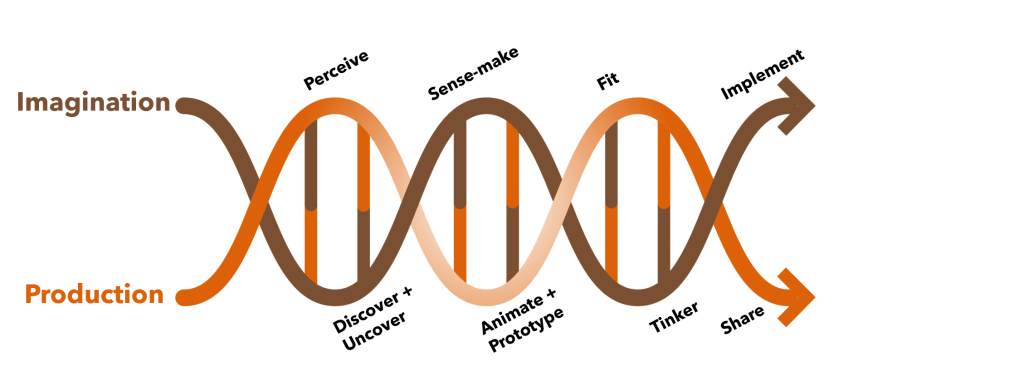
The Design Helix

We developed the Design Helix as a model to explain the activities that go into design. Like any good model, it’s meant to guide, not prescribe, design work.

You can start by identifying a problem or situation you want to change. Nearly every organization faces situations they want to see improved, avoided, or enhanced. What’s sometimes called Problem Finding is a big part of design, because we often tackle the wrong problem.

People don’t want a quarter-inch drill, they want a quarter-inch hole”

Theodore Leavitt (attributed)

The above quote illustrates a common issue of people confusing the problem with a solution. Purchasing a drill to create a hole is one solution. But what is the hole for? If it’s to hang a picture, then ask yourself if there are other ways to hang the picture? Do you need a picture? Could a change of paint or a houseplant do the same thing? Is the point of the drill the hole, what the hole does, or whether the hole is a means in a chain to beautify a room? Your solution might be to purchase a drill, but it could be many other things.

The technique known as the 5-Whys is one of the ways we can get closer to the root of the situation and better define the problem at hand. This is part of doing design. The Design Helix guides us through two parallel, intertwined processes: imagination (envisioning what might be) and production (creating what is or will be).

Problem Defined, Solution Imagined

Innovators are interested in solutions — they want something better than before. Design is the means to create and sustain that. Defining a better problem is a big step toward developing that better solution.

Focus is a great benefit here. Most organizations have so much going on that focusing becomes difficult. They spend too much time focused on irrelevant or inconsequential problems. Once we have our problem or situation clarified, design allows us to walk through steps to address it.

That begins with research to reveal and explore what we know about our situation. This helps us to see if a solution exists and has yet to be implemented or whether there are aspects of a solution available to us that we can combine to address our problem or situation. Research will 1) optimize what is known, 2) spot opportunities in what’s already in place, 3) assess whether a solution can be achieved, 4) avoid costly development time and resources chasing an unsolvable issue, or 5) lead us down the innovation path.

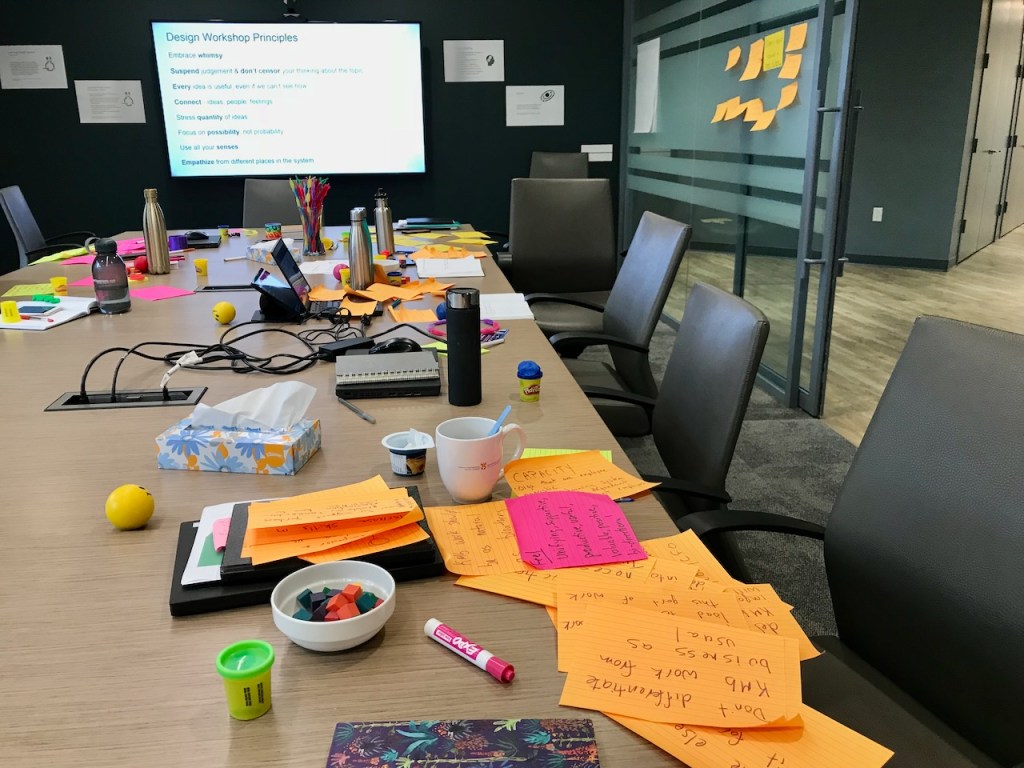
This is where we combine what we know with what we can imagine. It’s where the many tropes and (often) misleading models of design thinking come to mind, like people using sticky notes and whiteboards to brainstorm. In truth, this does happen sometimes. But the means to surfacing and generating ideas are many. At Cense, we use all those tools (and more) and also virtual spaces and dashboards and embed the idea-generation process in imagining possible futures and connecting it with strategy.

It’s part of a conversation about what you want, where you are, and where you want to go. We make better conversations by design.

Make Sense, Make Change

#DesignThinkinginAction

By sensemaking — a structured process of going over what we know, checking our assumptions, and matching it all with resources — we can figure out what we need to do next. Sensemaking takes our ideas and winnows them into possibilities that we can turn into innovations.

Next, we make things. Try these ideas out and make prototypes — mock-ups of the solution — in physical form, digital form, or even as a thought experiment. This helps innovation by testing our hypotheses, learning by doing, and also helps de-risk our ideas. By testing them out in limited form before deploying them widely, we can find bugs, correct assumptions, and make enhancements before they become live. This is a structured and very safe process, but it requires a willingness on the part of those designing. Usually, our designs could be better at the beginning. We make things better over time with iterative development, refinements and care.

This means you end up with a new product or service and a means to understand your market.

The alternative? Come up with a “good idea” and hope it works. Design is systematic, thorough, and focused on what people will use, not just what people want. That focus on the product and the consumer, customer, client, or citizen (whoever you’re designing for) and understanding how it fits within a system is what design is all about.

Are you interested in learning more about how this design process works and how it can help you? You can check out the design series on Censemaking, our blog archives, and, of course, contact us if you want help doing more to do better.

The post How to Use Design for Innovation appeared first on Cense Ltd. .

Written by cplysy · Categorized: cameronnorman

Dec 23 2022

Designing Powerful Gatherings for Impact

There is an art to creating a great gathering. There is also a science of sorts. We create great gatherings by design — meaning we take the principles of great service design and apply them to an event.

Whether it is a board retreat, an annual general meeting, or maybe a think tank, a great event starts with a good design. By good design, we mean applying what we know of the art and science of Design to gathering. It’s about creating experiences that meet a need and add value beyond what could be done independently.

That’s one of the reasons we gather.

Events As Services

A service has the following qualities:

  1. A purpose
  2. A set of resources designed to achieve that purpose
  3. A setting
  4. An interaction between a service-seeker and the service provider

An event is a type of service. The service-seeker (participant in the event) brings with her some expectations and is seeking to join the event for a purpose. Our job as a designer is to determine what their purpose(s) might be. That might be to learn something, to meet people, to create opportunities for business or partnerships, or to simply escape their usual day-to-day. It might be any or all of these.

Organizers have a purpose, too. They want to promote something, connect people, elicit ideas or feedback, work through problems, or make decisions. There are myriad reasons why we gather and why organizers want to host events.

As a designer, we look to how we can create value through an event for everyone — the service provider (the host) and the service seeker (the participants). This means designing for many different needs, wants, preferences and capacities and aligning them.

Next, we look at what resources we have available to achieve our goals. This is our space, time, people, and budget to ensure we achieve something worthy of the time, care, and attention of those who attend.

Why? Because our time and attention are more valuable than anything involved in an encounter.

Using tools like storyboards or attractor maps, we can map out the journeys of participants through the event toward a destination. When doing this, we consider both physical and virtual spaces involved and plan out the event from the very moment that someone encounters an event promotional message to the time they leave and beyond.

Events As Transformation

It’s our human-to-human links that make the most meaningful moments of our lives.

Joshua Cooper Ramo

The COVID-19 pandemic and everything tied to it reminded us of the role of gathering in our lives. We’ve learned that we can do things online that we never envisioned. We can work together more effectively using remote digital tools than before. We also see the value of real, in-person face-time.

We’ve come to learn how valuable our time is and what the value is in gathering.

If we are to spend the time and energy gathering, we need to make it pay. Pay means showing value — it has to be worth our time, care, and attention. When done well, our gatherings should transform. To use our key indicator of design: they must inspire.

A successful event must be designed for transformation. A powerful event takes us from here to there. That is a journey. It means we need to engage people, enlighten them, and ensure that those who attend engage with each other. It’s the reason why a single person attending a remote webinar, not engaging with others, rarely achieves transformative change.

A journey means knowing where we are when we begin, who is involved, what pathways we want people to travel (there may be many), and where we want them to go after their journey. This involves combining journey map-style methods with a theory of change. None of these need to be elaborate; rather they simply must be intentional. We have to be clear about what we want, otherwise, the event isn’t going to be designed properly.

Events as Process

How often have we been to events that were a bust because they weren’t fit for purpose? We’ve been to educational events that could have done a better job of teaching, networking events that gave few means for people to connect, and think tanks that provided little space to think and reflect. It happens all the time.

Good events come by design. Transformation comes from intention.

To achieve impact, we consider the event beyond the boundaries of the time and space allocated. A great, transformative event should linger. For example, we want people to learn by reflecting on what they encountered and using it long after they attend an event. So why end our interaction when people leave? Follow-up. We have the tools to do it.

This means designing the event as a process. You can design your event from the moment you share the first word about it to the last goodbye and follow-up. This is what makes the event memorable, and it’s those memories that form the fabric of our lives. It’s why we gather and connect.

Put thought together about what you want and what you want to happen, and then apply some service design thinking, and you will have something more than a gathering; it’s transformation.

Please contact us if you’re looking at hosting a strategic gathering to achieve impact and transformation. We design, facilitate, and evaluate them for impact.

The post Designing Powerful Gatherings for Impact appeared first on Cense Ltd. .

Written by cplysy · Categorized: cameronnorman

Nov 25 2022

Strategy as Conversation

A great strategy is designed. This means it was planned, implemented, and evaluated in ways that are aligned with the vision of the organization. Poor strategy neglect some or all of this.

We’ve seen many strategies poorly planned, not implemented, never evaluated and misaligned with the values and vision of the organization.

However, because we are dealing with human systems — complex, living systems — a strategy can’t be rigid and inflexible. This means creating the capacity to design, learn, and implement in a flexible, adaptive way.

We approach strategy as a conversation.

This means listening, reflecting, and speaking (projecting) in dialogue with the circumstances your organization finds itself in. Good conversations might have an explicit purpose, but there is an element of emergence that makes them attractive. Great conversations have aspects of curiosity, discovery, and serendipity.

We never know what a conversation will bring, even if we know what kind of information we wish to share. This metaphor and approach are particularly salient now. We are seeing such global transformation, disruption and uncertainty that taking a curious approach to what we see and do is a way to facilitate this adaptation.

Conversation Practice

What does this mean in practice?

  • It means viewing strategy as a process as much as an outcome.
  • Build a developmental approach to both design and evaluation.
  • Engage in — and set aside time and space for — sensemaking regularly.
  • Promise to learn absolutely and execute based on learning, not set plans.

These are simple steps but powerful in their impact. We help organizations do this by creating — by design — space to talk and learn. Make sure you create space to do this and view strategic conversations as something you regularly have, not every 5 years.

We love a good conversation. We also love good coffee, too. They go together well, so if you want to have both, reach out and let’s talk.

Image credit:  Gary Butterfield on Unsplash

The post Strategy as Conversation appeared first on Cense Ltd. .

Written by cplysy · Categorized: cameronnorman

  • « Go to Previous Page
  • Go to page 1
  • Go to page 2
  • Go to page 3
  • Go to page 4
  • Go to page 5
  • Go to page 6
  • Interim pages omitted …
  • Go to page 21
  • Go to Next Page »

Footer

Follow our Work

The easiest way to stay connected to our work is to join our newsletter. You’ll get updates on projects, learn about new events, and hear stories from those evaluators whom the field continues to actively exclude and erase.

Get Updates

Want to take further action or join a pod? Click here to learn more.

Copyright © 2026 · The May 13 Group · Log in

en English
af Afrikaanssq Shqipam አማርኛar العربيةhy Հայերենaz Azərbaycan dilieu Euskarabe Беларуская моваbn বাংলাbs Bosanskibg Българскиca Catalàceb Cebuanony Chichewazh-CN 简体中文zh-TW 繁體中文co Corsuhr Hrvatskics Čeština‎da Dansknl Nederlandsen Englisheo Esperantoet Eestitl Filipinofi Suomifr Françaisfy Fryskgl Galegoka ქართულიde Deutschel Ελληνικάgu ગુજરાતીht Kreyol ayisyenha Harshen Hausahaw Ōlelo Hawaiʻiiw עִבְרִיתhi हिन्दीhmn Hmonghu Magyaris Íslenskaig Igboid Bahasa Indonesiaga Gaeilgeit Italianoja 日本語jw Basa Jawakn ಕನ್ನಡkk Қазақ тіліkm ភាសាខ្មែរko 한국어ku كوردی‎ky Кыргызчаlo ພາສາລາວla Latinlv Latviešu valodalt Lietuvių kalbalb Lëtzebuergeschmk Македонски јазикmg Malagasyms Bahasa Melayuml മലയാളംmt Maltesemi Te Reo Māorimr मराठीmn Монголmy ဗမာစာne नेपालीno Norsk bokmålps پښتوfa فارسیpl Polskipt Portuguêspa ਪੰਜਾਬੀro Românăru Русскийsm Samoangd Gàidhligsr Српски језикst Sesothosn Shonasd سنڌيsi සිංහලsk Slovenčinasl Slovenščinaso Afsoomaalies Españolsu Basa Sundasw Kiswahilisv Svenskatg Тоҷикӣta தமிழ்te తెలుగుth ไทยtr Türkçeuk Українськаur اردوuz O‘zbekchavi Tiếng Việtcy Cymraegxh isiXhosayi יידישyo Yorùbázu Zulu