• Skip to main content
  • Skip to footer
  • Home

The May 13 Group

the next day for evaluation

  • Get Involved
  • Our Work
  • About Us
You are here: Home / Archives for allblogs / cameronnorman

cameronnorman

Jun 13 2022

Three Metrics for Design Evaluation

Design is about the creation of products, services, policies, and systems for use and benefit. It’s a structured, creative process that shapes what we do, how we do it, and what impact we create. Design is fundamentally about innovation: doing something different or new for benefit within a context.

Inspiration, Utility, and Values

How should we measure design and its impact on our organization? We suggest three core evaluation metrics above all to consider.

  1. Inspiration. A design has to inspire you. If you’re not excited about what you’re producing, why would it inspire your clients, customers, or users? By inspiration, we mean that it must capture or focus attention, delight, or attract energy. It does not mean a design has to be glamorous, just that it’s noticed for its purpose or appropriately invisible. For example, creating a negative opt-in to organ donation on driver’s license renewal forms vastly increases the donor pool (and reflects the desire of the population to be donors in the process) because it means people have to choose not to donate, rather than the opposite. Even with something benign like a form adjustment, Inspiration is an outcome.
  2. Utility. Use is the second key metric. Design is about being fit for purpose and if there is a poor fit then the benefits will also be poor. A great design fits the purpose for what it was designed for and is useful. It doesn’t have to be the best, just useful and better than the available alternatives. If your design is not used, then no matter how functional, attractive, or conceptually sound it is, it is a failure.
  3. Values. The alignment of your design with the values of your organization is critical to ensuring that the benefits that you accrue are the ones you want. If you value sustainability and responsibility, then your design has to reflect that. To illustrate, if you’re a company or organization that stands for human rights and ethical practices, what you produce (your designs) needs to reflect that. We see a lot of problems with organizations that say one thing and then design for something else.

From Perfection to Fit

There are no ‘perfect’ designs. A design is made within a time and context and the value and benefit of that design will change over time as the context changes. Even if we want things to stay the same and stable, the world around our designs is changing and evolving. Designs are also made with constraints posed by resources, time, and circumstances. However, design is designed — your process and procedures need to aspire and be set up to achieve the results you’re looking for.

These changes are why evaluation is such an important part of design: we need to continue to monitor and evaluate our designs in light of changes in context and circumstance.

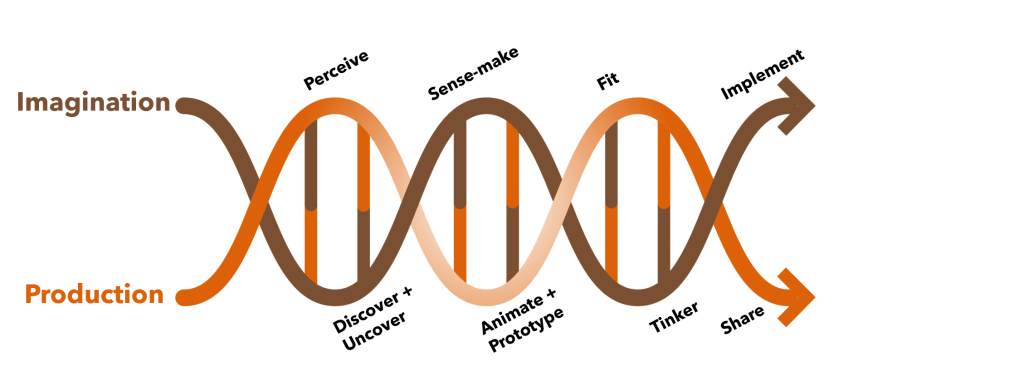
We can’t hope for inspiration, utility, and alignment with values unless we design our designs to match that. Models like the Design Helix (below) can provide some guidance on what can be done to facilitate this.
The process of design and innovation is part art and part science. If you’re looking to design better — whether it’s to improve your products and services, make better policies, or build a culture of innovation we can help. Let’s talk.

Photo by Annie Spratt on Unsplash

The post Three Metrics for Design Evaluation appeared first on Cense Ltd. .

Written by cplysy · Categorized: cameronnorman

May 19 2022

Thinking Frameworks

You might have heard or read about concepts like Systems Thinking and Design Thinking (both with and without capital letters) and asked yourself: what do they mean?

We see both of these are frameworks for thinking about problems. It’s somewhat confusing, but both systems thinking and design thinking are more than just ways of thinking, they often refer to a constellation of methods, tools, and approaches to problems.

For that reason, we tend to prefer using the terms systems practice and design instead. However, as frameworks for understanding problems, situations, and issues we see much benefit in using the term thinking.

Just like the image above: our thinking frameworks can help us determine whether we’re looking at the land, the sea, or both, together.

Why Thinking Frameworks?

Our mindset — the mental models, habits of mind, or ways of thinking about something — is the primary factor influencing what we do (or do not do). It shapes how we see the world around us, what we attend to, and determines what has value. When we become aware of how we think we reveal the biases (everyone has them) that direct our attention so we’re better able to direct them to where we want intentionally.

We use thinking frameworks in our work by starting out with identifying what kind of ones our clients are using. Ask yourself: what central ideas are useful to us in doing our best work?

This might include concepts such as: evidence-based practice, learning organizations, ethics stances (e.g., ‘green’), values-based frameworks, use-centred (e.g., words like ‘practical’ and ‘user-centred’). Any of these provide guides to what is valued in an organization. There are many more of these.

Exploring Thinking Frameworks

Once we’ve done that, we start to interrogate it (see what we mean by that narrative here). This process involves asking questions that connect what someone says, what they do, and what they accomplish. This helps to see where there might be alignment or misalignment.

In dynamic markets or communities it’s easy to see how an organization can be misaligned. Policies, strategies, and organizational practices are designed for a certain time and place using a certain kind of thinking framework and as things change so does the potential utility of what we’ve created.

By identifying how we think, we are better able to determine the benefits of it and make modifications.

A great tool is using visual thinking and simple sketch notes to illustrate our thinking. By visualizing what we think about we can better tell how we think.

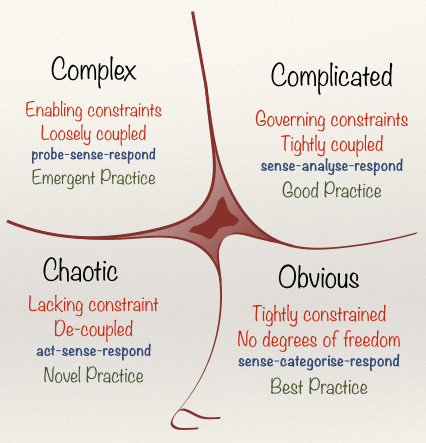
Tools like the Cynefin Framework can also focus our thinking (in this case about systems) to help refine our mental models.

Don’t make this complicated. There’s no need to worry about coming up with the correct terms, language or model for how or what you think about. The key is to simply identify and become more acquainted with how you think, see the benefits that confers, and understand its limitations. By seeing the blind spots, you’re better at seeing opportunities.

Cense helps our clients see things differently so they can do things differently. If you want help seeing or doing things differently, reach out and let’s talk about how we can be of service.

Image Credit: Xhulio Selenica on Unsplash

The post Thinking Frameworks appeared first on Cense Ltd. .

Written by cplysy · Categorized: cameronnorman

May 10 2022

Practical Systems Thinking: The Cynefin Framework

The Cynefin Framework is among the most widely used frameworks for understanding how systems are organized. It might be the most practical means of bringing systems thinking to life. A system, after all, is simply an organization of things within some constraint or boundary.

We rely on The Cynefin Framework (pronounced /kəˈnɛvɪn/ kuh-NEV-in) as a central platform in our training and consulting work for strategy, evaluation, and design. The reasons are many, but its utility is the most important of them.

What makes the Framework so useful is that people can relate to the stories we tell about systems using it. Perhaps the best story comes from the Framework’s founder and chief advocate, Dave Snowden in describing how to organize a children’s party using systems thinking*.

This video has been our most widely-referred source for teaching the fundamentals of systems thinking since it was first made.

The Framework has also been an inspiration informing the development of a centre for studying and intervening in complex systems based in Wales. It’s also developed into a burgeoning practice and learning community centred around the model.

The video below adds detail to help explain how the Cynefin Framework functions and where it came from.

We recommend reading Chris Corrigan’s excellent update on the Cynefin Framework. Chris has been one of the leading practitioners contributing to the thinking on the Framework’s use and development.

Using the Framework

Unlike many other Frameworks, Cynefin is useful throughout a project life cycle, not just at a particular stage.

In the beginning, we recommend using it to orient yourself to the situation you’re facing. What kind of problem situation do you find yourself in? What elements of the situation are complicated, complex, or simple? These questions aided by the Framework can help you identify key aspects of the system and complement systems mapping work.

As you move through the project, the Framework can help serve as a wayfinding tool. When you know where you are, it is easier to see where you are going. Social systems are dynamic, so while we may find ourselves in a quadrant at one stage, this can shift during the project or at particular moments.

The Framework can also be used as an evaluation tool by helping frame the questions you ask and the strategies that link your actions to your outcomes. By inquiring about the way your work and activities are organized within systems, we can ask better questions and assess real influence and possible impact.

We recommend starting any evaluation with the Cynefin Framework.

We also recommend using the framework as part of a strategic assessment approach to planning and sensemaking. The framework can help you to determine the role of evidence and practice — when to look for ‘best evidence‘, practice-based evidence, and innovative problem-solving options.

Moving Forward with Cynefin

We recommend using Cynefin Framework to anyone working in applied systems thinking, check it out. There is a global community of scholars, practitioners, and policy-makers who are working on advancing, testing, and documenting the use of it in practice. A recent book has been published that provides further examples and can be of use to anyone looking to get into Cynefin.

It’s worth the effort to explore – and we think you’ll agree.

* It is worth noting that our use of the term systems thinking is just that: thinking about systems and how they are organized and function. We recognize there are many different definitions and models of systems thinking including those used by Dave Snowden that may not fully subscribe to ours.

If you want help in applying lessons from the Cynefin Framework or building up your systems thinking capacity for action and strategy, reach out and let’s have a coffee meeting. We can help.

Image credit: Mitchell Luo on Unsplash; Snowded, CC BY-SA 3.0 https://creativecommons.org/licenses/by-sa/3.0, via Wikimedia Commons

The post Practical Systems Thinking: The Cynefin Framework appeared first on Cense Ltd. .

Written by cplysy · Categorized: cameronnorman

May 04 2022

Using Canvases

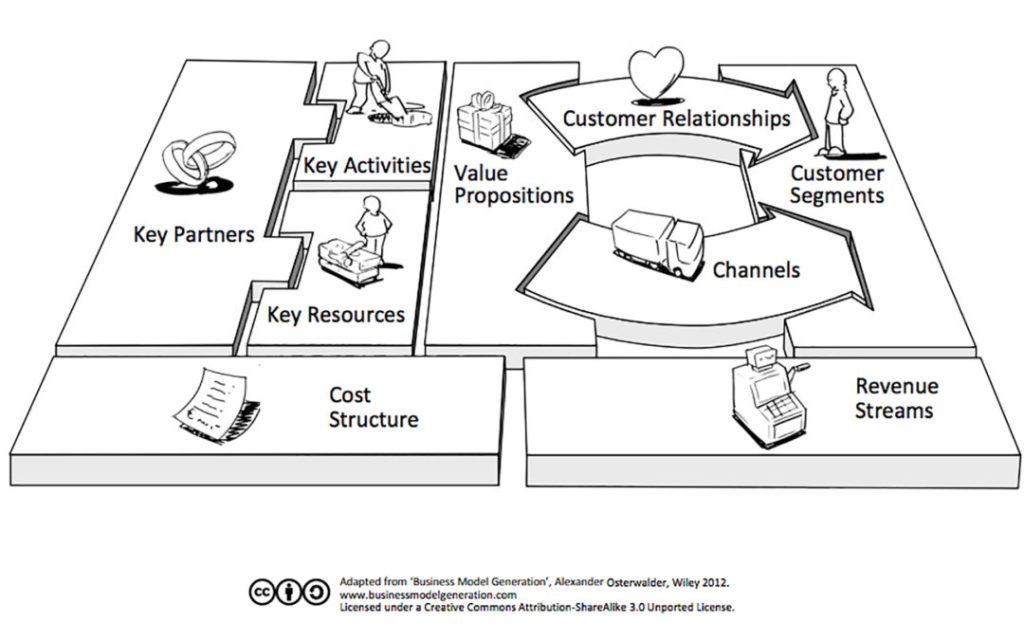
You might have noticed that the world seems to be awash in canvases these days. The canvas model owes much of its popularity to the work of Alex Osterwalder and Yves Pigneur and their Business Model Canvas.

A canvas is a form of system mapping that visualizes critical aspects of a system and organizes them. A canvas uses visual conventions like boxes and arrows to lay out key assumptions, resources, actors, and value claims.

Three examples of popular canvases include:

  1. Business Model Canvas
  2. Value Proposition Canvas
  3. Social Lean Canvas

Andi Roberts has pulled together a massive list of fifty different types of canvases that cover issues ranging from value chain analysis, ethics, and strategy, to project management and more.

Some popular canvases like the Business Model Canvas are even pre-loaded as templates in visual thinking tools like Miro and Mural.

There is even a tool called Canvasizer that can help you create your own personalized canvas.

But how do we use these in practice?

Canvas Application

Most of these canvases rely on a similar structure. The simple form of using 8-12 boxes organized in an essentially linear format. This is a strength and weakness of the approach. The reason? It reduces complexity and interdependence, favouring a simplified organizational approach.

The simplification makes it attractive to people and relatively easy to use. The difficulty is the risk of oversimplifying the situation and confusing the model with reality.

It is for both of these reasons that we use canvases with caution. Canvases can be helpful in the following circumstances:

  1. When a project team is unsure where to start. A canvas reduces complexity and can help people start getting things on the page. Just getting started can be an enormously powerful reason to use canvases. Too often, organizations pause because they do not know where to begin. This can nudge that process forward.
  2. When the research hasn’t been entirely done or organized while the need to move forward is high in its absence. Sometimes, there are holes in the research (what we know about a situation) and plotting key themes or issues on a canvas can help us to hypothesize more clearly what else we need, know, or ought to consider.
  3. In times when there isn’t a budget to support in-depth research and sense-making. Canvases can help us to anticipate what a situation has present and available. In the absence of data, we can imagine what might be needed. This isn’t faking data and should be used when research is used to guide, not to prove or validate.
  4. When the number of anticipated themes and key variables for consideration is relatively tiny. Massive systems with many variables don’t fit well, but in many situations, we are not dealing with large, massive, complicated systems — they are small and complex. There are a few key categories and for these, canvases can work well.
  5. When there’s coaching time available. Canvases shouldn’t be used for client work without sense-making and coaching. We see many people confuse the map and model with the landscape and reality.. Plotting out data on a canvas is relatively simple and can be done with little time. What takes time is making sense of what it means and how it can inform strategy. Designing a strategy from a canvas takes time, care, and attention. Doing this is where the value of a canvas comes in.

Canvases are useful. Find or create one, and you can focus your team on what’s most important, organize it, and help foster the kind of conversations needed to assess what to do and how we might do it in the future. Canvases are design tools, and if you consider their advantages and limitations, you can become a great organizational designer.

We use canvases and many other tools. If you want some help setting this up, applying it, or learning other tools and methods, let’s have a coffee and talk about your needs and how we can help.

The post Using Canvases appeared first on Cense Ltd. .

Written by cplysy · Categorized: cameronnorman

May 04 2022

Using Decision Canvases

You might have noticed that the world seems to be awash in canvases these days. The canvas model owes much of its popularity to the work of Alex Osterwalder and Yves Pigneur and their Business Model Canvas.

A canvas is a form of system mapping that visualizes critical aspects of a system and organizes them. A canvas uses visual conventions like boxes and arrows to lay out key assumptions, resources, actors, and value claims.

Three examples of popular canvases include:

  1. Business Model Canvas
  2. Value Proposition Canvas
  3. Social Lean Canvas

Andi Roberts has pulled together a massive list of fifty different types of canvases that cover issues ranging from value chain analysis, ethics, and strategy, to project management and more.

Some popular canvases like the Business Model Canvas are even pre-loaded as templates in visual thinking tools like Miro and Mural.

There is even a tool called Canvasizer that can help you create your own personalized canvas.

But how do we use these in practice?

Canvas Application

Most of these canvases rely on a similar structure. The simple form of using 8-12 boxes organized in an essentially linear format. This is a strength and weakness of the approach. The reason? It reduces complexity and interdependence, favouring a simplified organizational approach.

The simplification makes it attractive to people and relatively easy to use. The difficulty is the risk of oversimplifying the situation and confusing the model with reality.

It is for both of these reasons that we use canvases with caution. Canvases can be helpful in the following circumstances:

  1. When a project team is unsure where to start. A canvas reduces complexity and can help people start getting things on the page. Just getting started can be an enormously powerful reason to use canvases. Too often, organizations pause because they do not know where to begin. This can nudge that process forward.
  2. When the research hasn’t been entirely done or organized while the need to move forward is high in its absence. Sometimes, there are holes in the research (what we know about a situation) and plotting key themes or issues on a canvas can help us to hypothesize more clearly what else we need, know, or ought to consider.
  3. In times when there isn’t a budget to support in-depth research and sense-making. Canvases can help us to anticipate what a situation has present and available. In the absence of data, we can imagine what might be needed. This isn’t faking data and should be used when research is used to guide, not to prove or validate.
  4. When the number of anticipated themes and key variables for consideration is relatively tiny. Massive systems with many variables don’t fit well, but in many situations, we are not dealing with large, massive, complicated systems — they are small and complex. There are a few key categories and for these, canvases can work well.
  5. When there’s coaching time available. Canvases shouldn’t be used for client work without sense-making and coaching. We see many people confuse the map and model with the landscape and reality.. Plotting out data on a canvas is relatively simple and can be done with little time. What takes time is making sense of what it means and how it can inform strategy. Designing a strategy from a canvas takes time, care, and attention. Doing this is where the value of a canvas comes in.

Canvases are useful. Find or create one, and you can focus your team on what’s most important, organize it, and help foster the kind of conversations needed to assess what to do and how we might do it in the future. Canvases are design tools, and if you consider their advantages and limitations, you can become a great organizational designer.

We use canvases and many other tools. If you want some help setting this up, applying it, or learning other tools and methods, let’s have a coffee and talk about your needs and how we can help.

The post Using Decision Canvases appeared first on Cense Ltd. .

Written by cplysy · Categorized: cameronnorman

  • « Go to Previous Page
  • Go to page 1
  • Interim pages omitted …
  • Go to page 4
  • Go to page 5
  • Go to page 6
  • Go to page 7
  • Go to page 8
  • Interim pages omitted …
  • Go to page 21
  • Go to Next Page »

Footer

Follow our Work

The easiest way to stay connected to our work is to join our newsletter. You’ll get updates on projects, learn about new events, and hear stories from those evaluators whom the field continues to actively exclude and erase.

Get Updates

Want to take further action or join a pod? Click here to learn more.

Copyright © 2026 · The May 13 Group · Log in

en English
af Afrikaanssq Shqipam አማርኛar العربيةhy Հայերենaz Azərbaycan dilieu Euskarabe Беларуская моваbn বাংলাbs Bosanskibg Българскиca Catalàceb Cebuanony Chichewazh-CN 简体中文zh-TW 繁體中文co Corsuhr Hrvatskics Čeština‎da Dansknl Nederlandsen Englisheo Esperantoet Eestitl Filipinofi Suomifr Françaisfy Fryskgl Galegoka ქართულიde Deutschel Ελληνικάgu ગુજરાતીht Kreyol ayisyenha Harshen Hausahaw Ōlelo Hawaiʻiiw עִבְרִיתhi हिन्दीhmn Hmonghu Magyaris Íslenskaig Igboid Bahasa Indonesiaga Gaeilgeit Italianoja 日本語jw Basa Jawakn ಕನ್ನಡkk Қазақ тіліkm ភាសាខ្មែរko 한국어ku كوردی‎ky Кыргызчаlo ພາສາລາວla Latinlv Latviešu valodalt Lietuvių kalbalb Lëtzebuergeschmk Македонски јазикmg Malagasyms Bahasa Melayuml മലയാളംmt Maltesemi Te Reo Māorimr मराठीmn Монголmy ဗမာစာne नेपालीno Norsk bokmålps پښتوfa فارسیpl Polskipt Portuguêspa ਪੰਜਾਬੀro Românăru Русскийsm Samoangd Gàidhligsr Српски језикst Sesothosn Shonasd سنڌيsi සිංහලsk Slovenčinasl Slovenščinaso Afsoomaalies Españolsu Basa Sundasw Kiswahilisv Svenskatg Тоҷикӣta தமிழ்te తెలుగుth ไทยtr Türkçeuk Українськаur اردوuz O‘zbekchavi Tiếng Việtcy Cymraegxh isiXhosayi יידישyo Yorùbázu Zulu