• Skip to main content
  • Skip to footer
  • Home

The May 13 Group

the next day for evaluation

  • Get Involved
  • Our Work
  • About Us
You are here: Home / Archives for allblogs / cameronnorman

cameronnorman

Nov 01 2022

Speed Versus Depth

There are many threats to quality action and behaviour change, but the most persistent and pernicious of these is brevity.

Speed and efficiency are two twins tied to productivity, value, and innovation. At least, in theory.

We have yet to see any substantive value created from a fast, quick fix or rapid change initiative. Change takes time and if we were to recommend anything to prospective clients or those seeking it in their work, this is it.

You can not dodge through the work required to prime people for change and to support them through it.

We can’t speed past a process of innovation development to get a high-quality product faster. There are rare cases where things go much faster than anticipated, but those are just that: rare. No one can design for this.

Better Living Systems

One of the significant issues is that we have to design for living systems. These systems adhere to the laws of complexity. This means we can’t control systems or predict outcomes; we can only create means to influence behaviour and limit the effects of actions on us. Design principles for living systems also require us to account for things like evolution, relationships, network effects, and feedback.

Organizations operate the same way. We see our clients wrestle with the expectations of their boards, staff, funders, and communities for change and have to deal with pressures to do it fast. Yet, we also see the enormous benefits of taking things slower — at the pace of a living system. This allows organizations to learn, reflect, and design their pathway wisely.

Just as we can’t rush growing a garden (even if we wanted to), we can’t do this for organizations and change, either.

We are much like a car driving through the woods; our engine is powerful, and our capacity for speed might be significant. But the journey is beautiful, the leaves are falling, and change is everywhere. If we go too fast we might miss what’s going on.

Image by Roberto Nickson on Unsplash

The post Speed Versus Depth appeared first on Cense Ltd. .

Written by cplysy · Categorized: cameronnorman

Aug 09 2022

Principles: Evaluation, Strategy and More

Over at our sister site (Censemaking), we are publishing a series on Principles-Focused Evaluation. The series is looking at the basic building blocks that underpin the approach and will describe how to use it.

We will be posting some additional materials here at a later date.

But before one starts out using principles, it’s essential to understand what they are and why they matter.

Principles in Practice

When we look at principles in practice we first need to look at the definition of the term.

PrincipleDownload

As we can see from above, principles are guides for conduct. They are touchstones that can inform planning and action in the face of uncertainty. If we were sure about causes and consequences, we could rely on rules. When we are uncertain, principles will have to do.

Principles are also evaluable.

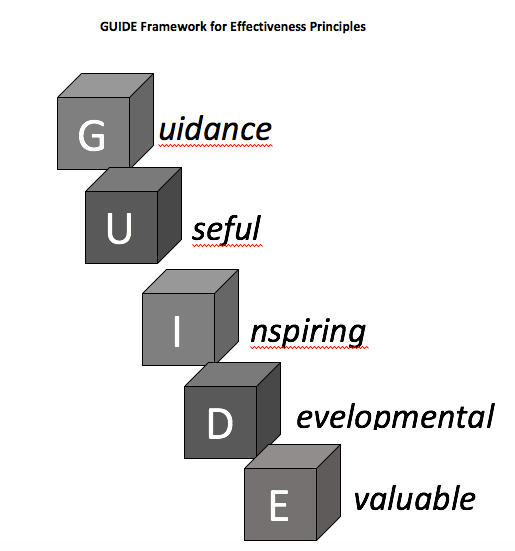
Michael Quinn Patton has riffed on this role of principles in his GUIDE Framework for Principles-focused Evaluation.

As Patton writes on Principles-Focused Evaluation,

Principles-focused evaluation examines (1) whether principles are clear, meaningful, and actionable, and if so, (2) whether they are actually being followed and, if so, (3) whether they are leading to desired results.  Principles are derived from experience, expertise, values, and research.

Principles, Values and Strategy

Principles reflect our values. Values are about what has meaning for us, what we invest in, and subsequently, what has value. That is why we can evaluate good principles.

The first step in developing principles is determining what you value.

The second step is determining your values. Values are the beliefs we hold that guide our actions and shape our identity.

Thirdly, connect the two; this is strategy.

Drawing on the GUIDE framework above, consider reflecting on what you value, your values, and how (or if) they are connected. We work with many organizations with a gap between their stated values and desires and their actions. Much of our work is on closing this gap with our clients. The reasons are often that we let our environment shape our actions without connecting them to values or value.

We find many clients do things with low value yet are a product of legacy systems in place to accomplish something else. By clarifying our values and determining what has value, we can change this by design.

This is what strategic design is all about.

So now you know why principles, strategy, and design are all related.

If this is something that you want help in doing, let’s talk. This is what we do.

Photo by Amrit Sangar on Unsplash

The post Principles: Evaluation, Strategy and More appeared first on Cense Ltd. .

Written by cplysy · Categorized: cameronnorman

Jul 26 2022

The Innovation Walkabout

Did you ever notice how much you take in visiting a new city or town for the first time?

Maybe it’s time to get out more.

The Innovation Walkabout is a simple technique that adopts what we do naturally when encountering something new. The method is as simple as it sounds.

The first step is to pick an issue you’re looking to develop. This might be expanding a market, serving a client better, or changing your focus.

Our second step is to find a physical space where you can learn about this issue. This would be where your customers are, your competition might be, or something else.

The third step is to go for a walk to this place with the mindset of being a newcomer. What do you notice?

What are people doing? Pay attention to the kind of relationships that you see. Are there structures — physical or otherwise — that inhibit or facilitate what happens in that space?

What Do You Notice?

When you notice something, ask yourself: what else? We suggest adopting a coaching stance by asking these questions:

  1. What is going on and what captures your attention?
  2. What else do you notice? Keep asking: what else and you’ll be amazed at what you come up with.
  3. Can you imagine what your collaborators would notice?
  4. How about what your competitors might notice?
  5. What would someone who sees this scene every day notice?

When we ask these questions, we start taking the stance of different audiences — this helps us to learn. Take notes on what you see, sense, think, and hear. By taking better notes you can increase your learning, too.

So What?

This seems almost absurdly simple, but that is where its power lies. We can do this almost anytime. The metrics for success in this exercise are:

  1. New insights.
  2. New ideas.
  3. Number of ideas.
  4. Quality — detail — within those ideas.

If you are looking to innovate and need some new intelligence, try walking outside your door. Be intentional and purposive in your walking. Practice what Rob Walker calls “The Art of Noticing” and you will find you notice a lot more.

You might be surprised at what you see and find to help you out.

We design systems to help integrate simple and complex strategies for learning and innovating. If you want help to grow, learn and innovate, reach out and lets go for a walk. Who knows what we’ll notice together?

Image Credit: yns plt on Unsplash

The post The Innovation Walkabout appeared first on Cense Ltd. .

Written by cplysy · Categorized: cameronnorman

Jul 14 2022

Note-Taking for Learning and Innovation

Do your notes bore you? They shouldn’t if you’re serious about learning.

Note-taking is among the most powerful, accessible, and portable means to support innovation and learning. Yet, most of us do it poorly. Do you review your notes after you take them? Do you know why you are taking notes in the first place?

There is an art to good note-taking and to using notes effectively. Notes capture what happens, what is discussed or observed, and record insights and commentary — but only if we use them.

Let’s look at ways to improve this.

Tools of the Trade

Fast Company has a remarkably detailed and useful guide to selecting a notebook. The New York Times annually reviews the best pens. Your choice of both can make a big difference to your willingness to use them. That is the key. The best tools are the ones you use.

If pen-and-paper isn’t your thing, consider using one of many apps. In his new book, Building Your Second Brain, Tiago Forte explores how apps and systems can help us better record and retain information. The secret is that the best app is the one that matches the way that you learn and use notes in your practice.

Forte has conducted research into the use of note-taking apps by canvassing the thousands of people who attend his workshops and he’s found that the top tools are:

  1. Evernote
  2. Obsidian
  3. Notion

These aren’t the only ones out there, but they are the most used. Each of these map on to three different note-taking styles such as those suggested by Anne-Laure Le Cunff, which we’ll explore below.

Note-taking Styles

Anne-Laure Le Cunff from Ness Labs has written extensively on note-taking — read her detailed explanation here. She reviews the literature and suggests a variety of strategies that work depending on your goals and preferences. She also provides recommendations on which app to use based on the kind of note-taker you are.

Le Cunff proposes three main note-taking styles:

  • The architect. They enjoy planning, designing processes and frameworks, and need a note-taking tool that allows them to easily structure their ideas.
  • The gardener. They enjoy exploring, connecting various thoughts together, and need a note-taking tool that allows them to easily grow their ideas.
  • The librarian. They enjoy collecting, building a catalogue of resources, and need a note-taking tool that allows them to easily retrieve their ideas.

The best way to learn is to design your systems to match your needs, preferences, and style of note-taking.

Systems of Use

Once you’ve got tools and matched them to your preferences, the next is building an actual use system. This means getting serious about learning. Learning will fail in bad systems as illustrated in a post over on Censemaking.

We suggest asking yourself the following questions ahead of any learning-based activity like a course or webinar:

  • Will I create the time to review, integrate or reflect on what I am exposed to?
  • Is the delivery of this course suited to the ways in which I make sense of the world and develop new skills?
  • Am I invested in the product — a certificate, degree, or outcome — or the process?
  • Am I engaged with this program (course, webinar, tutorial) to escape from asking myself difficult questions about my work?
  • Do I have a system in place to revisit, re-work, and apply what I’ve learned in place before I start?

A good learning system involves the following:

A good learning system is something that:

  1. Reduces distraction (preserves and hones attention to find, gather, synthesize and sense-make the most useful information)
  2. Protects/creates/utilizes time (is fit-for-purpose in connecting our knowledge to our purpose and our strategy)
  3. Articulates care (creates principles for practice)
  4. Fits the culture of your organization (creates space for integration)

Learn By Design

As you can see, any good learning experience involves good design. Our choice of tools, motivation, and systems all shape what we learn, what we retain, and whether it’s of practical value.

Learning is easy to say, more complicated to do. But it is something we can design into our organization.

You can learn to learn better by design. Remember: the best system is the one that you use.

If you want help creating a learning system for your organization to help get the most out of what you do every day, reach out and let’s grab a coffee and learn from one another.

Photo by Jan Kahánek on Unsplash

The post Note-Taking for Learning and Innovation appeared first on Cense Ltd. .

Written by cplysy · Categorized: cameronnorman

Jun 15 2022

Making Visions Work For You

A good vision statement should do many things for your organization. Too often, a vision statement is created that goes into PR and marketing materials, gets framed on the wall, and then left alone. When we have a good vision, we have so much more than that.

Vision statements can indicate your ‘North Star’. A vision statement can also be your Southwest star, too; it’s about indicating direction. But, it’s more than that.

A good vision statement should:

  1. Provide strategic direction.
  2. Help you make decisions about your strategic activities.
  3. Inspire you and your organization.
  4. Focus on the direction of your efforts.
  5. Align your resources with your goals.

Using Your Vision

It’s worth putting in the work to create a strong vision. A vision will allow you to weather the complexity of your market or circumstances. If you’re getting pushed to do new things, a vision can help you to determine what things are most appropriate. A vision might not tell you exactly what to do, but it will reduce the number of options available. By reducing the volume of information and number of decisions, a vision reduces complexity.

That reduction in complexity reduces the amount of effort you need to put into decisions.

When we have fewer decisions, we can focus more on the quality of those decisions.

Creating Your Vision

Vision statements and the like do not need to require days of meetings and processes. We suggest the following steps:

  1. Research what the pressing needs are of the organization.
  2. Ask what the priorities are of the organization based on these needs.
  3. Inquire about what actions are needed to be achieved within a certain time frame (e.g., year, 3-years, etc..).
  4. Determine the values that guide the work.
  5. Bring together the key leaders and stakeholders to frame what kind of feelings and sensations represent success in achieving the goals.
  6. Put these words (descriptors) together.

Yes, it can be that simple. The aim is to create a good enough phrase that can be used in practice. The focus must be on those who will use the vision, not external audiences. Why? Unless you’re looking to create a PR exercise, the vision is meant to inspire and focus your team.

That means designing it for the humans in your organization, not anonymous external individuals. With a vision ready, you can allow it to serve as your compass as you navigate complexity in the years ahead.

Ready to develop your vision? Want help? Let’s talk – we do this with human services organizations working in complex settings, high-pressure environments, and with a need to innovate.

Image Credit: Erlend Ekseth on Unsplash

The post Making Visions Work For You appeared first on Cense Ltd. .

Written by cplysy · Categorized: cameronnorman

  • « Go to Previous Page
  • Go to page 1
  • Interim pages omitted …
  • Go to page 3
  • Go to page 4
  • Go to page 5
  • Go to page 6
  • Go to page 7
  • Interim pages omitted …
  • Go to page 21
  • Go to Next Page »

Footer

Follow our Work

The easiest way to stay connected to our work is to join our newsletter. You’ll get updates on projects, learn about new events, and hear stories from those evaluators whom the field continues to actively exclude and erase.

Get Updates

Want to take further action or join a pod? Click here to learn more.

Copyright © 2026 · The May 13 Group · Log in

en English
af Afrikaanssq Shqipam አማርኛar العربيةhy Հայերենaz Azərbaycan dilieu Euskarabe Беларуская моваbn বাংলাbs Bosanskibg Българскиca Catalàceb Cebuanony Chichewazh-CN 简体中文zh-TW 繁體中文co Corsuhr Hrvatskics Čeština‎da Dansknl Nederlandsen Englisheo Esperantoet Eestitl Filipinofi Suomifr Françaisfy Fryskgl Galegoka ქართულიde Deutschel Ελληνικάgu ગુજરાતીht Kreyol ayisyenha Harshen Hausahaw Ōlelo Hawaiʻiiw עִבְרִיתhi हिन्दीhmn Hmonghu Magyaris Íslenskaig Igboid Bahasa Indonesiaga Gaeilgeit Italianoja 日本語jw Basa Jawakn ಕನ್ನಡkk Қазақ тіліkm ភាសាខ្មែរko 한국어ku كوردی‎ky Кыргызчаlo ພາສາລາວla Latinlv Latviešu valodalt Lietuvių kalbalb Lëtzebuergeschmk Македонски јазикmg Malagasyms Bahasa Melayuml മലയാളംmt Maltesemi Te Reo Māorimr मराठीmn Монголmy ဗမာစာne नेपालीno Norsk bokmålps پښتوfa فارسیpl Polskipt Portuguêspa ਪੰਜਾਬੀro Românăru Русскийsm Samoangd Gàidhligsr Српски језикst Sesothosn Shonasd سنڌيsi සිංහලsk Slovenčinasl Slovenščinaso Afsoomaalies Españolsu Basa Sundasw Kiswahilisv Svenskatg Тоҷикӣta தமிழ்te తెలుగుth ไทยtr Türkçeuk Українськаur اردوuz O‘zbekchavi Tiếng Việtcy Cymraegxh isiXhosayi יידישyo Yorùbázu Zulu