• Skip to main content
  • Skip to footer
  • Home

The May 13 Group

the next day for evaluation

  • Get Involved
  • Our Work
  • About Us
You are here: Home / Archives for allblogs

allblogs

Dec 14 2021

Accessibility Quick Wins: Lower the Numeracy Level

How do we make our graphs more accessible? 

There’s a misconception that accessibility takes all day, that’s it’s costly, or that it’s complicated. Those are all false.
It's a myth that dataviz accessibility is complicated.

Accessibility is woven into all my trainings, but since this is a topic I get asked about a lot, I decided to make a new talk that’s focused just on accessibility for dataviz. 

In Spring 2021 I gave a talk at the Good Tech Fest conference about dataviz accessibility quick wins. 

The talk was a “Choose Your Own Adventure” style where the audience chose what we discussed from a list of options. They chose: 

  • direct labels, 
  • lower the reading level, and 
  • lower the numeracy level. 

You can watch the recording or read the highlights. Enjoy! 

—– 

Watch the Conversation 

You’ll learn about lowering the numeracy level. Then, you’ll see a case study that combines several accessibility quick wins. 

How to Lower the Numeracy Level 

We’ve discussed how to lower the reading level, but how do we lower the numeracy level?  

Lowering the numeracy level just means making sure the numbers are easy to understand.  

There are a couple of stages to this, so even if you only move one step, that’s a win.  
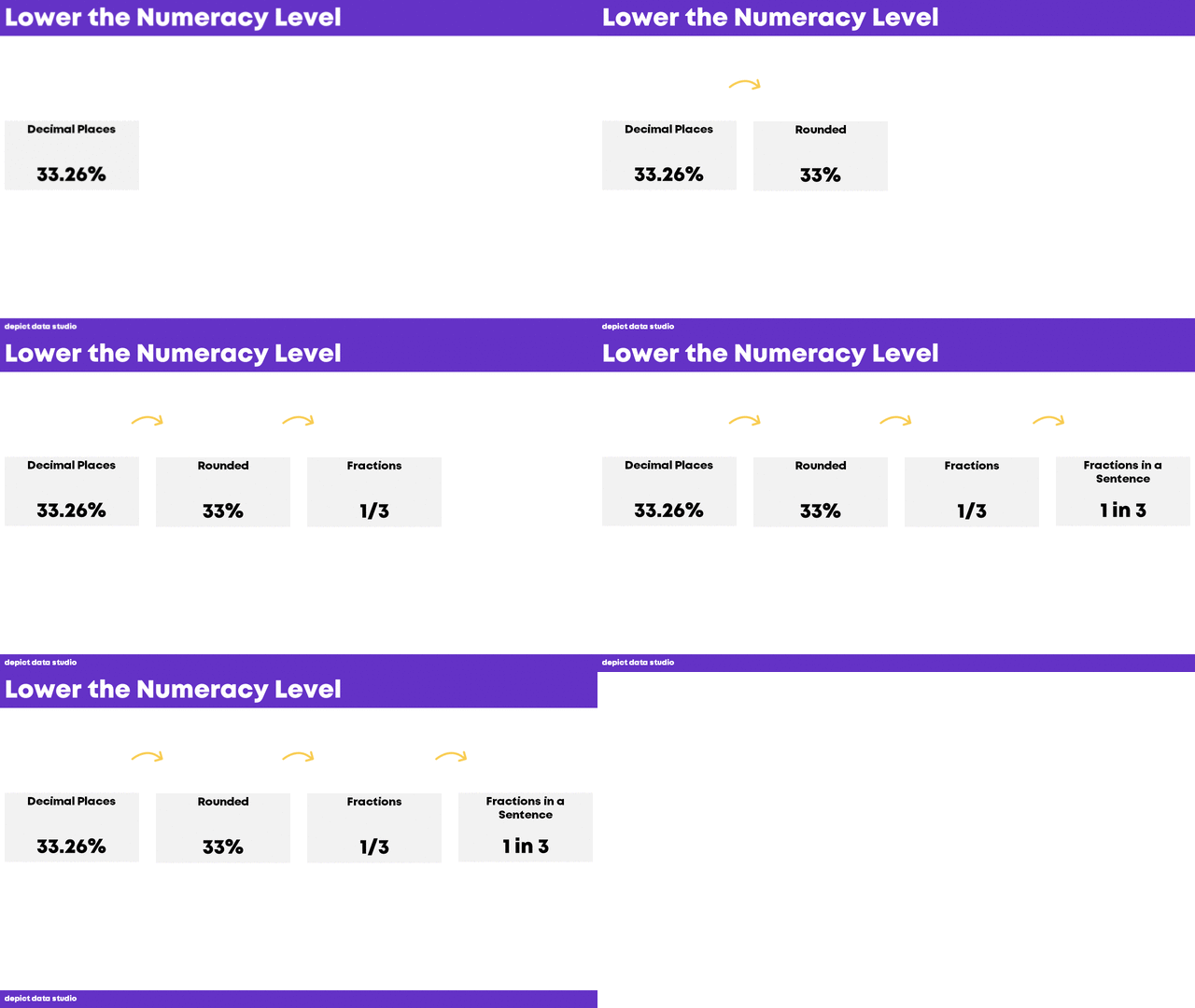
Lowering the numeracy level just means making sure the numbers are easy to understand. There are a couple of stages to this, so even if you only move one step, that’s a win.  

For example, let’s say you’re starting with 33.26%.

To lower the numeracy level, the first stage would be to round it to 33%. That’s a win!

The next stage would be to go from rounded percentages to fractions. So, we could turn that 33% into 1/3. Another win!

The final stage would be taking that 1/3 fraction and changing it to 1 in 3 in a sentence.

This is a general goal to aim for. It won’t work every single time for every single project. In other words, you can’t move from 33.26% to 1 in 3 for every project. Just try to move one step in every project.

Before: Percentages with Two Decimal Places

Let’s practice lowering the numeracy level.

Donut chart showing that 33.26% of participants agreed that the program was a good use of time.

Let’s talk about what’s already going well:

  • It’s a donut chart with only two slices – check.
  • It’s got dark-light contrast – check.
  • And the sentence, “33.26% of participants agreed that the program was a good use of time” is readable. (It scored a 5.8 on the Flesch-Kincaid scale.)

After: Round to the Nearest Whole Number

Let’s make it even better!

I know you understand percentages. Of course you do. You’re reading a data blog. 😊

But percentages are tricky for people who don’t work in data careers.

Percentages.

Percent changes.

Percentage point changes.

Percentiles.

Those are similar-sounding terms with completely different math and meanings.

No wonder others get confused by percentages.

Let’s be proactive and stop confusion at the source—by avoiding percentages whenever possible.

One improvement would be to round the decimal places to the nearest whole number.
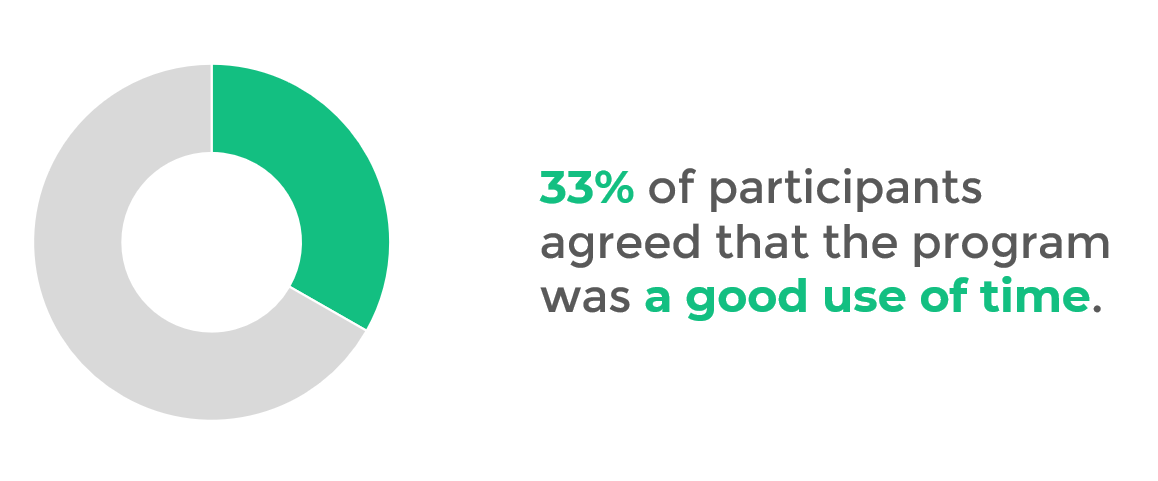
Donut chart stating that 33% of participants agreed that the program was a good use of time.

After: Use Fractions Instead of Percentages

Another quick win would be to turn the 33% into a fraction (1/3).
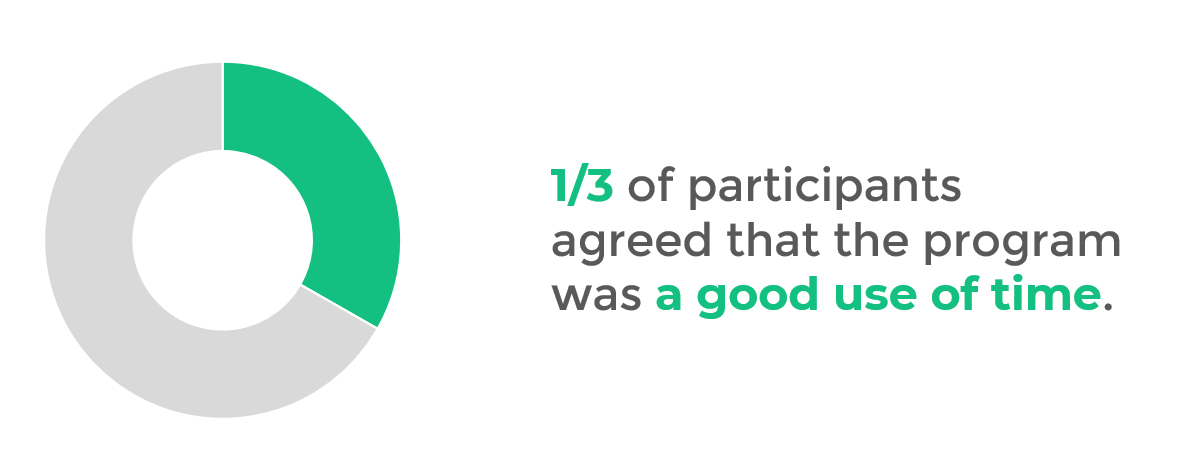
Donut chart stating that 1/3 of participants agreed that the program was a good use of time.

After: Put the Fraction into a Sentence

And the best practice would be to turn the 1/3 into one in three.

You could also adjust the chart, transforming the donut chart into an icon array.

That way, there’s cohesion between the chart and the text (i.e., they both talk about one in three).

I don’t recommend using gingerbread people.

  • Men don’t have to wear pants and women don’t have to wear dresses.
  • Some people don’t identify as men or women.
  • You may not know if the data collected represents men or women.
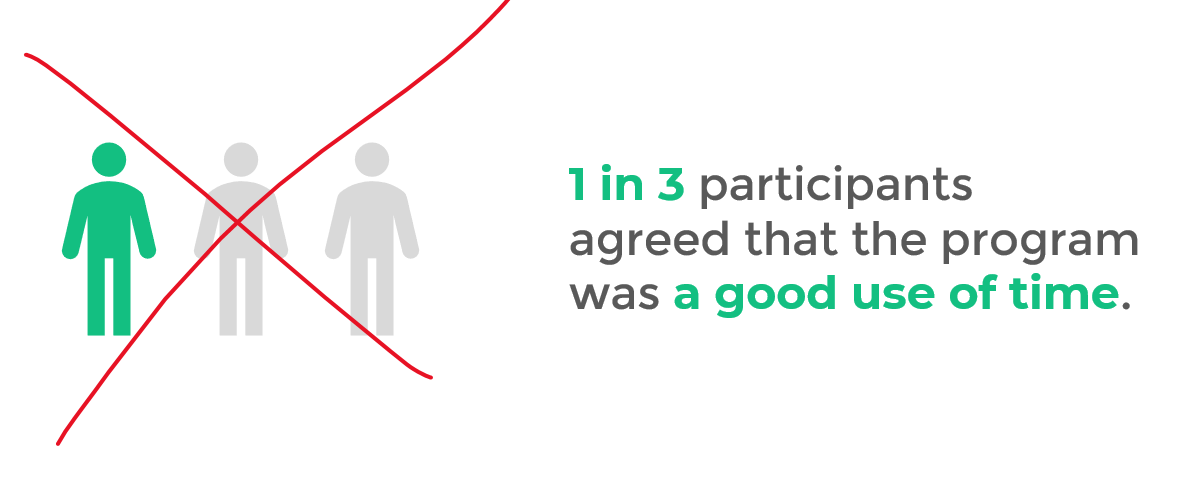
I don’t recommend using gingerbread people that are gendered (men in pants and women in dresses).

So, what to do instead?

Use icons of real people.

This example is about people, so let’s show the people.

This is symbol font called WeePeople. You can download this for free and use it to visualize people as the real human beings they are.
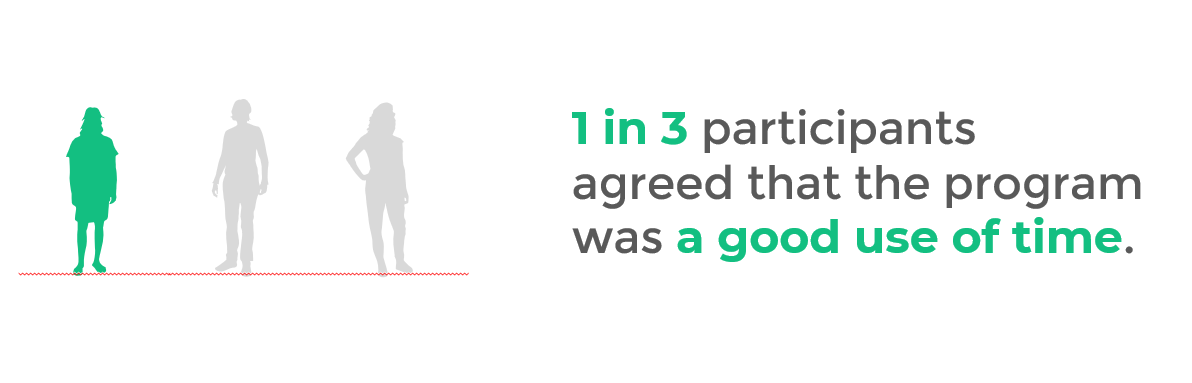
I recommend using a symbol font called WeePeople to visualize people as the real human beings they are.

Accessibility Case Study

By now, you’ve learned about direct labeling, lowering the reading level, and lowering the numeracy level.

Let’s look at a case study and put it all together.

Here’s a before graph based on a real-life project. This organization was running a workforce development program.
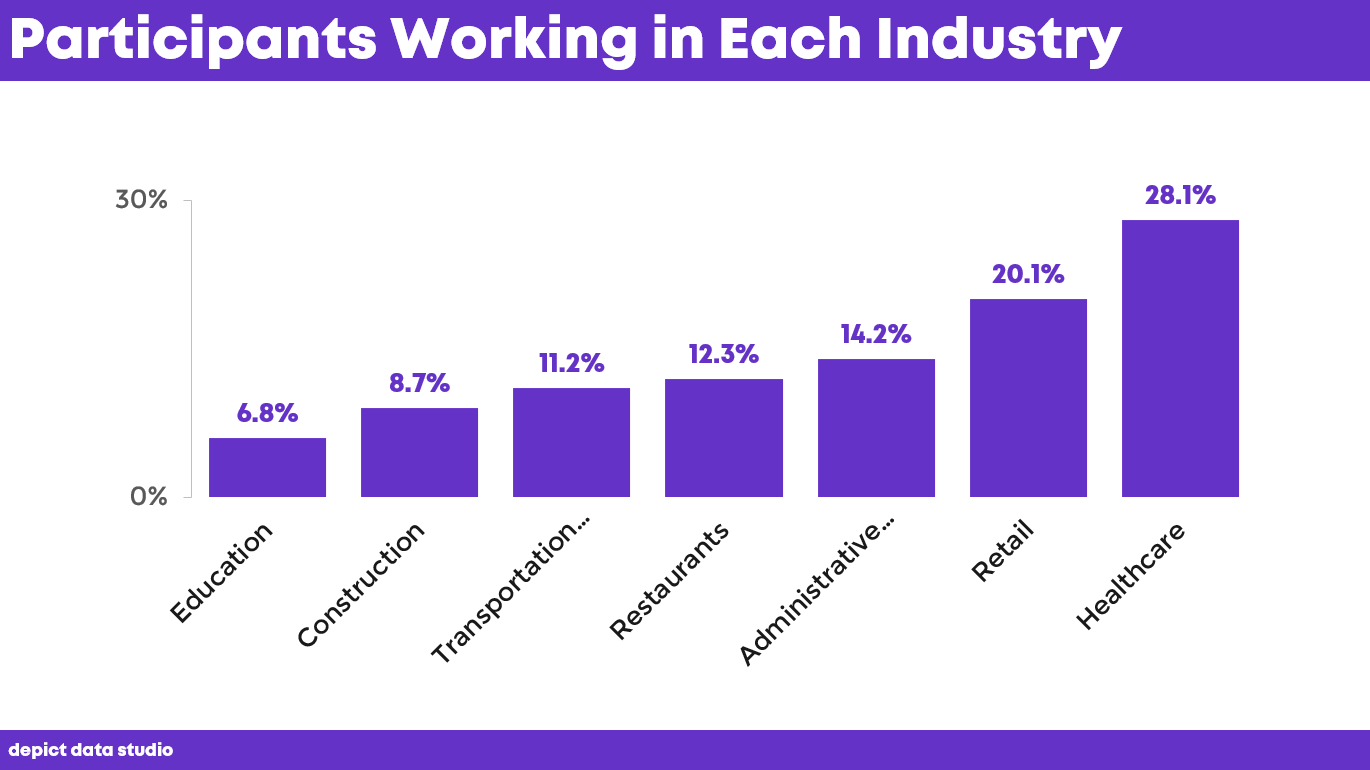
Here’s a before graph based on a real-life project. This organization was running a workforce development program.

In the Good Tech Fest session, I asked the audience to describe what they saw going wrong.

Here’s what they came up with:

  • Diagonal text
  • Decimals
  • Change from a column chart into a bar chart
  • Add a takeaway title
  • Reverse the order
  • Color coding

Within three minutes, we made quick edits that made a big difference.

Rotate the Chart

The first thing we did was rotate it from a column chart to a bar chart.

(We wanted all the text to be horizontal.)
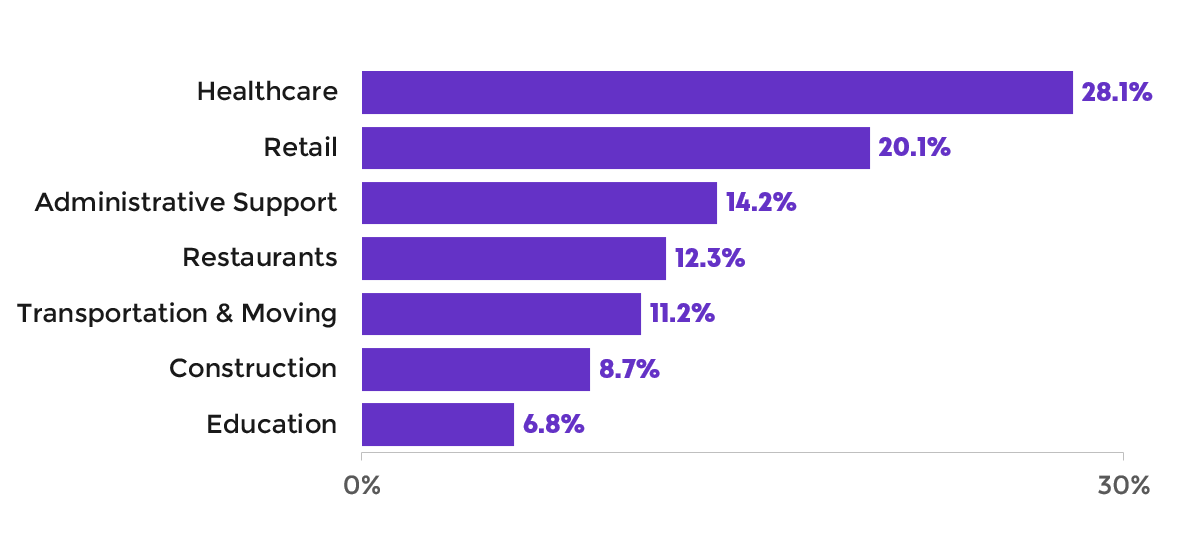
The first thing we did was rotate it from a column chart to a bar chart. (We wanted all the text to be horizontal.)

Round Decimals to Whole Numbers

Our next edit was to round the decimals to the nearest whole numbers.
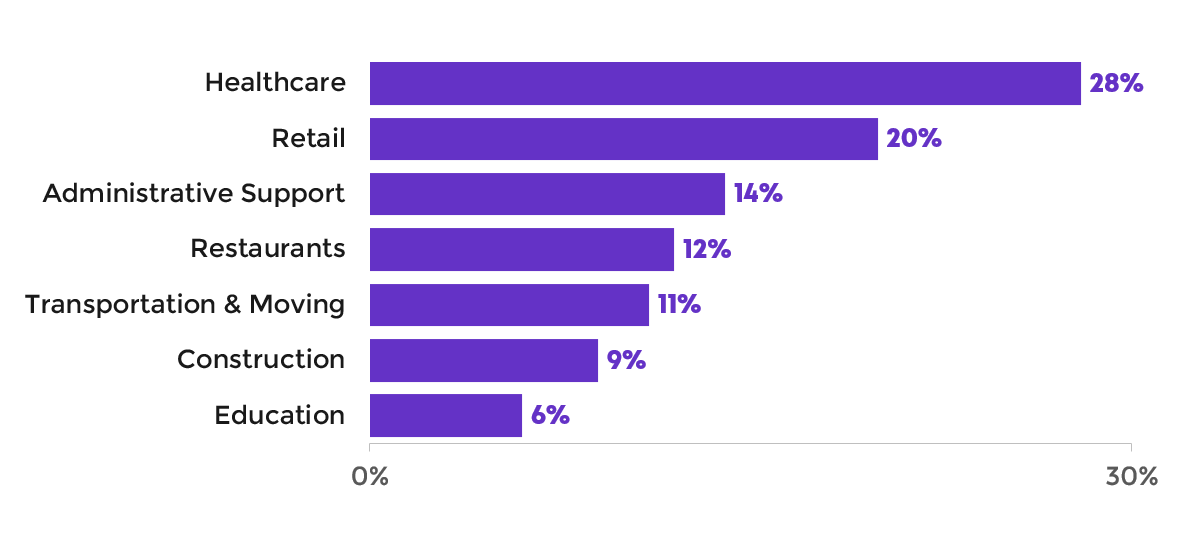
Our next edit was to round the decimals to the nearest whole numbers.

Add a Takeaway Title and Dark-Light Contrast

Next, we added a takeaway title.

Instead of “Participants Working in Each Industry,” we now have “20% of Participants Worked in Retail.”

Then, we highlighted the retail data. We changed that bar to a darker color and grayed out everything else. Dark-light contrast is an easy and effective data storytelling technique.
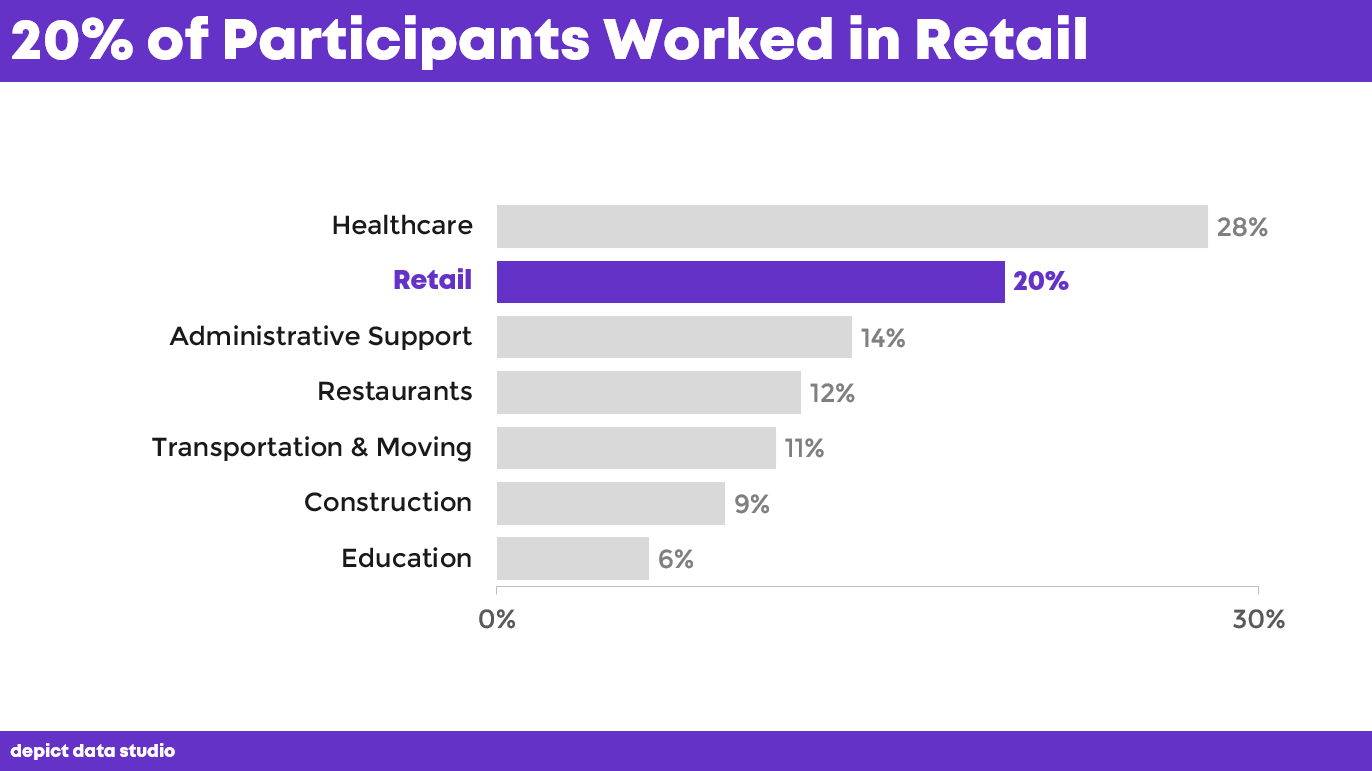
Next, we added a takeaway title. Then we highlighted the retail data.

Add Fractions within a Sentence and Icons

We changed the percentage to a fraction in a sentence.

Then, we added icons, which makes our data more memorable.
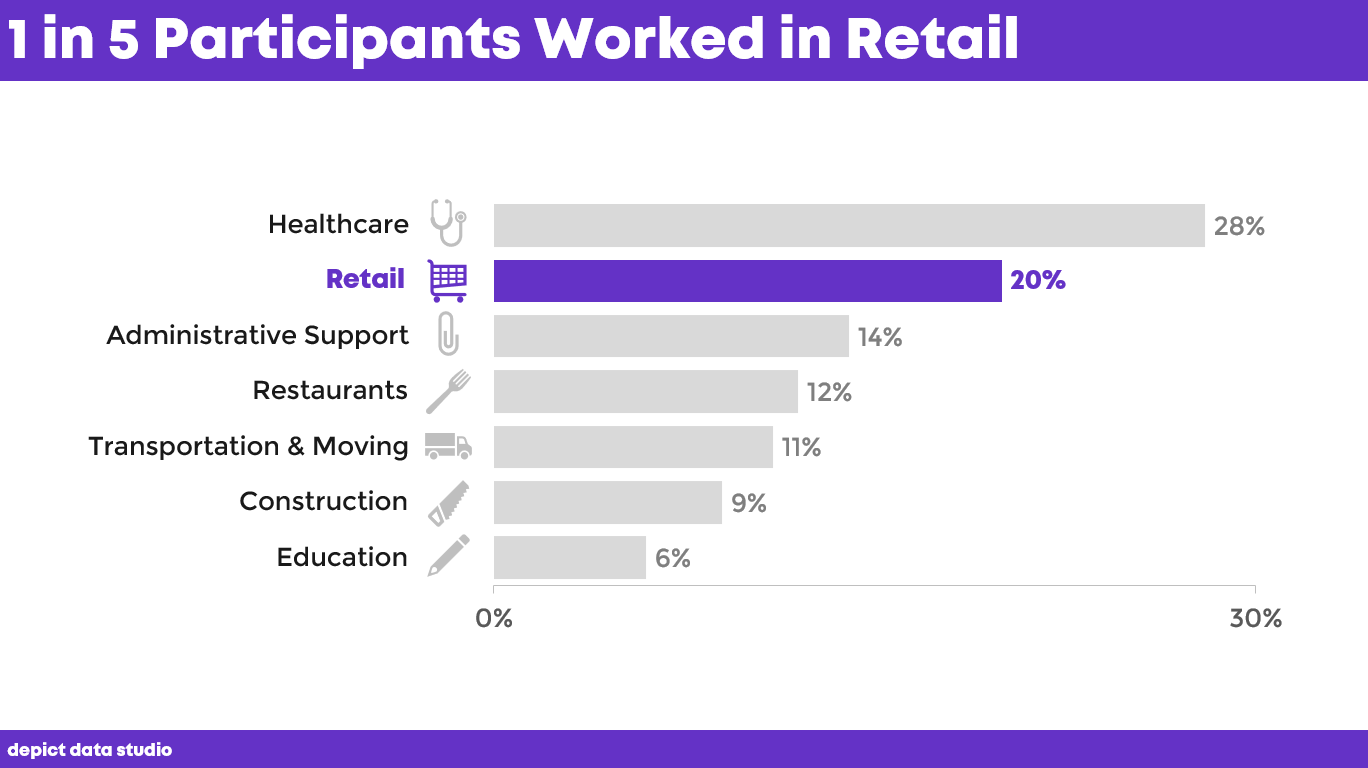
We changed the percentage to a fraction in a sentence. Then, we added icons, which makes our data more memorable.

Accessibility doesn’t have to take all day.

Accessibility doesn’t have to cost anything.

Accessibility doesn’t have to be complicated.

With a few quick edits, we’ve made this chart faster to read; we lowered the numeracy; we lowered the reading levels; and we made it more memorable.
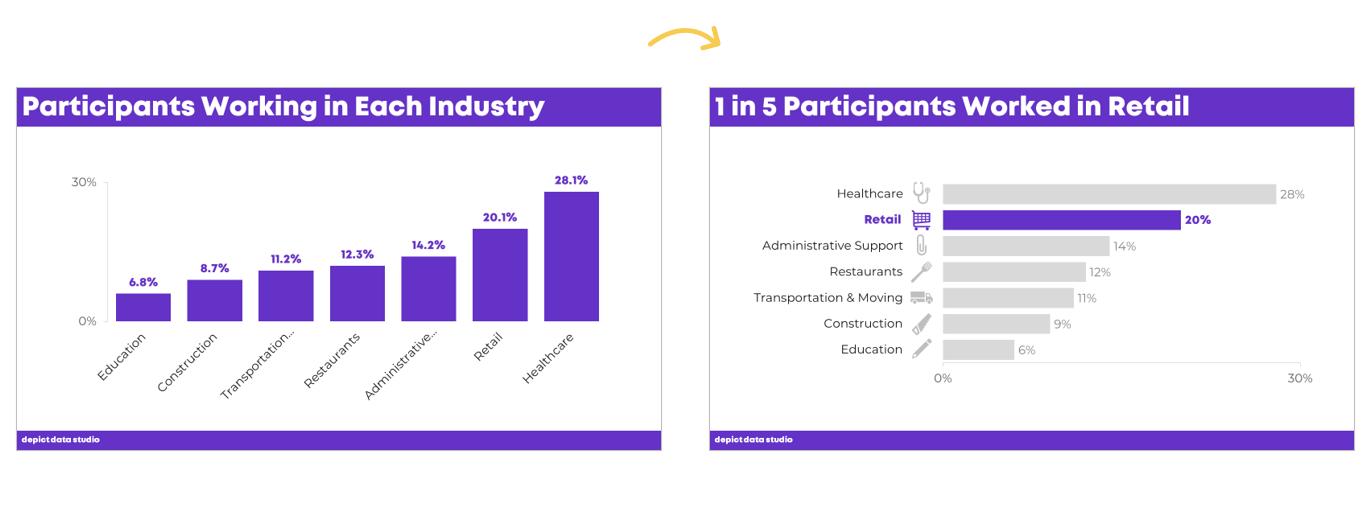
With a few quick edits, we’ve made this chart faster to read; we lowered the numeracy; we lowered the reading levels; and we made it more memorable.

Download the eBook

Want to learn more about accessible data visualization?

In this ebook, you’ll learn 10 quick wins for designing accessible data visualizations. These small edits can have a big impact for our coworkers, board members, and funders who have color vision deficiencies, hearing loss, or learning disabilities–and for all of us who are pressed for time.

Download the Ebook

For your complimentary copy, use code: goodtechfest

Written by cplysy · Categorized: depictdatastudio

Dec 14 2021

The 10 Metrics Your Evaluation Consultancy Should Track


Part of the job of an evaluator is to identify and define metrics for our clients. But what about you? Are you as disciplined when it comes to defining and tracking metrics for your own business?  

At Three Hive Consulting, we track a variety of metrics – some of the metrics are KPIs we review each week and some we monitor less frequently. The following list provides an overview of some of the metrics we track and the types of decisions they inform in our organization. Your metrics and how often you monitor them should be customized to your business’ decision-making needs.    


1. Number of Sales Conversations

The number of leads generated is a common metric in business. It is used to monitor the number of prospective clients. Many businesses will measure “leads,” but we found that definition didn’t fit our needs; we aren’t cold calling potential clients or investing deeply in marketing, so the majority of our “sales” come from RFPs, limited competitions, and direct requests for quotes.

Instead, we count the number of sales-related conversations our Sales Lead has as one of our weekly KPIs. We define a “sales conversation” broadly; it includes emails, phone calls, LinkedIn chats, in-person conversations, proposal or quote submissions. It is easy to measure and is a good leading indicator of how active sales are in our organization.


2. Total Proposals Submitted

This indicator is the total number of proposals for work submitted in a certain time period, which includes public RFP, sole source, or limited bid competitions. It is helpful to look at this indicator over time to see if there are trends when people are seeking evaluation support. For example, our data shows that February is a busy proposal month for us, so we need to consider additional resources for proposal development in that month.

3. Win Rate

We track how much work we actually win! This means we take the number of clients who have signed contracts within a specified time period and divide it by the number of project proposals that we bid on and quotes we submit during the same time period.

We can also look at our win rate according to type of competition (sole source, RFP, and limited competition) and the sector/topic area to see where we are most successful. Examining our win rate has helped us decide on which projects make the most sense for us to bid on and which projects we should pass on.

4. Total Contract Amount Won

We also track the total amount of contract dollars we have won by adding up the contract amounts for the proposals we won in a certain time period. We like to look at this over time to make sure it is going up!

5. Total Contract Amount Lost

Similarly, we want to know how much we have left on the table. We track the total amount lost by adding up the contracts amounts for the proposal we were not successful on. Ideally, this amount is going down; however, it also needs to be interpreted with the average contract amount and with consideration for how much we might be stretching beyond our more successful content areas on some proposals.

6. Average Contract Length

This a new metric we are starting to collect. We are often trying to forecast how to resource projects. Documenting and monitoring the length of our projects will help with this decision-making. It is simply the total number of months for all our successful contracts divided by the number of successful contracts for a certain time period.

7. Utilization Rate

In consultancies we spend time on project work, but also non-project work like accounting, administration, marketing, sales, team meetings and training. It is important to understand how much time people are spending on project work (i.e., work that you get paid for!).

Our employees enter and report their utilization time each week: the number of billable client hours within a specific time period divided by the total available hours. We have a target, and if our employees are consistently under that target we know we need to take a closer look at the other sales-related metrics to bring in more work.

This number is easily tracked through a time tracking software we use called Harvest (Refer to Business Tools You Need to Run Your Evaluation Consultancy for more information).

8. Client Satisfaction

Most companies collect and track this metric through a client survey. As part of our project closing process, we send a survey to collect quantitative data on our client experience. However, we don’t want to wait until the end of a project to hear from our clients. Instead, we collect this information qualitatively through regular client check-in meetings.

We also have a weekly agenda item on our team meetings where team members report back client feedback (the good and the bad). If it is bad feedback, then we discuss ways to resolve it as a team.

9. Gross Margin

We like to understand if and how profitable our business is. It is important to understand our company’s profit to help us decide if we have money to invest in other areas of our business (i.e., hiring employees, employee compensation, marketing, etc.). We use QuickBooks Online. It has an online dashboard and built-in reports to easily monitor our financial metrics.

10. Project Margin

We also want to understand if and how profitable certain projects are. We can monitor this in real-time through our time tracking software, Harvest. Harvest shows the billable amount and internal costs of the projects, so Project Leaders can monitor and have conversations with clients if it looks like the project is going to deviate from the estimated budgets.

We also record and monitor this indicator across projects to see if certain types of projects have different margins, which then informs our sales and estimating processes.


Want to put some of these metrics into practice? Download our proposal dashboard template to help get you started tracking your own metrics.


Sign up for our newsletter

We’ll let you know about our new content, and curate the best new evaluation resources from around the web!


We respect your privacy.

Thank you!


Written by cplysy · Categorized: evalacademy

Dec 14 2021

What conversations do you need to have at the start of an evaluation?


Every evaluation project, from small to large scale, has similar processes or phases. There is the initiation stage, followed by planning, data collection, analysis, reporting, and project-close-out phases. I find the planning stage the most exciting and challenging since it requires quick learning of the program and attention to detail.  

At the planning stage, there are multiple meetings with the program team to decide on the evaluation approach, timelines, and goals. Although it is impossible to have a meeting agenda template that works for every meeting, I have an Evaluation Kick-off Meeting Agenda Template that I often use at the start of a new evaluation project.  


1. Introductions and role clarity

The first thing on my agenda is introductions of the program and evaluation team members. Knowing the program team members who will participate in the evaluation will help ensure the involvement of the appropriate team members from the start.

Similarly, knowing the roles of the evaluation team members will save the program team time and energy when trying to get evaluation information. It is also a good idea to include a brief ice-breaker activity to help meeting attendees relax and ease into the work.


2. Program Goals

The purpose of a program provides the direction for the program. In addition, the program purpose and goals are the foundation upon which other program elements are defined, including the evaluation. It is, therefore, essential that the evaluation team understands the program’s purpose, goals, and objectives.

The evaluation team will have other opportunities to examine in detail the program’s objectives, such as during logic model or theory of change activities, however understanding the broader goal, the evidence, philosophy and/or rationale behind it helps brainstorm evaluation approaches.

3. Evaluation Goals

A big challenge at the planning phase is undefined evaluation goals. Sometimes the program team members don’t know what exactly they want from the evaluation, or they can’t agree. When the goals aren’t clear, it’s difficult to manage the project.

Scoping the evaluation, i.e., having an open discussion about the purpose of the evaluation and how the program team plans to use the evaluation results, will help tailor the evaluation design and deliverables.

4. Communication and information exchange

Lack of communication or miscommunication can be a challenge in evaluation. Although it is likely unnecessary to prepare a communication strategy for a small to medium scale evaluation project, it is still important to identify key approaches such as: 

  • designated contact person for both the program and evaluation  

  • preferred way to reach the program contacts  

  • format and recipients of status updates  

  • meeting frequency  

  • availability of team members and preferred timeline for meetings/activities 

  • data exchange (e.g., set up a shared drive/ Teams channel, etc.)  

5. Evaluation Timelines

Poor evaluation scheduling is also a common challenge in evaluation. Not allocating sufficient time for planning may result in evaluation methodology that is not suitable for the program.

Similarly, insufficient time for data collection, analysis, or reporting can lead to bias, error, poor quality, and disappointment in the deliverables. Although it may not be possible to identify the timeline for each evaluation activity at this stage, important program events and high-level evaluation timelines should be discussed.


In conclusion, effective start to program evaluation will make the work more efficient and easier. Project management in evaluation requires diligence, and simplifying the process makes it easier to plan and execute.  

We are passionate about starting an evaluation right!  Check out our other article HOW TO KICK OFF YOUR EVALUATION KICK OFF MEETING.


Sign up for our newsletter

We’ll let you know about our new content, and curate the best new evaluation resources from around the web!


We respect your privacy.

Thank you!


Written by cplysy · Categorized: evalacademy

Dec 09 2021

Eval Academy’s Top 10 Posts of 2021


To celebrate the end of the year, we thought we’d highlight Eval Academy’s top ten posts from 2021.

What posts would you like to see in 2022? Tweet us @EvalAcademy or connect with us on LinkedIn!


#10 – Evaluation Question Examples

Sometimes we just need to see some examples to get us started. Coming in at #10 is a short article that provides you with some examples of evaluation questions to inspire your own.

#9 – How We Used an Outcome Harvest

Moving up a spot from last year, this post shares how we used outcome harvesting and what we wished someone had told us before we started.

#8 – Improve your Logic Model Using 3 Simple Design Principles

Logic Models can be great communication tools. However, we’ve all seen ones that could take hours to decipher. This article summarizes three simple visual design principles you can apply to your logic models that will boost interpretation.

#7 – Reflexivity in Evaluation

We’ve all heard of reflective evaluation practice, but what is reflexive evaluation practice? This article breaks it down for you and outlines tools and ideas for reflexion.

#6 – Arts-Based Data Collection Techniques

At #6 is an article that outlines five arts-based data collection techniques with ideas of how you can incorporate them into your evaluation practice.

#5 – How to Transcribe Interview Like a Pro

At #5 is a short article that outlines four tips to get you transcribing like a pro!

#4 – The Components of An Evaluation Plan

Coming in at #4 is an oldie but a goodie. If you are looking to build an evaluation plan make sure to take a look at this article to see what elements to include.

#3 – How to “Quantify” Qualitative Data

#3 is for all the “quants” out there who need to quantify anything and everything. The “quals” may hiss at this post, but the framework provided for quantifying qualitative data is one you’ll want to bookmark.

#2 – Interview Guide Template

Interviews are common in evaluation. Simplify your interview planning by downloading the interview guide template.

#1 – How to Write Good Evaluation Questions

Our top post for 2021 remains untouched from last year’s list! This article outlines what an evaluation question is and pointers to consider when drafting your evaluation questions.


Sign up for our newsletter

We’ll let you know about our new content, and curate the best new evaluation resources from around the web!


We respect your privacy.

Thank you!


Written by cplysy · Categorized: evalacademy

Dec 08 2021

Evaluation Roundup – November 2021

Welcome to our monthly roundup of new and noteworthy evaluation news and resources – here is the latest.

Have something you’d like to see here? Tweet us @EvalAcademy!

#Eval21 — Resources

If you logged in to the American Evaluation Association conference this year (#Eval21) and participated in any of the sessions you may have been busy copy and pasting the links to resources that were shared in the presentations and the chats. Here are a few resources shared during this year’s conference.

White Supremacy Culture

A link to pages from the Dismantling Racism: A workbook for social change groups was shared during one the plenary session titled “Abolishing Carcerality and Whiteness in, through and around evaluation. It lists characteristics and antidotes to white supremacy culture which show up in our organizations and through our evaluation practice.

Advancing Health Equity: A guide to language, narrative and concepts

The American Medical Association has a guide on its website for stimulating thinking about language, narratives and concepts for promoting health equity.

Adopting Inclusive & Non-Violent Language

Elizabeth Grim also created a guide for inclusive language. This guide targets language related to data and evaluation and is a more concise guide than the AMA guide (listed above).

Outcome Harvesting Resources

If you are looking to learn more about outcome harvesting then head to this outcome harvesting website for a list of outcome harvesting resources and links all in one spot!

Journey Mapping Resources

If you have heard of a journey map but are not sure exactly what it is or where to start, then check out this overview by the Nielsen Norman Group. This article by User Interviews is also a great resource to see examples of journey maps.

New and Noteworthy — Courses & Events

Strategies for Reporting Qualitative Evaluations

  • Organized by: EvaluATE

  • Date: December 15 @ 1PM EST

  • Type: Webinar

Evaluation Management

  • Organized by: EnCompass Learning Centre

  • Date(s): December 7, 9, 14, 16

  • Type: Online Course

Written by cplysy · Categorized: evalacademy

  • « Go to Previous Page
  • Go to page 1
  • Interim pages omitted …
  • Go to page 150
  • Go to page 151
  • Go to page 152
  • Go to page 153
  • Go to page 154
  • Interim pages omitted …
  • Go to page 310
  • Go to Next Page »

Footer

Follow our Work

The easiest way to stay connected to our work is to join our newsletter. You’ll get updates on projects, learn about new events, and hear stories from those evaluators whom the field continues to actively exclude and erase.

Get Updates

Want to take further action or join a pod? Click here to learn more.

Copyright © 2026 · The May 13 Group · Log in

en English
af Afrikaanssq Shqipam አማርኛar العربيةhy Հայերենaz Azərbaycan dilieu Euskarabe Беларуская моваbn বাংলাbs Bosanskibg Българскиca Catalàceb Cebuanony Chichewazh-CN 简体中文zh-TW 繁體中文co Corsuhr Hrvatskics Čeština‎da Dansknl Nederlandsen Englisheo Esperantoet Eestitl Filipinofi Suomifr Françaisfy Fryskgl Galegoka ქართულიde Deutschel Ελληνικάgu ગુજરાતીht Kreyol ayisyenha Harshen Hausahaw Ōlelo Hawaiʻiiw עִבְרִיתhi हिन्दीhmn Hmonghu Magyaris Íslenskaig Igboid Bahasa Indonesiaga Gaeilgeit Italianoja 日本語jw Basa Jawakn ಕನ್ನಡkk Қазақ тіліkm ភាសាខ្មែរko 한국어ku كوردی‎ky Кыргызчаlo ພາສາລາວla Latinlv Latviešu valodalt Lietuvių kalbalb Lëtzebuergeschmk Македонски јазикmg Malagasyms Bahasa Melayuml മലയാളംmt Maltesemi Te Reo Māorimr मराठीmn Монголmy ဗမာစာne नेपालीno Norsk bokmålps پښتوfa فارسیpl Polskipt Portuguêspa ਪੰਜਾਬੀro Românăru Русскийsm Samoangd Gàidhligsr Српски језикst Sesothosn Shonasd سنڌيsi සිංහලsk Slovenčinasl Slovenščinaso Afsoomaalies Españolsu Basa Sundasw Kiswahilisv Svenskatg Тоҷикӣta தமிழ்te తెలుగుth ไทยtr Türkçeuk Українськаur اردوuz O‘zbekchavi Tiếng Việtcy Cymraegxh isiXhosayi יידישyo Yorùbázu Zulu