• Skip to main content
  • Skip to footer
  • Home

The May 13 Group

the next day for evaluation

  • Get Involved
  • Our Work
  • About Us
You are here: Home / Archives for allblogs

allblogs

Nov 23 2021

‘Relevance’ of Museums: From Rhetoric to Reality?

With enthusiastic support from Robert Mac West, editor and publisher of the Informal Learning Review (ILR), RK&A is pleased to share Emlyn Koster’s recent opinion, ‘Relevance’ of Museums: From Rhetoric to Reality? which was part of ILR’s pandemic-themed September/October 2021 issue.  Emlyn’s original article is reproduced in full below. It is followed by his additional ‘seeing the forest for the trees’ themed remarks, spurred by the topical context of the UN’s just-completed Climate Change Conference in Scotland and the UN’s just-announced 2022 Human Environment Conference next June in Sweden. Huge thanks to Robert and Emlyn for allowing us to repost this timely piece and commentary!

‘Relevance’ of Museums: From Rhetoric to Reality?

A black pair of glasses is in the foreground as if the viewer is about to put them on. There is a forest full of trees with green leaves in the background. Looking through the glasses lenses makes the forest in the background appear clear, while the forest looks blurry outside its frames.
Not Seeing the Forest for the Trees
By: Emlyn Koster

“… Will history show that the Covid-19 pandemic stimulated the museum sector to take steps toward a resilient future? In 2009 Marjorie Schwarzer recalled in Museum News: “When the funds began to flow again, museums quickly forgot the shock of the Depression as well as their moments of innovation on behalf of the public… An opportunity to be societal role models for the wisest possible use of resources and talent was lost”. In 2012 when interviewed for an AAM Annual Meeting keynote address, Neil deGrasse Tyson predicted: “If in 2050 we were delivering the same messages, either we’ve failed at affecting change in society and still needed to give those messages, or we just got left behind and we were no longer on the frontier of what mattered in society”. 

‘Making Museums Matter’ in 2002 by Stephen Weil, a scholar emeritus at the Smithsonian, arguably continues to be the sector’s most thought-provoking book. ‘Beyond Management’, his last article in 2006 which was published by ICOM, emphasized the awkward fact that museums lack a standard for gauging their relative worthiness. They still do. At the core of the museum sector’s value lies the often used, but seldom defined, concept of relevance. With synonyms and antonyms that include pertinent and unconnected, respectively, it means being consequential to one or more specific matters at hand.

In his 1992 book ‘Visionary Leadership: Creating a Compelling Sense of Direction for Your Organization’, Burt Nanus cited a 1980 book about the genius of the composer Bach, the artist Escher and the logician Gödel. One way to imagine a more successful future is to synthesize new concepts by taking old ones and assembling them in new ways. In a 2006 AAM Museum News article, I opined that relevance involves topical content such as the divergence of society into rich and poor, the rise and fall of superpowers, the winning and losing of wars, and humanity’s disruption of the natural world. My recent article in AAM’s Exhibition journal elaborated on the paradigm shift that is needed to illuminate the Earth System with a holistic past-present-future mindset.

Each crisis confronting the world is named to enable public communication as it unfolds and for historical reference. When news breaks about catastrophes such as Delta, Dixie and Ida, most people soon grasp their what, why and how details. Yet for too long, progress of the museum sector—borne of a purpose to be reflective and inspirational resources―has been impeded by numerous perceptual disconnects. Homo sapiens are but one species among the millions of others who share Planet Earth. Nature and culture are interconnected. Environmental health and human health are interdependent. Academia and curatorship suffer from hyper-specialization. The different types of museums ought to blur their boundaries. Diversifying staff is only an advantage if this measure is surrounded by collateral big-picture actions. Timidity is the enemy of what is needed. The nice versus necessary debate is passé.

With this chapter of history besieged by a mutating pandemic, systemic racism, authoritarian regimes, and climate change with extreme weather, a profound introspection across the museum sector should be underway. While COVID-19 instantly resulted in major operational adjustments, airing of the hefty implications for each institution’s values, visions, missions, and strategies remains inadequate. What was already a busy agenda of apt topics for museums abruptly magnified into a vital focus if they are to be meaningful in today’s troubled world. The profound challenge before the museum sector is to seize this jolting period of environmental and societal changes as a launchpad for directional improvements and not just for operational adjustments. History tells us, however, that inertia tends to be a more powerful influence than courage.

As a geologist, museologist and humanist focused on the Anthropocene, my view of what urgently faces the museum sector is a wake-up call to become an integral player in the ecosystem of what matters locally and globally. Well-marketed meaningful experiences require deep directional thought with new stakeholders, including those who are rising up to publicly object to the status quo. In particular, it is my hope that this surfaces as a commitment to integrate the philosophies and priorities of associations and institutions. Well-informed, visionary, and effective leadership has never been more critical ...” 

Turning Rhetoric into Reality in Practice

The priority when I was appointed at the helm of the NC Museum of Natural Sciences in 2013 ― then in urgent need of a post-capital slowing of pace and directional clarity — was an organization-wide situation analysis. Widely consultative and completed within six months, this was embraced as a blueprint for tackling strategic and operational needs and became recalled as a pivotal step when AAM issued its report on the Museum’s re-accreditation in 2017. An anecdote about generative thinking in a Harvard Business School research summary had been instructive. A staff member excitedly updating a board meeting that an approach to an institutional challenge had just surfaced was met with a board member retort of “well, you haven’t asked the right core question yet!”. As the distant and close-up views of a forest and its trees imply, a bifocal vision is an imperative for museums in need of change, and especially so in this tumultuous world. One cannot grasp the nature and causes of a problematic situation by only considering parts of it.

Several years later when proposing a holistic ethos for nature-focused museums in the Anthropocene (see Emlyn Koster, Eric Dorfman and Terry Nyambe, 2018, A holistic ethos for nature-focused museums in the Anthropocene. In: The Future of Natural History Museums, edited by Eric Dorfman, Routledge: 29-48), I recommended two other planning approaches from outside the museum sector. The Triple Bottom Line approach was introduced in 1994 by a UK consultancy called SustainAbility. Advocating that sustainable decisions are characterized by balanced attention to three bottom lines —people (referring to social responsibility), planet (referring to environmental responsibility), and profit (referring to feasibility and growth) — the concept offers an important reminder that organizations should take a long-term and holistic perspective when formulating big decisions. Introduced in 2004 by two professors of strategy at INSEAD, one of the world’s top business schools, Blue Ocean Strategy is an approach contrary to conventional profit motives. Centered on the refreshing notion of uncontested market space, the example of Cirque de Soleil is commonly cited. This enterprise reinvented the core attribute of a circus with artistic performers replacing trained animals. This innovation together with news that two longstanding circuses and killer whale performances at a prominent marine park were ending were clear expressions of a new public conscience. As the Association of Zoos and Aquariums announced during that period, the time had come to envision a world where all people respect, value and conserve wildlife. For their part, museums ought to also probe their driving philosophy and practice in a generative and innovative manner.

About the Author

Emlyn Koster, PhD has been the CEO of the Royal Tyrrell Museum of Paleontology, Ontario Science Centre, Liberty Science Center, and NC Museum of Natural Sciences. A distinguished alumnus of the University of Ottawa, his awards include Humanitarian of the Year by the American Conference on Diversity and volunteerism includes the Ambassadors Circle for the International Coalition of Sites of Conscience. The initial chair of ICOM’s Anthropocene working group and an adjunct professor in Marine, Earth and Atmospheric Sciences at NC State University, he can be reached at koster.emlyn@gmail.com and his previous RK&A blog posts are here.

The post ‘Relevance’ of Museums: From Rhetoric to Reality? appeared first on RK&A.

Written by cplysy · Categorized: rka

Nov 23 2021

Copy Cat: Learning Through Observation

Is there a competitor or colleague that does something you admire? Is there a small pang of jealousy or envy in how another firm does what it does? Rather than lament it, embrace it.

We can channel our impressions of others into benefit if we transform our envy or observations into actions. This is a technique called Copy Cat.

Copy Cat is a simple technique that can be done as part of a monthly review and fit in with your regular strategy and sensemaking sessions. This technique allows you to focus learning on aspects of a competitor or peer’s behaviour and activities that you would like to learn from and maybe copy. Copy Cat is a form of appreciative inquiry. It works by focusing our attention on specific qualities or actions that we can adopt in our organization and practice.

How to be a Copy Cat

Copy Cat involves systematic attention and review of specific organizations and activities you admire or wish to copy. This is a technique based on the psychological concept of modelling and self-efficacy. Copy Cat begins by identifying those individuals, organizations, or groups that we admire or wish to emulate. It may be specific persons or it may also be behaviours or practices.

After we identify what it is that we wish to model, the next step is to begin observing the person/organization/behaviour/practice we are interested in. Literal observation, use of artifacts (e.g., articles, news stories, word of mouth, or marketing materials can all help. Your data gathering should be systematic, but it does not need to be comprehensive.

The next step is to engage in sensemaking. Sensemaking is a social process that allows us to make meaning of what we find. Bring together all your data, share it with those involved (this can be done independently, but is far more powerful in a small group), and make it accessible to everyone involved. Sensemaking helps us to ask questions about what we see and what it might mean for us in our work.

We use Copy Cat to see how others’ actions might apply to our work. Copy Cat provides guidance on what to do and how it can be done.

Applying Copy Cat

When we systematically, attentively watch others using Copy Cat we begin to consider how what we see can apply to us. This is where our design skills come into play.

We ask the following questions:

  1. What resources are employed in these actions? Do we have them?
  2. What knowledge or skills are required to do these activities?
  3. What circumstances are present in these actions? Did they help or hurt what was done?
  4. What outcomes emerged from these actions and can we tell what they are?
  5. What might this look like if we did those actions? What do we need that we don’t have?
  6. What negatives might emerge from these actions?

Copy Cat allows us to dissect the core components of someone else’s actions and consider how we might apply those lessons to our work.

By taking time to do this — we recommend spending 2-3 hours per month on this activity — some distinct benefits can be revealed.

  1. We sharpen our observation skills
  2. We begin learning more about our market
  3. We open our eyes to new ways to do something and the constraints others operate in
  4. It engages us in reflective practice about what we do and why
  5. It keeps us active in our market
  6. It builds systematic learning and praxis into our organization
  7. We enhance our curiosity and use it to channel energy in our organization

This simple method can have enormous benefits for an organization and helping build learning, innovation, and engagement in your people and your market. It requires little in the way of specialized tools and only a small amount of time.

If you want help building this into your learning and innovation practice, let’s talk. This is what we do and we’d love to help you do it, too.

Photo by Jonas Lee on Unsplash and Max Baskakov on Unsplash

The post Copy Cat: Learning Through Observation appeared first on Cense.

Written by cplysy · Categorized: cameronnorman

Nov 21 2021

Visualizing Data Projections in Excel

Recently, a colleague asked me how to visualize projections in Excel. The pressure was on, and they needed to wow their boss with their skills. The hardest part of a projection graph is, well, the actual projections. If you already have that data, like this group did, then making an informative graph is simple with just a few tweaks to the Excel default.

The post Visualizing Data Projections in Excel appeared first on Elizabeth Grim Consulting, LLC.

Written by cplysy · Categorized: elizabethgrim

Nov 19 2021

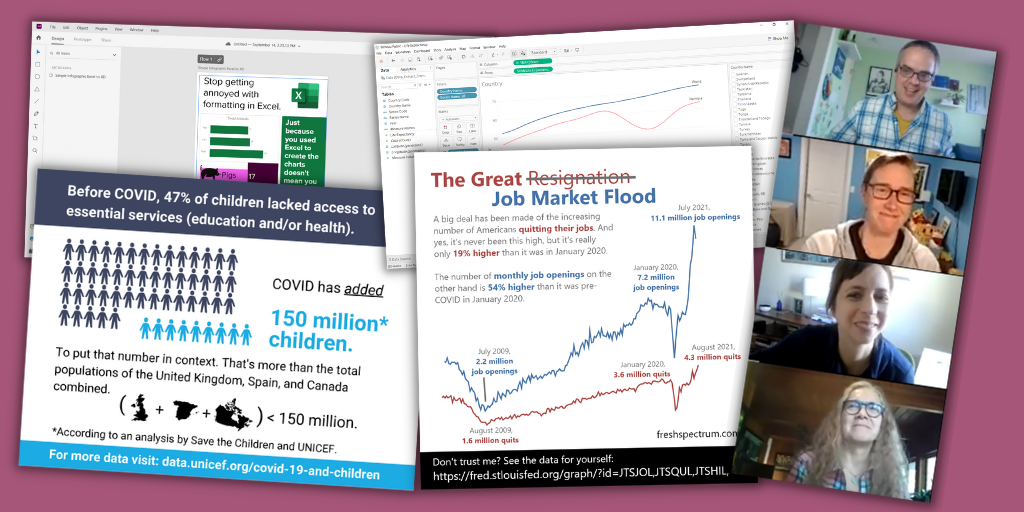
5 reporting myths that need to die.

Researchers and evaluators have developed some bad reporting habits. This post seeks to dispel some of the myths that keeps those bad habits thriving.

In today’s post:

  • Myth #1. Your final report should be 8.5 by 11 (or A4).
  • Myth #2. Illustration is not required.
  • Myth #3. Your report can serve all audiences.
  • Myth #4. Telling stories and adding personal insight is unethical.
  • Myth #5. Reports are annual, or end of project deliverables.
  • My Creative Reporting Workshop Black Friday Sale
"Nobody wants to read my reports."
This you? Consider joining my creative reporting workshop: diydatadesign.com

Myth #1. Your final report should be 8.5 by 11 (or A4).

Here is a question I’ve often asked while delivering my creative reporting workshops. “When you read a report now-a-days, what do you use to read it?”

  • It’s on Paper
  • A Smart Phone
  • A Tablet/eReader
  • A Desktop/Laptop

The overwhelming answer is…

A Desktop/Laptop.

We have a reporting habit that dictates that every report should be written on standard pieces of paper. And even though we have produced our work digitally for decades and moved the vast majority of our report distribution online, we are still stuck with this idea that a report should be “regular paper” sized and formatted.

But here is the thing. The vast majority of your audience are likely reading your report on a regular computer in a landscape orientation. Producing your report in a profile orientation makes people have to scroll to read it.

Alternative: Create your report like a set of presentation slides.

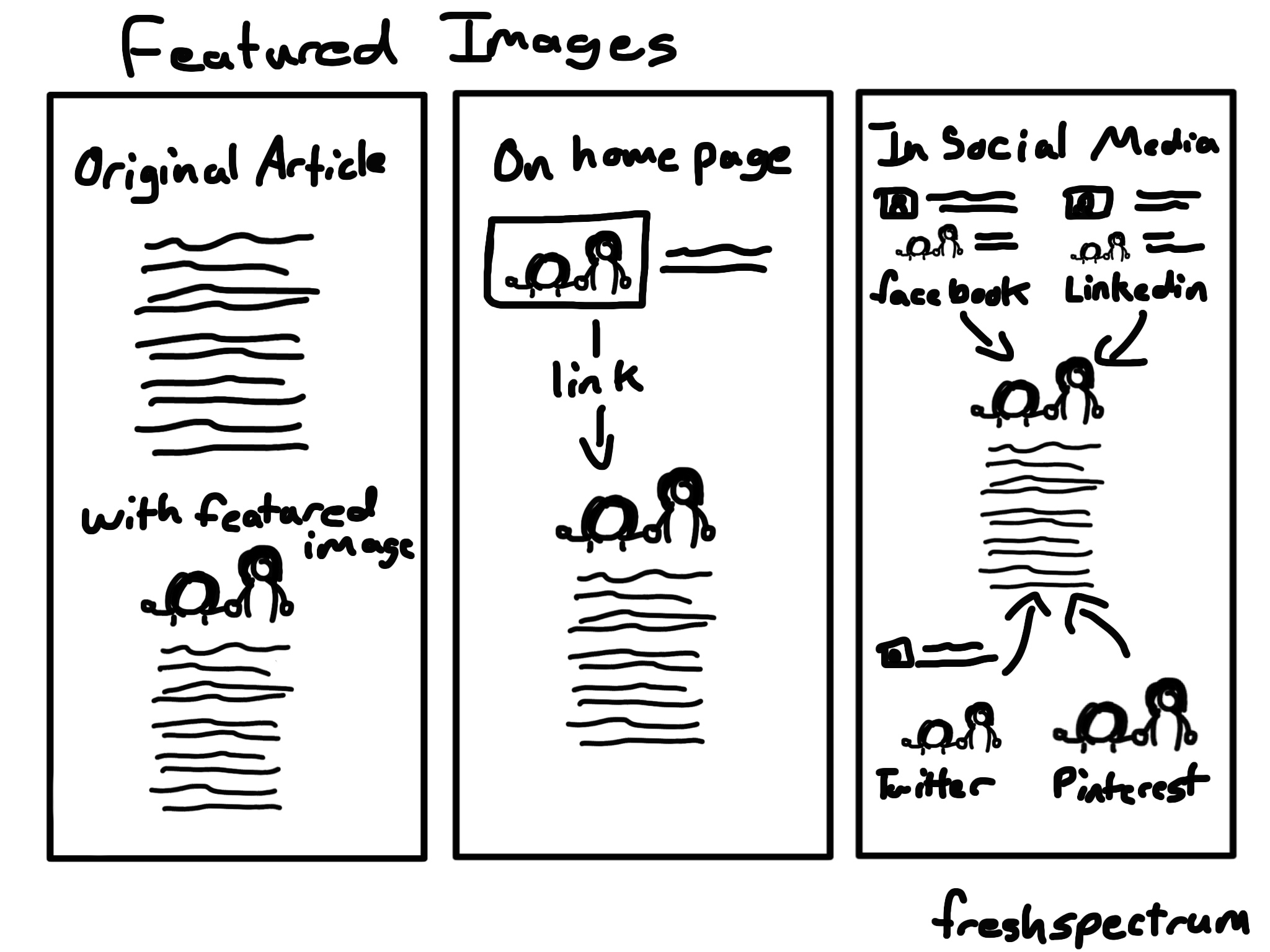
Featured image example cartoon by Chris Lysy of freshspectrum.com

Myth #2. Illustration is not required.

Have you ever noticed how few illustrations you’ll find in academic journals?

For a long time now, if you want to add a picture to your academic writing you really have to justify the use. The idea of introducing visuals simply to have visuals is not a common value. And for awhile, when things need to be printed to be shared and black and white text only journals were cheaper to print, this seemed to make sense.

Given that the fields of research and evaluation are filled with the academically trained, this not-so-visual habit has carried forward to reporting. Because evidence and reasoning doesn’t need illustration…

Except that it does. Especially now.

The web is a space where visuals are required, regardless of the content. Because visuals help us to map out our world. And if you want to share your work effectively on social media, through blogs, or any other digital media channel, it requires more pictures.

Quick Read: Featured Image Paradigm

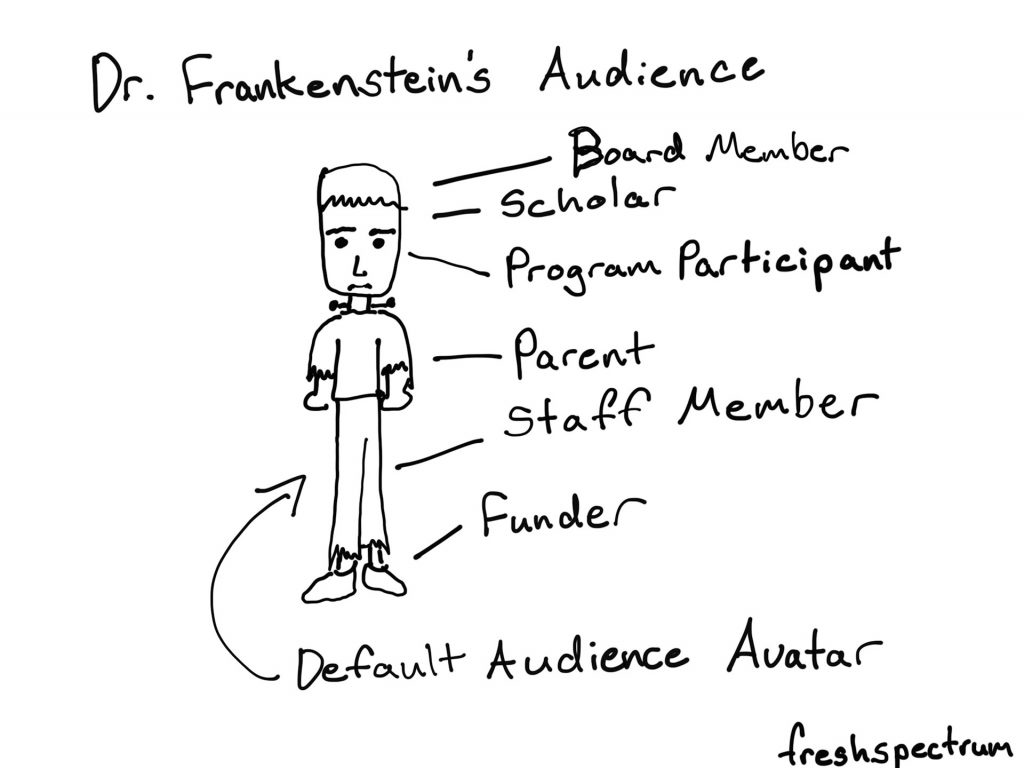
Cartoon by Chris Lysy.  Dr. Frankenstein's Audience. Board Member, Scholar, Program Participant, Parent, Staff Member, Funder. All represented as a Default Audience Avatar that looks like Frankenstein's monster.

Myth #3. Your report can serve all audiences.

You can’t make everyone happy.

But you can make everyone unhappy.

I get this argument every time I talk about report reader personas. Basically we work through a set of activities that pushes participants to think about the people they are trying to reach with a report. And ultimately somebody says, “well we have lots of audiences, and if we focus on just a few personas, we are going to leave some of those audiences out.”

And it’s true. If you create a good report you are going to leave audiences out. But creating a report that serves nobody just leaves everyone out. It’s better to be intentional about who your report serves, and even more importantly, who it does not serve.

Because pretending we don’t make that design choice every time we communicate anything doesn’t make it not true.

Alternative: Consider adapting your report into multiple infographics to reach different audiences.

Cartoon by Chris Lysy
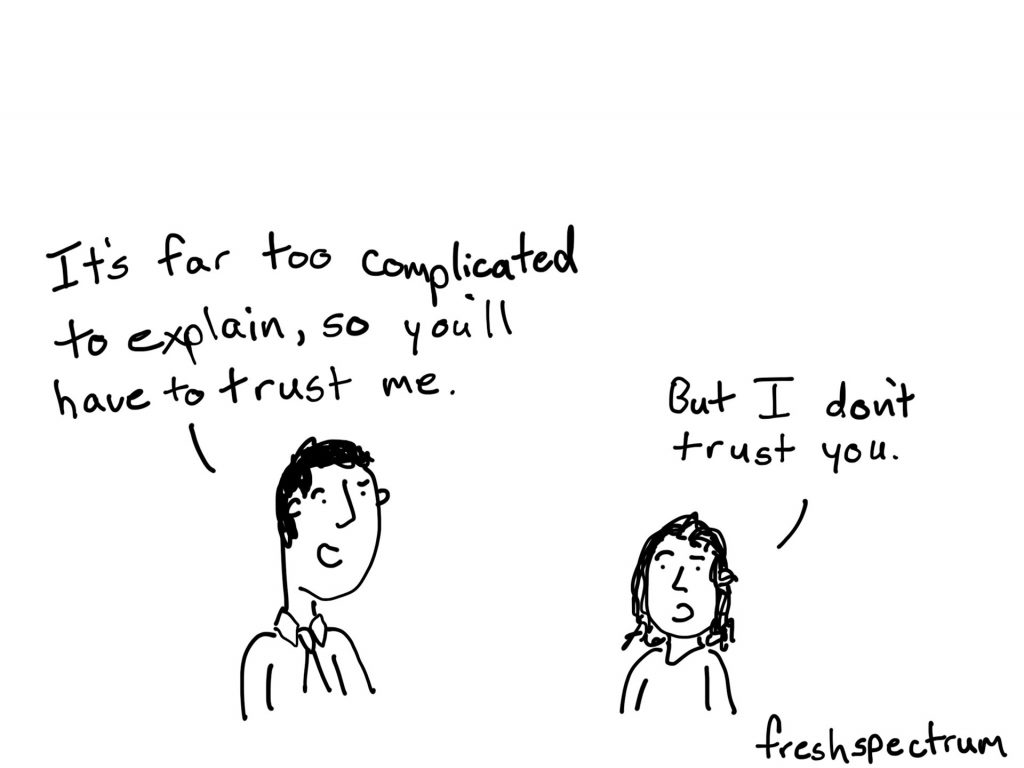
"It's far too complicated to explain, so you'll have to trust me."
"But I don't trust you."

Myth #4. Telling stories and adding personal insight is unethical.

Evaluation’s move toward becoming a discipline was delayed by the prominence of the value-free doctrine in the standard social sciences centering on the assertion that evaluation could not be objective or scientific and therefore had no place as a scientific discipline.

Michael Scriven on the Differences Between Evaluation and Social Science Research

I think we have inherited this idea from Social Science’s inferiority complex. That in order to be objective and scientific, we should leave our own commentary and stories out of our work.

But regardless of where you stand on the value-free doctrine, reports are not meant to be devoid of all humanity. They are the result of an expert (or set of experts) collecting, analyzing, and sharing evidence and analysis.

These are people hired because of their expertise and insight. They also tend to be the ones who have spent the most time with the specific findings they are attempting to share. As such, their commentary is valuable.

And if that describes you. Remember that the audience would like to see what you see. Understanding what you have experienced in the process of collecting and analyzing can help them see the data through your eyes. Don’t keep it secret and just hope that they see it in the same way.

Don’t know how to find the stories in your data? Start here.

Cartoon by Chris Lysy
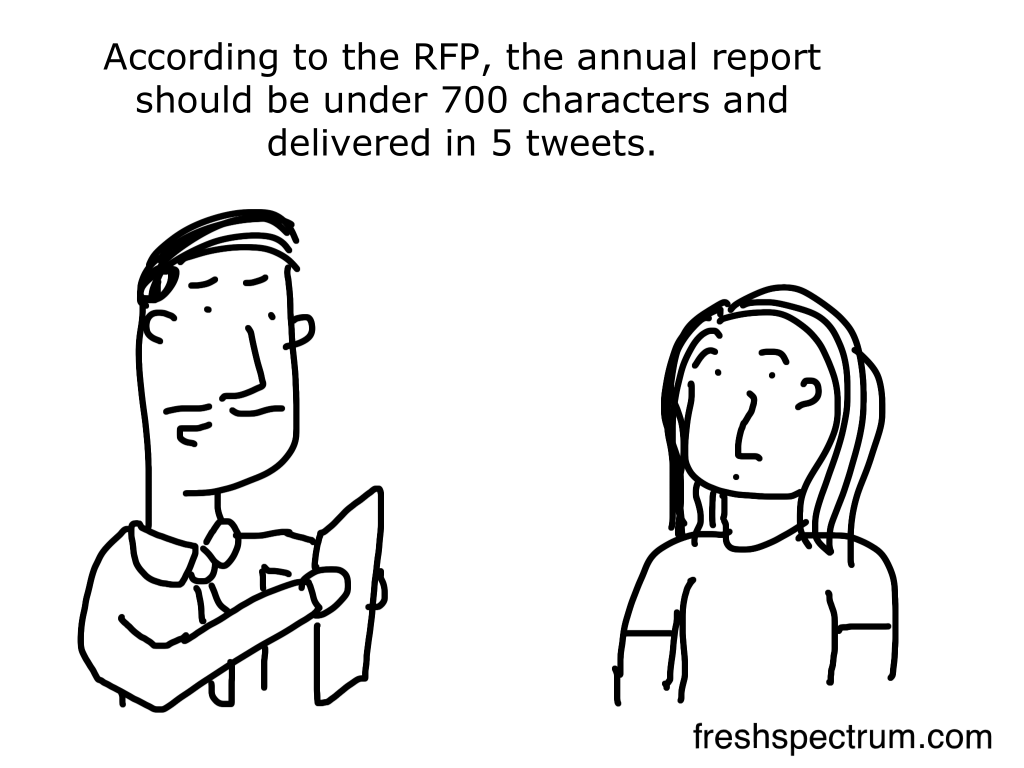
"According to the RFP, the annual report should be under 700 characters and delivered in 5 tweets."

Myth #5. Reports are annual, or end of project deliverables.

For lots of data people, reports are an every once and awhile thing.

  • You create a report when the project is coming to its end.
  • Or if the project is long term, you might create a report annually.

This kind of deliverable reporting is what I call the noun form of report. The problem with this type of reporting is that it usually involves a lot of waiting. And then, when it finally comes time to report, you have either run out of funding, run out of time to properly share your work, or you have just lost interest and have moved onto the next thing.

But report is also a verb. Reporting is something that can be done on a regular basis, when the methods have been constructed, during the data collection, and while the evidence is being analyzed. Since distribution is now a button click (and not anything that needs lots of organization) why wait until you can package everything together?

Diydatadesign.com creative reporting workshop

What to report differently? Join my creative reporting workshop. Black Friday Sale through Nov. 30.

Want to boost your creative reporting skills? Now’s the time to join my workshop as I’m offering the biggest deal since the launch.

The deal.

7 Day FREE Trial + 25% off with Annual Plan (that’s a $125 discount)

You can also get a 7 Day FREE Trial with our new Monthly Plan ($50/month).

What you get:

  1. Weekly Live Group Coaching Sessions
  2. Recorded Coaching Sessions
  3. Practice Activities, Short Lessons, and Inspiration
  4. Accountability and Support Forum
  5. COMING SOON – Self-Paced Courses

You can learn more and register at diydatadesign.com.

Written by cplysy · Categorized: freshspectrum

Nov 19 2021

(At)tractor Beams for Transformation

Many transformation efforts fail because they focus on what people say they want, not what holds their attention and are attracted toward. This is the role of attractors. We’ve written about attractors before and how to map them, however in this post we want to explore how they benefit strategy development more fully.

An attractor is just what it sounds like: something we are attracted to. That might be something positive (an opportunity), an area of activity like a part of the market, or it could be something we fear. The idea of attractors is rooted in complexity science although, unlike many areas within it, the application of our understanding of attractors is actually quite straightforward for decision making. Attractors help to establish coherence. That’s why they are useful in strategy development.

Aside from using it in mapping a system, how might we learn from what people pay attention to rather than what they think? That’s the role of attractors. They focus us on what humans — and by extension, organizations – find important even if they are not conscious of what that might be.

Using Attractors To Focus Discussion and Strategy

Just like the Death Star uses a tractor beam to pull spaceships into its orbit, we can use attractors to help us focus our strategic thinking. The first step is to determine what attractors we have. This might not be conscious — we can often find ourselves unaware of what is driving us. This is where having an evaluation plan can really help.

If not, here’s what we recommend doing.

  1. Talk. Ask questions and open up the conversation about what is not only valued, but what has value. This is about the narrative of what is important — what those stated goals are — and about what kind of evaluation metrics guide decision making. For example, consider a student who focuses on whether they get a grade of 94, an A, or a pass. Each of these are metrics that shape what is valued and what has value.
  2. Observe. This is where evaluation comes in. Evaluation is fundamentally an assessment of what is valued and how that value is expressed. Some say it’s about merit, worth, and significance. Regardless of how you define evaluation, the key is using methods and tools that can help you detect what an organization pays attention to and considers in its decisions. Take for example the role of evidence in decision making. If an organization claims to be evidence based, yet repeatedly neglects its research or fails to invest the energy in reviewing research, it shows that this value isn’t valued in practice.
  3. Sort Once you have the data from what is reported and what is witnessed it’s important to sort and to engage in a form of sensemaking that involves a social process of meaning-making from data that is usually complex and multi-layered. Our attractions and attractors are things that often fit this because they aren’t straightforward. There are issues of what we want and what we actually feel. It’s often why we experience feelings of cognitive dissonance — a separation between what we think and what we do.
  4. Design. The last part is to take what we learn and design a strategy around what we are attracted to — or want to avoid. By being conscious of what it is that we are looking to move toward or from we can be far more intentional in how we go about setting up systems and strategies to get us where we desire. This intention, design-driven process both works with how we are and who we want to be (as an organization or individuals).

Attractors, as their name suggests, can draw us to them and be powerful vehicles for focusing change if we’re aware of them and work with them, rather than against them.

We can help if you want some support in identifying and using attractors as a means to help you learn, grow, and focus your organization and generate impact. Contact us to learn more.

“Strange attractor?” by Kevin Dooley is licensed under CC BY 2.0.

The post (At)tractor Beams for Transformation appeared first on Cense.

Written by cplysy · Categorized: cameronnorman

  • « Go to Previous Page
  • Go to page 1
  • Interim pages omitted …
  • Go to page 152
  • Go to page 153
  • Go to page 154
  • Go to page 155
  • Go to page 156
  • Interim pages omitted …
  • Go to page 310
  • Go to Next Page »

Footer

Follow our Work

The easiest way to stay connected to our work is to join our newsletter. You’ll get updates on projects, learn about new events, and hear stories from those evaluators whom the field continues to actively exclude and erase.

Get Updates

Want to take further action or join a pod? Click here to learn more.

Copyright © 2026 · The May 13 Group · Log in

en English
af Afrikaanssq Shqipam አማርኛar العربيةhy Հայերենaz Azərbaycan dilieu Euskarabe Беларуская моваbn বাংলাbs Bosanskibg Българскиca Catalàceb Cebuanony Chichewazh-CN 简体中文zh-TW 繁體中文co Corsuhr Hrvatskics Čeština‎da Dansknl Nederlandsen Englisheo Esperantoet Eestitl Filipinofi Suomifr Françaisfy Fryskgl Galegoka ქართულიde Deutschel Ελληνικάgu ગુજરાતીht Kreyol ayisyenha Harshen Hausahaw Ōlelo Hawaiʻiiw עִבְרִיתhi हिन्दीhmn Hmonghu Magyaris Íslenskaig Igboid Bahasa Indonesiaga Gaeilgeit Italianoja 日本語jw Basa Jawakn ಕನ್ನಡkk Қазақ тіліkm ភាសាខ្មែរko 한국어ku كوردی‎ky Кыргызчаlo ພາສາລາວla Latinlv Latviešu valodalt Lietuvių kalbalb Lëtzebuergeschmk Македонски јазикmg Malagasyms Bahasa Melayuml മലയാളംmt Maltesemi Te Reo Māorimr मराठीmn Монголmy ဗမာစာne नेपालीno Norsk bokmålps پښتوfa فارسیpl Polskipt Portuguêspa ਪੰਜਾਬੀro Românăru Русскийsm Samoangd Gàidhligsr Српски језикst Sesothosn Shonasd سنڌيsi සිංහලsk Slovenčinasl Slovenščinaso Afsoomaalies Españolsu Basa Sundasw Kiswahilisv Svenskatg Тоҷикӣta தமிழ்te తెలుగుth ไทยtr Türkçeuk Українськаur اردوuz O‘zbekchavi Tiếng Việtcy Cymraegxh isiXhosayi יידישyo Yorùbázu Zulu