• Skip to main content
  • Skip to footer
  • Home

The May 13 Group

the next day for evaluation

  • Get Involved
  • Our Work
  • About Us
You are here: Home / Archives for allblogs

allblogs

Jan 31 2024

Is your team, report deficient?

Long, boring, dusty-shelf reports might be a problem, but it’s rarely the biggest problem most data teams face.

When teams decide to start tackling their report design problems, that’s where they start. They think that if they can turn their long, boring, dusty-shelf report into something that’s not as long, not as boring, and more enticing to read, everything will be better.

So they commit most of their reporting resources towards that goal. Which just leads to shorter, more interesting, dusty-shelf reports.
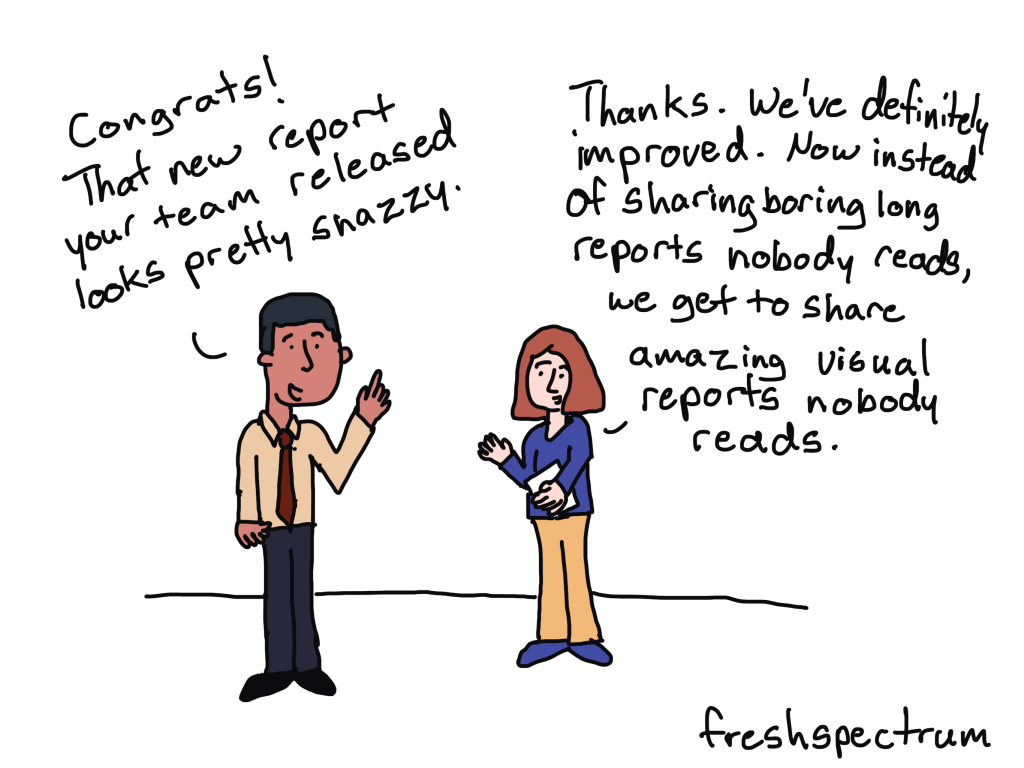
Report deficiency should be the first problem you tackle.

The easiest shortcut to better serving modern audiences is to create more reports. Reports of different lengths, in different formats, and with audience tailored content.

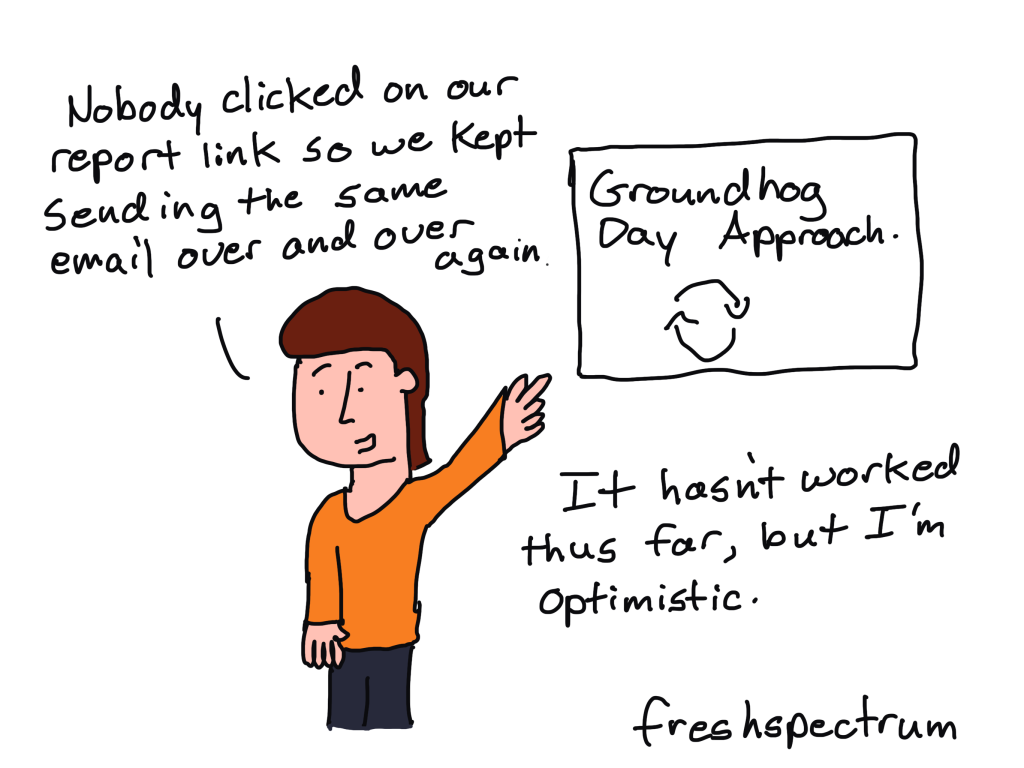
The half-life of any piece of content shared today is remarkably short. So an org with only one really good report has two options, to share it once and move on or spam share it over and over again.

Nobody likes being spammed by an organization trying to push their one big report. But by altering formats, lengths, and content you create additional sharing opportunities that don’t feel forced. You also make it easier for those reports to be shared with different audiences.
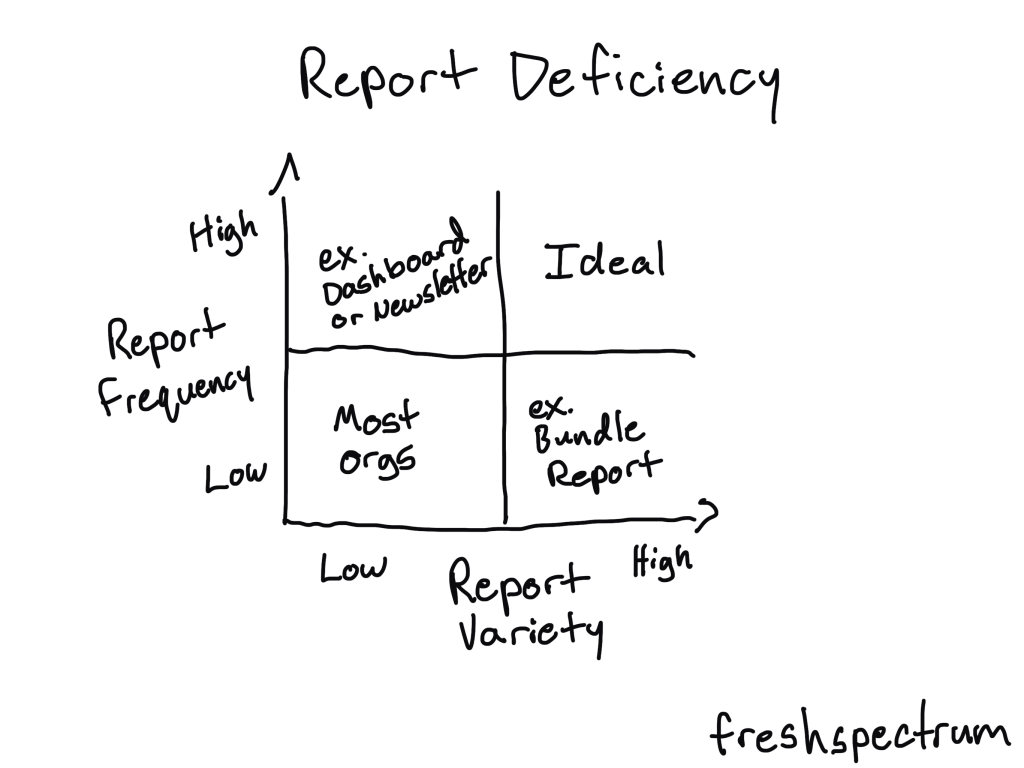
The two basic ways to treat report deficiency

The first is to increase frequency.

Higher frequency lets you develop an audience. If you only share a single report once every year you don’t have much of an opportunity to grow and cultivate a report audience.

Blogs and email newsletters are likely the easiest ways to increase frequency. But you can also just create shorter visual reports more often, establishing a cadence that can help you grow that audience.

The second is to increase variety.

Don’t just share one big annual report. Or, if you do, adapt that long report into a collection of different formats (ex. short visual reports, infographics, videos, webinars, presentations, courses, slidedocs, etc.).

These different formats create more opportunities to share your work that feel natural and organic, not spammy. They also give your collaborators (colleagues, program teams, executives, academics, politicians, etc.) choices in how they share your work with broader audiences.
Want to learn some easy ways to create effective everyday visual reports?

I’ll be teaching a live public half-day virtual workshop on designing everyday visual reports.

In this highly practical live course you’ll learn:

  • How to design effective short visual reports for use as fact sheets, executive summaries, case studies, method briefs, and more.
  • How to apply fundamental graphic design principles to give your reports that modern professional feel.
  • A process you can use that will benefit both the writing and design of your report.

Registration in this course includes:

  • Two live 90 minute sessions (on February 20 & 22 at 10 AM Eastern).
  • Forever access to the recordings.
  • Optional-to-attend after session Q&As (I’ll hang around for questions up to 30 minutes after each session).
  • One year of office hours with Chris Lysy (a $250 value).

Written by cplysy · Categorized: freshspectrum

Jan 31 2024

Three Things Evaluators Can Learn from Psychologists

This article is rated as:


Different professions have unique strengths and skills! Recognizing these provides us as evaluators with a great opportunity to learn from other professions to enhance our own work.

February is National Psychology Month here in Canada, and in honour of our counselling, clinical, and educational psychologist friends, I explored what we as evaluators can learn from psychologists to improve our practice! While evaluation and psychology practices are different in many ways, they also share quite a few similarities. For instance, both professions often involve working with people, using evidence to support our work, using tools like interviews and questionnaires, writing reports, and continuing professional development.

By looking closer at some of the skills that are essential to psychology practice, we can borrow some ideas to grow our own skills as evaluators. Using this lens can help us discover new strategies to try or remind us to be more intentional about things we may already be doing without thinking!

In this article, I’ll share three top tips we can learn from psychology practice to support our work as evaluators.


  1. Communication and active listening

The first tip is about communication. Psychologists spend much of their time communicating with clients, families, and other professionals. To make these interactions go smoothly, psychologists learn how to communicate effectively. For example, they often practice active listening in their interactions.

Active listening is a communication strategy that goes beyond simply hearing someone’s words. It involves showing understanding through both verbal and non-verbal cues. To practice active listening, psychologists might use techniques like the following:

  • Attending (being present, showing interest by nodding or saying, “I see,” for example)

  • Paraphrasing (restating what they hear in other words to show understanding)

  • Reflecting (expressing an understanding of the other person’s feelings)

  • Silence (encouraging the other person to continue or providing an opportunity for reflection)

Psychologists also pay attention to their own communication styles and might choose to adapt how they speak or interact to match a client’s style. For example, with a client who uses plenty of jokes and avoids eye contact, a psychologist might also intentionally incorporate some humour and limit their eye contact too. This helps the client feel more comfortable and builds the relationship between two people.


What can evaluators learn?

Evaluators also spend a great deal of time communicating in our work! Whether it’s conversations with coworkers, clients, project staff, or collecting data from interviewees, evaluators rely on the information we gain from our interactions. We can practice active listening to make sure we understand what someone is sharing by listening carefully, asking clarifying questions, and allowing silences. Active listening also supports relationship-building by letting others feel heard and seen in conversations.

To make our communication as effective as possible, we can also tune in to the other person’s communication style by noticing their body language, volume, tone of voice, use of humour and metaphors, or the specific terminology they use (for example, “partner” vs. “spouse” or “patient” vs. “client”). We can then consider mirroring certain elements to create shared understandings, such as by matching their volume or referring to a metaphor they used.


2. Interdisciplinary and collaborative work

Most psychologists don’t work in isolation. Psychologists who work in agencies or healthcare settings often need to collaborate with other professionals, like social workers, nurses, or housing workers to support their clients. Psychologists in private practices may consult with other psychologists on their cases to seek advice and discuss strategies.

Collaboration and working with professionals from other disciplines can be valuable for psychologists. It can help them understand a client’s experiences (e.g., dealing with a chronic illness or navigating the legal system) and offers them diverse perspectives to inform their approach. Psychologists can also discover new resources or learn new skills and techniques to incorporate into their work.


What can evaluators learn?

Collaboration can benefit evaluation practice too! Whether it’s with other evaluators or people from other disciplines, collaboration provides a great opportunity to problem-solve, learn new ideas, and build relationships. Asking someone to help you talk through an issue (I like the phrase “being a soundboard”) and paying attention to what others share about their work are two easy ways to start regularly incorporating collaboration into your work.

Even people who are the only evaluators on their team can incorporate this tip! Get involved in professional organizations like your local Canadian Evaluation Society chapter or check out interdisciplinary advocacy or learning events in your area. You can also stay connected to past fellow students or colleagues on a site like LinkedIn  to expose yourself to new developments in other fields.

It can also be useful to seek out learnings in casual interdisciplinary interactions. Any interaction with someone from another field or background, such as a project manager, an academic researcher, a nurse, or the Executive Director of a non-profit, can be a built-in interdisciplinary learning opportunity! Here are a few simple ways to make the most of these opportunities.

  • Reflect on any differences in how they approach their work compared to how you approach yours. Could any of these differences potentially be beneficial to your work?

  • Pay attention to the kinds of tools they use in their work, such as tools for collaboration, decision-making, or productivity. Could any of them be useful for you?

  • Ask questions when you feel curious or when you don’t understand something.

  • Think about how they do training and professional development in their role. Are there any resources you could learn from too?


3. Documentation

Psychologists need to document everything! From intake forms to case notes to communication logs to insurance documents, psychology practice requires strong procedures for documentation while protecting client confidentiality and privacy. Because they have so many records, many of which contain confidential information, psychologists typically follow clear processes for creating, sorting, keeping, and destroying documents. They often schedule blocks during the week to create case notes or update other files, for instance, and they adhere to record-retention procedures set by their professional organizations.


What can evaluators learn?

While evaluators may not use the exact same kinds of documents as psychologists, it is still important to be intentional about the ways in which we create, organize, and retain documents.

It’s a good idea to create a strong digital file organization system to help keep track of project documents, notes, and deliverables. Here at Three Hive & Eval Academy, we use a standard folder setup for each project (such as folders for Planning, Data, and Reporting) so everyone knows where to find a document. The organization system you use is up to you—create whatever categories make the most sense for your work—but just make sure you have a system! It’s also important to have clear record-retention and destruction policies and ensure everyone on your team is aware of them.

Evaluators can also take inspiration from the communication logs that psychologists might use to keep thorough records of any communication you have during a project. It’s helpful to schedule regular time to track these communications to avoid losing anything essential, make it easy to refer back to previous interactions, and create transparency in case you need to demonstrate what has been carried out. You could track emails with clients, survey invitations, meetings, phone or face-to-face interviews, or documents shared with you—and that’s just a start! What types of communication do you think could be helpful to track in your work?


Do these tips apply to your own work? Is there anything else you have learned from psychologists? Share with us in the comments!

Written by cplysy · Categorized: evalacademy

Jan 31 2024

Enhance Meeting Note-Taking Efficiency with Our Latest Template

This article is rated as:


You may have a program steering committee or an evaluation advisory committee meeting coming up and want to ensure you can track the discussion and any action items. These strategic and planning-type meetings are notorious for complexity, and it may be hard to document the many issues discussed, decisions being made, and action items that need to be followed through. The challenge is, how do we keep track of it all?

Note-taking is just one piece of this puzzle which can include calendars, Gantt charts, and project or task management software like Asana or Microsoft Planner. Here is a template I use to help track notes in project meetings.


Why a note-taking template?

This template helps you to:

  • Document what is important during the meeting;

  • Record key details you need to refer back to or follow up on;

  • Document decisions, challenges, and action items;

  • Increase team accountability by tracking who is responsible for follow-up on action items;

  • Efficiently update other project management tools.


Who’s it for?

This template is for anyone who needs to track updates and action items in project meetings!


What’s included?

The Meeting Notes Template in Microsoft Word is a tool to use when needing to keep track of challenges, changes, and action items discussed in a project meeting. The template captures who is in attendance, changes to the project, what challenges may affect the project, and who is responsible for action items.


How do I use this template?

In preparation for a meeting, I pre-populate the agenda items for the meeting into the Topic column. If any agenda items get added, I add a new row, or if I’m using a printed copy of the template, I write on the back or in a notebook to add these later.

Once completed, it can act as a useful tool to help drive the project forward by clearly listing the action items. Action items can be added to whatever project management or to-do list tracking system you prefer.


Learn more: related articles and links

You can learn more about project management in evaluation through the following links:

Project Management for Evaluation

How to Present Your Evaluation Timelines: 4 Simple Ideas

Written by cplysy · Categorized: evalacademy

Jan 30 2024

Evaluative Thinking: What does it mean and why does it matter?

This article is rated as:


In a world driven by data and outcomes, the ability to think evaluatively has become an important skill for individuals, organizations, and communities. Evaluative thinking goes beyond data analysis alone; it involves a systematic and reflective approach to understanding the effectiveness and impact of actions, programs, and decisions. In this article, we explore what evaluative thinking means, its key components, and why evaluative thinking is important.


What is Evaluative Thinking?

Evaluative thinking is a cognitive process focused on the analysis, interpretation, and judgment of information to guide decision-making. It involves posing critical questions, weighing evidence, and reflecting on experiences to gather insights into the successes or challenges of a project or program. Evaluative thinking is critical to the practice of evaluation and recognizes the importance of continuous learning. Based on a curious mindset and a strong belief in the importance of evidence, evaluative thinking involves tasks like recognizing assumptions and considering different perspectives. As put by Michael Quinn Patton: evaluation is an activity, evaluative thinking is a way of doing business.


Key Components of Evaluative Thinking:

  • Questioning and Inquiry: Evaluative thinking begins with asking the right questions. This includes questioning assumptions, motivations, and expected outcomes behind a project or program. Evaluative thinking is guided by an overall curiosity and a willingness to explore various elements of a change process. This way of thinking encourages us to explore the details of a situation rather than accepting it at face value.

  • ·Data Collection and Analysis: Gathering relevant data is a fundamental aspect of evaluative thinking which has a strong belief in the value of evidence. This could involve quantitative data and qualitative data. The integration of both forms of data enriches the evaluation process, providing a holistic understanding of the topic. Analyzing this data helps us to understand patterns, trends, and potential areas for improvement.

  • Reflection and Interpretation: Taking time to reflect on the collected data and interpreting its meaning is crucial. This goes beyond observation; it involves considering the context and identifying contributing factors and underlying patterns.

  • Continuous Learning and Improvement: At its core, evaluative thinking embraces continuous learning and improvement. Rather than viewing evaluations as endpoints, it positions them as facilitators for growth and improvement. Individuals and organizations committed to evaluative thinking actively seek to take lessons from both successes and setbacks, using these insights to inform future decisions such as refining strategies, reallocating resources, or adapting approaches to achieve intended outcomes.


Why Evaluative Thinking Matters:

  • Informed Decision-Making: Evaluative thinking lays the groundwork for informed decision-making. By systematically analyzing data and reflecting on experiences, individuals and organizations can make decisions rooted in evidence.

  • Accountability and Transparency: Evaluative thinking fosters accountability by creating a culture where individuals and organizations are responsible for their actions and can transparently communicate their results, whether they are successful or present challenges.

  • Resource Optimization: By understanding what works and what doesn’t, evaluative thinking enables the optimization of resources. This involves allocating funds, time, and efforts more efficiently, ensuring that resources are directed toward strategies and initiatives that have proven to be effective while minimizing investments in areas that may not yield the desired outcomes.

  • Adaptability and Innovation: A mindset of evaluative thinking encourages adaptability and innovation. It allows individuals and organizations to adapt strategies based on real-world feedback, fostering a culture of continuous improvement and innovation.

  • Community and Stakeholder Engagement: In community development and social initiatives, evaluative thinking fosters meaningful engagement with stakeholders by deepening our understanding of the program’s impact on communities. This process not only builds trust and collaboration but also propels community engagement, as it prompts an exploration of the “why” and may necessitate collaboration with others to address underlying issues.


To expand your evaluative mindset, incorporate the following practices into your thinking process:

  1. Maintain Curiosity: Expand your curiosity by consistently asking “why.” Fostering a curious mindset deepens your understanding of the world, catalyzing evaluative thinking. This includes asking questions and enriching your understanding by probing into situations, decisions, or information. Ask the less obvious questions to explore what might be causing the situation and uncover potential gaps. Similar to the concept of negative space in art, effective evaluation often involves not only observing what’s evident but also identifying what may be missing or not directly addressed. Consider the cultural context too; for example, in some Indigenous cultures, direct negative feedback might not be given, so it’s important to explore the unspoken, gaining a nuanced understanding of unintended outcomes and cultural nuances.

  2. Rely on Evidence: Base your decisions on collected data, thoroughly reviewing information to underpin your reasoning. Utilize this data to shape recommendations and implement changes, ensuring your choices are well-supported and grounded in thorough analysis.

  3. Reflect on Experiences: Consider your past experiences to evaluate what worked well, identify areas for improvement, and extract valuable lessons for future endeavours. This process may also involve considering diverse viewpoints through perspective-taking and seeking feedback from others.

  4. Embrace Learning Opportunities: Consider challenges as opportunities for growth and improvement. Embrace the opportunity to grow through experiences and continuously seek ways to enhance your skills.


Evaluative thinking is not just a process; it’s a mindset that empowers individuals and organizations to navigate complex challenges with evidence. By adopting evaluative thinking, we can collaboratively make a difference through our work.


How do you adopt evaluative thinking? Let us know in the comments below!

Written by cplysy · Categorized: evalacademy

Jan 29 2024

Looking Ahead to 2024: What’s Coming to Depict Data Studio 

Wondering what I’ve got planned this year? 

Here’s what’s in store for 2024 related to: 

  • Online Courses, 
  • Private Training, 
  • Conference Keynotes, and 
  • My Personal and Professional Goals. 

Online Courses 

The biggest improvement for 2024 is that all 6 courses will be offered LIVE (!!!).

We’ll meet over Zoom on Monday, Tuesday, Wednesday, and Thursday afternoon from 1 – 4:30 pm Eastern each day. We’ll have 10 minute breaks every hour, and the last 30 minutes is reserved for extra Q&A time.

Classes are highly interactive. I’ll teach a skill for ~10 minutes, and then you’ll immediately apply it. I’ll teach, you’ll immediately practice, and so on. Within our four half-days, you’ll spend 25% of the time listening and 75% of the time doing. No more pressure to find time in your already-packed schedule for implementation.

Yes, sessions are recorded and immediately uploaded and captioned in case you can’t make it live. You’ll get lifetime access to the latest recordings.

Why?? The #1 roadblock is that participants don’t have time for recorded courses. Something always comes up. A rescheduled meeting. A shifting deadline. With live classes, you’ll simply show up, learn, and implement.

And, selfishly, offering live classes means personal satisfaction; i.e., I know that the latest and greatest version of the course is available. I spend weeks every year re-recording, re-editing, re-uploading, re-making handouts, re-writing ebooks, and re-creating templates. It’s a logistical nightmare to keep online courses up to date! I block off a day for recording, and then a client deadline shifts. I block off another day for recording, and then another deadline shifts. And so on. In 2023, for example, I re-recorded a 1-hour module in January… but didn’t edit and upload those videos until November! Eek. It was weighing on my mind all year. Never again.

By offering all 6 courses live, participants will get the best learning experience. And I’ll get the personal satisfaction that all 6 of my courses have been fully upgraded this year.

Calendar

  • Simple Spreadsheets, our data analysis course: March 4 – 7, 2024 from 1 – 4:30 pm Eastern each day. Register here by March 1.
  • Great Graphs, our software-agnostic dataviz course: April 15 – 18, 2024 from 1 – 4:30 pm Eastern each day. Register here by April 12.
  • Great Graphs in Excel, our Excel-specific dataviz course: May 20 – 23, 2024 from 1 – 4:30 pm Eastern each day. Register here by May 17.
  • Report Redesign, our deep dive on creating reports that people actually read: October 7 – 10, 2024 from 1 – 4:30 pm Eastern each day. Register here by October 4.
  • Powerful Presentations, our public speaking and slide design course: November 4 – 7 , 2024 from 1 – 4:30 pm Eastern each day. Register here by November 1.
  • Dashboard Design, our deep dive on building static and interactive dashboards: December 9 – 12, 2024 from 1 – 4:30 pm Eastern each day. Register here by December 6.

Tuition

Registration is $997/participant for 2024, which includes the 4 half-day classes AND lifetime access to the recordings AND supplemental materials like handouts and ebooks AND Office Hours for the entire calendar year.

No price increases for the fourth year in a row.

We also have group rates available. Group rates for online courses will always be more cost-effective than a private training.

Private Training 

Want to bring me in to speak to your team? 

Each year, I lead ~200 private sessions for foundations, nonprofits, universities, and government agencies who work on social good issues. 

Here’s more info about my workshops, which can be held virtually or in-person. 

Package 1: Private Training

What’s included:

  • Live Training for up to 25 Staff. You’ll get live, custom training for up to 25 people. (Yes, we have per-person rates for events with more than 25 attendees.) The most popular option is 1 day on-site, or 2 half-days virtually. For example, we might meet from 9 – 5 in your conference room. Or, we might meet from 12:30 – 4:30 virtually for two days in a row (e.g., a Tuesday-Wednesday).
  • 6 Classes to Choose From. I have 6 full-length topics to choose from (e.g., dataviz best practices, or dashboards, or reports, or Excel how-to’s). We’ll work together to choose one class that’s best for your team.
  • Review of 5-10 Sample Materials. Seeing your staff members’ real projects will help me customize the agenda for their exact needs.
  • Customized Agenda. After I review your sample materials, I’ll customize the agenda to fit your team’s current skill level. For example, we might skip over beginner-level topics and move right into advanced techniques. We’ll cover your Wish List topics, too. In the past, groups have opted to cover qualitative dataviz, maps, before-after graphs, and longitudinal data.
  • Zoom Set-Up and Hosting. If we’re meeting virtually, I’ll handle the behind-the-scenes Zoom setup so you don’t have to worry about it. You’ll send your staff a link to RSVP for the sessions. I’ll set everything up on my own account. I’ll host the trainings so you can take it off your to-do list. You’ll receive weekly registration updates so we can monitor how many people have RSVP’d. I can also send you Zoom attendance reports afterwards so you can see exactly who attended, and for how long.
  • Recordings for 1 Full Year. YES, we can record everything! YES, for virtual and in-person events! Recordings are helpful because: scheduling conflicts are inevitable; staff get stressed that they might forget something; and new staff can watch the recordings as part of their onboarding process. You’ll get access to your password-protected site for an entire year.
  • Materials. Worried you won’t remember everything? You’ll get the PDF’d slides of everything we cover. Your staff will love the side-by-side examples showing them exactly how to fix common graphical mistakes. Depending on which class we choose, you’ll also get handouts, checklists, ebooks, and graph templates.
  • Recommended Resources. Don’t want to lose time googling for the best resources? You’ll get my curated resource list with my favorite books, blogs, podcasts, and software tools.
  • Certificates of Completion. Want to build your portfolio as part of your annual review process? You’ll get personalized Certificates of Completion after our private training.
  • Satisfaction Surveys. I’m sure you can handle this on your own, but I’ll take care of the satisfaction surveys to save you time. You’ll get a copy of the results to help with future planning.
  • Email Recaps. I’ll also send emails before and after the sessions to keep the conversations going.
  • Alumni-Only Community. Everyone will be invited to our students-only LinkedIn group, where you can network, post drafts, and get feedback from others.
  • Swag. For in-person workshops, I’ll bring plenty of stickers, magnets, pins, and buttons.

Package 2: Private Training + Longer-Term Support

Want to make sure your staff are supported for the long-run, so they can apply everything they’ve
learned to your projects?

I’ll provide consulting, weekly technical assistance sessions, and style guide and accessibility support.

You’ll get everything from Package 1: Private Training and:

  • 5 Hours of Follow-Up Zoom Support. Have questions after the private workshop? Don’t want to post your drafts in the LinkedIn group? You’ll get 5 hours of follow-up consulting – via email or Zoom, your choice. For example, you can email me with quick questions and pick my brain. Or, we can hop on Zoom, share screens, and troubleshoot together. You can use your follow-up consulting anytime within 12 months of the workshop.
  • 3 Before-After Makeovers. Want to see exactly how these principles can be applied to your own data? I’ll create 3 quick makeovers of your work. For example, I’ll transform a text-heavy slide or revamp a page of your report.
  • Lifetime Course Access. All 25 staff will get lifetime access to my online course, which goes broader and deeper than our training together. For example, if you choose the Simple Spreadsheets class for our live training, then your staff will also get access to the Simple Spreadsheets online course (!). Your private training is 8 hours of highlights… but the online course has dozens more tutorials and gets updated regularly. Your staff will have lifetime access to the latest and greatest lessons.
  • Makeovers. We’ll create 3 quick makeovers of your work. For example, we’ll transform your report’s cover, revamp a text-heavy slide, etc.
  • Accessibility Audits. Are you required to make 508-accessible graphics? We’ll meet for 60 minutes over Zoom and review one of your publications, slideshows, or dashboards. I’ll use a fine-toothed comb to check for “Big A Accessibility” (legal 508/ADA requirements) and “little a accessibility”(making sure it’s easy to understand). You’ll leave with a detailed to-do list of edits from my Dataviz Accessibility Checklist.
  • Data Visualization Style Guides. Even your intern can make great graphs—if they’re using branded, accessible, intuitive templates as their foundation. In our first 90-minute session, I’ll review your existing branding materials, like style guides, colors, fonts, photographs, and/or icons. We’ll go through my Checklist for Dataviz Style Guides so you know exactly how to improve your resources in the future. Then, I’ll create a Data Visualization Style Guide and Chart Templates for you. In our second 90-minute session, we’ll walk through your Guide and Templates together.
  • Office Hours for 1 Year. All 25 staff will be invited to weekly Q&A sessions—for an entire year! These are “consulting lite” sessions where I’ll review your draft dashboards, reports, and slides. You’ll get a list of: What you’re already doing well; Quick Wins that you can tackle with ~15 minutes of editing; and Not-So-Quick Wins to keep in mind for your future projects.

Want to learn more about private training? Book a call.

Conference Keynotes

I’m looking forward to providing keynote speeches, pre-conference workshops, and breakout sessions at a variety of in-person and virtual conferences this year.

Want to learn more about conference keynotes? Book a call.

Personal Goals 

I’m going to continue working the K12 school calendar. When my kids are home from school, the Depict Data Studio office is closed. No courses or private trainings over spring break, summer break, Thanksgiving, winter holidays, etc.

We might be moving in a month or two (just down the street in the greater Orlando area – with a bit more room). The paperwork should be finalized today, fingers crossed! We bought our current house when we had 2 kids. Now we have 5. So.

I’m still obsessed with edible gardening. At our current house, we’ve got papayas, bananas, avocados, lemons, oranges, guavas, cherries, figs, blueberries, blackberries, raspberries, mulberries, grapes, and pineapples. If/when we move, I’ll start anew in that backyard.

I might start bicycling again, TBD. Pre-kids, I’d ride 50-80 miles every weekend, plus commuting to/from work on nice days. I signed up for a 50-mile ride in February. But it’s January 29 and I haven’t even pumped up my tires yet, let alone started training, so. When the twins are 6 months old, they can safely ride in the bike trailer. That’s when I can realistically start riding again. They’re only 4 months old, so it’s a bit soon.

In the meantime, I’m still using my walking pad while I work. Most days, I can easily walk ~10 miles during the workday. Walk an hour, stand still for a Zoom, walk an hour, grab some lunch, walk an hour, stand still for a meeting, etc. I even walked a marathon a few weeks ago! My goal is to walk 2,000 miles on the walking pad in 2024 (10 miles per work day x 20 work days a month x 10 working months).

Professional Goals

I’m going to focus on blogging again this year. Little to no YouTubing, podcasting, guest lectures in universities, free talks, etc. My time’s limited, and blogging is the most efficient one to many structure.

In past years, my goal has ranged from 24-36 new blog posts (2-3 new articles every month). This year, I’ll focus on revamping the existing blog posts rather than publishing brand new posts. I started 2024 with ~330 posts. I already deleted ~30 blog posts that were no longer relevant. I’ll revamp existing posts by adding new photos, new examples, and new screenshots.

(“Ann, WHY are you deleting precious blog posts?? What if someone needs those tips??” No, they don’t. Internet clutter makes it harder for everyone to find what they need. Less is more.)

I’m also taking a year-long break from social media, sort of. I realized that I’ve been on Facebook for 20 years, since it came out in 2004 (!). And, I used AOL Instant Messenger and chat rooms before that. My entire adolescence and adulthood has been online. In December 2023, I deactivated Facebook; I no longer log into Instagram or Twitter; and I stopped scrolling through TikTok. I still use LinkedIn here and there for work. The instant result: My attention span is instantly improved, and I’m loving long-form content again. My brain prefers movies over short clips; my brain prefers books over online articles; and my brain prefers audiobooks and podcasts over soundbites. Social media isn’t black and white. I wish it was! There are pros and cons to being connected with online communities. For example, I love seeing photos of my cousins’ children. But I don’t need to see photos of other peoples’ beautiful kitchens and living rooms and vacations that I just get jealous of. Hence the year-long experiment: to see whether social media is actually a net positive for me and society. A month into my experiment… I’m pretty sure it’s not.

I’m continuing to focus on building my own Excel skills. I’ll be speaking at and attending the Excel Sum(it) in a couple weeks. I’ll likely find some online or in-person workshops to attend, too. I’d rather have elite skills in a single software program than mediocre skills in a handful of programs.

Administrative & Logistical Tasks

I hesitated to mention these, since they’re so boring.

Are you interested in behind-the-scenes details??

If so, here’s what’s also on my radar:

  • Lean staffing. I tried virtual assistants a few years ago. I tried subcontracting projects to colleagues a few years before that. I’m happily continuing as a one-woman company. It’s not that I don’t need help; I don’t need help with work. Thanks to Zapier, ConvertKit, and Teachable, I’ve automated nearly everything behind the scenes. And, we’ve got the pool company, landscapers, babysitters, preschool, a stay-at-home husband, etc. to help on the household side. The popular business advice is to hire, hire, hire. More staff usually means higher gross income, but not higher net income. What’s the point of complicating anything? Simple is best.
  • Accounting. I’ve upgraded accountants and software over the years. I’ve switched from a sole proprietor to LLC to S Corp. There’s nothing left to fine-tune.
  • Website. I did a website revamp in 2022. I’ll probably do another one in 2025. Websites are usually an every-3-year thing in my world, with minor tweaks in between that.
  • Newsletters. I’ll continue sending newsletters ~weekly throughout the year; scrubbing the list; A/B testing the subject lines; and keeping the open rate and click-through rates high.
  • Digital resources. I’ll continue posting digital resources, like ebooks and chart templates, on Gumroad.
  • Hiring my kids. I’ve been working with my accountant to start legally and ethically hiring my 8-year-old. We’re putting her on payroll; she’ll put 100% of her earnings into a Roth IRA; and we’ll likely write blog posts and submit conference sessions together. The theme will be something like “how to make graphs so accessible that even an 8-year-old can understand them.”

Your Turn 

What are you focused on in 2024?  

Are you hoping to learn a new software program? Achieve a personal goal?  

Comment anytime and let me know! 

Written by cplysy · Categorized: depictdatastudio

  • « Go to Previous Page
  • Go to page 1
  • Interim pages omitted …
  • Go to page 60
  • Go to page 61
  • Go to page 62
  • Go to page 63
  • Go to page 64
  • Interim pages omitted …
  • Go to page 310
  • Go to Next Page »

Footer

Follow our Work

The easiest way to stay connected to our work is to join our newsletter. You’ll get updates on projects, learn about new events, and hear stories from those evaluators whom the field continues to actively exclude and erase.

Get Updates

Want to take further action or join a pod? Click here to learn more.

Copyright © 2026 · The May 13 Group · Log in

en English
af Afrikaanssq Shqipam አማርኛar العربيةhy Հայերենaz Azərbaycan dilieu Euskarabe Беларуская моваbn বাংলাbs Bosanskibg Българскиca Catalàceb Cebuanony Chichewazh-CN 简体中文zh-TW 繁體中文co Corsuhr Hrvatskics Čeština‎da Dansknl Nederlandsen Englisheo Esperantoet Eestitl Filipinofi Suomifr Françaisfy Fryskgl Galegoka ქართულიde Deutschel Ελληνικάgu ગુજરાતીht Kreyol ayisyenha Harshen Hausahaw Ōlelo Hawaiʻiiw עִבְרִיתhi हिन्दीhmn Hmonghu Magyaris Íslenskaig Igboid Bahasa Indonesiaga Gaeilgeit Italianoja 日本語jw Basa Jawakn ಕನ್ನಡkk Қазақ тіліkm ភាសាខ្មែរko 한국어ku كوردی‎ky Кыргызчаlo ພາສາລາວla Latinlv Latviešu valodalt Lietuvių kalbalb Lëtzebuergeschmk Македонски јазикmg Malagasyms Bahasa Melayuml മലയാളംmt Maltesemi Te Reo Māorimr मराठीmn Монголmy ဗမာစာne नेपालीno Norsk bokmålps پښتوfa فارسیpl Polskipt Portuguêspa ਪੰਜਾਬੀro Românăru Русскийsm Samoangd Gàidhligsr Српски језикst Sesothosn Shonasd سنڌيsi සිංහලsk Slovenčinasl Slovenščinaso Afsoomaalies Españolsu Basa Sundasw Kiswahilisv Svenskatg Тоҷикӣta தமிழ்te తెలుగుth ไทยtr Türkçeuk Українськаur اردوuz O‘zbekchavi Tiếng Việtcy Cymraegxh isiXhosayi יידישyo Yorùbázu Zulu