• Skip to main content
  • Skip to footer
  • Home

The May 13 Group

the next day for evaluation

  • Get Involved
  • Our Work
  • About Us
You are here: Home / Archives for allblogs

allblogs

Feb 14 2024

Choosing Your Community Partners Wisely

While building a partnership with other organizations, engaging the right participants is crucial to facilitating a process that’s mutually beneficial. Your organization knows the key community players who are doing the same work, whose work is adjacent to yours, or whose work is in another areas but they can champion your work. A facilitator may […]

The post Choosing Your Community Partners Wisely appeared first on Nicole Clark Consulting.
Written by cplysy · Categorized: nicoleclark

Feb 12 2024

How to Visualize Population Projections with Small Multiples Population Pyramids

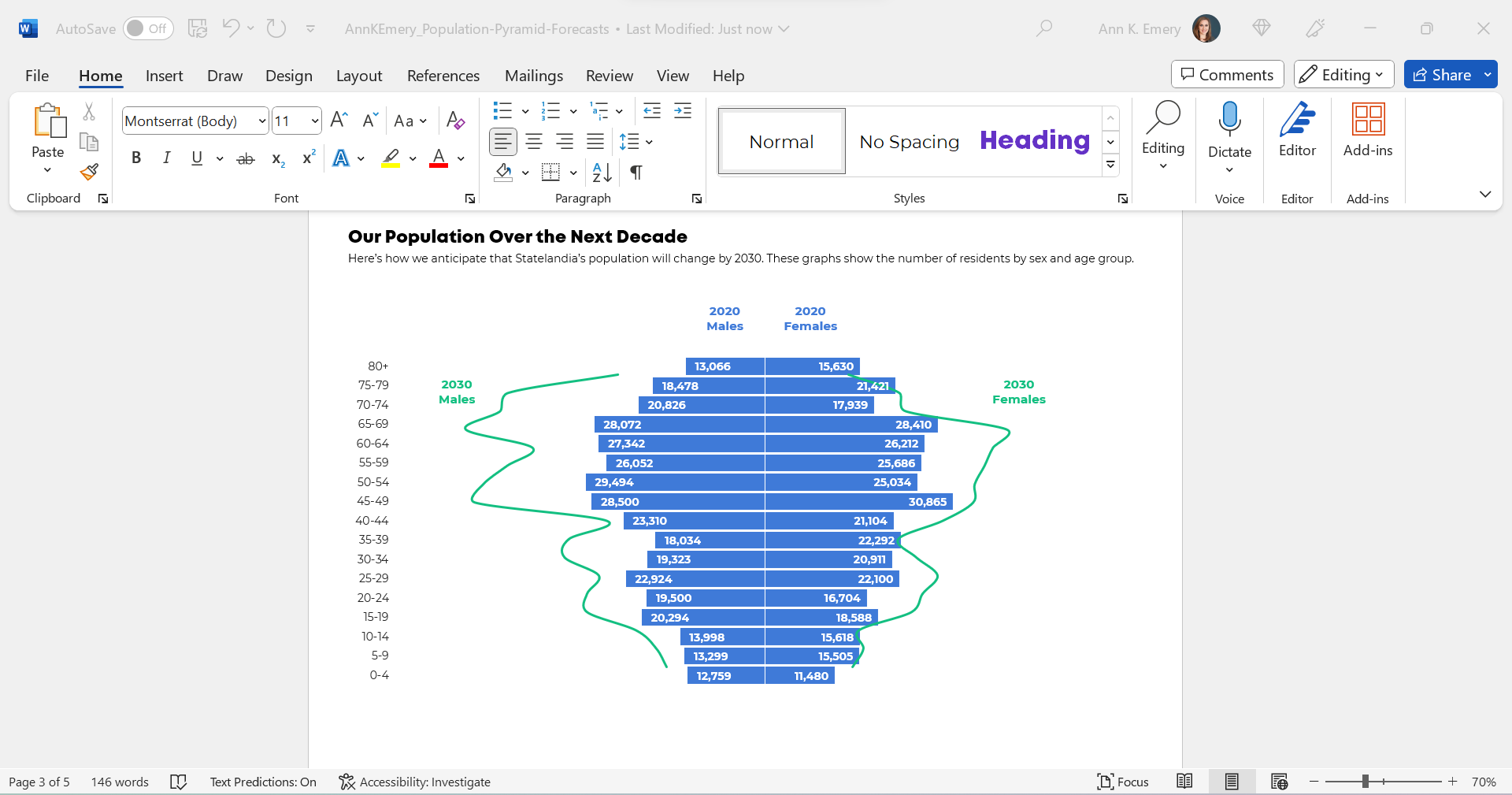
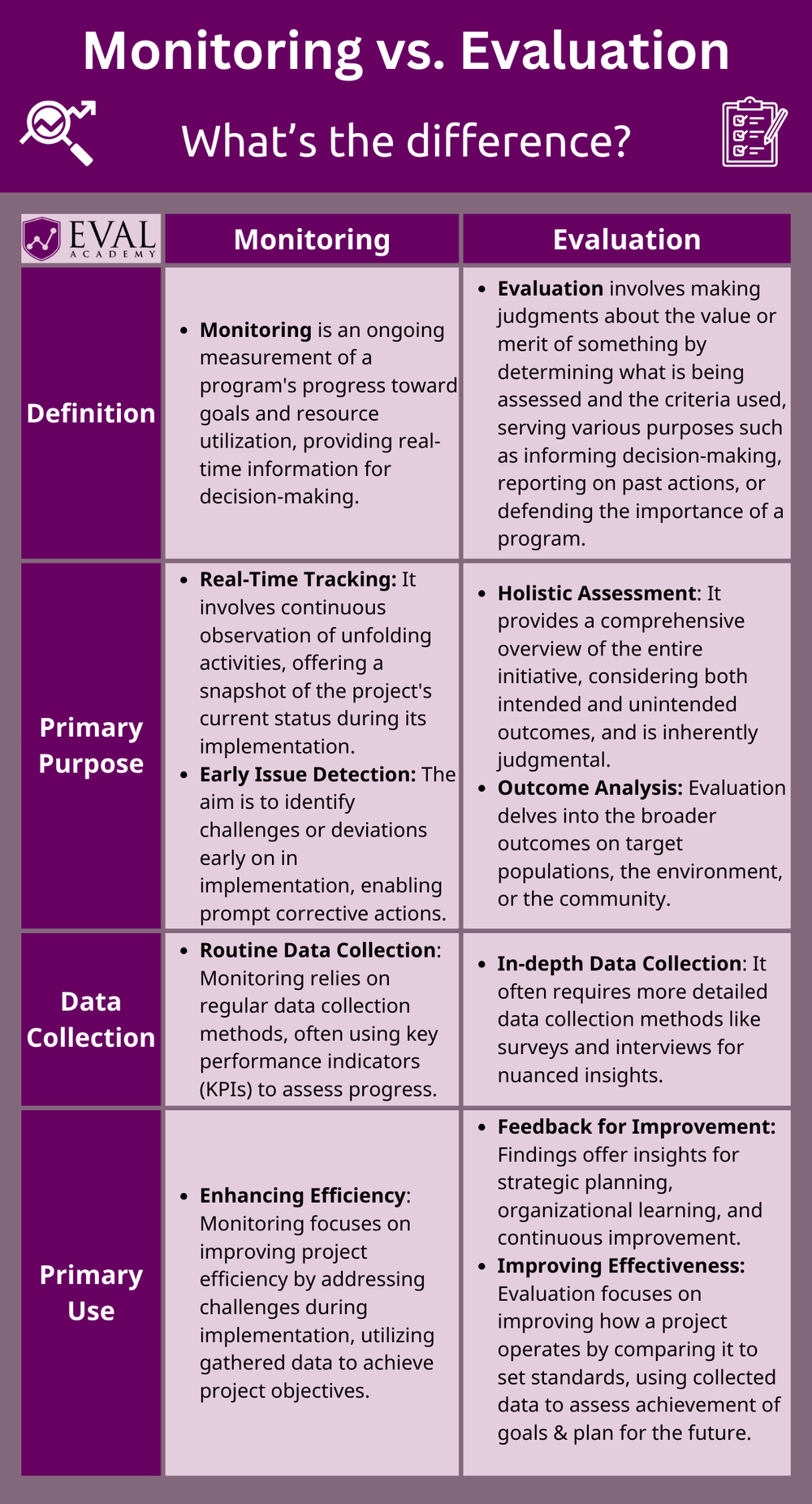
A few months ago, one of my favorite students brought this graph to Office Hours:

(These aren’t the exact numbers, age ranges, or years. But you get the idea.)

She already knew how to make population pyramids in Excel. Population pyramids require Level 4 vizardy skills. Woohoo!

But she wanted to take the population pyramid a step further, and she wanted to show how the population might change over time, especially for older adults.

So, she followed this online tutorial to add those curvy lines. (Yep, it’s made with a combo chart in Excel.)

Bare-Minimum Edits

As usual, we tackled the bare-minimum edits first:

  • We removed the legend and directly labeled the data, which helps the graph pass “Big A Accessibility” rules (a.k.a. 508/ADA compliance).
  • We nudged the bars closer together by reducing the gap width to make more of a smoothed-out histogram.
  • We outlined the touching filled-in rectangles in white, a small detail that helps with grayscale printing.
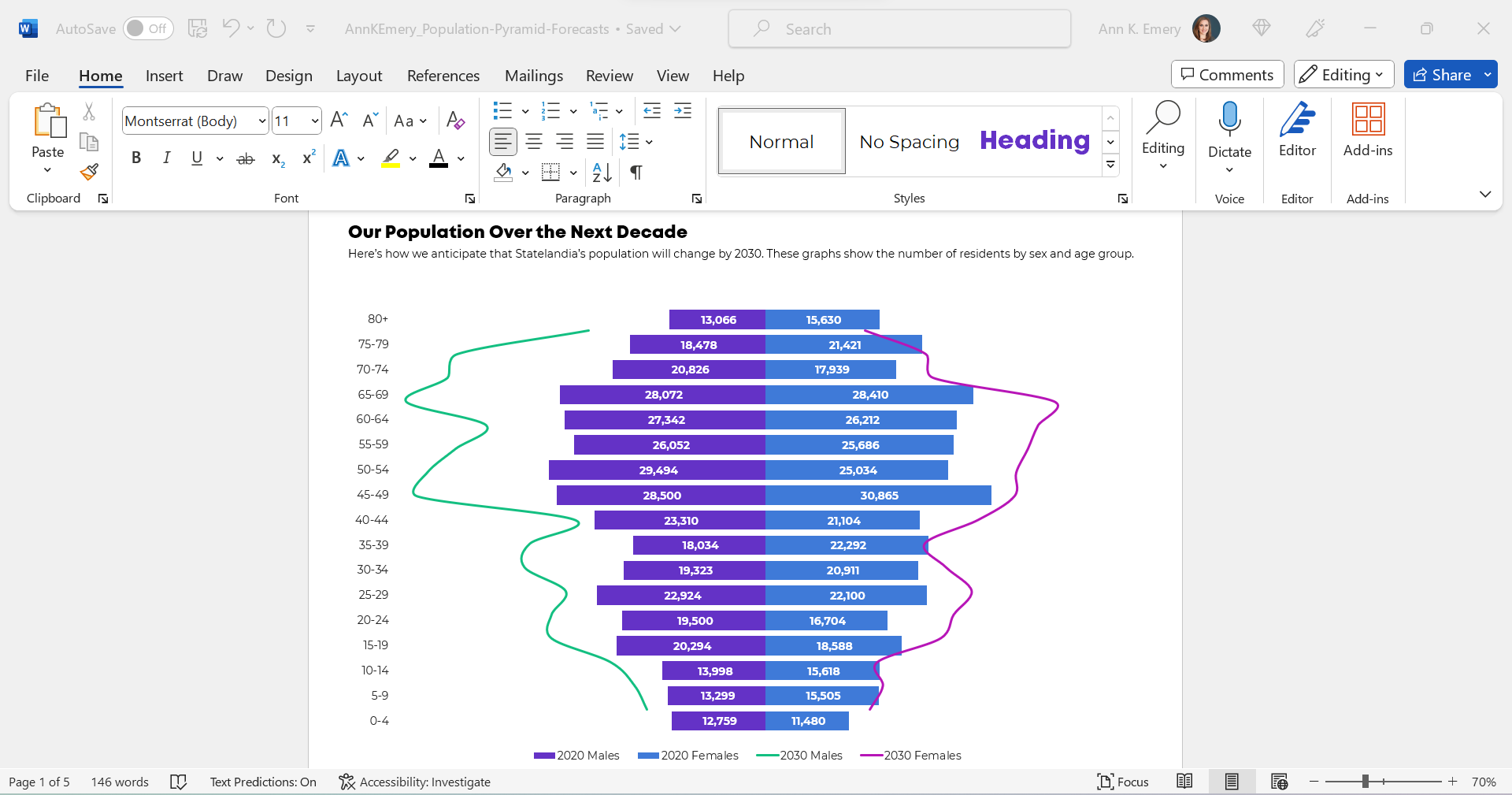
  • We used fewer colors. Before, there were 4 different hues: for 2020 males, 2030 males, 2020 females, and 2030 females. That’s a lot to keep track of! Instead, we color-coded by category (one hue for males, and another hue for females).

We also tried color-coding by year, instead of color-coding by sex, like this:

We were getting closer!

But we wanted to make sure that the forecasted numbers for 2030 were extremely obvious to viewers. For most of us, this isn’t a chart type that we see every day.

I was hesitant to keep the combo chart. This was an apples-to-apples comparison, so I wanted to use all bars.

(The bars/lines combo seemed more like an apples-to-oranges comparison, which this isn’t.)

Small Multiples Population Pyramids

Here’s a Dataviz Rule of Thumb:

Anytime your graph feels too dense… try creating more graphs.

Small multiples layouts can save the day!

The Traditional Version

We tried traditional and storytelling versions of a small multiples population pyramid.

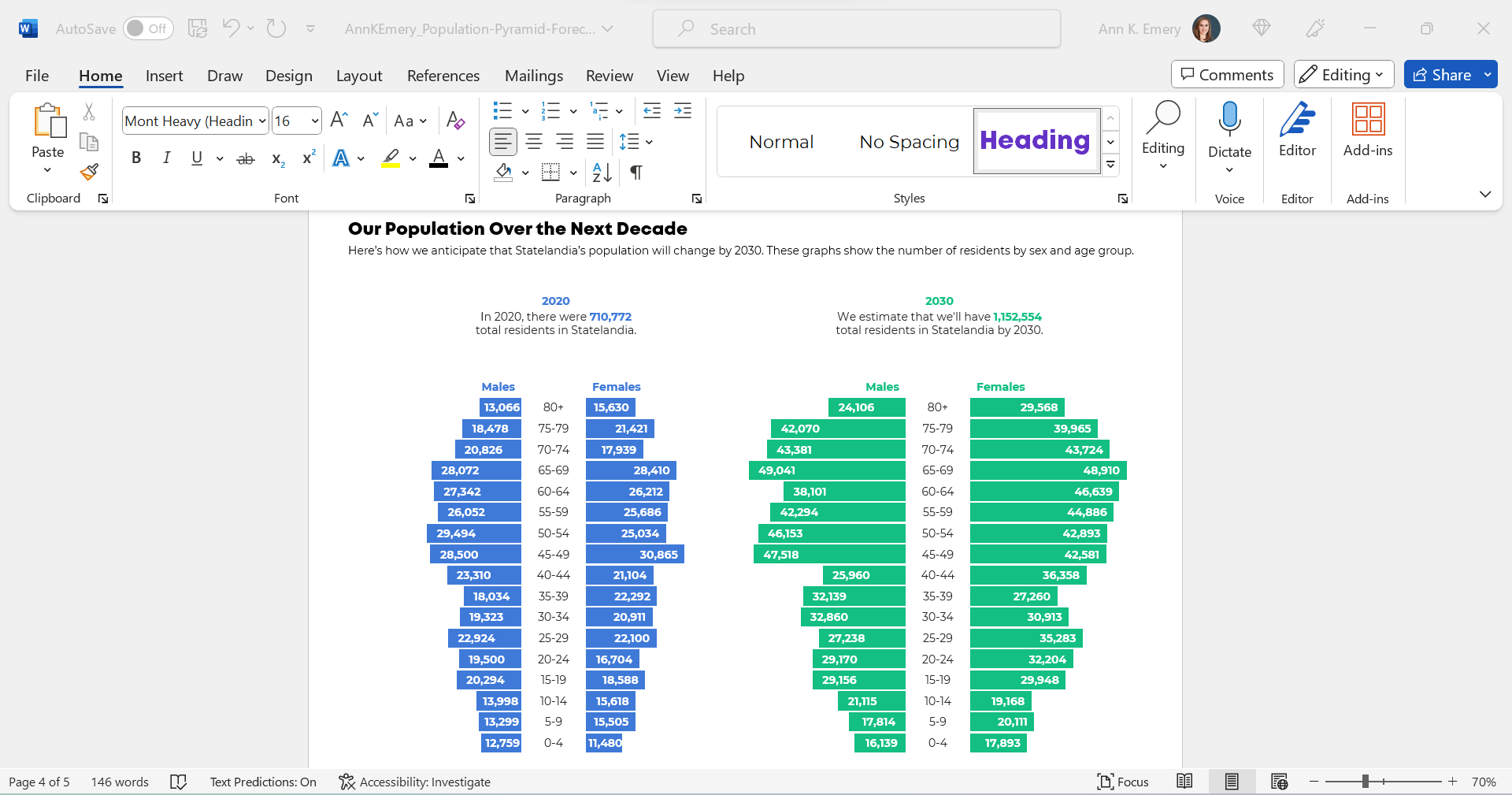
Here’s what the traditional version would look like inside her report.

You’ll notice the topical titles, color-coding by category (one hue per year), and how the graphs are all one color.

The Storytelling Version

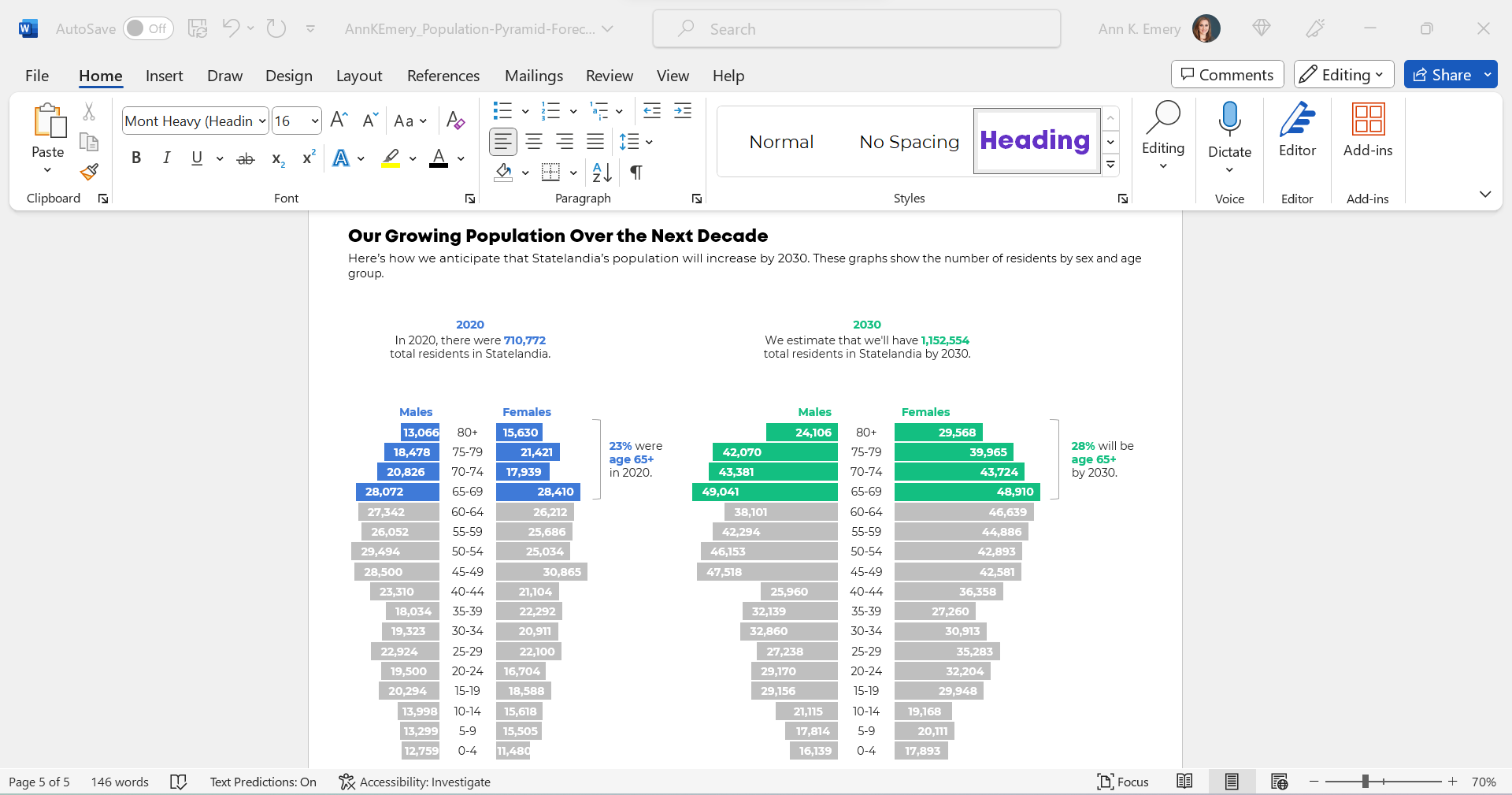
And here’s what the storytelling version would look like inside her report.

This version draws attention to the 65+ age group, which she wanted.

You’ll notice the takeaway title, the color-coding by category (one hue per year), the dark-light contrast (highlighting the residents who are ages 65+), and the annotations.

The Bottom Line

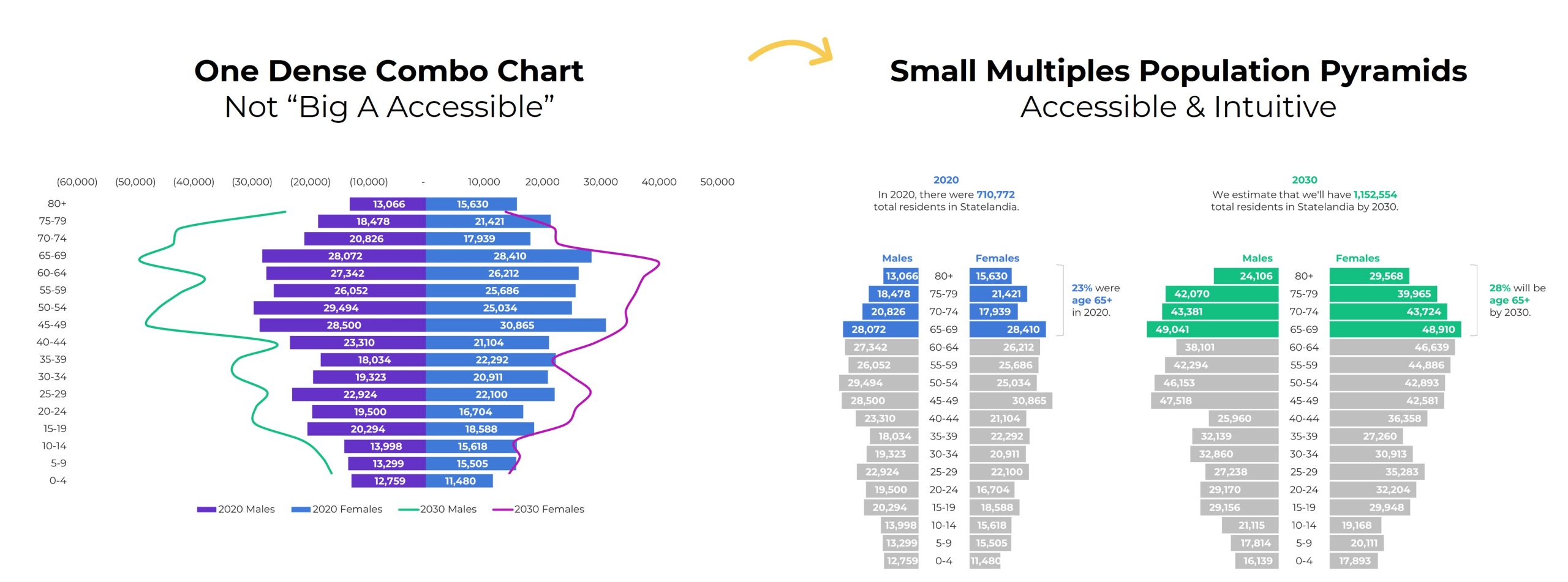
Even with the bare-minimum edits, I wasn’t a fan of the original combo chart. The bar-line combo was suggesting an apples-to-oranges comparison.

Instead, anytime your chart feels too dense (when there are literally lines and bars combined within one chart), try a small multiples layout instead!

We can format the chart as a traditional or storytelling version. In this case, storytelling was a perfect fit because we especially wanted to highlight the 65+ age group.

Written by cplysy · Categorized: depictdatastudio

Feb 08 2024

5 Baby Steps to Better Reports

A couple of years ago I put out a book called the Reporting Revolution. And while I still believe just about everything I wrote in that book, I know many of you are not actually looking to start a revolution. You just want to start creating better reports.

So, with that in mind, today’s post is just a collection of baby steps. Simple things you can do now to improve your reporting.

1. Don’t focus on making your long report look better.

Your long report will only ever reach a small audience, even if it’s fantastic. And longer reports usually take lots of time and effort to make them pretty. It’s far more valuable to put that time you would spend updating your longer report into creating short reports.

2. Create a slidedoc.

A slidedoc could replace your long reports, but it doesn’t have to replace one to be useful. Slidedocs are simply just fantastic adaptations. Slidedocs are easier to create than infographics, and offer far more utility.

The easiest way to think through a slidedoc design is to consider it like a really nice visual presentation that doesn’t require a presenter to deliver. If you are already creating nice visual presentations, start from the slidedecks and just add words.

If you want a little more guidance on where to start, I wrote a blog post on slidedocs a couple of years ago that is still very relevant.

3. Create two graphs instead of one.

Don’t agonize over chart choice before you start designing. Instead go with a basic chart (like a bar graph) and then create something fancy (like a dot plot or slope graph) with the same data. Now you have choices that can be compared and contrasted.

This is useful if you are on your own, but it’s especially useful if you are working with a team. A “this one or that one” conversation produces far more useful comments than a “yes or no” or “what do you think of this” conversation.

4. Always create at least one micrographic with any report.

Ask yourself, “if someone is going to share this on social media, what image would go along with the post?” Don’t just fall back to the report cover. Find a particularly interesting chart, question, or finding from your report. Then feature it in a slide-sized little infographic.

Here is a post I wrote with tips on creating simple infographics.

5. Add some white space.

If your pages are wall to wall text, it’s going to feel too dense to read.

Page count restrictions are deceiving. It’s almost always better to create a report with more pages and more space around the words than it is to create a report with fewer, but more dense, pages.

For tips on how to do this check out this short video, Ditch the Text Walls, Embrace the White Space!

Want more tips?

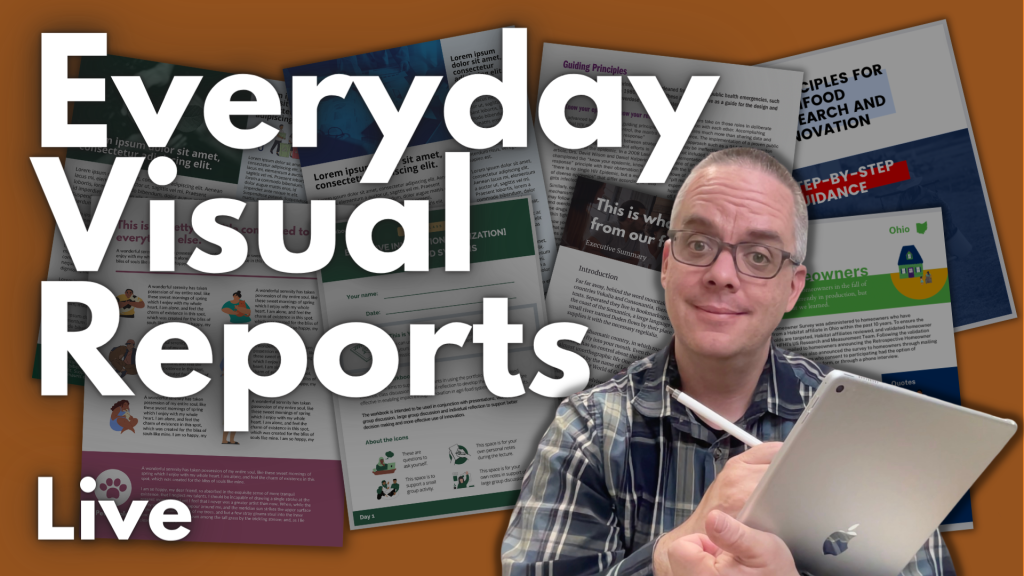
You should consider joining my upcoming live course, Everyday Visual Reports, which will be taught on February 20 & 22. This course is designed to be super practical with things to learn at all skill levels.

Written by cplysy · Categorized: freshspectrum

Feb 07 2024

Ask Nicole: The #1 Misconception About Meeting Facilitators

Have a question you’d like to be featured? Let me know. Let’s get straight into it ! The #1 misconception about meeting facilitators is that they are responsible for generating buy-in to your organization’s call to action. Let’s say you want to build a partnership with organizations doing similar work to address an emerging issue […]

The post Ask Nicole: The #1 Misconception About Meeting Facilitators appeared first on Nicole Clark Consulting.
Written by cplysy · Categorized: nicoleclark

Jan 31 2024

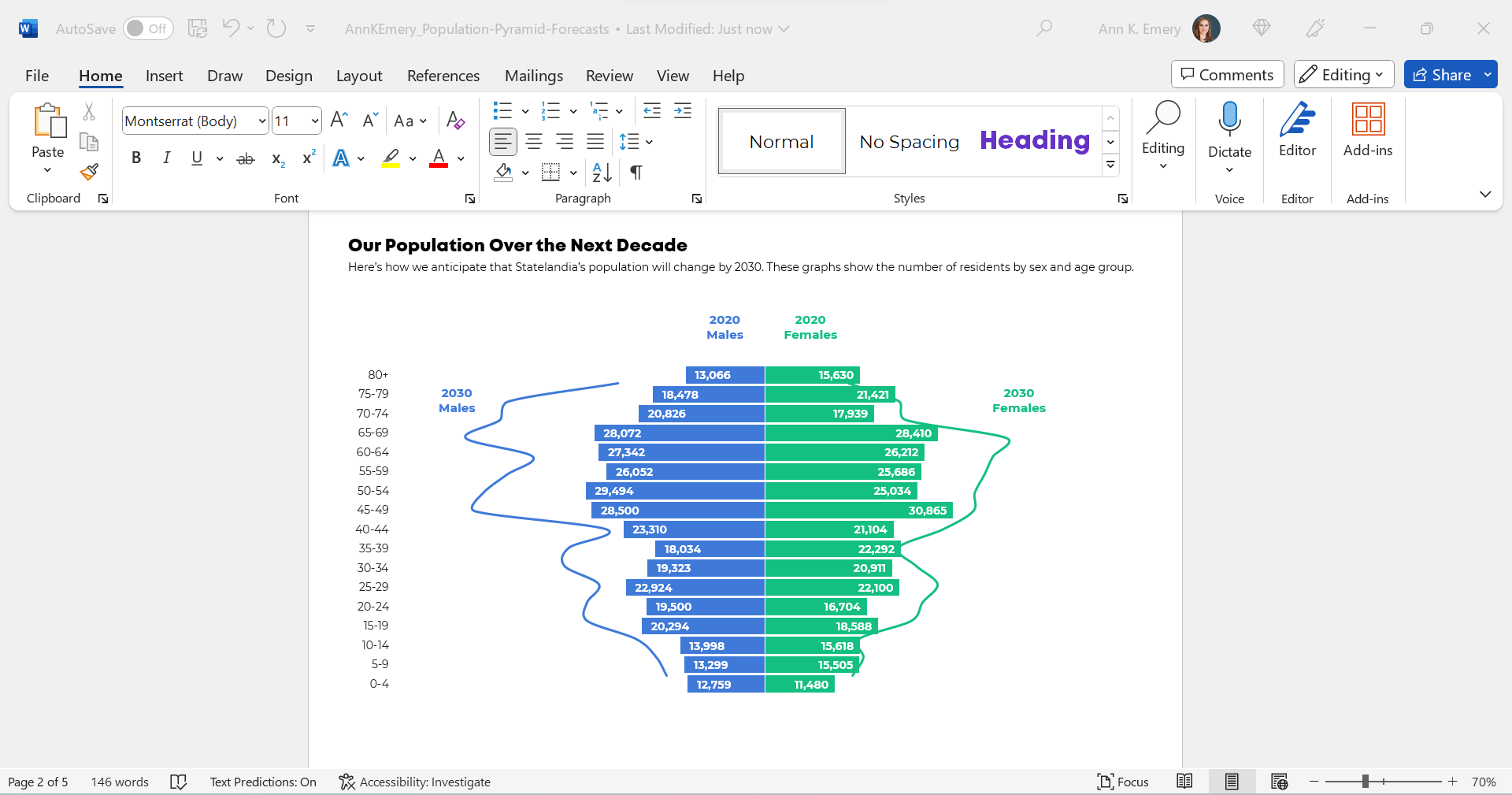
New Infographic: Monitoring vs. Evaluation

This article is rated as:


Eval Academy just released a new infographic: Monitoring vs. Evaluation


Who’s it for?

This infographic is for anyone looking to learn more about the difference between monitoring and evaluation.


What’s the purpose?

The Monitoring vs. Evaluation infographic will help you to:

  • Learn the definitions of monitoring and evaluation.

  • Identify the primary purpose of monitoring compared to evaluation.

  • Identify key differences in data collection between monitoring and evaluation.

  • Learn about the primary use of monitoring compared to evaluation.


What’s included?

A one-page, downloadable infographic as a png file.


Download the Monitoring vs. Evaluation infographic now!


Learn more: related articles and links:

  • What is Evaluation? A Review of AEA’s Recent Post

  • 10 great reasons to evaluate!

  • Research and Evaluation

  • A beginner’s guide to evaluation

Written by cplysy · Categorized: evalacademy

  • « Go to Previous Page
  • Go to page 1
  • Interim pages omitted …
  • Go to page 59
  • Go to page 60
  • Go to page 61
  • Go to page 62
  • Go to page 63
  • Interim pages omitted …
  • Go to page 310
  • Go to Next Page »

Footer

Follow our Work

The easiest way to stay connected to our work is to join our newsletter. You’ll get updates on projects, learn about new events, and hear stories from those evaluators whom the field continues to actively exclude and erase.

Get Updates

Want to take further action or join a pod? Click here to learn more.

Copyright © 2026 · The May 13 Group · Log in

en English
af Afrikaanssq Shqipam አማርኛar العربيةhy Հայերենaz Azərbaycan dilieu Euskarabe Беларуская моваbn বাংলাbs Bosanskibg Българскиca Catalàceb Cebuanony Chichewazh-CN 简体中文zh-TW 繁體中文co Corsuhr Hrvatskics Čeština‎da Dansknl Nederlandsen Englisheo Esperantoet Eestitl Filipinofi Suomifr Françaisfy Fryskgl Galegoka ქართულიde Deutschel Ελληνικάgu ગુજરાતીht Kreyol ayisyenha Harshen Hausahaw Ōlelo Hawaiʻiiw עִבְרִיתhi हिन्दीhmn Hmonghu Magyaris Íslenskaig Igboid Bahasa Indonesiaga Gaeilgeit Italianoja 日本語jw Basa Jawakn ಕನ್ನಡkk Қазақ тіліkm ភាសាខ្មែរko 한국어ku كوردی‎ky Кыргызчаlo ພາສາລາວla Latinlv Latviešu valodalt Lietuvių kalbalb Lëtzebuergeschmk Македонски јазикmg Malagasyms Bahasa Melayuml മലയാളംmt Maltesemi Te Reo Māorimr मराठीmn Монголmy ဗမာစာne नेपालीno Norsk bokmålps پښتوfa فارسیpl Polskipt Portuguêspa ਪੰਜਾਬੀro Românăru Русскийsm Samoangd Gàidhligsr Српски језикst Sesothosn Shonasd سنڌيsi සිංහලsk Slovenčinasl Slovenščinaso Afsoomaalies Españolsu Basa Sundasw Kiswahilisv Svenskatg Тоҷикӣta தமிழ்te తెలుగుth ไทยtr Türkçeuk Українськаur اردوuz O‘zbekchavi Tiếng Việtcy Cymraegxh isiXhosayi יידישyo Yorùbázu Zulu