Very simple and practical information on getting the formulation right. Do you have a similar formula on outcome and impact level? That would be great!
thomaswinderl
Comment on Monitoring? Evaluation? Isn’t it the same? by Thomas Winderl
In reply to peru.
Thanks, Peru – that’s nice to know. What concrete issues are you struggling with? What tool etc. could help you to find more clarity?
Comment on Monitoring? Evaluation? Isn’t it the same? by peru
Excellent post. I’m going through a few of these issues as well..
Comment on How to formulate strong outputs by Julius Awullama Abimiku
I need more of monitoring and evaluation knowledge.
How to formulate strong outputs
Outputs are arguably not the most important level of the results chain. It is outcomes that should be the focus of a good plan. Ultimately, that´s what counts.
However, outputs still matter.
Just to be clear: Simply put, outputs refer to changes in skills or abilities, or the availability of new products and services. In plain lingo: Outputs are what we plan to do to achieve a result.
Ok, let’s be a bit more precise: Outputs usually refers to a group of people or an organization that has improved capacities, abilities, skills, knowledge, systems, policies or if something is built, created or repaired as a direct result of support provided. That’s a definition we can work with.
Language is important
When describing what you do, focus on the change, not the process. Language matters.
Don’t say: ‘Local organisations will support young women and men in becoming community leaders.’ This emphasises the process rather than the change.
Instead, emphasis what will be different as a result of your support. Say: ‘Young women and men have the skills and motivation to be community leaders’.
Make it time-bound
An organization’s support is typically not open-ended. You usually expect to wrap up what you do at a certain time. Emphasise that your activities are carried out within a certain time frame. So it’s always helpful to include in the formulation for example ‘By January 2019, …’.
A formula for describing what you do
To ensure that you accurately describe what you do, use the following formula:
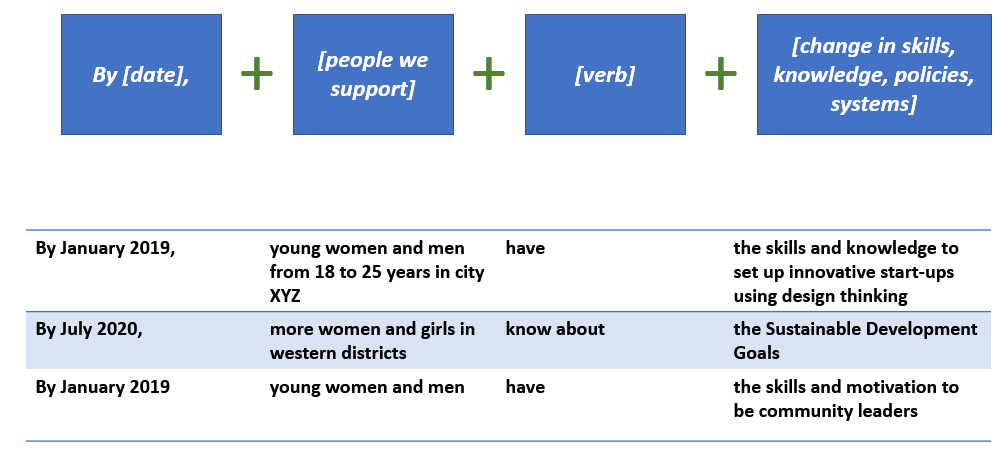
Thomas Winderl, 08.09.2020
The post How to formulate strong outputs appeared first on Thomas Winderl.
 English
 Afrikaans
 Shqip
Shqip አማርኛ
አማርኛ العربية
 Հայերեն
 Azərbaycan dili
 Euskara
 Беларуская мова
 বাংলা
বাংলা Bosanski
 Български
 Català
 Cebuano
 Chichewa
 简体中文
简体中文 繁體中文
繁體中文 Corsu
Corsu Hrvatski
 Čeština
 Dansk
Dansk Nederlands
 Esperanto
 Eesti
Eesti Filipino
 Suomi
Suomi Français
 Frysk
Frysk Galego
 ქართული
 Deutsch
 Ελληνικά
 ગુજરાતી
 Kreyol ayisyen
 Harshen Hausa
 Ōlelo Hawaiʻi
 עִבְרִית
 हिन्दी
 Hmong
Hmong Magyar
 Íslenska
 Igbo
Igbo Bahasa Indonesia
 Gaeilge
 Italiano
 日本語
日本語 Basa Jawa
 ಕನ್ನಡ
ಕನ್ನಡ Қазақ тілі
 ភាសាខ្មែរ
 한국어
한국어 كوردی
كوردی Кыргызча
 ພາສາລາວ
 Latin
Latin Latviešu valoda
 Lietuvių kalba
 Lëtzebuergesch
 Македонски јазик
 Malagasy
 Bahasa Melayu
 മലയാളം
 Maltese
 Te Reo Māori
 मराठी
मराठी Монгол
 ဗမာစာ
ဗမာစာ नेपाली
 Norsk bokmål
 پښتو
پښتو فارسی
فارسی Polski
 Português
 ਪੰਜਾਬੀ
 Română
 Русский
 Samoan
 Gàidhlig
 Српски језик
 Sesotho
 Shona
Shona سنڌي
سنڌي සිංහල
සිංහල Slovenčina
 Slovenščina
 Afsoomaali
 Español
 Basa Sunda
 Kiswahili
 Svenska
 Тоҷикӣ
 தமிழ்
தமிழ் తెలుగు
 ไทย
ไทย Türkçe
 Українська
 اردو
اردو O‘zbekcha
 Tiếng Việt
 Cymraeg
 isiXhosa
 יידיש
יידיש Yorùbá
 Zulu
Zulu