• Skip to main content
  • Skip to footer
  • Home

The May 13 Group

the next day for evaluation

  • Get Involved
  • Our Work
  • About Us
You are here: Home / Archives for cplysy

cplysy

Nov 19 2021

(At)tractor Beams for Transformation

Many transformation efforts fail because they focus on what people say they want, not what holds their attention and are attracted toward. This is the role of attractors. We’ve written about attractors before and how to map them, however in this post we want to explore how they benefit strategy development more fully.

An attractor is just what it sounds like: something we are attracted to. That might be something positive (an opportunity), an area of activity like a part of the market, or it could be something we fear. The idea of attractors is rooted in complexity science although, unlike many areas within it, the application of our understanding of attractors is actually quite straightforward for decision making. Attractors help to establish coherence. That’s why they are useful in strategy development.

Aside from using it in mapping a system, how might we learn from what people pay attention to rather than what they think? That’s the role of attractors. They focus us on what humans — and by extension, organizations – find important even if they are not conscious of what that might be.

Using Attractors To Focus Discussion and Strategy

Just like the Death Star uses a tractor beam to pull spaceships into its orbit, we can use attractors to help us focus our strategic thinking. The first step is to determine what attractors we have. This might not be conscious — we can often find ourselves unaware of what is driving us. This is where having an evaluation plan can really help.

If not, here’s what we recommend doing.

  1. Talk. Ask questions and open up the conversation about what is not only valued, but what has value. This is about the narrative of what is important — what those stated goals are — and about what kind of evaluation metrics guide decision making. For example, consider a student who focuses on whether they get a grade of 94, an A, or a pass. Each of these are metrics that shape what is valued and what has value.
  2. Observe. This is where evaluation comes in. Evaluation is fundamentally an assessment of what is valued and how that value is expressed. Some say it’s about merit, worth, and significance. Regardless of how you define evaluation, the key is using methods and tools that can help you detect what an organization pays attention to and considers in its decisions. Take for example the role of evidence in decision making. If an organization claims to be evidence based, yet repeatedly neglects its research or fails to invest the energy in reviewing research, it shows that this value isn’t valued in practice.
  3. Sort Once you have the data from what is reported and what is witnessed it’s important to sort and to engage in a form of sensemaking that involves a social process of meaning-making from data that is usually complex and multi-layered. Our attractions and attractors are things that often fit this because they aren’t straightforward. There are issues of what we want and what we actually feel. It’s often why we experience feelings of cognitive dissonance — a separation between what we think and what we do.
  4. Design. The last part is to take what we learn and design a strategy around what we are attracted to — or want to avoid. By being conscious of what it is that we are looking to move toward or from we can be far more intentional in how we go about setting up systems and strategies to get us where we desire. This intention, design-driven process both works with how we are and who we want to be (as an organization or individuals).

Attractors, as their name suggests, can draw us to them and be powerful vehicles for focusing change if we’re aware of them and work with them, rather than against them.

We can help if you want some support in identifying and using attractors as a means to help you learn, grow, and focus your organization and generate impact. Contact us to learn more.

“Strange attractor?” by Kevin Dooley is licensed under CC BY 2.0.

The post (At)tractor Beams for Transformation appeared first on Cense.

Written by cplysy · Categorized: cameronnorman

Nov 17 2021

Comment on IRB 101: What are they? Why do they exist? by IRB 101: What types of human subjects research are exempt from IRB?

[…] this IRB 101 series, I have provided general context for IRBs, including what IRBs are and why they exist and potential risks to research participants to illustrate IRBs’ purpose. This post will help […]

Written by cplysy · Categorized: rka

Nov 17 2021

IRB 101: What types of human subjects research are exempt from IRB?

In this IRB 101 series, I have provided general context for IRBs, including what IRBs are and why they exist and potential risks to research participants to illustrate IRBs’ purpose. This post will help you determine—if indeed you are conducting human subjects research—whether it is exempt from IRB review.

The word "exempt" appears in purple, capital letters, with a purple rectangular border around it and a white background. It's in the style of something stamped onto a piece of paper.

What are exemptions?

The Office of Human Research Protections (OHRP) within the Department of Health and Human Services (HHS) provides federal regulations for human subjects research. One part of the regulation known as Subpart A, or the Common Rule, identifies exemption categories for human subjects research. OHRP updated the Common Rule in 2018. OHRP now identifies eight categories of human subjects research that are considered exempt from the Department of Health and Human Services’ regulatory requirements. All eight categories are found here, described technically.

Exemptions applicable to visitor studies research and evaluation

Interpreting the technical language of the eight exemption categories can prove confusing. Here, I describe (in as plain language as possible) the four exemptions categories that are likely to apply to visitor studies research and evaluation in museums. Keep in mind that all exemption categories describe research practices that pose no more than minimal risk to research participants. The exemption categories aim to identify what about the research process makes it pose no more than minimal risk to research participants.

Exemption Category 2

Are you collecting surveys, interviews, or observations of public behavior?

If yes, your study may be exempt under Exemption Category 2. The study is exempt if the identity of the human subjects participating (the people you are collecting data from) cannot be readily ascertained (e.g., anonymous data, or data delinked from identifiers like names or email addresses, and kept confidential); OR if the identity of human subjects is disclosed, the disclosure does not have detrimental consequences or potential risks.

Examples of exempt research in this category:

  • An anonymous survey of a random sample of adult visitors
  • Interviews with teachers about their program experience
  • Unobtrusive observations of families at the museum

For research with children, observations of public behaviors can be exempt under this category (i.e., observations of families at the museum). However, surveys or interviews with children are not exempt under this category because any interactions with children are subject to greater oversight.

Exemption Category 3

Are you collecting study information involving a benign behavioral intervention (e.g., changing noise in exhibitions) OR using audiovisual recording?

If yes, the study may be exempt under Exemption Category 3 if the human subject consents.  Plus, as in Exemption Category 2, the study is exempt if you can’t easily identify participants OR disclosure of participants’ identity does not have detrimental consequences or potential risks.

Examples of exempt research in this category:

  • An experimental study where adult visitors consent to experience an interactive with ambient noise and without noise (e.g., benign interview)
  • Audio-recorded interviews with teachers about their program experience (with their consent)
  • Adult visitors video recording their visit to an exhibition after consenting to participate in the study.

No research with children is exempt under this category.

Exemption Category 4

Are you analyzing old data sets that other researchers collected?

If yes, the study may be exempt under Exemption Category 4. Private information that is publicly available, or that was recorded in a way that the subjects can no longer be identified, is considered “secondary use.” Research with secondary use data is usually exempt from IRB review.

Examples of exempt research in this category:

  • Analyzing publicly available open access data
  • Conducting analysis on data previously collected by another researcher (who had IRB permission); you are provided data delinked from identifiers

Exemptions NOT applicable to visitor studies research and evaluation

Exemption Category 1

It may be tempting to say visitor studies research is exempt under Exemption Category 1. This category describes research in commonly accepted educational settings, involving normal educational practices. While museums might consider themselves to be educational settings, research within museum settings are not exempt under this category because they are not considered “commonly accepted educational settings.”

Still feeling lost?   

Do you still feel confused as to whether you need IRB review or not?  In my next post, I will share a decision tree that distills this information even further.

The post IRB 101: What types of human subjects research are exempt from IRB? appeared first on RK&A.

Written by cplysy · Categorized: rka

Nov 16 2021

10 Tips for Redesigning Reports

2011 called.

It wants its 100-page reports back.

My wish: Limit yourself to just 30 pages (or less!).

It wants its portrait reports back.

Are people printing your doc… or reading it from their (landscape) computer?

It wants its text-heavy reports back.

We need visuals on every single page.

Ready to revamp your technical reports?

10 Tips for Redesigning Reports

Here are 10 quick wins to improve your next text-heavy document.

You don’t need to apply all 10.

Even one of these techniques will make dense reports more readable for our non-technical and busy audiences.

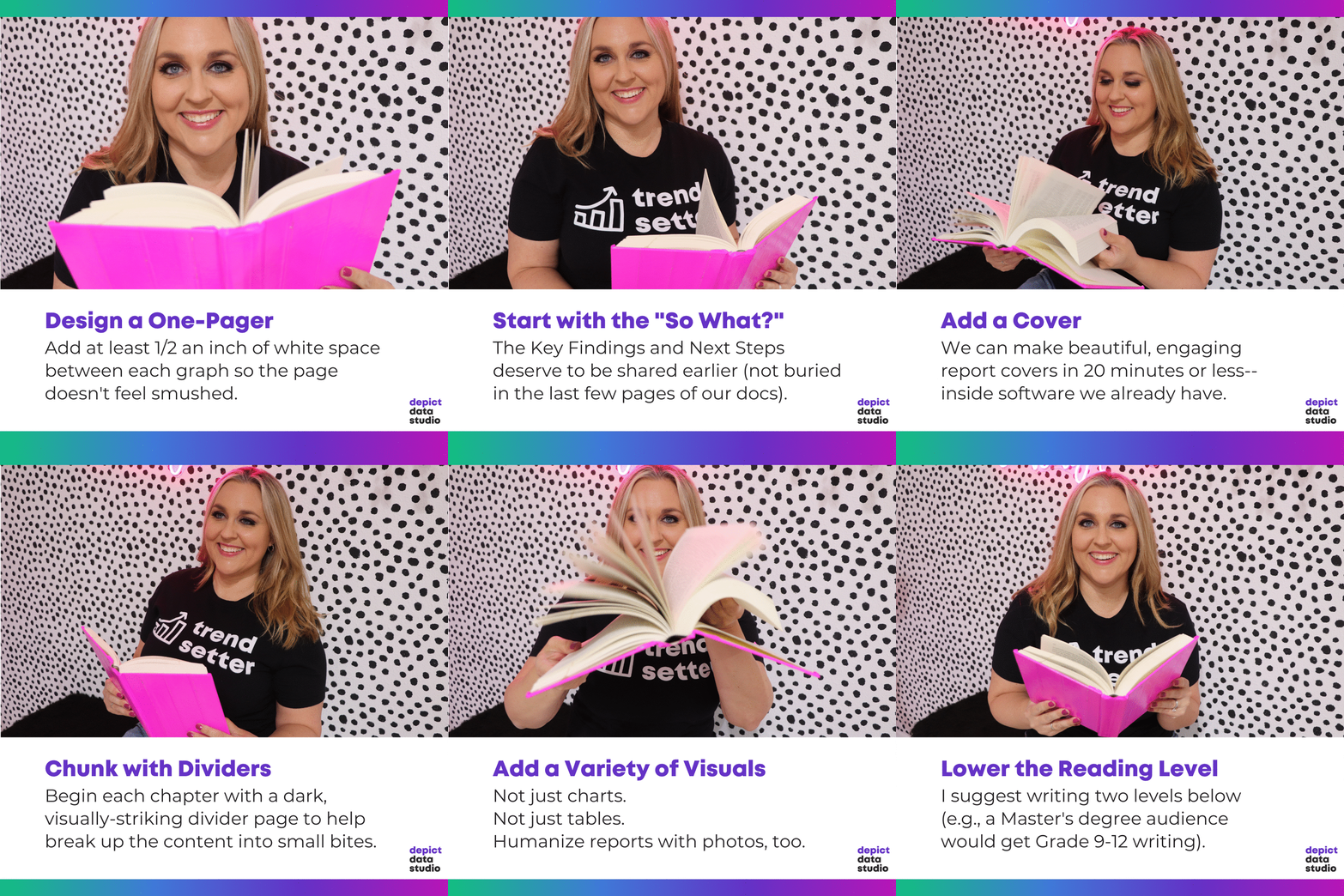
Design a One-Pager 

The 30-3-1 Approach is the bare minimum for designing reports that actually inform decisions. You can read more about 30-3-1 here.

When you’re creating one-pagers, don’t forget to add at least ½ inch of white space between each graph so the page doesn’t feel smushed.

It’s tempting to try and fit everything into a one-pager. A one-pager is just the highlights; the full report can go into more detail.

Use Brand Colors and Fonts 

Never, ever, ever use your software program’s defaults. 

I’m looking at you, Calibri.  

If you’re using Microsoft Office programs, like Excel, Word, or PowerPoint, then Theme Colors and Theme Fonts can save you hours of time.

Start with the “So What?” 

The Key Findings and Next Steps deserve to be shared earlier (not buried in the last few pages of our docs).  

Use Landscape Orientation 

Will you pay to print your reports and mail them to your recipients? 

If not, they’ll probably read in on their (landscape) computer screen.  

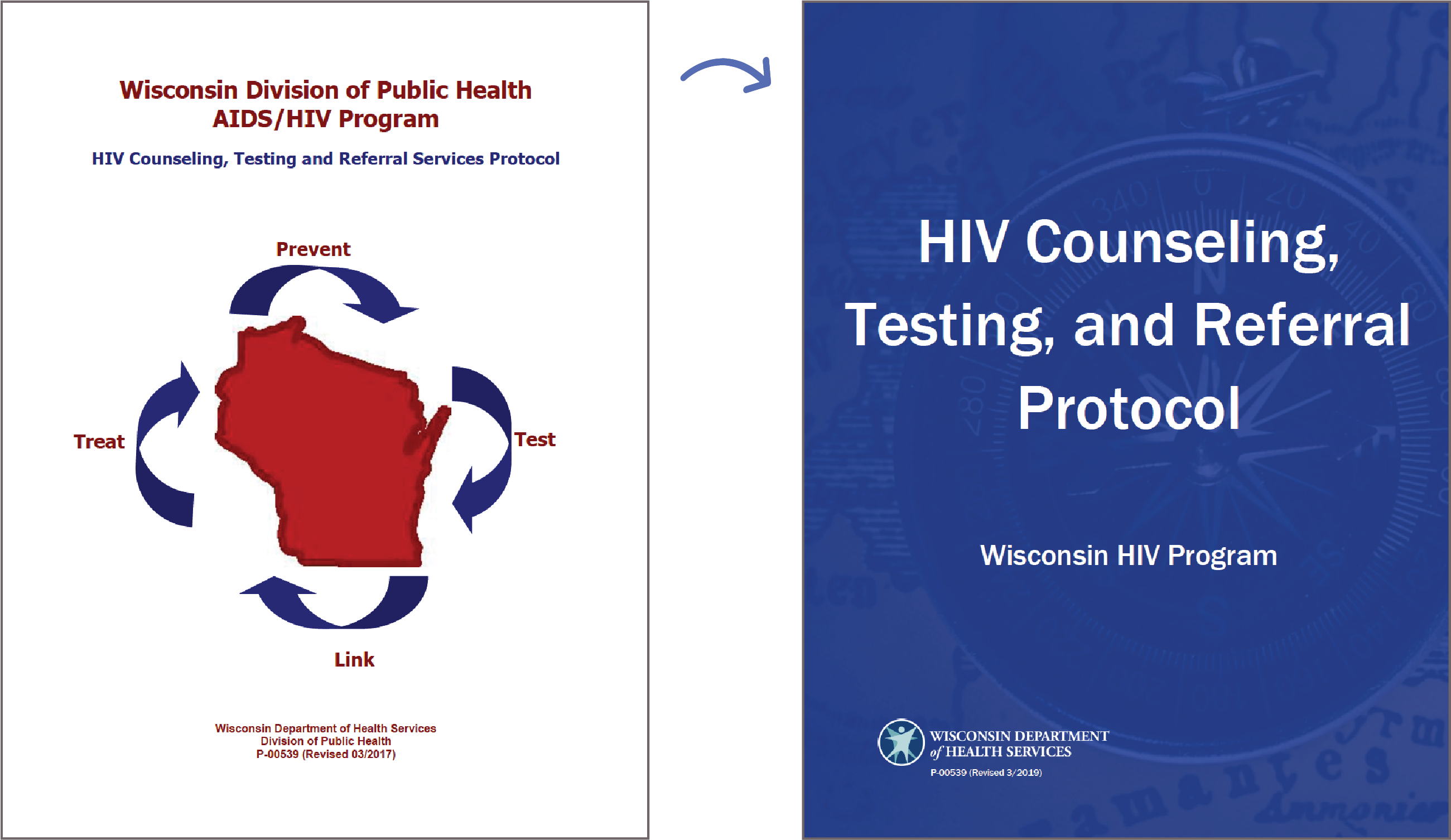
Add a Cover 

We can make beautiful, engaging report covers in 20 minutes or less— inside software we already have.  

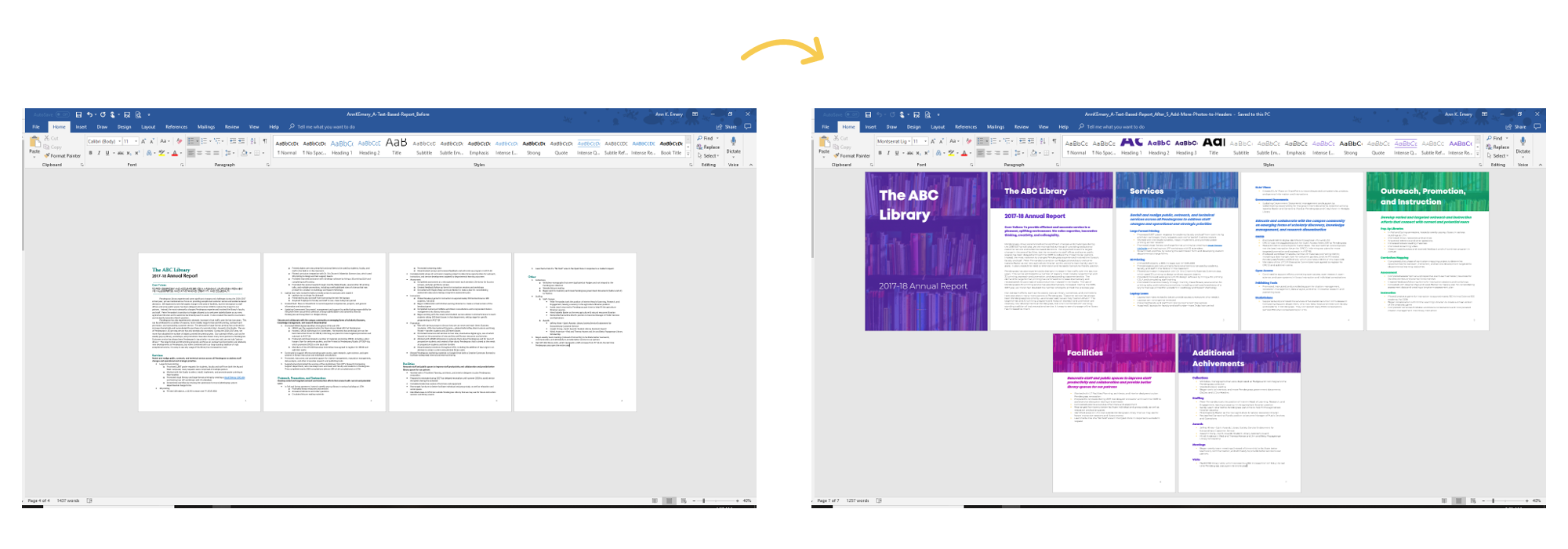
Here’s one of my favorite before/after transformations from Sara DeLong:

An example of an eye-catching cover that only took 20 minutes to create.

Chunk with Dividers 

Begin each chapter with a dark, visually-striking divider page to help break up the content into small bites.  

Size your fonts according to their importance. A text hierarchy tells your viewers which information is most important (headings) and which information is least important (the regular ol' paragraphs).

Add 1+ Visual Per Page 

Think of a recent report: how many pages had visuals? 

The Text Wall takes too long to read.  

Add a Variety of Visuals 

Not just charts.

Not just tables. 

Humanize reports with photos, too.  

You can grab my Checklist of 15 Types of Visuals from this podcast with Alli Torban.

Go Beyond the Bar Chart 

My old reports: bars, clustered bars, stacked bars and columns charts.  

Zzzzzzzzzzzzz… 

Let’s escape the bar chart.  

Lower the Reading Level 

I suggest writing two levels below (e.g., a Master’s degree audience would get Grade 9-12 writing).  

Your Turn 

Which tip will you apply to your next technical report? Comment anytime and let me know.

Written by cplysy · Categorized: depictdatastudio

Nov 15 2021

A Sleep-Deprived perspective on Data Tracking

A sleep-deprived perspective on data tracking

I’m back from maternity leave! 

I’ve always had great admiration for parents and caregivers, and after almost two months with a newborn, that respect has grown ten-fold! 

Parenting (especially without much sleep) is tough work. 

While I was out, I had a few discussions with data-minded colleagues and read some articles about tracking data about the baby’s behaviors to help understand their habits and establish better routines. 

Of course, that’s pretty intriguing for me, since that’s essentially what my business is about. 

But I found that my pajama-clad, sleep-deprived self was too overwhelmed to even begin to set up a new spreadsheet. 

Me! Couldn’t handle a spreadsheet! (I know, I’m just as shocked and bewildered.)

In that moment, before I collapsed on the sofa to take a nap, I had a realization. 

For many overworked, overwhelmed, and exhausted educators — the ones who are giving their all, day-in and day-out, for their kids and families — they may not have the brain space or energy to even begin to take on something new. 

In my work, I’ve tried to break it down, provide simple strategies, and offer encouragement to those who were unsure about where to begin with tracking their family engagement data. 

But I didn’t factor in that people may not have room left for a new skill or for tracking details of their work in ways that are unfamiliar to them. 

For example, my husband and I keep a notebook where we log how much our daughter eats and when. Yet this is purely for survival – otherwise, we simply can’t remember!

It reminds me of the piles of sign-in sheets I used to have when I was a Community School Coordinator. The data’s all there, but I didn’t always know what to do with it. 

I have also thought about tracking her sleep and wake windows in an attempt to get her to sleep better at night. 

In my head, I have grand visions of a Gantt chart where I’d color-code each time block of the day. 

Want to know how far I’ve gotten?

One note to myself on my phone. SIGH. I gave up.

Pre-baby, I would have had the entire spreadsheet designed and in use within an hour. 

So if you’re reading this and you have aspirations of being more data-driven but have struggled to find the bandwidth to get there, I see you.

While of course, I wish that I would have gotten significantly more sleep over the past eight weeks, I am grateful for this new insight.

I look forward to using my new perspective to inform how I work with educators whose attention – rightfully so – is on educating children and engaging families.

Written by cplysy · Categorized: engagewithdata

  • « Go to Previous Page
  • Go to page 1
  • Interim pages omitted …
  • Go to page 152
  • Go to page 153
  • Go to page 154
  • Go to page 155
  • Go to page 156
  • Interim pages omitted …
  • Go to page 304
  • Go to Next Page »

Footer

Follow our Work

The easiest way to stay connected to our work is to join our newsletter. You’ll get updates on projects, learn about new events, and hear stories from those evaluators whom the field continues to actively exclude and erase.

Get Updates

Want to take further action or join a pod? Click here to learn more.

Copyright © 2026 · The May 13 Group · Log in

en English
af Afrikaanssq Shqipam አማርኛar العربيةhy Հայերենaz Azərbaycan dilieu Euskarabe Беларуская моваbn বাংলাbs Bosanskibg Българскиca Catalàceb Cebuanony Chichewazh-CN 简体中文zh-TW 繁體中文co Corsuhr Hrvatskics Čeština‎da Dansknl Nederlandsen Englisheo Esperantoet Eestitl Filipinofi Suomifr Françaisfy Fryskgl Galegoka ქართულიde Deutschel Ελληνικάgu ગુજરાતીht Kreyol ayisyenha Harshen Hausahaw Ōlelo Hawaiʻiiw עִבְרִיתhi हिन्दीhmn Hmonghu Magyaris Íslenskaig Igboid Bahasa Indonesiaga Gaeilgeit Italianoja 日本語jw Basa Jawakn ಕನ್ನಡkk Қазақ тіліkm ភាសាខ្មែរko 한국어ku كوردی‎ky Кыргызчаlo ພາສາລາວla Latinlv Latviešu valodalt Lietuvių kalbalb Lëtzebuergeschmk Македонски јазикmg Malagasyms Bahasa Melayuml മലയാളംmt Maltesemi Te Reo Māorimr मराठीmn Монголmy ဗမာစာne नेपालीno Norsk bokmålps پښتوfa فارسیpl Polskipt Portuguêspa ਪੰਜਾਬੀro Românăru Русскийsm Samoangd Gàidhligsr Српски језикst Sesothosn Shonasd سنڌيsi සිංහලsk Slovenčinasl Slovenščinaso Afsoomaalies Españolsu Basa Sundasw Kiswahilisv Svenskatg Тоҷикӣta தமிழ்te తెలుగుth ไทยtr Türkçeuk Українськаur اردوuz O‘zbekchavi Tiếng Việtcy Cymraegxh isiXhosayi יידישyo Yorùbázu Zulu