• Skip to main content
  • Skip to footer
  • Home

The May 13 Group

the next day for evaluation

  • Get Involved
  • Our Work
  • About Us
You are here: Home / Archives for cplysy

cplysy

Aug 31 2021

Applying Data Visualization Principles to Your Business: A Before/After One-Pager Makeover

Lillian Haley, Ph.D., MSW, ChFC® is the president and owner of Haley Evaluation & Research Services (HERS). She’s a Depict Data Studio student and when she shared her before/after makeover during our graduation ceremony, I knew I wanted to showcase her work. Keep up the great work, Lillian! – Ann

—–

I discovered Ann’s data visualization work at the 2016 American Evaluation Association (AEA)’s annual conference held in Atlanta, Georgia.

I was making the transition from academia to commercial research and was struggling mightily with telling a visual story. When your training is entirely writing journal articles in APA style, it can be challenging to transition to producing beautiful, easily consumable content.

I remember Ann and Stephanie Evergreen presenting and sharing their data visualization checklist. They poked fun at common reporting shortcomings in a relatable, engaging manner.

What they shared just made sense. They were speaking about content that applied to my job. I was sold!

I needed to be better at data visuals and storytelling. I tried unsuccessfully to get approval from my employer to cover professional development expenses for data visualization training.

So, I sufficed with Ann’s free Soar Beyond the Dusty Shelf Report course and blog posts.

Fast forward four years later, I found myself launching my research firm, Haley Evaluation & Research Services (HERS). Now, I had total control over my professional development.

Ann’s Dashboard Design was one of the first courses I wanted to sign up for. I stalked the website waiting for registration to open. I registered for the Dashboard Design course along with Simple Spreadsheets, Great Graphs: Design Principles, and Great Graphs: Excel How-To’s.

Developing a Capabilities Statement

Enrolling in courses at Depict Data Studio is one of the best professional developments I have ever made. I used what I learned to give my company’s capabilities statement a makeover.

What is a capabilities statement? Great question!

A capability statement is a concise, one-page document of your business competencies. Think of it as your business’ resume. Its purpose is to provide specific information that will convince potential customers to do business with you. When written well, it will differentiate your business from the competition!

Before taking Dashboard Design, my template was based upon an example provided on the U.S. Department of Health and Human Services website.

I reasoned I’d like to do business with the government, so I might as well follow their lead. Unfortunately, what I produced was text-heavy and lacking any visuals, minus a logo or color scheme that would help my business be an appealing option.  Would you trust this company to write your report or design your dashboard?
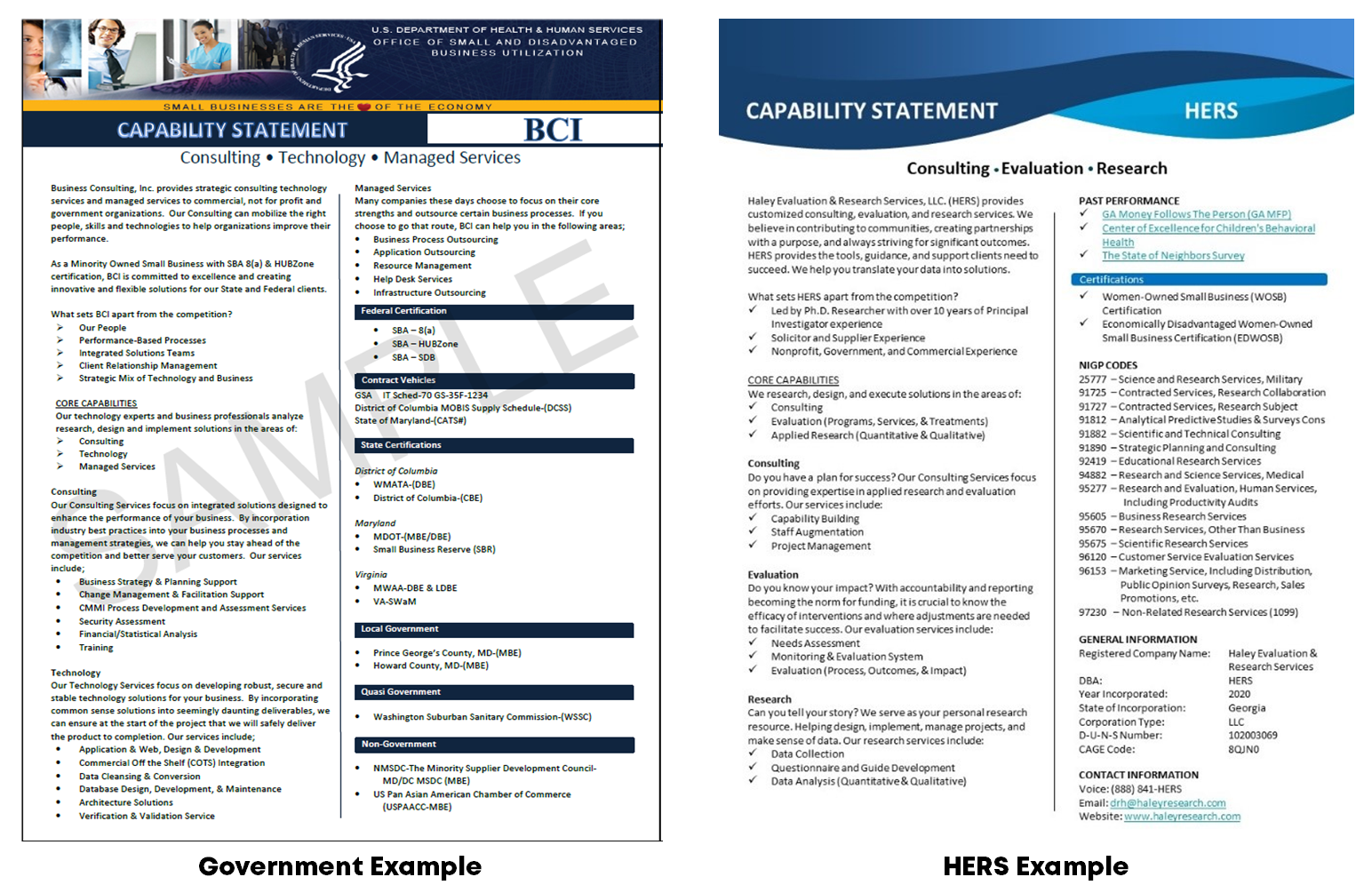
Lillian Haley based her company's capability statement off of an example provided on the U.S. Department of Health and Human Services website.

Revamping the Capability Statement with Skills Learned in Depict Courses

After eight months with Ann, I was able to turn my blah capabilities statement into something I am happy to share! It is painfully apparent I grew in my knowledge about leveraging:

  • White Space
  • Decluttering
  • Branding
  • Font size
  • Bolding
  • Color
  • Icons

I could go on and on about the many design and data visualization lessons I’ve learned from Ann.

Instead, I’ll end by saying that books and blogs are excellent resources. I have several books and subscribed to many blogs. However, they do not compare to live and on-demand instruction of Depict Data Studio.

Just look at my After one-pager!
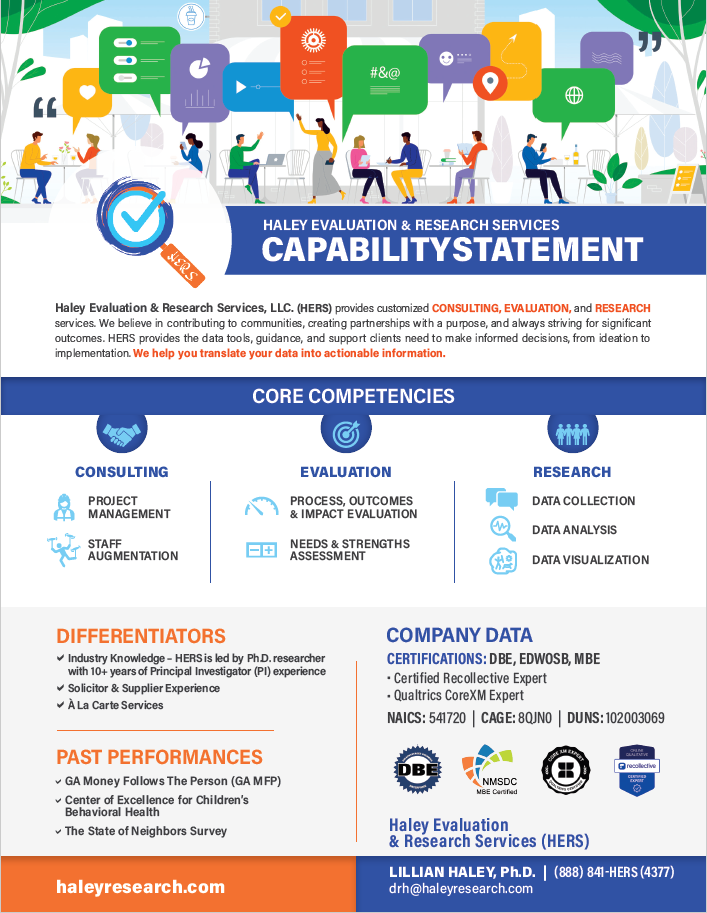
Using skills learned in Depict Data Studio courses, Lillian Haley transformed her company's capability statement.

Connect with Lillian Haley

Website: https://www.haleyresearch.com/

Written by cplysy · Categorized: depictdatastudio

Aug 30 2021

Comment on Dissertation RQ2: To what extent do interpersonal factors relate to use beyond research factors? by Dissertation RQ3: How do researchers and evaluators differ in use, interpersonal factors, and research/evaluation factors?

[…] Question 2: To what extent do interpersonal factors relate to use beyond research factors? […]

Written by cplysy · Categorized: danawanzer

Aug 30 2021

Comment on Factors that promote use: A conceptual framework by Dissertation RQ3: How do researchers and evaluators differ in use, interpersonal factors, and research/evaluation factors?

[…] Factors that promote use: A conceptual framework […]

Written by cplysy · Categorized: danawanzer

Aug 27 2021

Museums during Existential Crises: Long and Wide Lenses for Directional Thinking

By: Emlyn Koster

An Earth scientist with 32 years at the helm of four large nature and science museums and with publications and presentations continuing to delve into what leadership of external relevance entails, Emlyn reflects on the potentially greater value of museums in a world beset by crises.

The period since early 2019 has been an unprecedented slog of stressful uncertainty for every type of organization. Yet with the museum concept inspired by The Muses―the goddesses of the arts and sciences in Greek mythology—museums should, in particular I believe, be striving to use long and wide lenses to shape their most valuable responses to today’s circumstances.

During the pandemic, understandably, online exchanges among museums have been much more about pressing operational matters than big-picture strategic matters. Also, published leadership-level musings have been rare. Each a commendable sharing of reflective thoughts, these include the perspectives of directors at a cultural anthropology museum, art and nature museum, a group of middle managers at four natural history and marine science museums, and two former science museum directors.

Wicked Problems

Before this decade, an ‘existential crisis’ described individuals consumed with anxiety about how they see themselves and their purpose. Announced as new vocabulary by Dictionary.com, it began to also be a whole society term as climate change, the Covid-19 pandemic, and structural racism dominated the news.

Introduced in the 1960s, the term ‘wicked problem’ has long struck me as a jarring label because wicked refers to a morally wrong stance. However, it seems apt for the situation of the Covid-19 pandemic and its variants because they have harmed our diverse society so deeply and inequitably. John Camillus of the University of Pittsburgh Graduate School of Business stated that wicked problems “can’t be solved, but [they] can be tamed” and that “solutions to wicked problems are not true or false, but good or bad”. Pathways to better times, he concluded, lie with continuous scanning of pertinent circumstances with assumption monitoring and adaptive decision-making.

A Long Lens

I have been surprised by the scarcity of references to motivational outlooks of the museum sector during the Great Depression, World Wars I and II, and after the September 11, 2001 terrorist attacks. Here are several examples. Presentations at the 1942 AAM Annual Meeting stated: “With every crisis, there comes a spiritual awakening, and also an intellectual advancement… Our institutions are not merely guardians of the past, but are factors in the building and molding of character for the future” (L. Hubbard Shattuck, 1942, Wartime duties of historical museums, Museum News, October 1, 6-8) and “The very subject of our discussion shows the painful anxiety and uncertainty with which we search for our proper function in the national struggle for a better future” (A.E. Parr, 1942, The Wartime duties of natural history museums, Museum News, September 1, 6-8). In a cautionary note, “When the funds began to flow again, museums quickly forgot the shock of the Depression as well as their moments of innovation on behalf of the public… An opportunity to be societal role models for the wisest use of resources and talent was lost” (Marjorie Schwarzer, 2009, Bringing it to the people: lessons from the first Great Depression, Museum, May-June, 49-54). Recalling an initiative by The Families of September 11 and Liberty Science Center: “Our careers and backgrounds are so dissimilar that we could barely imagine how our professional lives could ever intersect: a mental health professional specializing in trauma and a president of a science center… We committed to a vision for the future based on what we learned”.

A Wide Lens

A stack of leadership books against a plain background. The books have titles of key leadership words on their spines, like "Integrity."
Source

Also, I often lean on recommendations about organizational leadership that have passed the test of time. Here are several favorites. Aristotle (384-322 BC) viewed leadership as the harmonious pursuit of positive consequences in the world: significant, I think, because of his emphasis on linked internal and external dynamics. John Cotton Dana (1856-1929) advocated that museums align their activities with the needs of their communities: significant, I think, because he prioritized needs above wants. Stephen Covey (1932-2012) echoed Peter Drucker (1909-2005) in stressing the distinction between effectiveness and efficiency: respectively doing the right things and doing things right which they emphasized are the main responsibilities of leadership and management. John Kotter (1947- ), Emeritus Professor of Leadership at the Harvard Business School, listed these steps for a successful renewal:

  • Establish a sense of urgency
  • Form a powerful guiding coalition
  • Create a vision
  • Communicate the vision
  • Empower others to act on the vision
  • Plan for and create short-term wins
  • Consolidate improvements and produce still more change
  • Institutionalize new approaches

Because vision is a central thread, I also wish to cite a first page statement in a 1992 book titled ‘Visionary Leadership’: “There is no more powerful engine driving an organization toward excellence and long-range success than an attractive, worthwhile, and achievable vision of the future, widely shared”. A contrary view, which I also applaud because it encourages the weighing of options, has recently been advanced by a university art museum director.

Planning Parameters

A fair question in today’s chaotic world surrounds what is achievable? A quarter century ago, the 150th anniversary symposium of The Smithsonian Institution heard this admonition: “The mission statement of most museums which often states “Our mission is to collect, preserve and interpret fill-in-the-blank will no longer do. Such statements do not answer the vital question of ‘So what?’””. Arguably more than ever, museums need to specify their ‘so what?’ intentions in past-present-future contexts. This behooves museums to have less lofty missions with realistic content (exhibitions/programs/conversations) and audience (onsite/offsite/online) goals. In my view, this adaptive step becomes part of what continues to be a robust approach to strategic planning―namely, the following sequential, but needing to be frequently revisited, steps to distinctively define an organization and attract friends and funds to it:

  • Values: Enduring attitudinal traits, typically 5-7, that define the organization’s core culture and that must not be violated by any transaction or decision (in a new organization these are a mix of early realities and credible aspirations). 
  • Stakeholders: Those with vested interests in the well-being of the organization, both those who can affect and be affected by its performance, most notably its core audience(s).  
  • Mission:  Jargon-free, memorable, often one-sentence statement of the organization’s purpose / ‘so what?’ / raison d’être / beating heart in relation to external needs (a marketing tagline / slogan is a potential addition). 
  • Vision: Forward-looking, inspiring, one or two paragraph statement of a more advanced stage of the organization’s impacts. 
  • Strategy: High-level roadmap of the organization’s intentions as a guide to how value-conforming efforts will best advance the mission in the direction of the vision (there is definitional variation between several interrelated terms, including strategies, goals, key result areas, and objectives).

“Greatness is Not a Function of Circumstance”

Facing wicked problems requires bold and innovative leadership with a preparedness to revisit strategic plans for timely adjustments. In his manifesto for the social sector, Jim Collins (1958- ) concluded: “Greatness is not a function of circumstance. Greatness, it turns out, is largely a matter of conscious choice, and discipline”.

About the Author

Emlyn Koster, PhD was the CEO at Canada’s Royal Tyrrell Museum of Paleontology and Ontario Science Centre between 1986-96 and at NJ’s Liberty Science Center and the NC Museum of Natural Sciences between 1996-2018. Concurrently, he had advisory roles at the Getty and Noyce Leadership Institutes and attended ‘Strategic Perspectives for Nonprofit Management’ at the Harvard Business School. An ambassador for the International Coalition for Sites of Conscience and an adjunct professor at NC State University, he writes, speaks and advises on the Anthropocene which is transdisciplinary shorthand for human disruption of the Earth System. You can read his previous blog posts here.

The post Museums during Existential Crises: Long and Wide Lenses for Directional Thinking appeared first on RK&A.

Written by cplysy · Categorized: rka

Aug 27 2021

A gut check

A gut check

While I am lucky that I get to consult with schools and districts in their work with families, it isn’t often that I get to engage with students and families directly (especially since COVID derailed my weekly mentoring sessions at a high school here in Columbus).

So I was especially delighted this week, when, through my part-time work at Ohio State, I got the opportunity to begin a series of focus groups with kinship caregivers (grandparents, aunts/uncles, and other relatives or close friends who are the primary guardians for their relatives’ children).

Through this study, we are trying to learn how the pandemic has impacted kinship families and how we can advocate for the resources and supports they really need to improve the quality of life of the children in their care and themselves.

To me, this study is a great example of engaging with data – using our conversations with key stakeholders to guide future interventions and advocacy efforts. 

Well, the first focus group was last night, and what I heard really impacted me. 

I talk a lot about telling your story and how using qualitative data with numbers and stats can amplify the effect of our analysis.

This focus group reminded me of just how powerful that effect can be. 

You see, for my work at OSU, I’ve done a lot of digging into the literature about kinship care and the national statistics about how children in and around the child welfare system fare in different settings. 

Yet hearing a particular focus group participant share their story last night made it all come to life for me, in a way I haven’t experienced since my time working in schools. 

This caregiver shared the raw, painful emotions they were experiencing as a result of caring for multiple children with few supports but plenty of challenging family dynamics, fears, and frustrations. It was impossible to not be moved by their story.

From reading other studies about kinship care or even reviewing survey data from this and other studies, I knew that all of these factors were common for kinship caregivers. 

Yet this qualitative data – this person’s actual experiences shared in their own voice – helped me better understand just how real these phenomena are and just how important it is to use our findings to help improve lives.  

This was a gut check for me – a reminder to always seek the stories in our data, connect them to real people, and use my place of privilege to try to make their world a bit better. 

As we re-enter schools this fall in a once-again scary and uncertain time, remember that the lines in your spreadsheets and the names on your event sign-in sheets are real people, often living difficult lives in an especially challenging time. 

Thankfully, as educators, we have the ability to connect our students and families with resources and supports, if only we are able to hear their stories.

For more information on using qualitative data in your engagement work, check out some past posts here, here, and here.

Written by cplysy · Categorized: engagewithdata

  • « Go to Previous Page
  • Go to page 1
  • Interim pages omitted …
  • Go to page 166
  • Go to page 167
  • Go to page 168
  • Go to page 169
  • Go to page 170
  • Interim pages omitted …
  • Go to page 304
  • Go to Next Page »

Footer

Follow our Work

The easiest way to stay connected to our work is to join our newsletter. You’ll get updates on projects, learn about new events, and hear stories from those evaluators whom the field continues to actively exclude and erase.

Get Updates

Want to take further action or join a pod? Click here to learn more.

Copyright © 2026 · The May 13 Group · Log in

en English
af Afrikaanssq Shqipam አማርኛar العربيةhy Հայերենaz Azərbaycan dilieu Euskarabe Беларуская моваbn বাংলাbs Bosanskibg Българскиca Catalàceb Cebuanony Chichewazh-CN 简体中文zh-TW 繁體中文co Corsuhr Hrvatskics Čeština‎da Dansknl Nederlandsen Englisheo Esperantoet Eestitl Filipinofi Suomifr Françaisfy Fryskgl Galegoka ქართულიde Deutschel Ελληνικάgu ગુજરાતીht Kreyol ayisyenha Harshen Hausahaw Ōlelo Hawaiʻiiw עִבְרִיתhi हिन्दीhmn Hmonghu Magyaris Íslenskaig Igboid Bahasa Indonesiaga Gaeilgeit Italianoja 日本語jw Basa Jawakn ಕನ್ನಡkk Қазақ тіліkm ភាសាខ្មែរko 한국어ku كوردی‎ky Кыргызчаlo ພາສາລາວla Latinlv Latviešu valodalt Lietuvių kalbalb Lëtzebuergeschmk Македонски јазикmg Malagasyms Bahasa Melayuml മലയാളംmt Maltesemi Te Reo Māorimr मराठीmn Монголmy ဗမာစာne नेपालीno Norsk bokmålps پښتوfa فارسیpl Polskipt Portuguêspa ਪੰਜਾਬੀro Românăru Русскийsm Samoangd Gàidhligsr Српски језикst Sesothosn Shonasd سنڌيsi සිංහලsk Slovenčinasl Slovenščinaso Afsoomaalies Españolsu Basa Sundasw Kiswahilisv Svenskatg Тоҷикӣta தமிழ்te తెలుగుth ไทยtr Türkçeuk Українськаur اردوuz O‘zbekchavi Tiếng Việtcy Cymraegxh isiXhosayi יידישyo Yorùbázu Zulu