• Skip to main content
  • Skip to footer
  • Home

The May 13 Group

the next day for evaluation

  • Get Involved
  • Our Work
  • About Us
You are here: Home / Archives for cplysy

cplysy

Mar 05 2025

Ask Nicole: Participant Dropout (and What Your Program Can Learn From It)

Participant dropout is a reality in programs. Learn why participants leave, the impact on retention, and how to improve engagement.

The post Ask Nicole: Participant Dropout (and What Your Program Can Learn From It) appeared first on Nicole Clark Consulting.

Written by cplysy · Categorized: nicoleclark

Mar 04 2025

How to Make Online Courses

I just finished re-recording Dashboard Design!

I’ve had 10,000+ students in my online courses since 2018, and I get a lot of questions about this process, like…

  • How did you turn your keynote into a full-length online course?
  • How did you turn your private, on-site workshop into an asynchronous online course?

In this video, you’ll go behind the scenes and learn about the course creation process.

What’s Inside

First, you’ll see the student’s perspective:

  • 0:00 Intro
  • 0:31 Student Perspective: Inside the Videos and Lessons via Teachable
  • 2:25 Student Perspective: Private Community via LinkedIn
  • 2:38 Student Perspective: Weekly Messages via Kit
  • 3:39 Student Perspective: Live Office Hours via Zoom

Then, you’ll learn about the instructor’s perspective:

  • 5:10 Instructor Perspective: Step 1 – Make the Content
  • 6:54 Instructor Perspective: Step 2 – Record (via Camtasia)
  • 7:15 Instructor Perspective: Step 3 – Edit
  • 7:35 Instructor Perspective: Step 4 – Upload (e.g., captions and transcripts via Descript)
  • 9:36 Instructor Perspective: Step 5 – Get People to Register
  • 10:45 Who’s Involved (Outsourcing)
  • 11:43 How Long it Takes

Resources Mentioned

  • https://teachable.com/
  • https://kit.com/
  • https://www.techsmith.com/store/camtasia
  • https://web.descript.com/
  • https://zapier.com/

Written by cplysy · Categorized: depictdatastudio

Feb 27 2025

Report Like This, my new FREE masterclass.

I’ve been thinking about writing a new book, but while you wait on that, I created a free masterclass.

Modern report design isn’t harder than the old way, it’s just different. In this free masterclass I’ll teach you my approach. The masterclass is short (it’s a single video course that’s under 15 minutes). I also include a digital workbook (built in Google Docs) you can use working through the reporting process.

You can watch the masterclass right now by following this link.

About the potential book.

Here is the concept I shared on LinkedIn.

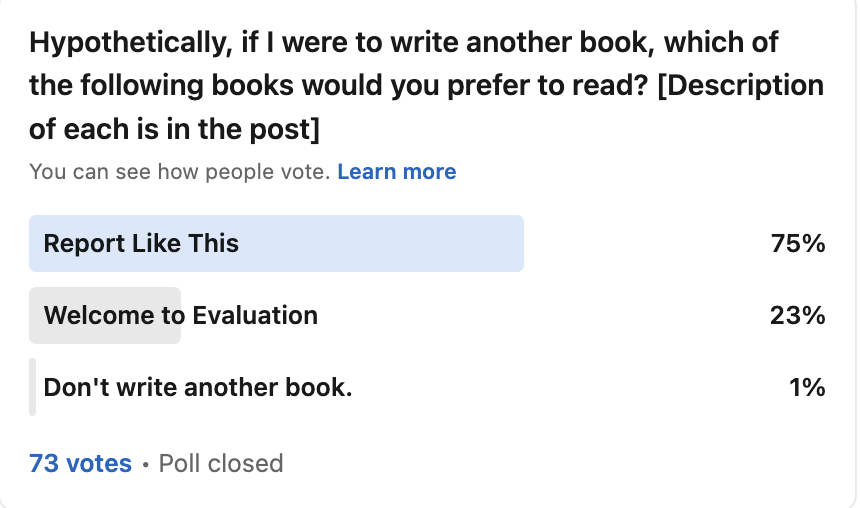
Report Like This is a practical step by step book on modern report design. It would walk through exactly how I would suggest you report evaluation results using a layered strategy. This would include some tutorials and tool suggestions as well as guidance on developing your creative reporting skills.

I put it up against another book concept (Welcome to Evaluation) but Report Like This was clearly the audience favorite.

What do you think, is this a book you would want? Let me know in the comments.

Sidenote: New Report Design Bundle

I’ve finally gone through the process of bundling together my three report design courses. Now you can enroll in all of them at once, with a discount ($100 off). It also includes a year of Data Design Support Club.

Currently all three are available self-paced. I’m also planning to deliver Effective Data Storytelling live again in April (and if you buy the bundle you also get access to every live session).

Also, hint, hint, if you click the button for my free masterclass you’ll also get an additional $200 off.

Written by cplysy · Categorized: freshspectrum

Feb 27 2025

La Inevitabilidad de la Imperfección en la Gestión de Problemas Complejos

El 25 de febrero de 2025, Gabriele Bammer publicó un artículo titulado «Dealing with Imperfection in Tackling Complex Problems» en The Australian National University, Canberra.

En este artículo, Bammer explora la importancia de aceptar la imperfección al intentar comprender y abordar problemas complejos tanto sociales como ambientales.

Bammer argumenta que la imperfección es inevitable debido a varias razones. Primero, los problemas complejos son problemas de sistemas, y todas las vistas de sistemas son parciales, lo que significa que no se puede tener en cuenta todo el sistema. Además, los problemas ocurren en contextos específicos con dimensiones históricas, políticas, geográficas, culturales y económicas que son imposibles de comprender completamente. También existen desconocidos ilimitados que continúan surgiendo a medida que cambian las circunstancias y se realiza más investigación. Además, el cambio es multifacético, dinámico e impredecible, lo que dificulta examinar los problemas y controlar el impacto de las acciones. Las perspectivas, valores e intereses de las personas involucradas también afectan la comprensión de los problemas y las acciones deseables, y los recursos siempre serán limitados.

Bammer advierte contra la sobreconfianza en soluciones perfectas y la desesperanza, incompetencia, corrupción y sesgo retrospectivo. En lugar de eso, sugiere enfocarse en los mejores resultados posibles, comunicar claramente que las soluciones siempre son limitadas y construir procesos de gestión adaptativa. También recomienda usar modelos para explorar impactos potenciales, siendo conscientes de sus limitaciones, y documentar decisiones y limitaciones de manera transparente.

Este artículo es interesante porque ofrece una visión realista y práctica sobre la inevitabilidad de la imperfección y proporciona estrategias claras para manejarla. Bammer cita a Stafford Smith (2015) en su obra «Responding to global environmental change» como una fuente de referencia principal.

Comparado con otros artículos sobre el mismo tema, este post se destaca por su enfoque en la inevitabilidad de la imperfección y la necesidad de estrategias adaptativas, lo que lo hace único en comparación con otros artículos que pueden centrarse más en soluciones ideales.

Son interesantes los argumentos del autor sobre la inevitabilidad de la imperfección y la importancia de estrategias adaptativas. La transparencia y la gestión adaptativa son esenciales para abordar problemas complejos.

Este post es relevante para investigadores, profesionales y cualquier persona interesada en la gestión de problemas complejos, ya que ofrece una perspectiva realista y estrategias prácticas. Los lectores pueden aplicar las estrategias propuestas en sus propios contextos para manejar la imperfección de manera efectiva.

El estilo de escritura de Bammer es claro y accesible, lo que facilita la comprensión de conceptos complejos. Recomendaría este post a otros debido a su enfoque práctico y realista sobre la gestión de problemas complejos. Además, sugeriría leer otros artículos de Gabriele Bammer y publicaciones sobre gestión adaptativa y sistemas complejos para complementar este post.

Referencias

  • Bammer, G. (2025) “Dealing with Imperfection in Tackling Complex Problems.” The Australian National University, Canberra.
  • Stafford Smith, M. (2015) “Responding to global environmental change.” En Bammer, G. (ed) Change! Combining analytic approaches with street wisdom. The Australian National University, Canberra: ANU Press. Disponible en: ANU Press

Written by cplysy · Categorized: TripleAD

Feb 26 2025

Beyond the Grant Award: Setting Up Evaluation Systems for Long-Term Success

Congratulations! Landing a grant feels great—it’s validation that your work matters and your approach is solid. But the work doesn’t stop when the money arrives. In fact, securing funding is just the beginning. Building sustainable evaluation practices helps your organization measure progress, stay on top of program updates, and be positioned for future funding opportunities. […]

The post Beyond the Grant Award: Setting Up Evaluation Systems for Long-Term Success appeared first on Nicole Clark Consulting.

Written by cplysy · Categorized: nicoleclark

  • « Go to Previous Page
  • Go to page 1
  • Interim pages omitted …
  • Go to page 19
  • Go to page 20
  • Go to page 21
  • Go to page 22
  • Go to page 23
  • Interim pages omitted …
  • Go to page 304
  • Go to Next Page »

Footer

Follow our Work

The easiest way to stay connected to our work is to join our newsletter. You’ll get updates on projects, learn about new events, and hear stories from those evaluators whom the field continues to actively exclude and erase.

Get Updates

Want to take further action or join a pod? Click here to learn more.

Copyright © 2026 · The May 13 Group · Log in

en English
af Afrikaanssq Shqipam አማርኛar العربيةhy Հայերենaz Azərbaycan dilieu Euskarabe Беларуская моваbn বাংলাbs Bosanskibg Българскиca Catalàceb Cebuanony Chichewazh-CN 简体中文zh-TW 繁體中文co Corsuhr Hrvatskics Čeština‎da Dansknl Nederlandsen Englisheo Esperantoet Eestitl Filipinofi Suomifr Françaisfy Fryskgl Galegoka ქართულიde Deutschel Ελληνικάgu ગુજરાતીht Kreyol ayisyenha Harshen Hausahaw Ōlelo Hawaiʻiiw עִבְרִיתhi हिन्दीhmn Hmonghu Magyaris Íslenskaig Igboid Bahasa Indonesiaga Gaeilgeit Italianoja 日本語jw Basa Jawakn ಕನ್ನಡkk Қазақ тіліkm ភាសាខ្មែរko 한국어ku كوردی‎ky Кыргызчаlo ພາສາລາວla Latinlv Latviešu valodalt Lietuvių kalbalb Lëtzebuergeschmk Македонски јазикmg Malagasyms Bahasa Melayuml മലയാളംmt Maltesemi Te Reo Māorimr मराठीmn Монголmy ဗမာစာne नेपालीno Norsk bokmålps پښتوfa فارسیpl Polskipt Portuguêspa ਪੰਜਾਬੀro Românăru Русскийsm Samoangd Gàidhligsr Српски језикst Sesothosn Shonasd سنڌيsi සිංහලsk Slovenčinasl Slovenščinaso Afsoomaalies Españolsu Basa Sundasw Kiswahilisv Svenskatg Тоҷикӣta தமிழ்te తెలుగుth ไทยtr Türkçeuk Українськаur اردوuz O‘zbekchavi Tiếng Việtcy Cymraegxh isiXhosayi יידישyo Yorùbázu Zulu