Welcome to our September roundup of new and noteworthy evaluation news and resources – here is the latest.
Have something you’d like to see here? Tweet us @EvalAcademy or connect on LinkedIn!
Virtual conference resources
Conference season is upon us! Ordinarily most of us would be looking forward to hopping on a plane to meet up with our peers in some exotic (and sometimes not so exotic) place. Instead, we are forced to join yet one more Zoom meeting from home. Below are some resources for presenters and attendees to make virtual conference season an enjoyable one.
Amplifying your message with help from Duarte
Duarte (@duarte) is a firm of expert communicators. I took the Duarte VisualStory workshop years ago and have been singing their praises since. Not only that, I continue to use the workbook and resources that were included as part of the workshop. It may be too late to register for one of their workshops in time for your upcoming conference presentation, but they do offer individual and team trainings as well. Besides their courses and training, they have a resource section on their website where you can access a number of guides and tool to make your presentation a memorable one. My favourites are:
Slidedocs template
Your presentation shouldn’t be a list of narrative and text for people to look at. What goes on your slide should be a visual aide that enhances what you are speaking about. The problem is if people are interested in what you are saying then they will want a document to read and reference afterward; hence, the age-old, “can I get a copy of your slides?” If you are designing your slides correctly they should be a useless reference for people after the fact – all the meat and details should come from you and not text on a slide. To bridge this gap, Duarte suggests a Slidedoc, “a visual document intended to be read and referenced instead of projected.” The Slidedoc template can be downloaded for free – it guides you through how you can design a Slidedoc for your presentation that is visually appealing and user friendly.
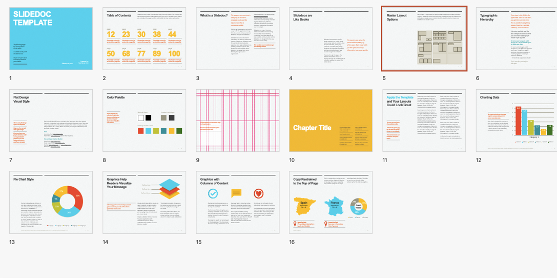
Duarte’s Slidedoc template
Diagrammer
One aspect of an effective presentation is using visuals to show relationships and linkages between information. Another important aspect is having a cohesive look to each of your slides. Duarte’s Diagrammer is a visualization system that contains various diagrams to communicate relationships all with a consistent colour palette (think SmartArt on steroids.) It is free to download, and you can modify as much or as little as you want. See below for a sneak peek of some of the available designs.
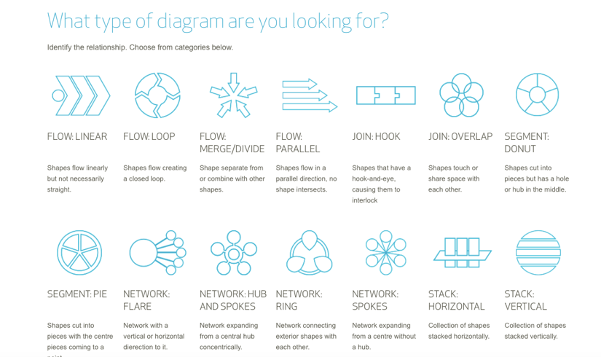
Duarte’s Diagrammer
Creating Potent Presentations
If you are an evaluator you are likely more familiar with the presentation resources the American Evaluation Association has developed under its Potent Presentations Initiative (p2i). This initiative was developed to explicitly help evaluators improve their presentation skills. The initiative has a series of free checklists and worksheets you can download, along with webinars and slides to help you craft a presentation that effectively delivers the message you are trying to get across. Sheila Robinson (@sheilabrobinson) and Stephanie Evergreen (@evergreendata) are a few who have developed resources. I find the Messaging Model Handout particularly useful when planning a presentation. Don’t be that person who spends the entire presentation talking about the background and methods and then frantically flips through the results and next steps because you ran out of time!
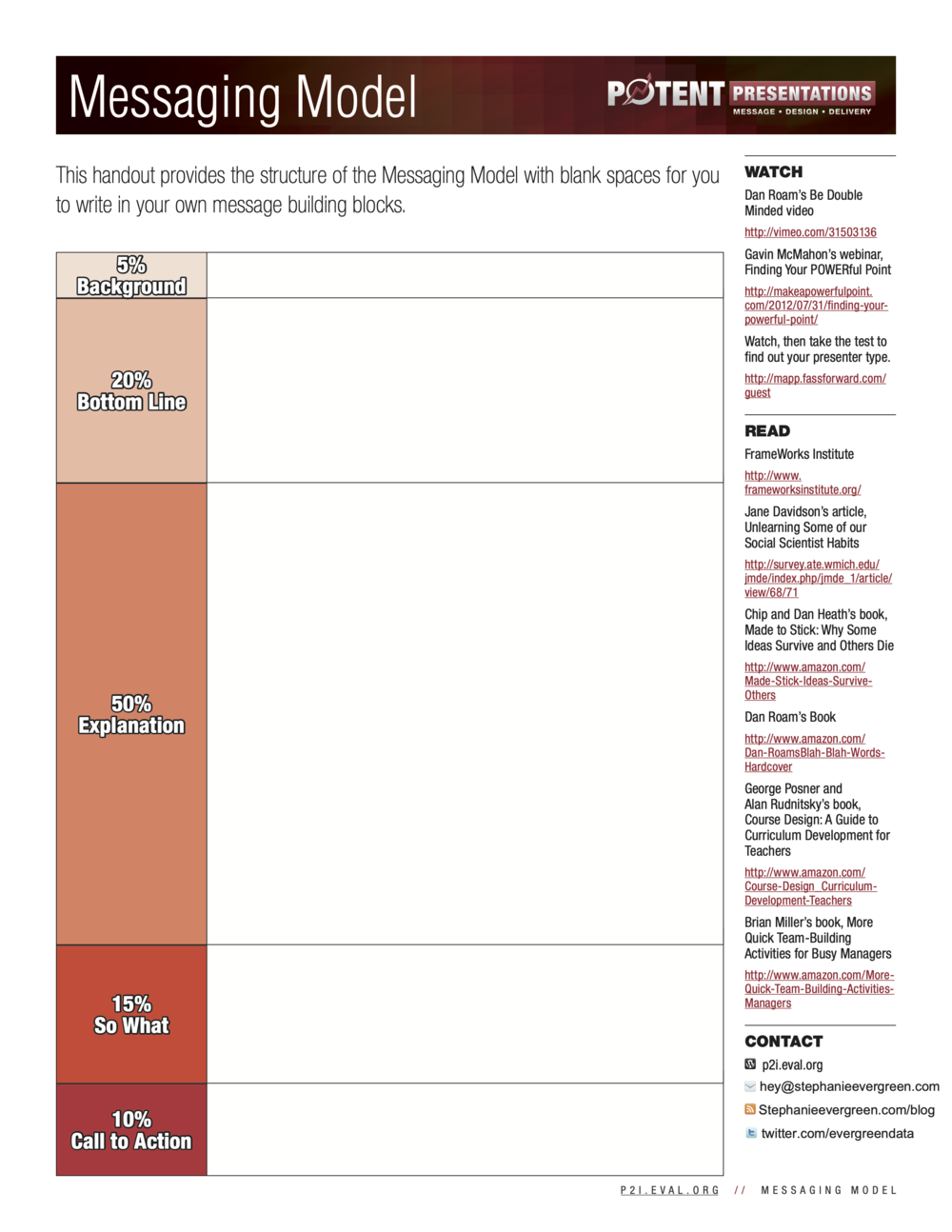
AEA Messaging model handout
Public speaking tips for evaluators
Now that you have designed a perfectly crafted presentation and corresponding reference material, you need to actually deliver the presentation. Check out Ann Emery’s (@annkemery) recent blog with Isaac Castillo (@isaac_outcomes) where they talk about public speaking. His advice for not running out of time with your presentation: prepare half as much content as you think you need.
Facilitating a virtual workshop
What about if you’re conducting your first virtual workshop? Workshop guru Stephanie Evergreen (@evergreendata) recently posted a blog outlining five shifts workshop facilitators should consider when moving online. It covers everything from filling up dead space, adjusting slides for online audiences, break times, and the importance of interactivity. In this blog she also directs readers to Mike Morrison (@mikemorrison) who has some sage advice on conference posters.
Your poster needs to change – here’s how
Mike Morrison’s (@mikemorrison) twitter profile reads “trying to speed up science with #UXDesign.” If you look at his manifesto video he talks about how academia has an antiquated and ineffective way of sharing knowledge and proposes how this needs to change. One place to begin changing how knowledge is presented and consumed is changing those oh so horrible conference posters. Check out his entertaining video on YouTube, “How to create a better research poster in less time (including templates)”. He provides a funny overview on why they are so horrible, but more importantly walks us through how to reinvent our posters so people actually want to look at them and can take in the key learnings.
Attending a virtual conference? Make the most of it
If you are not presenting or facilitating a workshop at a virtual conference, then maybe you are attending one for the first time? If so, check out EvaluATE’s recent blog that talks about making the most of a virtual conference, but from an evaluator’s perspective. In this blog Lyssa Wilson Becho (@LyssaBecho) talks about how we can put on our evaluative thinking hat to define what it is we want to get out of the conference; from there, we can be more intentional about making those outcomes come to fruition.
New and Noteworthy — Courses, Events and Webinars
October 2020
Most Significant Change (MSC)
Sponsor: Clear Horizon Academy
Date: October 12
Venue: Online course
Evaluation 2020
Sponsor: American Evaluation Association
Dates: October 27 – 30
Venue: Virtual Event
Participatory Evaluation: Community-Based Assessment + Strategic Learning Practices
Sponsor: Tamarack Institute
Date: October 20
Venue: Virtual Workshop
November 2020
Using data analysis and visualization to drive social impact
Sponsor: Clear Horizon Academy
Date: October 12
Venue: Online course
Keep the roundups coming? Sign up for our monthly roundup here:
Subscribe to Our Newsletter
Sign up with your email address to receive news and updates from Eval Academy every month.
We respect your privacy.
Thank you!
 English
 Afrikaans
 Shqip
Shqip አማርኛ
አማርኛ العربية
 Հայերեն
 Azərbaycan dili
 Euskara
 Беларуская мова
 বাংলা
বাংলা Bosanski
 Български
 Català
 Cebuano
 Chichewa
 简体中文
简体中文 繁體中文
繁體中文 Corsu
Corsu Hrvatski
 Čeština
 Dansk
Dansk Nederlands
 Esperanto
 Eesti
Eesti Filipino
 Suomi
Suomi Français
 Frysk
Frysk Galego
 ქართული
 Deutsch
 Ελληνικά
 ગુજરાતી
 Kreyol ayisyen
 Harshen Hausa
 Ōlelo Hawaiʻi
 עִבְרִית
 हिन्दी
 Hmong
Hmong Magyar
 Íslenska
 Igbo
Igbo Bahasa Indonesia
 Gaeilge
 Italiano
 日本語
日本語 Basa Jawa
 ಕನ್ನಡ
ಕನ್ನಡ Қазақ тілі
 ភាសាខ្មែរ
 한국어
한국어 كوردی
كوردی Кыргызча
 ພາສາລາວ
 Latin
Latin Latviešu valoda
 Lietuvių kalba
 Lëtzebuergesch
 Македонски јазик
 Malagasy
 Bahasa Melayu
 മലയാളം
 Maltese
 Te Reo Māori
 मराठी
मराठी Монгол
 ဗမာစာ
ဗမာစာ नेपाली
 Norsk bokmål
 پښتو
پښتو فارسی
فارسی Polski
 Português
 ਪੰਜਾਬੀ
 Română
 Русский
 Samoan
 Gàidhlig
 Српски језик
 Sesotho
 Shona
Shona سنڌي
سنڌي සිංහල
සිංහල Slovenčina
 Slovenščina
 Afsoomaali
 Español
 Basa Sunda
 Kiswahili
 Svenska
 Тоҷикӣ
 தமிழ்
தமிழ் తెలుగు
 ไทย
ไทย Türkçe
 Українська
 اردو
اردو O‘zbekcha
 Tiếng Việt
 Cymraeg
 isiXhosa
 יידיש
יידיש Yorùbá
 Zulu
Zulu