• Skip to main content
  • Skip to footer
  • Home

The May 13 Group

the next day for evaluation

  • Get Involved
  • Our Work
  • About Us
You are here: Home / Archives for cplysy

cplysy

Sep 08 2020

Public Speaking Tips for Researchers and Evaluators from Isaac Castillo

Remember that Excel Test? Where I walked into a job interview, was asked about my prior experience with data, and then—surprise!!—the Director gave me a timed test to assess my true skill level??? And I panicked. Heart pounding. Face flushed. Hands shaking as I rushed to finish the test as quickly as possible??

That was Isaac Castillo…

…a.k.a. an Outstanding Boss, Evaluator, and Public Speaking Extraordinaire.

I’m so happy he hired me a decade ago, and I’m even happier that we’ve stayed in touch over the years.

Haven’t met Isaac yet? Isaac Castillo is the Director of Outcomes, Assessment and Learning at Venture Philanthropy Partners.  He has 20+ years of experience with research, evaluation and measurement. 

Today, the tables have turned. I got to interview Isaac!

Watch Our Conversation

During this 5-minute interview, we talked about Isaac’s career trajectory and his best public speaking advice for researchers, evaluators, and data analysts.

Prepare Half as Much Content as You Think You Need

Although Isaac has spent two decades working in research and evaluation, he started his career as a competitive debater and public speaking coach.

I asked Isaac for his #1 piece of public speaking advice.

Isaac advised us to prepare half as much content as we think we need.

For example, if you’ve been asked to speak for a half hour, prepare for 15 minutes worth of speaking.

We Always Need More Time Than We Think

Why does this work?

First, we often don’t have a good sense of how long it takes to deliver our content, or how long our speaking styles result in the content being delivered. We always take more time to present our information than we think we do.

When Isaac was speaking in high school and college, he struggled giving timed speeches. It’s taken more than a thousand presentations for Isaac to get a good sense of pacing and how fast he can go. Most of us haven’t given a thousand presentations, so we haven’t had enough practice fine-tuning our timing yet. Isaac says we’re always going to take more time than we think.

We Don’t Want to Seem Rushed

Often times, we accidentally put our most important content at the very end.

Then, when we get to the meaty content, we’ll look at the clock, realize we have 3 minutes left, and then try and wrap it up and rush through it.

If we prepare half as much content as you need, we can take your time. We can go off on some tangents as they feel appropriate. We can answer questions throughout our presentation. We won’t feel rushed.

We Can Focus Better on the Most Important Content

Preparing half as much content as we think we need forces us to really focus on the most important content. Which points do we want to drive home?

It also forces you to get rid of content that isn’t central to the points we’re trying to deliver.

It used to be hard for me to cut content from my presentation. Deleting slides forever felt too permanent. What if I wanted to share those topics in a future presentation? Mentally, I remind myself that those points aren’t gone forever. I’m just saving them for a future presentation.

Leave Our Audience Wanting More

Isaac’s friend is a Beatles fan, and she gave him great advice.

The Beatles intentionally wrote short songs to leave us wanting more, so Isaac has internalized that as well.

Give Enough to Pique Interest

Finally, Isaac said that if we give enough information to pique interest, then our audience will ask questions and want to follow-up with us.

Connect with Isaac Castillo

Connect with Isaac:

  • Twitter: @Isaac_Outcomes
  • LinkedIn: Linkedin/in/IsaacDCastillo
Written by cplysy · Categorized: depictdatastudio

Sep 08 2020

How to formulate strong outputs

Outputs are arguably not the most important level of the results chain. It is outcomes that should be the focus of a good plan. Ultimately, that´s what counts.

However, outputs still matter.

Just to be clear: Simply put, outputs refer to changes in skills or abilities, or the availability of new products and services. In plain lingo: Outputs are what we plan to do to achieve a result.

Ok, let’s be a bit more precise: Outputs usually refers to a group of people or an organization that has improved capacities, abilities, skills, knowledge, systems, policies or if something is built, created or repaired as a direct result of support provided. That’s a definition we can work with.

Language is important

When describing what you do, focus on the change, not the process. Language matters.

Don’t say: ‘Local organisations will support young women and men in becoming community leaders.’ This emphasises the process rather than the change.

Instead, emphasis what will be different as a result of your support. Say: ‘Young women and men have the skills and motivation to be community leaders’. 

Make it time-bound

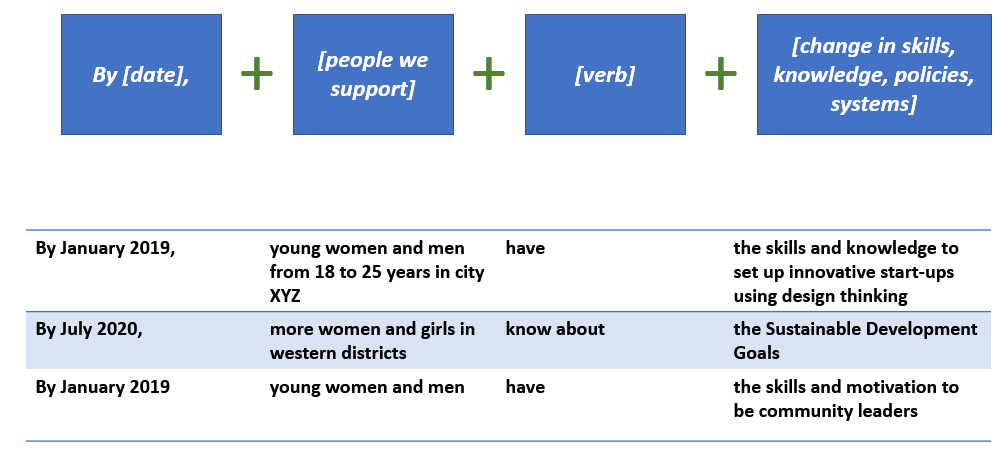
An organization’s support is typically not open-ended. You usually expect to wrap up what you do at a certain time. Emphasise that your activities are carried out within a certain time frame. So it’s always helpful to include in the formulation for example ‘By January 2019, …’. 

A formula for describing what you do

To ensure that you accurately describe what you do, use the following formula:

Thomas Winderl, 08.09.2020

The post How to formulate strong outputs appeared first on Thomas Winderl.

Written by cplysy · Categorized: thomaswinderl

Sep 03 2020

Evaluation Roundup – August 2020


Welcome to our August roundup of new and noteworthy evaluation news and resources – here is the latest.

Have something you’d like to see here? Tweet us @EvalAcademy or connect on LinkedIn!


New and Noteworthy


Evaluation Podcasts

While podcasts aren’t new it seems like podcasts are a new medium for the evaluation field. Recently there was a Twitter thread asking about evaluation podcasts. Below is a summary of current evaluation podcasts that were mentioned and what they are all about: 

Eval Cafe – is co-hosted by Carolyn Camman (@c_camman) and Brian Hoessler (@strongRoots_SK). The premise for this podcast is “informal chats on evaluation-related topics – the kind you might overhear at your favourite coffeeshop, if it was frequented by evaluators.” There have been 35 episodes produced since its first episode in June 2017. Previous guests have included Khalil Bitar (@khalilbitar), Kylie Hutchinson (@evaluationmaven), Dana Wanzer (@danawanzer), Sarah Farina (@broadleafc) and Michael Quinn Patton (@MQuinnP). When there isn’t a guest, Brian and Carolyn discuss and explore various evaluator topics like: how do we explain what we do? What is so scary about evaluation? And other evaluator questions you may grapple with. 

The Glass Frog Podcast – This podcast started in 2018 by GlassFrog Solutions (@glassfrogtweets) – a research and evaluation firm. It has produced 20 episodes with a wide-variety of evaluation-related content, including a) empathy in evaluation, b) survey design, c) evaluating collaboratives, d) photography and evaluation, and so much more! 

EvalCrisis – is produced by the DEVCO/ESS Evaluation in Crisis Initiative. The purpose of the podcast is to share teachings for the evaluation community to learn from so they can adapt evaluations in crisis situations, like the current COVID-19 pandemic. The podcast series began in June 2020 and have eight episodes posted on its site. Topics discussed so far have included, safety, remote data collection, ethical issues, and shifting evaluation foci. 

Evaluland – is hosted by Dana Wanzer (@danawanzer). The podcast discusses the land of evaluation. It is a relatively new podcast that started this year; so far there have been six episodes produced. The focus of the podcast thus far has been on evaluation theory and teaching evaluation, which is a natural fit for Dana who is an Assistant Professor teaching evaluation at the University of Wisconsin-Stout. 

EvalEdge – The European Evaluation Society started a podcast series last month. So far there have only been two episodes produced. The first episode introduced the podcast and co-hosts @1marcolorenzoni, @hurhassnain and @saskia_sbr and the second podcast hosted Linda Raftree (@meowtree), co-founder of MERL Tech, about innovative examples of using big data and the ethical considerations to be aware of.


New and Noteworthy — Tools


Charles and Lynn Schusterman Family Foundation – A guide toward diversity, equity and inclusion in data collection

At Three Hive Consulting, have been discussing how we can be more mindful and intentional when collecting our data to promote inclusion and equity – this guide is a great resource. It was produced “as a starting point to spark inquiry, conversation, disruption and, ultimately, better data collection practices within organizations.” In this guide they provide examples for collecting survey data related to gender identity, sexual orientation, race and ethnicity, and disability. It also includes a list of additional resources to access.

Clear Horizon Academy – Tools and resources

I stumbled across Clear Horizon’s Academy where they have a tools and resources section. This section of the site includes “must haves” for change makers. It includes tools and approaches for measurement, evaluation and learning; guides for different approaches like Most Significant Change, and; real-life examples on how these tools and approaches can be applied to support change.

Khulisa’s #evaltuesdaytip for photo elicitation and evidence maps

Each Tuesday Khulisa outlines, you guessed it, tips for evaluators. This month Khulisa created a blog post that unpacks photo elicitations and how it can be applied in youth or children in the education sector by providing seven insightful resources. Another helpful post was its #evaltuesdaytip that provided 14 links to evidence maps. Check out Beam Exchange for an example of what an evidence-map is and how it can be used.


New and Noteworthy — Courses, Events and Webinars


September 2020

Asian Evaluation Week: Evaluating for a Better Future

Sponsor: Asia-Pacific Finance and Development Institute and the Asian Development Bank’s Independent Evaluation Department (IED)

Dates: September 7 – 11

Venue: Virtual event


Group deliberations (focus groups, etc) in realist evaluations and reviews

Presenter: Dr. Ana Manzano (RealismLeeds)

Date and Time: September 11; 02:30 – 03:30 MDT

Venue: Online

Evalpalooza I: Evaluation Failures with Kylie Hutchinson and Thought Leaders

Presenters: Kyle Hutchinson & Libby Smith

Date and Time: September 24; 12pm CDT

Venue: Online


October 2020

Evaluation 2020

Sponsor: American Evaluation Association

Dates: October 27 – 30

Venue: Virtual Event


Subscribe to Our Newsletter

Sign up with your email address to receive news and updates from Eval Academy every month.


We respect your privacy.

Thank you!


Written by cplysy · Categorized: evalacademy

Sep 03 2020

Six Hacks for Renovating Your Evaluation Report


Part 1 – Take them on a journey

Evaluators are notorious for bad reporting. According to Jane Davidson it has to do with our training. Often evaluators are trained in social sciences – a world that prepares people for academic style research and how to write scientifically. The problem is this doesn’t work in the “real world.” Leaders and decision makers don’t want to comb through pages and pages of text to try and find findings and what they should do about them. #TLDR

At Three Hive Consulting we took Jane’s advice and started unlearning these bad reporting habits. Instead we looked to creative fields like graphic design and visual storytelling to inform our reporting. Canva is a great place to start learning about design. They have free courses and tutorials that walk you through design basics you can apply to your reporting. In this series of posts, I am going to walk you through how I reno’d draft evaluation reports using six of Canva’s design lessons. This first post relates to Canva’s design lesson “Take them on a journey.”


The importance of storytelling

The best way to engage an audience is to tell them a story. Our brains love stories and are much more likely to remember information is we activate our imagination and our emotions through story, as opposed to showing facts alone.

A well-crafted story will take people on a journey. If you think back to your favourite stories they likely have two common characteristics. The first is, good stories feature transformation – there was a problem, someone (or something) overcame that problem and now there is some sort of resulting change. The second is, good stories have a clear structure – a beginning, middle and end. This journey is what activates our imagination and emotions and gives our message staying power. Not only this, a good story will motivate people to act.

As evaluators we want our stakeholders to use our findings (i.e. act). The problem is evaluators often take people on a really boring journey full of facts and data in our reports. As Jane describes in her editorial, Unlearning Some of our Social Scientist Habits:

“Executive Summary (lots introductory information, methodology, sampling, random snippets of findings that fail to give a clear sense of the program’s quality or value, plus something incomprehensible about moderator variables), Introduction, Literature Review, a theoretical model and detailed explanation of the relevant social science theory explaining the links along some variables (unfortunately not a program logic model, and not even remotely linked to an evaluation question—this part contributed by a university faculty member with no evaluation expertise), Methodology, Findings (about 20 pages of raw data, all presented separately by source and data type with virtually no explanatory narrative, none of it linked back to the questions), Conclusions (some glimmers of hope in here, but by now we are 37 pages into the report and have lost most of our audience), Appendices.”

It is no wonder the only action stakeholders take when reading these types of evaluation reports is to shut their eyes! We need to stop this useless reporting if we want them to engage and act on the findings. Unlearning this is hard, but once you give yourself the freedom to let go you will never look back. Instead, let’s look at how to craft a story to take our stakeholders on a more interesting journey.


Crafting your story

Get to know your audience

Before you begin crafting your story you need to get to know your audience (aka your stakeholders) in order to make that report accessible. Who are they? What are their needs and how can this information address them? How can the information you discovered solve their problem? What do you want them to do with the information? Asking questions like these are critical for crafting your story so the content is relevant and resonates with your audience. Refer to my post, Three Ways to Increase the Chances Your Evaluation Results Will Actually Get Used, where I dig into stakeholder analysis and how to tailor reporting needs to different stakeholders.

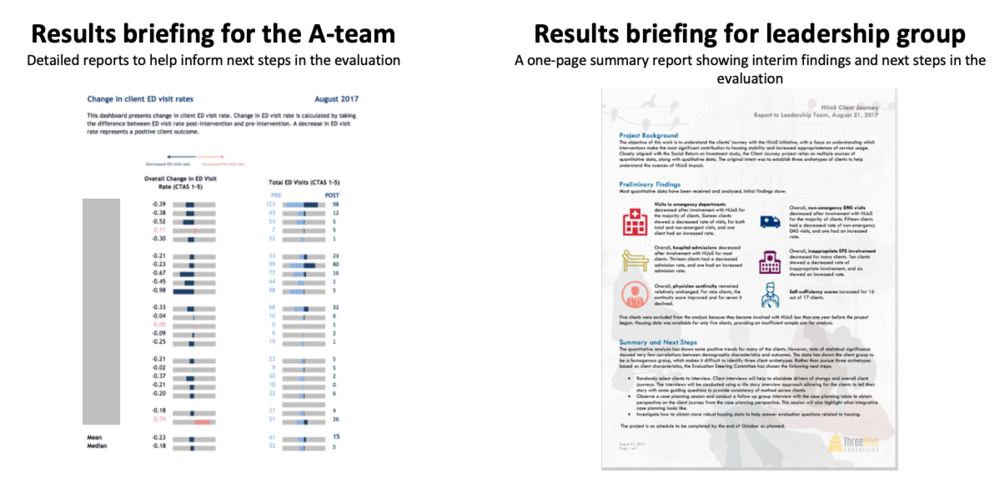
Results briefing for the A-team:  Detailed reports to help inform next steps in the evaluation (Left)   Results briefing for leadership group:  A one-page summary report showing interim findings and next steps in the evaluation (Right)

Results briefing for the A-team: Detailed reports to help inform next steps in the evaluation (Left)

Results briefing for leadership group: A one-page summary report showing interim findings and next steps in the evaluation (Right)

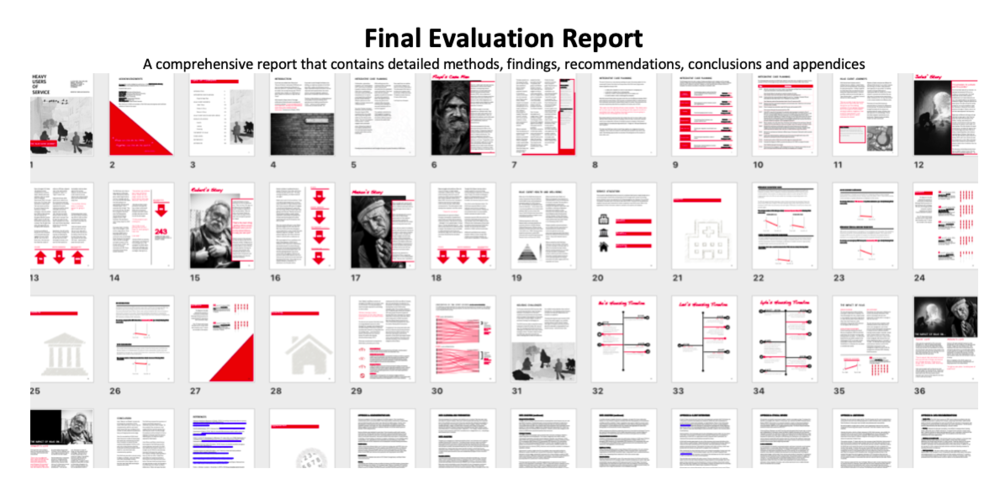
Final Evaluation Report:  A comprehensive report that contains detailed methods, findings, recommendations, conclusions and appendices

Final Evaluation Report: A comprehensive report that contains detailed methods, findings, recommendations, conclusions and appendices

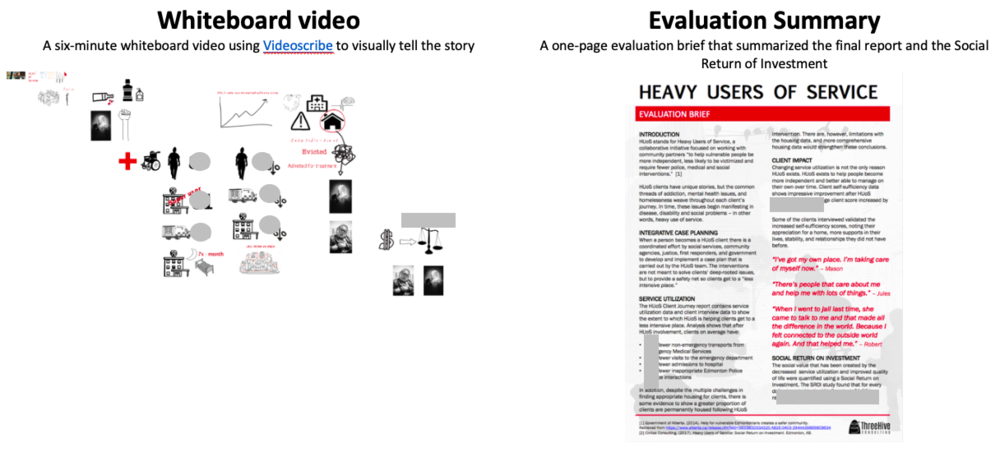
Whiteboard video:  A six-minute whiteboard video using  Videoscribe  to visually tell the story (Left)   Evaluation Summary:  A one-page evaluation brief that summarized the final report and the Social Return of Investment (Right)

Whiteboard video: A six-minute whiteboard video using Videoscribe to visually tell the story (Left)

Evaluation Summary: A one-page evaluation brief that summarized the final report and the Social Return of Investment (Right)


Figure out the point(s)

In this post Stephanie Evergreen talks about the most important question in data viz, “what’s your point?” This question is just as important with your overall evaluation reporting. Jane discusses in her editorial how evaluators have a bad habit of producing reports with pages and pages of data but little acknowledgement of how the findings were used to answer any question of value; “when, oh when are they going to get to the point?” she asks. Bottom line when it comes to reporting – have a point. It seems somewhere along the way we forgot about those thesis statements and may need to re-learn how to incorporate those.

Picture1.png

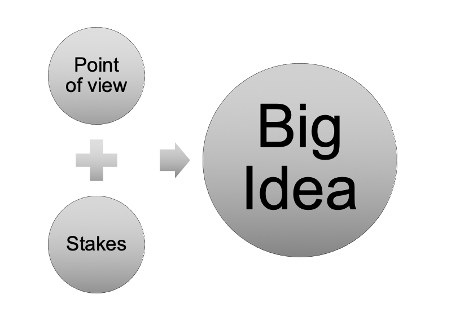
But since we’re trying to unlearn our scientific writing style perhaps we should think of our thesis statement as a ‘big idea’ – term coined by master communicator, Nancy Duarte. A big idea is the core message you want your audience to hold on to. A big idea contains two components:

  1. Point of view – your point of view on a subject

  2. Stakes – the reason why the audience for your report should care.


For your evaluation, the point of view should come from the findings – what is the data telling you? The stakes should be driven by who the evaluation stakeholders are (specifically for this evaluation report) and how do they intend to use the findings? Combining these will help you figure out your point or big idea. Everything you put in your report should then focus on that big idea.

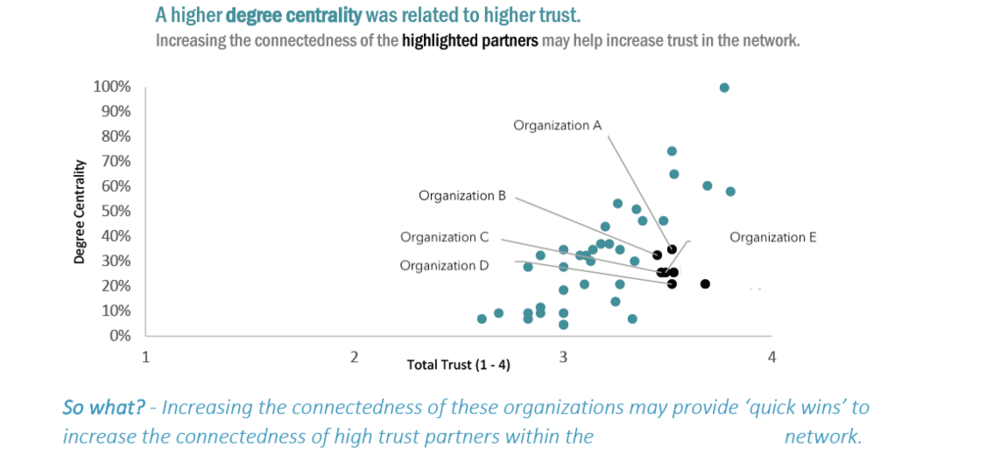
We recently conducted a Social Network Analysis with a client. Ultimately, this client wanted to understand what its collaborative network looked like and how it could be strengthened. Throughout the report we presented the findings, so they answered the evaluation questions. In addition, as results were presented, we identified the meaning behind the findings and by calling out the ‘so what’ in italics (see below). You’ll notice we also didn’t use generic graph titles like, “Relationship between degree centrality and trust.” Instead, we told people the point – “A higher degree centrality was related to higher trust.”

Picture1.png


Lead the audience to a destination

Taking an audience on a journey means we need to lead them to a destination. You were hired to evaluate something for a purpose. Hopefully you’ve discovered answers to questions that your stakeholders didn’t know before they hired you. Leading our stakeholders to a destination means we need to not only outline what they should they do with the information (i.e. recommendations), but in order to motivate people to act we need to outline why they should act (or not). What will happen to them as a result? What will happen if they don’t act? Nancy Duarte describes this as a “new bliss.” For evaluators this means not just listing off recommendations but why our stakeholders should implement those recommendations. For example, if we are recommending a department reorganization it is important to outline what that new bliss will look like after the reorganization (e.g. a saner workload.)

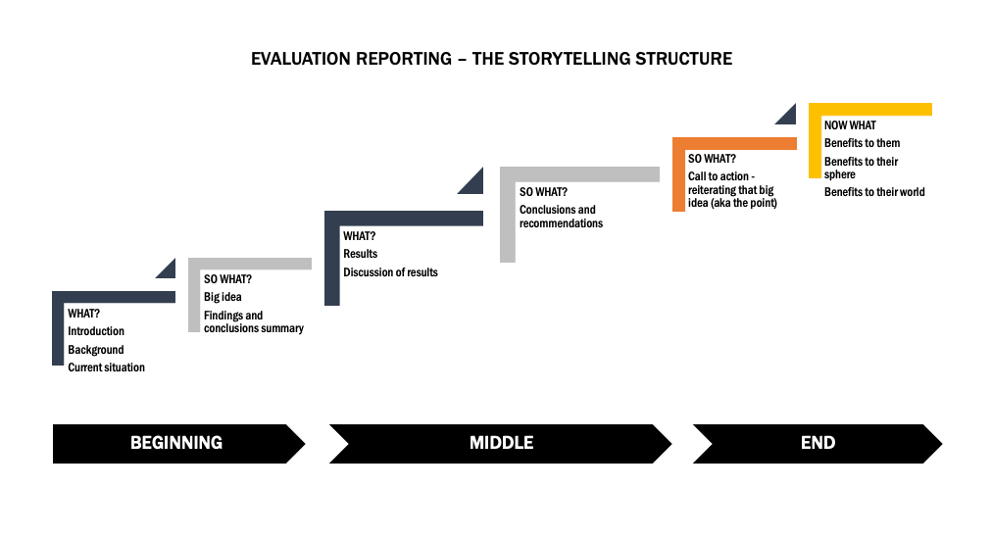
So how can we re-jig how we report our findings, so we incorporate these storytelling principles and take our stakeholders on a journey that motivates them to act? Below is a reporting structure we encourage you to try. It gets rid of that long-winded scientific style that forces people to flip through pages and pages of information searching for the point. Instead, this structure presents an alternative that weaves those two important characteristics of storytelling – transformation (what, so what, now what) and a clear structure (beginning, middle and end).

Picture1.png


Try it out and make sure to stay tuned for the next article in our six part series, “Consistency is cool” where I show you how I reno’d an evaluation report using consistent design (e.g. font, colours, heading levels).


Sign up for our newsletter

We’ll let you know about our new content, and curate the best new evaluation resources from around the web!


We respect your privacy.

Thank you!


Written by cplysy · Categorized: evalacademy

Sep 03 2020

Thinking like a sociologist.

Just like evaluation, sociology found me.

I started undergrad majoring in biological resources engineering. At the time I was a lazy student lacking motivation. And because those two things don’t mix well, I almost dropped out of school after freshman year.

Luckily, I was able to change course. And after a few more major switches, I discovered my field.

Sociology is a landing spot for students who prefer classroom discussion to multiple choice. Where psychology is about people, sociology is about the context surrounding the people.

But for me sociology was always more than just the discipline. It was the types of people and conversations it brought together. The best sociology professors were not lecturers, they were conversation facilitators. And the conversations, contentious as they may have been from time to time, helped me to develop my critical thought process.

In today’s cartoon newsletter I’ll dig into just a little bit of work from a few sociologists.

Digging Deeper

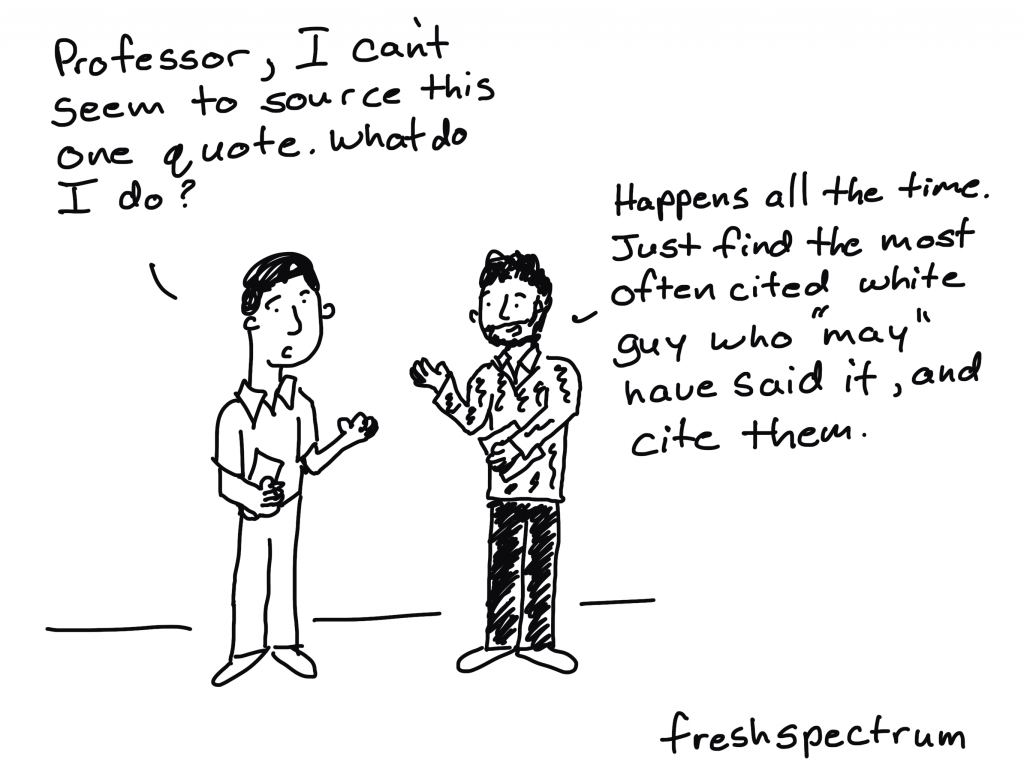
Have you ever tried to source a quote and found yourself diving deeper and deeper into a never ending rabbit hole? This book by Merton is an account of one of these journeys, decades before the internet.

With playfulness and a large dose of wit, Robert Merton traces the origin of Newton’s aphorism, “If I have seen farther, it is by standing on the shoulders of giants.” Using as a model the discursive and digressive style of Sterne’s Tristram Shandy, Merton presents a whimsical yet scholarly work which deals with the questions of creativity, tradition, plagiarism, the transmission of knowledge, and the concept of progress.

On the Shoulders of Giants: The Post-Italianate Edition

Challenging Assumptions

Ever since connecting with Vidhya Shanker‘s work I find myself diving deeper into theorists I missed while in grad school. There is so much to discover across all fields often hidden in plain sight.

Here is one, the late sociologist Fatema Mernissi. While you should definitely check out her work, a simple starting point would be this 7 minute NPR remembrance.

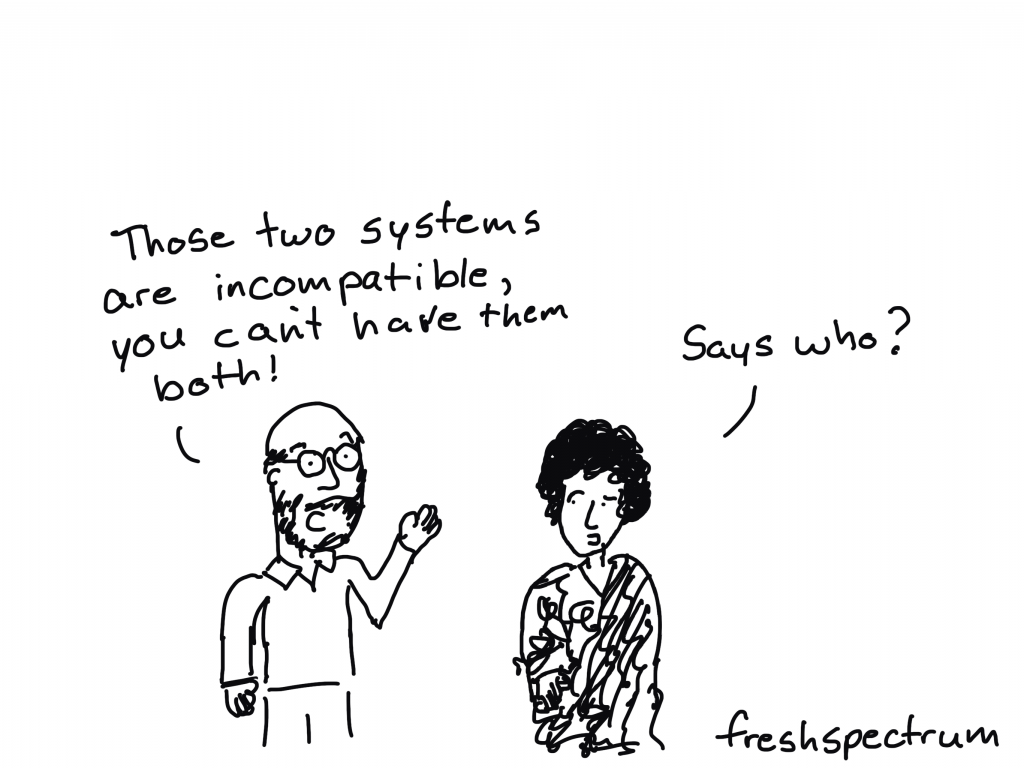
I started this slogan. I, as a Muslim woman living in 1993, I want to have two things – the mosque and the satellite, both at the same time. And no one can mutilate me by telling me I cannot have the mosque or the Koran. Someone else is going to read for me or go at my place to the mosque, and/or to tell me you shouldn’t take anything from the West because the West is the enemy and so on. It is to me to decide. I am intelligent enough to be critical towards the West and take what I need and reject what is bad for me.

Remembering Islamic Feminist Fatema Mernissi

Understanding does not mean approval

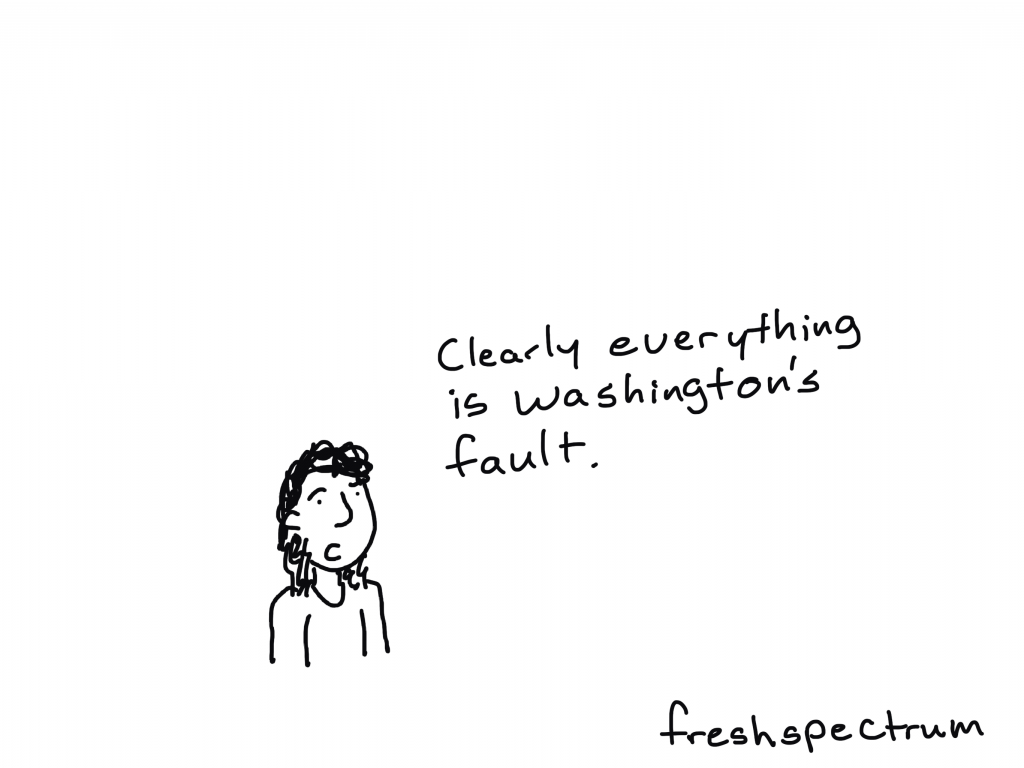
When in doubt, blame the federal government. And if you can get enough people to do that, you can the find your way to the top federal government position by railing against people currently in the federal government.

I’m not sure that Washington is doing anything to harm these communities. To be honest, a lot of it is just scapegoating. And that’s why you see more xenophobia and racism in these communities. There’s a sense that things are going badly, and the impulse is to blame “others.”

A Princeton sociologist spent 8 years asking rural Americans why they’re so pissed off

Masculinity and Trump Support

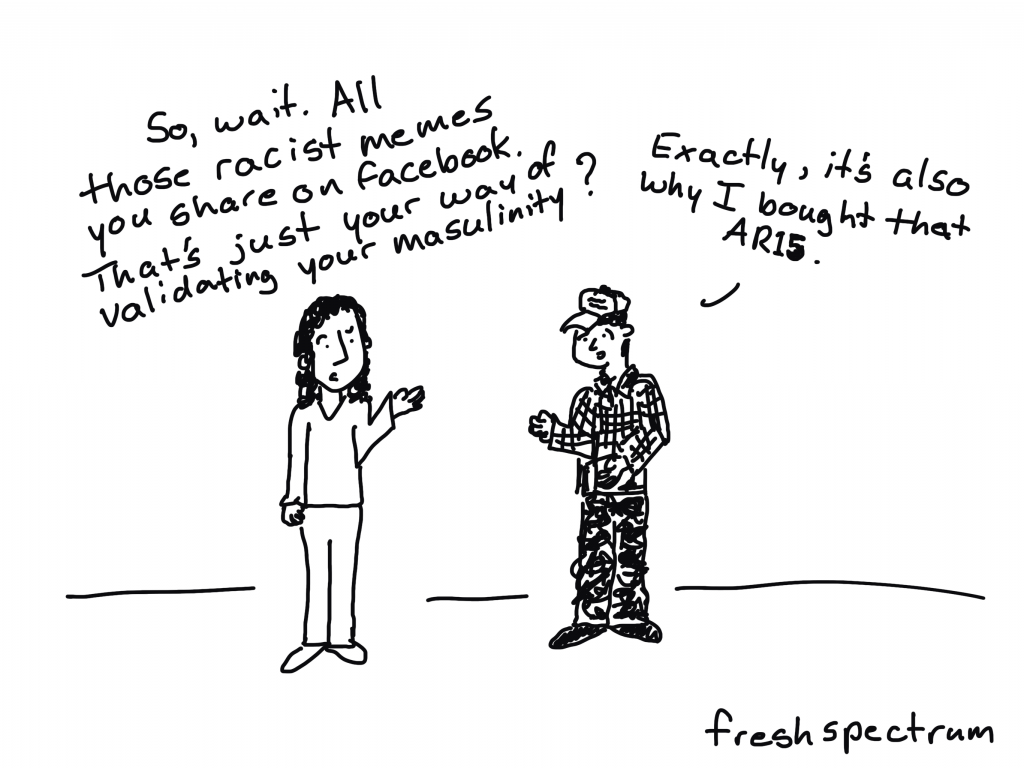
I read a Vice article last week about the Kenosha murderer, and there was a line at the end that’s been haunting me. It was something the author pulled from far-right message boards “Well he became a man today, that’s for sure.”

I doubt anyone following this newsletter needs to hear this, but that is not what it means to be a man.

I think it’s a false debate. I think nature and nurture are intimately linked. What we know is that testosterone as a hormone both drives aggression and responds to aggression. It is a really malleable hormone. And I think that you can’t understand the natural biological conditions of violence without understanding the social conditions, and I think you can’t understand the social conditions without understanding the biological conditions.

‘Angry white men’: the sociologist who studied Trump’s base before Trump

Upending the Status Quo

Patricia Hill Collins was my personal introduction to intersectionality through her book Black Feminist Thought. She was also the first black woman to be president of the American Sociological Association (in 2009, in the association’s 100th year).

The quote below comes from a talk she gave at Cambridge. It’s a long 50 minute talk, but she is a fantastic teacher. She doesn’t show slides, so it’s also the kind of talk where you can hit the play button on youtube and just listen.

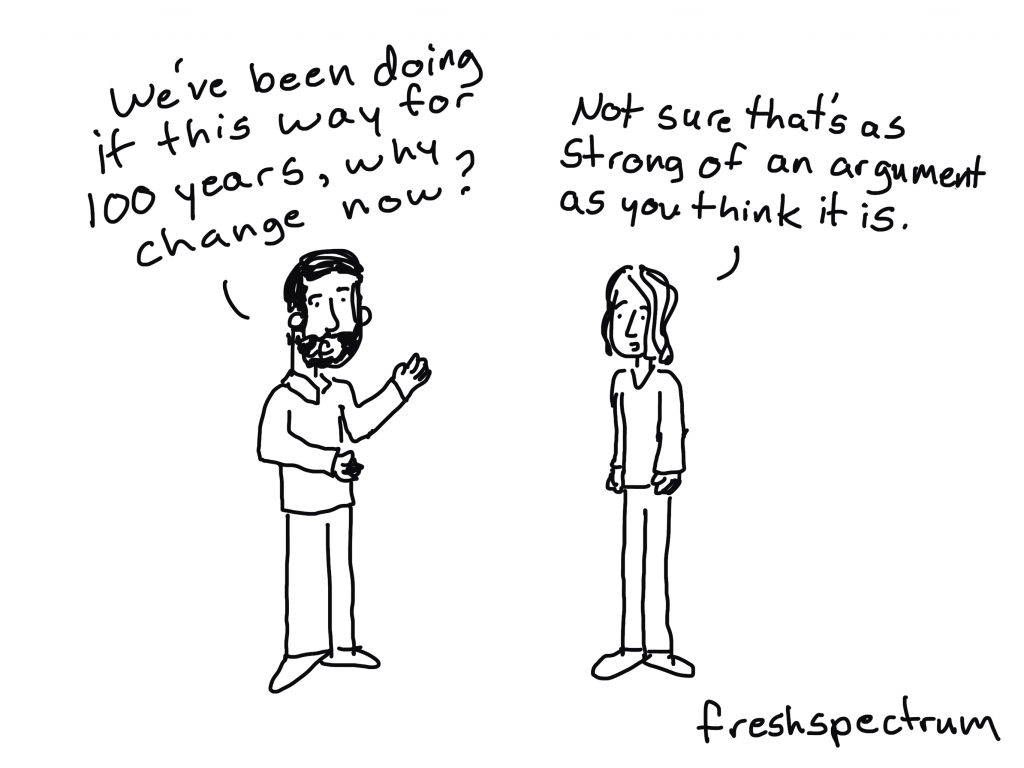
It clearly has an established track record, but its challenge now is how much is it willing to leave behind what it has defended so staunchly for over 100 years?

Intersectionality and Sociology – Professor Patricia Hill Collins

Written by cplysy · Categorized: freshspectrum

  • « Go to Previous Page
  • Go to page 1
  • Interim pages omitted …
  • Go to page 234
  • Go to page 235
  • Go to page 236
  • Go to page 237
  • Go to page 238
  • Interim pages omitted …
  • Go to page 304
  • Go to Next Page »

Footer

Follow our Work

The easiest way to stay connected to our work is to join our newsletter. You’ll get updates on projects, learn about new events, and hear stories from those evaluators whom the field continues to actively exclude and erase.

Get Updates

Want to take further action or join a pod? Click here to learn more.

Copyright © 2026 · The May 13 Group · Log in

en English
af Afrikaanssq Shqipam አማርኛar العربيةhy Հայերենaz Azərbaycan dilieu Euskarabe Беларуская моваbn বাংলাbs Bosanskibg Българскиca Catalàceb Cebuanony Chichewazh-CN 简体中文zh-TW 繁體中文co Corsuhr Hrvatskics Čeština‎da Dansknl Nederlandsen Englisheo Esperantoet Eestitl Filipinofi Suomifr Françaisfy Fryskgl Galegoka ქართულიde Deutschel Ελληνικάgu ગુજરાતીht Kreyol ayisyenha Harshen Hausahaw Ōlelo Hawaiʻiiw עִבְרִיתhi हिन्दीhmn Hmonghu Magyaris Íslenskaig Igboid Bahasa Indonesiaga Gaeilgeit Italianoja 日本語jw Basa Jawakn ಕನ್ನಡkk Қазақ тіліkm ភាសាខ្មែរko 한국어ku كوردی‎ky Кыргызчаlo ພາສາລາວla Latinlv Latviešu valodalt Lietuvių kalbalb Lëtzebuergeschmk Македонски јазикmg Malagasyms Bahasa Melayuml മലയാളംmt Maltesemi Te Reo Māorimr मराठीmn Монголmy ဗမာစာne नेपालीno Norsk bokmålps پښتوfa فارسیpl Polskipt Portuguêspa ਪੰਜਾਬੀro Românăru Русскийsm Samoangd Gàidhligsr Српски језикst Sesothosn Shonasd سنڌيsi සිංහලsk Slovenčinasl Slovenščinaso Afsoomaalies Españolsu Basa Sundasw Kiswahilisv Svenskatg Тоҷикӣta தமிழ்te తెలుగుth ไทยtr Türkçeuk Українськаur اردوuz O‘zbekchavi Tiếng Việtcy Cymraegxh isiXhosayi יידישyo Yorùbázu Zulu