• Skip to main content
  • Skip to footer
  • Home

The May 13 Group

the next day for evaluation

  • Get Involved
  • Our Work
  • About Us
You are here: Home / Archives for cplysy

cplysy

Sep 02 2020

What happens after the storm?

My happy place.

The beach is the one place in the world I can totally relax. What is your happy place?

My family just got back from a week-long stay on St. George Island. We were supposed to go in May, but back then we thought the world was ending, so we moved our trip to August. Who knew at the time, the death rate from the pandemic would be so much worse?

This picture was taken after an afternoon storm, a pretty common event during summer afternoons in Florida.

This year has been one storm after another. I am not sure what your family has gone through this year, but our year started with the unexpected death of my brother-in-law in March.

From COVID-19, to economic hardship, to the increasing unrest in our cities after the killing of unarmed black men and women, to the toxic political culture. It’s all so, so much.

Strangely, I am more determined than ever to make a difference in the world. One of our readings from yesterday (Jeremiah 20:7-9) resonates with me. I couldn’t stay silent even if I wanted to.

What about you?

In the next few months, CES will be rebranding. Our tagline is Partnering for Social Change and we intend to live up to it. We will be more intentional about our client relationships, focusing on nonprofits and foundations who share our commitment for systemic change.

For the last six weeks, I have held office hours for new evaluators, offering whatever advice I can as they start their consulting businesses. If you are reading this, perhaps you have joined our meetings. If you haven’t and would like to, please send me an email.

Now a question for you. Have you ever been engaged in a conversation with someone but you just didn’t feel equipped to offer a coherent counter-argument? That’s how I feel! So, as part of our shift, I am in the process of planning a new podcast. The podcast will feature people doing the work of social change. We will focus on facts and the stories behind them. I am going to explore the things I want to know more about and I bet, they include things that just might interest you too. There is so much I don’t know! On any given day, I feel excited and terrified at the same time. Can you do me a favor though? Help me name the podcast and send me some ideas of things you want to learn about. Send me your ideas at aprice@communitityevaluationsolutions.com.

Until we can meet again in person, sending you virtual hugs.

—- Ann
Written by cplysy · Categorized: communityevaluationsolutions

Sep 01 2020

How to Avoid Annoying PowerPoint Habits: Interview with Dave Paradi, Microsoft MVP

Dave Paradi is one of my favorite people in the presentation design world. He is a Microsoft MVP, has been a professional speaker since 1999, and has authored 9 books and over 100 articles on PowerPoint. His focus is on helping business professionals create clear visuals of financial data. ​

I interviewed Dave about his current work, what it’s like to be a Microsoft MVP, and his presentation tips.

What’s Inside: Dave’s Career Trajectory

  • Dave says, “I deliver customized training sessions both in person and virtual and in those sessions I focus on 1) creating effective Excel charts and 2) effective PowerPoint presentations. It’s very corporate, business focused.”
  • How long Dave has been training others.
  • How he uses his own mistakes to train others. Dave told me, “I’ve been doing this for 21 years so I have made most of the mistakes in both a workshop as well as in running a business. That’s what I hope to share with my audiences, because when they say ‘What do you do when this happens?’ chances are I’ve made that mistake before.”
  • How Dave got his start in mutual funds and ended up giving a presentation series that changed his career trajectory.
  • How Dave and Ann connected. Dave said, “I’d noticed you first on Twitter and seen some of the stuff you were doing earlier on. And when you decided to go out on your own, I’d reached out and said ‘Hey Ann, would you like to have a conversation? I can share some of the stuff I messed up on and hopefully you won’t have to.’ One of the things I really appreciated when I got started was to learn from those who’d gone before. To learn the real-world information about what you should or should not do and should consider and I try to pay it forward.”
  • How Dave pays it forward to those younger or starting out. Dave said, “What mistakes have you made in an area of your life that you could pass on to somebody who is younger or starting out in the area? Help them, because it helps all of us.”

Dave’s Experience as a Microsoft MVP

I also asked Dave about his experience as a Microsoft MVP.

“We get to interface with the development team,” Dave explained.

“We just had a summit where we get to hear about what they’re working on, they get our advice, our input, things that they like and things they should change. I can’t tell you what they’re working on, but I can tell you that they’re constantly working on great, new features in Excel and PowerPoint.”

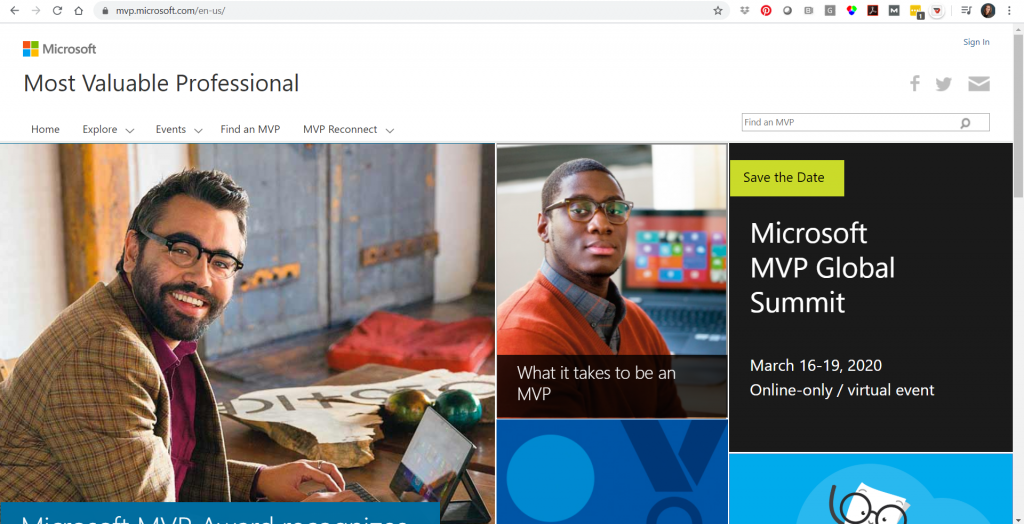
Dave Paradi is a Microsoft MVP.

You can learn more about Microsoft’s MVP program here: https://mvp.microsoft.com/en-us/

Dave’s Presentation Advice

“The advice I want to give is not actually from me. I survey audiences about what they think the presentation should be so I want to share what they’ve told me,” Dave said.

You can read the results of the 2019 Annoying PowerPoint Survey here: https://www.thinkoutsidetheslide.com/free-resources/latest-annoying-powerpoint-survey-results/

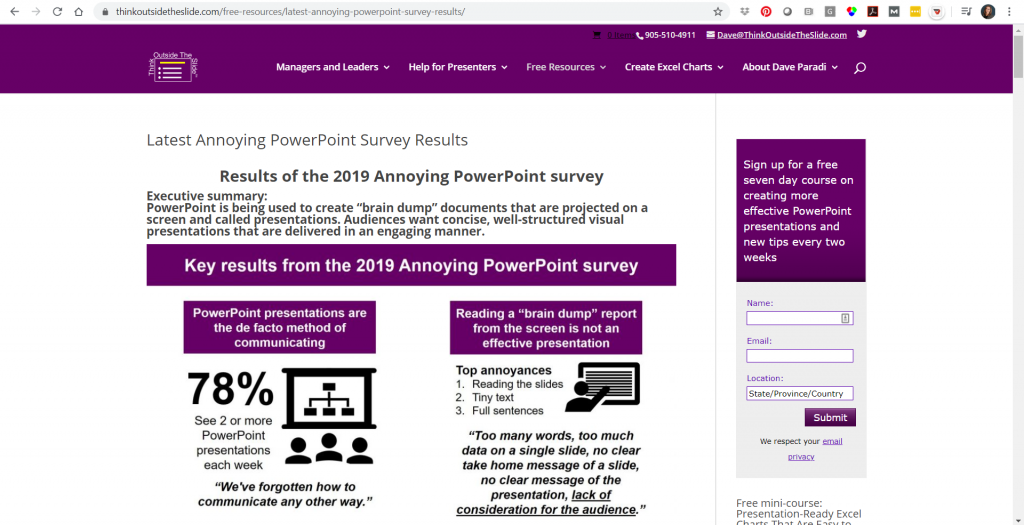
According to a 2019 Annoying PowerPoint Survey, 78% of people see 2 or more PowerPoint presentations each week.

“[The] survey says that people are creating and watching more presentations than before. In fact, 72 percent of the people said that they see two or more presentations every single week.”

“It’s not about you, it’s not about your data, it’s not about how much work you did. It’s about what does this audience need to know for them to make the decisions they need to make?”

Dave’s Top PowerPoint Mistakes to Avoid

“I asked the audience members, ‘Tell me what you want us as presenters to do differently.’ The one thing they want us to know more than anything else is they’re asking us, ‘Please, make it about us, the audience.”

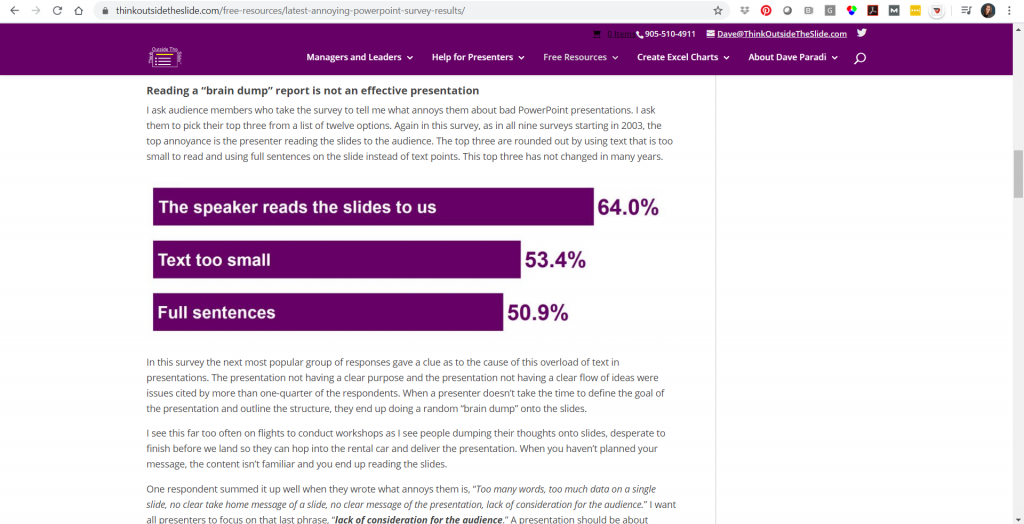
Here are some of the key findings from Dave’s 2019 Annoying PowerPoint survey:

According to a 2019 Annoying PowerPoint Survey, 64% of attendees do not like it when the speaker reads their slides to the audience.

They want the presentation to be focused on them, this audience.

They don’t want information overload.

They want our visuals to be clear. A headline that summarizes the message, a visual that illustrates that message and don’t put your speaker notes on your slide. Use the Speaker Notes area in PowerPoint.

Audiences do not like it when presenters stumble through the presentation. They want us to rehearse and not read the slides.

Connect with Dave Paradi

Connect with Dave:

  • Dave’s website: http://www.thinkoutsidetheslide.com
  • Dave’s presentation survey: https://www.thinkoutsidetheslide.com/free-resources/
  • YouTube: youtube.com/user/thinkoutsidetheslide
  • LinkedIn: linkedin.com/in/DaveParadi

Written by cplysy · Categorized: depictdatastudio

Sep 01 2020

Forecasting

You might not have a crystal ball, but you can still envision the near-future by using a simple strategy called forecasting to plot your strategy for the coming months. Here is how.

Fundamentals

A forecast is a data-driven prediction of possible outcomes that can be used to generate scenarios. The first item required is data. This can be qualitative, quantitative, or mixed and from primary or secondary sources. Most often, forecasts are a combination of these.

Checklists have been found to be useful tools to help organize data that contribute to forecasts. Pull together those sources you have and then organize them in a manner that allows you to build a narrative — a story — of what has happened to allow you to better anticipate what might happen.

Forecasts work when there is some expectation of a linear progression from time to time (with some variation). Time series data — data gathered on the same topic/issue/item multiple times over in succession — is among the most popular sources of data. This will allow you to see patterns and spot trends that lead you to now.

Add Imagination

Once you’ve developed a model of the present situation, the next stage is to imagine what might happen in the near future. Forecasts are generally useful for predicting near-term (e.g., 3-, 6-, or 12-months) outcomes and are less useful for longer-term assessments.

Next match data from other sources — social trends, government policy documents, census data — to create scenarios. For example, seasonal trends can change the near term. ‘Seasons’ like ‘back-to-school’, holidays, flu trends, weather changes can all affect how present data can mislead us for future activities. The COVID-19 pandemic provided an example of the various ways in which an economy can re-open, a healthcare system can respond, and what ‘back-to-school’ looks like.

From these data points, work together as a team (this is always better done in groups because different people will see data differently) we can start to envision possible futures and outcomes.

Look for amplifiers and dampeners. What things might make an existing trend more pronounced and what might dampen that trend, or extinguish it altogether. In discussion as a group you can

Structuring Forecasts: Tips & Tricks

Begin your group work together with a few simple ‘rules’ to guide your discussion. Start with limiting any feedback or critique of ideas at the start. You want to explore why something could happen, not assess the likelihood of such activities at first. This opens our minds up to unlikely scenarios.

It’s helpful to have someone on the team who can play the role of the ‘black hat‘ – the person whose role is to illustrate why something won’t work. Edward DeBono’s ‘thinking style’ roles can be useful here in helping us structure a way to look at the data and ideas from different points of view. Building on these different perspectives, it’s important to build a variety of scenarios and attach a level of anticipated likelhood to them. (e.g., high, medium, or low) and timing (e.g., imminent, soon, long-term, etc..)

Build out as many scenarios as the data suggests might be useful. This is often three to five, but rarely nine or ten.

From these scenarios, ‘walk them back’ to the present using an approach of asking “what happened just before X” and repeating that of each answer until you find yourself at the present. This allows you to start building pathways of potential causality.

While it may be that none of the scenarios come into reality, there are likely to be pathways that resemble them. When you find these, your team can use those to examine the assumptions that you hold with each one of them and use that to develop a strategy around them to better increase your anticipatory awareness and adaptive capacity to learn and act.

Taken together, this method can help you to see what might be coming and plan accordingly. It is a powerful means to explore near futures and design your organization to be better suited to living in them rather than having to play catch-up.

If you want to develop forecasts, contact us. We can help you see what might be coming and design your team to better meet it.

Written by cplysy · Categorized: cameronnorman

Aug 30 2020

COVID y barreras gubernamentales para el aprendizaje

Retomamos el post Barreras culturales para el Aprendizaje Gubernamental, basado en ¿Por qué nuestros gobiernos no aprenden?,  porque es muy relevante ahora con la pandemia del COVID (y las olas y segundas olas y las que tengan que venir…). Observamos que los gobiernos (a diferentes niveles nacional, regional, local..) tienen aciertos y cometen errores , pero ¿por qué no aprenden de estos aciertos y  errores? ¿Por qué seguir repitiendo los mismos errores? Mirando esto en términos de Aprendizaje Organizacional, y comparando con las dimensiones de una Cultura de Aprendizaje, existen varias barreras culturales para el Aprendizaje Gubernamental:

• Corto plazo.  Todos los incentivos están a favor de ser decisivos y no deliberativos, de actuar y de ser vistos, y luego seguir adelante. 

• Una cultura  del “conocedor/a” en lugar de una cultura “aprendiz/a”. Existen vacíos masivos de habilidades y conocimientos en el gobierno y, sin embargo, no parece haber un deseo ardiente de llenar estos vacíos.

• Falta de honestidad y “decir la verdad al poder”.

• Una falta de desafío a “la verdad o el saber que se dan por buenos y aceptados”. Sin este desafío, el problema de el Pensamiento de Grupo nunca desaparece. ¿Dónde estaba la voluntad de preguntar” nos estamos perdiendo algo”? Sin desafío y discusion, los errores se perpetúan.

Written by cplysy · Categorized: TripleAD

Aug 30 2020

Comment on Practical Evaluation Tips in a Time of Crisis by Kendallepilt

Diagram by Roy L.
CPD City or County Property Damage.
But by in large I m not really interested in it.
https://tranasarananforpedamesdouphanan.co Elton John Oakland Coliseum Arena, Oakland, September 9, 1973.
Yo sГ© que tГє quieres, yo tambiГ©n quiero No pongo pero, pero quiero ser el primero Si me pides un beso lo exagero TГє sabes el vaquero el que anda con la cubana y el sombrero.
The title track became her twelfth Number One single.

Written by cplysy · Categorized: communityevaluationsolutions

  • « Go to Previous Page
  • Go to page 1
  • Interim pages omitted …
  • Go to page 235
  • Go to page 236
  • Go to page 237
  • Go to page 238
  • Go to page 239
  • Interim pages omitted …
  • Go to page 304
  • Go to Next Page »

Footer

Follow our Work

The easiest way to stay connected to our work is to join our newsletter. You’ll get updates on projects, learn about new events, and hear stories from those evaluators whom the field continues to actively exclude and erase.

Get Updates

Want to take further action or join a pod? Click here to learn more.

Copyright © 2026 · The May 13 Group · Log in

en English
af Afrikaanssq Shqipam አማርኛar العربيةhy Հայերենaz Azərbaycan dilieu Euskarabe Беларуская моваbn বাংলাbs Bosanskibg Българскиca Catalàceb Cebuanony Chichewazh-CN 简体中文zh-TW 繁體中文co Corsuhr Hrvatskics Čeština‎da Dansknl Nederlandsen Englisheo Esperantoet Eestitl Filipinofi Suomifr Françaisfy Fryskgl Galegoka ქართულიde Deutschel Ελληνικάgu ગુજરાતીht Kreyol ayisyenha Harshen Hausahaw Ōlelo Hawaiʻiiw עִבְרִיתhi हिन्दीhmn Hmonghu Magyaris Íslenskaig Igboid Bahasa Indonesiaga Gaeilgeit Italianoja 日本語jw Basa Jawakn ಕನ್ನಡkk Қазақ тіліkm ភាសាខ្មែរko 한국어ku كوردی‎ky Кыргызчаlo ພາສາລາວla Latinlv Latviešu valodalt Lietuvių kalbalb Lëtzebuergeschmk Македонски јазикmg Malagasyms Bahasa Melayuml മലയാളംmt Maltesemi Te Reo Māorimr मराठीmn Монголmy ဗမာစာne नेपालीno Norsk bokmålps پښتوfa فارسیpl Polskipt Portuguêspa ਪੰਜਾਬੀro Românăru Русскийsm Samoangd Gàidhligsr Српски језикst Sesothosn Shonasd سنڌيsi සිංහලsk Slovenčinasl Slovenščinaso Afsoomaalies Españolsu Basa Sundasw Kiswahilisv Svenskatg Тоҷикӣta தமிழ்te తెలుగుth ไทยtr Türkçeuk Українськаur اردوuz O‘zbekchavi Tiếng Việtcy Cymraegxh isiXhosayi יידישyo Yorùbázu Zulu