• Skip to main content
  • Skip to footer
  • Home

The May 13 Group

the next day for evaluation

  • Get Involved
  • Our Work
  • About Us
You are here: Home / Archives for cplysy

cplysy

May 25 2023

Collective Impact Action Summit Conference 2023

Written by cplysy · Categorized: connectingevidence

May 25 2023

Your Report is a Website

It’s time to stop designing reports for that one person who one time printed and then, subsequently, read your report.

For the vast majority of people, your report is a website. It is read using a digital device, connected to the internet, and served from someone else’s computer (a.k.a. a server probably owned by Amazon).

So what does that mean? Well, it’s time to design your report like the website it truly is, taking advantage of better/more useful technology.
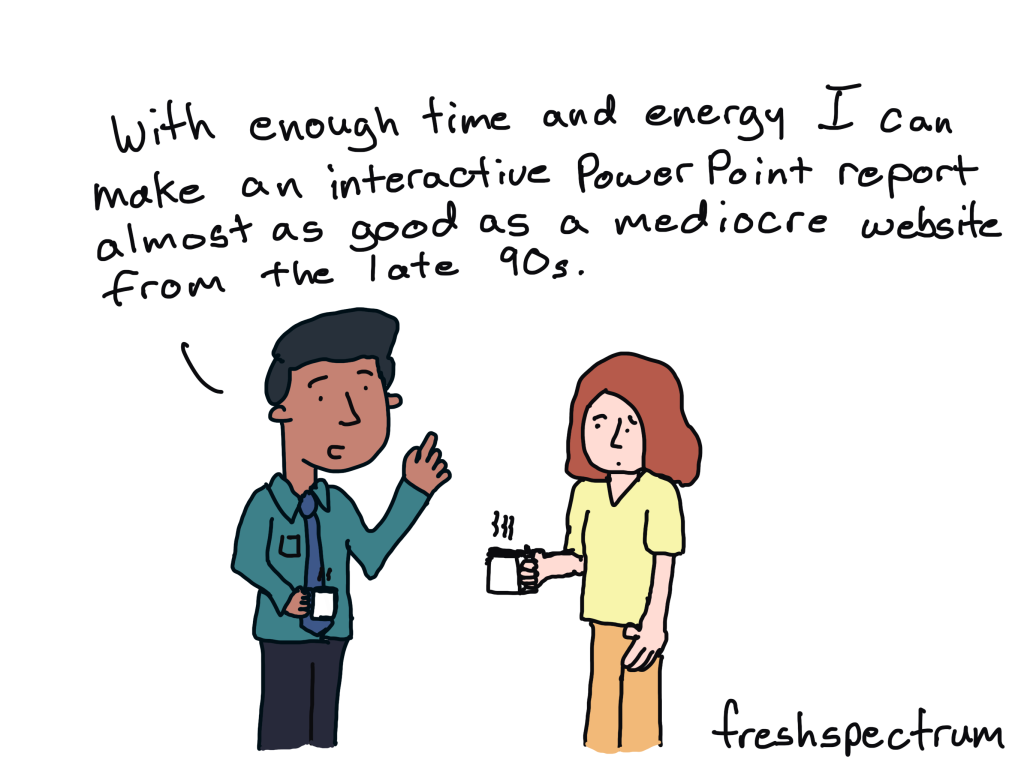
“Did you know that you can create interactive reports in PowerPoint?!? Or PDF! Or Canva! Or Google Docs! Or Tableau! Or Word!”

With linking and basic menus you can make almost anything work like a website.

You can also write a novel with pencil on post it notes. The fact that you CAN do something, doesn’t mean you should.

Creating an effective interactive report using non-web design tools is going to result in a mediocre report design that will likely take much longer than just using a tool like WordPress.

Why WordPress?

  • WordPress powers over half of the internet. It’s open source and has continued to evolve over decades.
  • Using WordPress doesn’t require huge software license investments.
  • There are tons of WordPress developers in the world, so if something goes wrong, you don’t have to find that one expert to fix stuff. Or pay some consultant at Tableau hundreds of dollars an hour to fix what broke.
  • You can do SOOOOO much with a modern WordPress site, even without any plugins. Far more than any of our standard reporting tools.
  • WordPress can easily be built for accessibility.
  • Since WordPress is such a popular platform it has had a profound influence on shaping the evolution of modern web design.
  • You can build both privately and publicly, on in-house servers or through a myriad of cloud based hosting services with the proper encryption.
  • WordPress sites are way better for SEO than any PDF, PowerPoint, or data dashboard tool could hope to match.
  • WordPress sites work really well with social media, email marketing, video, and other modern dissemination channels.

Don’t believe me, I’ll prove it!

This is my new mission (alongside teaching data design).

I’m going to build cutting edge interactive reports and data dashboards using WordPress.

Right now I’m developing out a concept gallery that I can use to show off certain concepts I have only shared with specific clients. Stay tuned.
Written by cplysy · Categorized: freshspectrum

May 24 2023

Letting Go of What No Longer Serves You in Evaluation

When we try to template and checklist our way out of complexity, we lose intentionality and creativity. Wouldn’t you rather build meaningful and sustainable evaluation strategies that ignite your passion and highlight your uniqueness? I know I would. And together we can. This post includes five questions to help you start to reimagine evaluation through intentional inquiry, meaningful measurement, and sustainable strategies.

The post Letting Go of What No Longer Serves You in Evaluation first appeared on Elizabeth Grim Consulting, LLC.

The post Letting Go of What No Longer Serves You in Evaluation appeared first on Elizabeth Grim Consulting, LLC.

Written by cplysy · Categorized: elizabethgrim

May 15 2023

Models of Design Thinking

Design Thinking Mode

Design Thinking is the process we use to conceive of our products and guide the process of design. Design is . This is the design journey. The benefits to engaging with design thinking go beyond the outcomes and include a variety of outputs.

Design thinking is a human-centered approach to innovation that draws from the designer’s toolkit to integrate the needs of people, the possibilities of technology, and the requirements for business success. There are several popular models of design thinking that are widely used in many industries. Here are some of the most common ones:

  1. Stanford d.school’s 5-Stage Model: Stanford d.school is known for its five-stage model of design thinking. The stages are Empathize, Define, Ideate, Prototype, and Test. Each stage is intended to be flexible and iterative, allowing designers to move back and forth between stages as needed.
  2. IDEO’s 3 “I” Model: IDEO, a global design company that popularized design thinking, uses a simplified three-stage model: Inspiration, Ideation, and Implementation. Inspiration is the problem or opportunity that motivates the search for solutions; Ideation involves generating, developing, and testing ideas; and Implementation brings the project to life.
  3. Double Diamond Model by the British Design Council: This model breaks down the design process into four distinct phases – Discover, Define, Develop, and Deliver. The model’s visual representation shows two diamonds, where each diamond represents a problem-solving stage – problem definition and solution generation.
  4. IBM’s Loop Model: IBM’s design thinking model uses a loop system with three main stages: Observe, Reflect, and Make. The stages repeat in a continuous loop, representing the iterative nature of design thinking. IBM also includes principles like focusing on user outcomes, restlessly reinventing, and embracing diversity.
  5. Google Ventures’ Design Sprint: Google Ventures (GV) developed a five-day process for answering critical business questions through design, prototyping, and testing ideas with customers. The five stages are Understand, Sketch, Decide, Prototype, and Validate. This model is often used for fast prototyping and user testing.
  6. The 4D Model by Nigel Cross: Nigel Cross, a notable scholar in design studies, proposed a simplified four-stage model: Discover, Define, Develop, and Deliver. This model is often employed in product and industrial design.
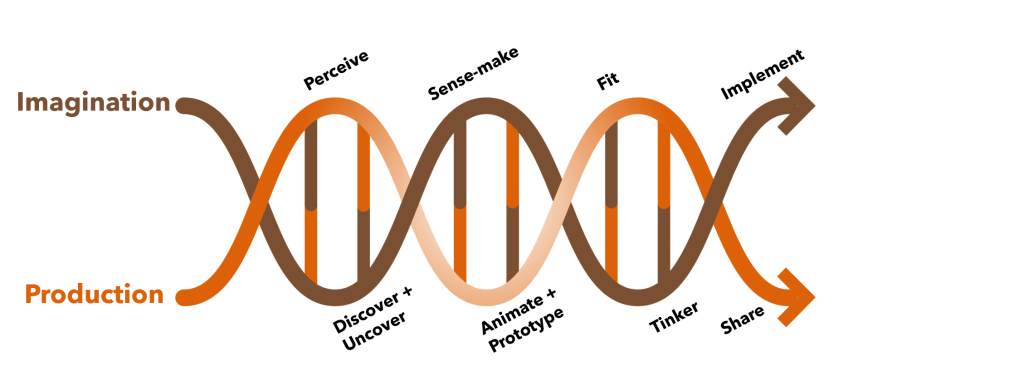
  7. The Design Helix by Cameron Norman and Cense. This is our in-house model designed for living systems and draws on many of the other models. It guides our work and reflects an evolutionary, naturalized, dynamic design process.

Each model has its strengths, and the best one to use can depend on the context and specific needs of the project. It’s also worth noting that while these models provide structure to the design thinking process, design thinking is often more fluid and non-linear than these models suggest.

The Design Helix model assumes that the process gets repeated over time, distinguishing it from other models. It embeds ongoing learning into the model until the purpose or need for the design is completed.

Participation, Co-Creation and Public Engagement

Whatever model you choose, consider that the process of design is often best achieved when it is done with high involvement of the perspective of the intended audience or user. Models like participatory design and co-design are ways to engage those who we are designing things for and are affected by what we create in the design process. This is about designing with, not just for, people.

Below are how the models use collaboration and co-creation:

Collaboration, participation and co-design are integral to most design thinking models but might not always be explicitly outlined. Here’s how collaboration and co-design are represented in each model:

  1. Stanford d.school’s 5-Stage Model: Collaboration is inherent in all stages, especially in the Empathize stage, where designers work closely with users to understand their needs and experiences. Also, the Ideate stage encourages brainstorming with a diverse group of people to generate a wide range of ideas.
  2. IDEO’s 3 “I” Model: Collaboration is embedded in all stages. Designers collaborate with stakeholders and users during the Inspiration stage to gather insights. In the Ideation stage, diverse teams work together to generate and refine ideas. The Implementation stage often involves collaboration between designers, users, and other stakeholders to bring the solution to life.
  3. Double Diamond Model by the British Design Council: Collaboration is crucial in the Discover phase, where designers work with users to understand their needs and experiences. The Develop phase is also highly collaborative, as designers work with each other and stakeholders to refine and improve ideas.
  4. IBM’s Loop Model: The Observe stage involves close collaboration with users to understand their needs. The Reflect stage encourages diverse teams to come together to understand what they’ve observed. The Make stage often involves co-design with users to ensure the solution meets their needs.
  5. Google Ventures’ Design Sprint: The Understand and Sketch stages involve collaboration between the design team and other stakeholders to define the problem and generate potential solutions. The Decide stage involves collaboration to choose the best ideas, and the Validate stage involves testing the solution with users.
  6. The 4D Model by N. Cross: Similar to the others, collaboration is inherent in all stages, particularly in the Discover and Develop phases, where designers work closely with users and other stakeholders.
  7. The Design Helix Model recognizes the benefit of high engagement but does not argue for any specific place for engagement. It recognizes that participation and involvement in the design process is a benefit and often critical to a design, yet it may be difficult or impossible to achieve as desired. Designers must work to determine the strategic and ethical considerations involved in each design process.

In all these models, co-design typically happens during the ideation and prototype stages. Co-design is a process where designers and users (or other stakeholders) work together to create a solution that meets the users’ needs. The idea is that involving stakeholders and prospective ‘users’ in the design process will make the final product more user-friendly and effective.

Design Thinking is a powerful process to channel creativity and facilitate innovation. If you want to implement it in your organization, let’s have a coffee and chat.

The post Models of Design Thinking appeared first on Cense Ltd. .

Written by cplysy · Categorized: cameronnorman

May 10 2023

Engaging in Beautiful Work

#image_title

If you’re stuck, looking to energize what you do, or reclaim the purpose of your organization or yourself, look to beauty to help you out.

Organizational aesthetics is a domain of practice that fuses workplace design, organizational psychology, and strategy. The focus is on beautiful work and, by extension, the health, well-being, and performance of those doing the work.

Beauty is something self-defined. It has aesthetic qualities to it, but those are not universal. If you find work beautiful, it is. It often includes visual aesthetics but is also a matter of taste. That’s the remarkable thing about beauty in the workplace: it’s what we make it.

What is Beautiful Work?

An organization that engages in beautiful work is one that values and prioritizes the following qualities:

  1. Purpose: An organization that engages in beautiful work has a clear sense of purpose and mission that is aligned with its values and goals. The organization is committed to making a positive impact on the world and is dedicated to creating work that is meaningful and fulfilling.
  2. Creativity: An organization that engages in beautiful work encourages creativity and innovation. It values new ideas and approaches and is willing to take risks to achieve its goals.
  3. Collaboration: An organization that engages in beautiful work promotes collaboration and teamwork. It values diversity and inclusivity and encourages individuals to bring their unique perspectives and experiences to the work and workplace.
  4. Excellence: An organization that engages in beautiful work strives for excellence in all that it does. It is committed to producing work that is of the highest quality and is always looking for ways to improve and innovate.
  5. Authenticity: An organization that engages in beautiful work is authentic and transparent. It values honesty and integrity and is committed to building trust with its stakeholders.
  6. Empathy: An organization that engages in beautiful work is empathetic and compassionate. It values the well-being and dignity of all individuals and is committed to creating a supportive and inclusive workplace culture.
  7. Sustainability: An organization that engages in beautiful work is committed to sustainability and responsible business practices. It values the environment and is committed to positively impacting the world and holds a clear sense of purpose and ethics.

Overall, an organization that engages in beautiful work values purpose, creativity, collaboration, excellence, authenticity, empathy, and sustainability. It creates a workplace culture that is supportive, inclusive, and committed to positively impacting the world.

Benefits

Engaging in beautiful work can have numerous organizational benefits, including:

  1. Increased Employee Engagement: Beautiful work can inspire and motivate employees, increasing job satisfaction, commitment, and productivity. When employees feel that their work is meaningful and fulfilling, they are likelier to be engaged and invested in it.
  2. Improved Brand Reputation: Organizations that engage in beautiful work are often viewed as ethical, responsible, and socially conscious. This can improve their brand reputation and help attract and retain customers who value these qualities.
  3. Increased Innovation: Beautiful work often involves creativity, risk-taking, and innovation. Organizations that engage in beautiful work are more likely to develop new ideas and approaches, leading to increased innovation and competitive advantage.
  4. Improved Financial Performance: Organizations that engage in beautiful work may experience improved financial performance due to increased employee engagement, customer loyalty, and innovation. Beautiful work can also help organizations attract and retain top talent, reducing turnover costs and improving productivity.
  5. Enhanced Workplace Culture: Organizations that engage in beautiful work often create a supportive and inclusive workplace culture that values diversity, authenticity, and empathy. This can improve employee morale, reduce conflicts, and create a positive work environment.
  6. Social Impact: Beautiful work often involves positively impacting the world. Organizations that engage in beautiful work can contribute to the greater good, creating social impact and benefiting the wider community.

Overall, engaging in beautiful work can lead to a range of organizational benefits, including increased employee engagement, improved brand reputation, increased innovation, improved financial performance, enhanced workplace culture, and social impact. By valuing purpose, creativity, collaboration, authenticity, empathy, and sustainability, organizations can create a culture of beautiful work that benefits both employees and society as a whole.

Key Resources:

Organizational Aesthetics (Journal)

Petrovski, D. Organizational Aesthetics and Creative Outputs. Acad Management Proc 2020, 14531 (2020).

Norman, C. D. A Beautiful Journey Through The Familiar Unfamiliar | Organizational Aesthetics. https://oa.journals.publicknowledgeproject.org/index.php/oa/article/view/249.

If you want to create a beautiful workplace and workforce, let’s grab a (virtual) coffee and talk about how we can help you do it.

The post Engaging in Beautiful Work appeared first on Cense Ltd. .

Written by cplysy · Categorized: cameronnorman

  • « Go to Previous Page
  • Go to page 1
  • Interim pages omitted …
  • Go to page 87
  • Go to page 88
  • Go to page 89
  • Go to page 90
  • Go to page 91
  • Interim pages omitted …
  • Go to page 304
  • Go to Next Page »

Footer

Follow our Work

The easiest way to stay connected to our work is to join our newsletter. You’ll get updates on projects, learn about new events, and hear stories from those evaluators whom the field continues to actively exclude and erase.

Get Updates

Want to take further action or join a pod? Click here to learn more.

Copyright © 2026 · The May 13 Group · Log in

en English
af Afrikaanssq Shqipam አማርኛar العربيةhy Հայերենaz Azərbaycan dilieu Euskarabe Беларуская моваbn বাংলাbs Bosanskibg Българскиca Catalàceb Cebuanony Chichewazh-CN 简体中文zh-TW 繁體中文co Corsuhr Hrvatskics Čeština‎da Dansknl Nederlandsen Englisheo Esperantoet Eestitl Filipinofi Suomifr Françaisfy Fryskgl Galegoka ქართულიde Deutschel Ελληνικάgu ગુજરાતીht Kreyol ayisyenha Harshen Hausahaw Ōlelo Hawaiʻiiw עִבְרִיתhi हिन्दीhmn Hmonghu Magyaris Íslenskaig Igboid Bahasa Indonesiaga Gaeilgeit Italianoja 日本語jw Basa Jawakn ಕನ್ನಡkk Қазақ тіліkm ភាសាខ្មែរko 한국어ku كوردی‎ky Кыргызчаlo ພາສາລາວla Latinlv Latviešu valodalt Lietuvių kalbalb Lëtzebuergeschmk Македонски јазикmg Malagasyms Bahasa Melayuml മലയാളംmt Maltesemi Te Reo Māorimr मराठीmn Монголmy ဗမာစာne नेपालीno Norsk bokmålps پښتوfa فارسیpl Polskipt Portuguêspa ਪੰਜਾਬੀro Românăru Русскийsm Samoangd Gàidhligsr Српски језикst Sesothosn Shonasd سنڌيsi සිංහලsk Slovenčinasl Slovenščinaso Afsoomaalies Españolsu Basa Sundasw Kiswahilisv Svenskatg Тоҷикӣta தமிழ்te తెలుగుth ไทยtr Türkçeuk Українськаur اردوuz O‘zbekchavi Tiếng Việtcy Cymraegxh isiXhosayi יידישyo Yorùbázu Zulu