
• Skip to main content
  • Skip to footer
  • Home

The May 13 Group

the next day for evaluation

  • Get Involved
  • Our Work
  • About Us
You are here: Home / Archives for allblogs / cameronnorman

cameronnorman

May 13 2021

Surfacing Your Organization’s Identity

Have you ever asked questions about your organization’s identity before?

Who are you?

What do you stand for?

What kind of things motivate you to action and direct your attention?

The answers to all of these questions shape what we do in our work. Organizations that have a clear sense of what they do, why they do it, and who they do it for tend to succeed. The reason? These organizations have greater alignment between purpose and strategy. In short: they have an identity.

Our identity — who we think we are — is a powerful guide for our behaviour. So how do we answer this question in our work?

Bulls Eye

A simple starting point for finding what matters and moves you is to use a Bull’s Eye diagram. A Bull’s Eye Diagram illustrates priorities through three layers of importance. All that is needed is a diagram of the ‘target’, sticky notes, and a space to organize the notes. The example below is done using the Mural tool and a pre-set template for ease of use..
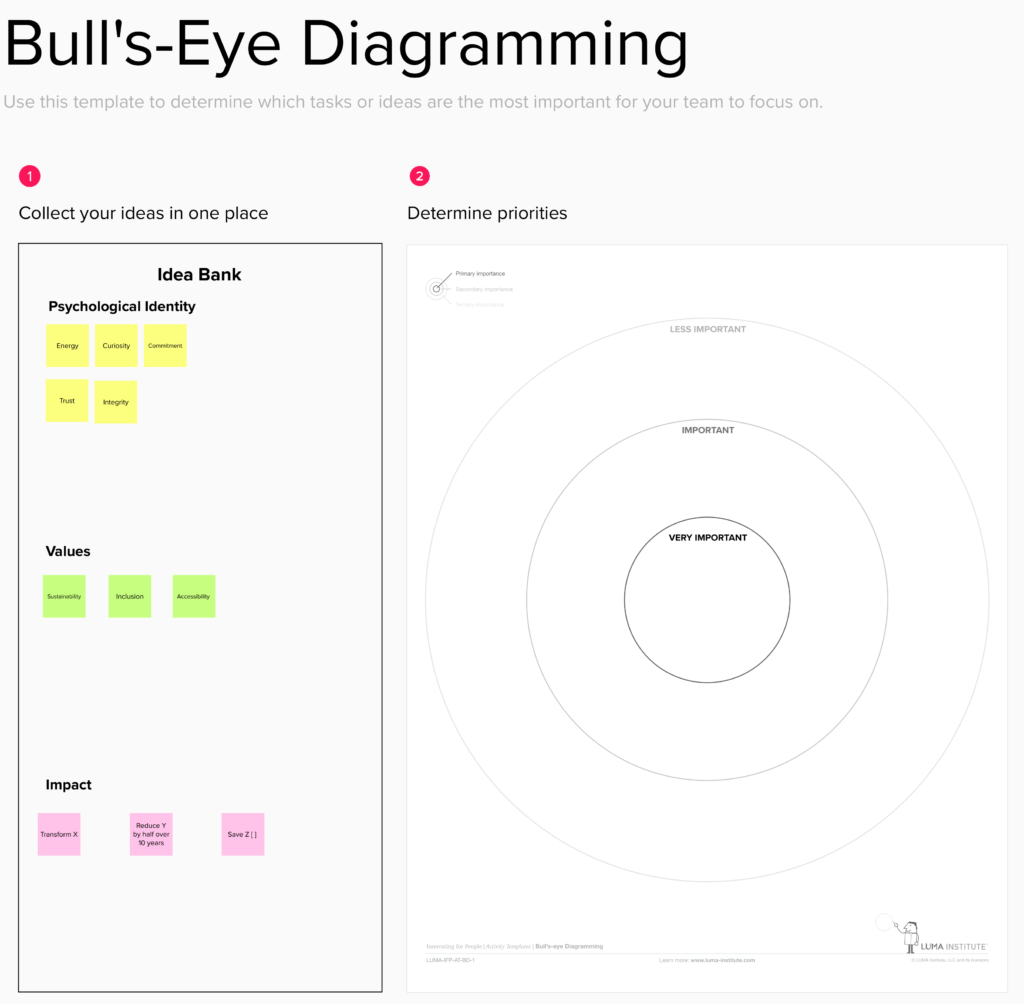
A Bull’s Eye diagram can be used with individuals or groups. We often use this for a project when a client is struggling to identify what is both important and necessary for their work.

We also recommend that you use the Bull’s Eye diagram at the start of an engagement.

Once the items from the sticky notes are placed, it’s easier to see themes in the ‘data.’ This approach allows organizations to see what their members think are most important. It is the aggregate of these ideas that shape the culture of an organization and when you know what they are it’s easier to design with them.

With this knowledge in hand your organization can better design a purposeful strategy and make your identity aspirations a reality in practice.

We help organizations to design their culture for success. If you want help using this or other tools like it, contact us.

The post Surfacing Your Organization’s Identity appeared first on Cense.

Written by cplysy · Categorized: cameronnorman

Apr 27 2021

Bundles and Stacks

Two powerful approaches to creating healthy habits are to bundle or stack behaviours together, by design. If we can learn to connect what we do in small ways to other things we can make big changes more easily.

For innovators seeking and making change, these two approaches can help break down a big goal into small, manageable actions.

Bundles

A bundle is a way of tying together two behaviours that don’t normally go together for positive benefit. It takes something you dislike and pairing it with something you like. For example, imagine doing uncomfortable rehab exercises while watching your favourite TV show. Maybe listen to your favourite music while doing your taxes.

There are many activities in our work that are tedious, unpleasant, or undesirable to do. By bundling those with something you do enjoy it can make those unpleasant tasks easier to do.

Consider the barriers to your service that might be unavoidable: how can you bundle those with something positive? How can you make the worst, but necessary, aspects of what you offer, better?

By considering a bundle, we can design for positive outcomes in spite of issues we cannot design around. This is particularly relevant for healthcare (e.g., dental visits, medication taking) or activities requiring paperwork or queuing.

Stacks

A stack is pairing small activities together to produce a larger effect. For example, consider listening to podcasts or e-books while running. This allows you to learn and exercise at the same time.

Another example is drinking a glass of water every time you check your email. This one accomplishes the goal of keeping you hydrated while ensuring you don’t check your email too often (preventing frequent trips to the bathroom).

We can design our ‘stacks’. Practically, this means creating an inventory of jobs to be done and pairing them together when possible. By simply knowing what has to be done we can create stacks that get tasks done together.

Design Considerations

The key to both activities is to break down what has to be done and mapping it out. This can be done using simple paper, sticky notes, a whiteboard, or tools like Miro or Mural. This activity has the added benefit of articulating what has to be done. It is a useful awareness-building exercise to reveal all the tasks and subtasks involved in our work.

Once completed, consider pairing tasks and activities together. What pairs might work? What systems can we put in place to help make things easier?

After pairing, the next step is to prototype and evaluate Try things out. If you wish to drink water with email, consider setting a glass or your favourite mug beside your computer. Create the prompts to remind you to try things out. These are new behaviours so it may take some time to get it right. If, after many attempts, the behaviour hasn’t changed (the bundle didn’t take, the stack didn’t work), try a different one.

The key is to keep trying. Whether this is for individuals or organizations, the key is to keep trying and learning. The more attempts you make, the more you will learn and the more likely you will succeed.

This behavioural strategy is both simple and easy to try and test even if changes are often difficult. If you need help in making these changes and designing for them, contact us – this is what we do.

The post Bundles and Stacks appeared first on Cense.

Written by cplysy · Categorized: cameronnorman

Apr 13 2021

The Art of Gathering

Innovation work from identifying problems in need of solutions, generating ideas, creating things, and simply providing the inspiration and mutual support for doing the work often requires gathering.

Whether it is face-to-face, online, or some hybrid option the same general rules apply for what makes a good gathering when it comes to the up-front work.

Priya Parker has made the art of gathering a focus of her life’s mission and work and has pulled together some brilliant resources for those of us who are looking to bring people together.

These opening questions are the starting place by asking some fundamental questions about the purpose of gathering (something too often forgotten about).

Here are Priya’s recommended questions to help guide you in gathering:

  • Who is this for? What is it that this person loves to do? 
  • What are the various gifts or talents or skills of the people invited? 
  • How do you actually want to spend the time? 
  • How will you create a “moment of focus”? 
  • If this is a digital gathering, what are simple ways you can have guests bring something or wear something that connects them to the purpose, the person of honor and each other?  

Among the most valuable assets engaged in any innovation effort is time and attention and by asking these simple questions we can best use and respect both.

Written by cplysy · Categorized: cameronnorman

Apr 01 2021

Perspective Taking Circles

The power of perspective is one of the things that differentiates high output and impact innovators from others. It’s easy to get lucky or have good timing, but it’s another to create value when those things don’t happen.

One of the ways we do this is by engaging in some perspective-taking. This simple exercise and question set can help build some of the ‘thought muscles’ that can help encourage us to see, imagine, and engage things differently for creative benefit.

The Exercise

This works best when physically in the same space and can work online as well. What you need is to create a space where people can re-position themselves against a central object that can be almost anything except a ball (because it looks the same from every angle). Place your participants around the object with a comfortable space to sit or stand.

You can do this virtually using a dynamic space like Kumospace or some other virtual reality-like environment. It can also work using a board like Miro or Mural with some designed object in the middle, but it is more awkward.

The idea is that everyone has a chance to literally see things from a different point of view.

This can be done as an observation exercise but is more enhanced when it is combined with drawing. Asking people to draw what they see — no matter what kind of skills or abilities participants have with sketching — is a great means to engage people in thinking more deeply about their perspective.

Once individuals have had time to observe and reflect on what they see, the next step is to have everyone share their perspective. This is where drawings are useful as people can speak to what they drew as drawing focuses us on certain elements and provides a means to account for those perspectives. It also allows others to point to the drawing and make specific, not general comments.

It’s that specificity that is key to illuminating and articulating differences of perspective.

Uses

The role of this method is to reveal how where we sit in a system — even a small one of people interconnected around a shared experience of an object — can have remarkably different perceptions of the same thing in the same space.

It begins to build cultural practices around creating space for exploring and sharing perspectives within an organization and can serve as a base for better organizational design and learning.

It’s simple, engaging, and revealing in its method.

Written by cplysy · Categorized: cameronnorman

Mar 25 2021

Designing for Awful

One of the most profound, fun, and engaging techniques for creating an attractive service or product design is oddly focused on the exact opposite: Designing for Awful.

How to use this

This strategy is as simple as it is effective. When workshopping ideas allot some time to have participants develop ideas and designs for the worst possible version of the thing they are designing.

This is a flip of a traditional ideation session where people try to develop suggestions for what to focus on, whom, and what the best use of resources might be. In Designing for Awful, we do the opposite. It is used usually in tandem with ideation sessions that are focused on surfacing ideas in general.

This can be used to frame a service, product or describe the experience of doing something like a survey or participating in an event. It’s a simple, fun, and sometimes counter-intuitive way to surface assumptions, biases, and qualities in what we want, need and don’t want in our design.

Like any ideation-focused exercise, it must be managed appropriately. Individuals need to feel safe in surfacing ideas, free to discuss them, and preferably, offer an opportunity to share at least some of them anonymously. People generally have a lot of fun with this simple exercise.

Benefits

The benefits of this are many.

Firstly, it focuses on the things we tend to avoid — unpleasant feelings, experiences, or sensation — and thus, might be missed in consideration of our design.

It also overcomes an optimism bias. Design is largely a positive-oriented practice where we look to solve problems, not make them. Designing for Awful helps us to move around this bias by looking at what is not addressed.

This approach is also excellent for helping surface values in practice and in specific terms. To illustrate, it’s one thing to speak in a positive or affirmative tone such as a statement like “we value inclusivity.” Designing for Awful could lead us to be specific “Our service is inaccessible to someone with a mobility disability” or “it is sexist” or “our product can only be used by people who are right-handed.” By surfacing what makes something not work we are better able to see what will.

This approach is also excellent in helping, paradoxically, surface what we want by framing things in terms we don’t want. How often have you met someone who first tells you what they don’t want in something before they get to describing what they want?

This allows people to have a little fun and we find that some people are more bold and assertive with their creativity in the negative, than the positive and this technique lets that come out.

Lastly, the exercise can be a useful way to surface who needs to be at the table moving forward. We find that the need for having the voices of certain individuals, groups, roles, or departments in the discussion is better clarified when we consider how bad things would be without them.

Try this out at your next design session or team meeting as part of a check-in and you might find some laughs and some deep insight along with it.

If you want to inspire new thinking and better design in your organization for engagement and impact, reach out and contact us. This is what we do.

Written by cplysy · Categorized: cameronnorman

  • « Go to Previous Page
  • Go to page 1
  • Interim pages omitted …
  • Go to page 11
  • Go to page 12
  • Go to page 13
  • Go to page 14
  • Go to page 15
  • Interim pages omitted …
  • Go to page 21
  • Go to Next Page »

Footer

Follow our Work

The easiest way to stay connected to our work is to join our newsletter. You’ll get updates on projects, learn about new events, and hear stories from those evaluators whom the field continues to actively exclude and erase.

Get Updates

Want to take further action or join a pod? Click here to learn more.

Copyright © 2026 · The May 13 Group · Log in

en English
af Afrikaanssq Shqipam አማርኛar العربيةhy Հայերենaz Azərbaycan dilieu Euskarabe Беларуская моваbn বাংলাbs Bosanskibg Българскиca Catalàceb Cebuanony Chichewazh-CN 简体中文zh-TW 繁體中文co Corsuhr Hrvatskics Čeština‎da Dansknl Nederlandsen Englisheo Esperantoet Eestitl Filipinofi Suomifr Françaisfy Fryskgl Galegoka ქართულიde Deutschel Ελληνικάgu ગુજરાતીht Kreyol ayisyenha Harshen Hausahaw Ōlelo Hawaiʻiiw עִבְרִיתhi हिन्दीhmn Hmonghu Magyaris Íslenskaig Igboid Bahasa Indonesiaga Gaeilgeit Italianoja 日本語jw Basa Jawakn ಕನ್ನಡkk Қазақ тіліkm ភាសាខ្មែរko 한국어ku كوردی‎ky Кыргызчаlo ພາສາລາວla Latinlv Latviešu valodalt Lietuvių kalbalb Lëtzebuergeschmk Македонски јазикmg Malagasyms Bahasa Melayuml മലയാളംmt Maltesemi Te Reo Māorimr मराठीmn Монголmy ဗမာစာne नेपालीno Norsk bokmålps پښتوfa فارسیpl Polskipt Portuguêspa ਪੰਜਾਬੀro Românăru Русскийsm Samoangd Gàidhligsr Српски језикst Sesothosn Shonasd سنڌيsi සිංහලsk Slovenčinasl Slovenščinaso Afsoomaalies Españolsu Basa Sundasw Kiswahilisv Svenskatg Тоҷикӣta தமிழ்te తెలుగుth ไทยtr Türkçeuk Українськаur اردوuz O‘zbekchavi Tiếng Việtcy Cymraegxh isiXhosayi יידישyo Yorùbázu Zulu