• Skip to main content
  • Skip to footer
  • Home

The May 13 Group

the next day for evaluation

  • Get Involved
  • Our Work
  • About Us
You are here: Home / Archives for allblogs / cameronnorman

cameronnorman

Jul 16 2021

Innovation Case Studies

If you’ve ever taught a course on an applied subject matter you’ve probably considered introducing case studies.

Case studies are systematic accounts of an activity and aim to provide evidence to illustrate or support an example of something. This might be to show a problem-solving approach, an introduction of a new technology, or demonstrate a particular implementation success or failure.

The case study approach is a core of what Harvard Business School uses and has been replicated in the Harvard Business Review and many other business journals. Harvard even has a structured method that has been adopted by business schools (and other faculties) worldwide.

Case studies are meant to provide us with guides based on practice to help us think through things, follow, or avoid. While this might be true in the abstract, our experience is that they are far better at stimulating discussion in class settings, but lousy at providing innovators with real guidance on what to do.

Partly, this has to do with the stories that are told and partly it’s because of the questions that are asked of the case examples themselves.

A New Case Study Approach

There is another way to approach case studies for innovation.

Innovation is always context-dependent. Complex contexts are those where there is a lot going on at multiple scales, intensities, and connect many different entities like people, organizations and networks. Increasingly, this is what describes the context in which innovators work.

This represents many if not most markets, public policy landscapes, schools, and care institutions today. If you’re involving humans, you’re involving complexity. This requires an approach to understanding and making sense of what happens that accounts for complexity. Consider the Cynefin Framework as a guide in assessment of what kind of situation you’re in.

So it makes sense that case studies — which are designed to take lessons from one context to apply broadly — reflect lessons tied to what’s special about a specific context and not try to reflect too many others.

By understanding what’s special we can better understand what’s general by allowing us to recognize the patterns that make something different and common not one or the other. It sounds simple, but it’s actually something that is lost in the current case study method.

We offer some questions to consider when you look at any case study — including the ones that you write for yourself – to better get value from an case to apply to your own situation. These questions can help you to get to a sense of where an innovation sits within a system and what barriers and facilitators were in place to shape the context, the actors, and the situations that define a case (and are often neglected).

Questions for Cases

For the sake of brevity the term innovator is used to reflect an individual, group, or organization who undertake the design, creation, implementation and ownership of the innovation — which can be a product, service, or policy.

  1. What kind of relationships or ecosystem is the organization/innovator a part of? (Innovation doesn’t exist in a vaccuum — it’s critical to understand what influences were available to shape the culture of innovation creation)
  2. How were these relationships leveraged, connected, or served in the development or execution of the innovation? (Innovations are a culmination of relationships in their creation, growth, and realization into a market to different extents, but never without them so they ought not be ignored).
  3. How was the innovation implemented? (This helps us understand the viable actions that were taken and how much was dependent on other things, what role happenstance (luck) played, and what degree the plan met reality)
  4. How much risk did the innovator assume? (This allows us to gauge how much motivation, fear, and pressure the innovator was under)
  5. What was going on in the immediate environment during the development and implementation of the innovation? (This reflects situational, policy, climate, and local contexts)
  6. What learning processes were put in place? (This speaks to the matter of sustainability and determines if this is likely to be a one-off or something that might be sustained)
  7. What outputs, outcomes, and impact was achieved? (Did the innovators capture what was produced and what effect it had on the world around the innovation, not just whether it was sold or bought)
  8. What evolved? (Scale isn’t about just ‘more’, but whether it evolves to meet the needs)
  9. What is the fit and the purpose? (Innovation is all about fit for purpose and these need to be articulated to assess whether or where it fits and what the purpose(s) are)
  10. Is there a ratchet? (A ratchet is something that gains leverage the more it’s used. Is there something that allows the lessons of the innovation development or the innovation itself to take something — the organization, people, or product/service/policy further with leverage?)

Try asking these of any case study and you might find what’s missing and what you can ask of your own work to learn more, do more, and innovate better. Case studies often reflect ‘one-off’ events that are highly constrained and not always transferable in what can be learned and applied. By asking these questions you might find answers that can help you make more from your own situation.

If you want help asking and answering these, contact us and we’d be happy to help you.

The post Innovation Case Studies appeared first on Cense.
Written by cplysy · Categorized: cameronnorman

Jul 08 2021

Designing for Humans: Considerations for Innovators

Over at our sister site Censemaking we wrapped up a series called Design for Humans. The focus of the series was on different considerations that we must make in the process of designing useful, impactful things for the world around us.

Strangely enough, we often don’t do a good job at designing for humans with our services and products. In the process of innovating, we make many assumptions about how the innovation will be received and the impact it will make.

There are reasons why real substantive change is actually very difficult to generate. Humans are difficult to work with and to influence and the more we can design for how humans actually live, think, work, and play the more likely our change-making efforts will yield positive results.

Deeper Research

One of the ways to do better design for humans is to conduct detailed research. This goes beyond a few focus groups or observations toward more fuller engagement with different audiences. Strangely, many of us actually don’t really know what we want. We think we know what we want or that we know how to articulate what we want.

Research in this context involves the time, care, and attention to who people see themselves and who they act as. This is about our imagined reality and our lived one. (The two intersect and diverge through our days and life).

Many of our purchases are based on decisions that involve aspiration, comfort, fear, convenience, ethics, and utility in different combinations. These are both our own and the ones that we adopt from others depending on our situation. Individual decisions are very often tied to collective ones. If we do not understand the different groups we are affiliated with or aspire toward being a part of, we lose much of what is known about what drives a decision.

If we do not take the time to understand who it is that we are speaking with or seeking to influence — their individual set of values, beliefs, and experiences — then we will create a ‘mass’ for a ‘mass market’ that is unlikely to be receptive.

Luck and Science

A great deal of impactful design is based on a dance between luck and science. Viral marketing campaigns are more brilliant in retrospect than in advance. As Tendayi Viki and Mitch Joel recently spoke about in their conversation on innovation, most great innovations look absurd in advance and clever in retrospect.

This means great design is about framing the ridiculous.

It also means ensuring that, practically speaking, we must consider the very way we humans think, feel, and live — which is often ridiculous to the outsider. Great campaigns and products tap into this.

They also are about luck. Designing for luck through great observation, research, testing (prototyping), and ongoing evaluation ensures that what we put into the world has the potential to succeed in making some positive difference, not necessarily that it will no matter how good it is.

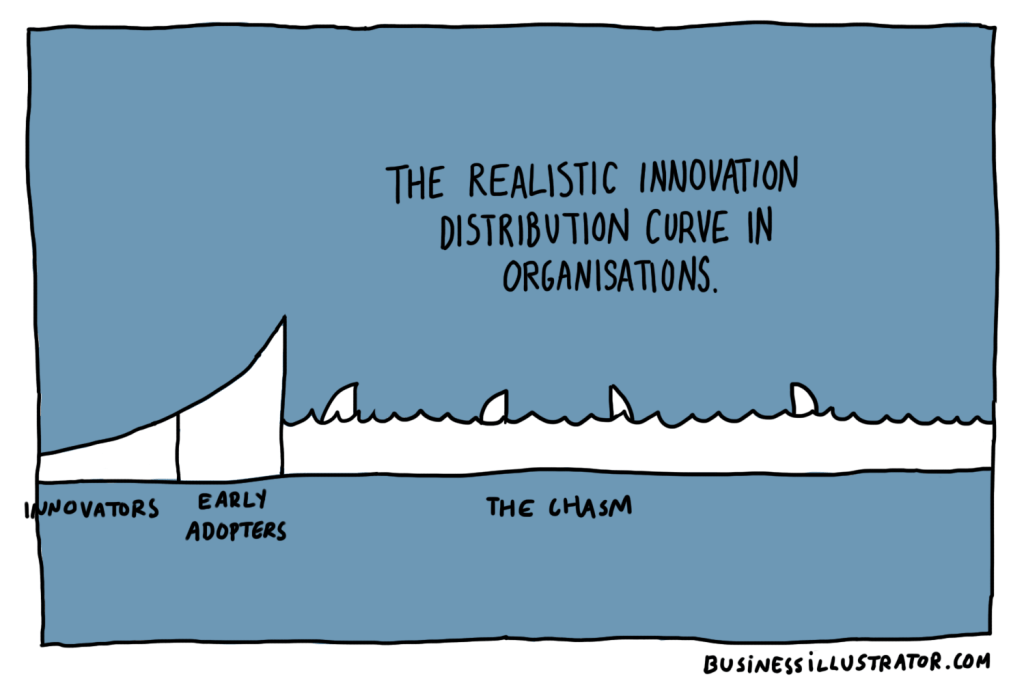
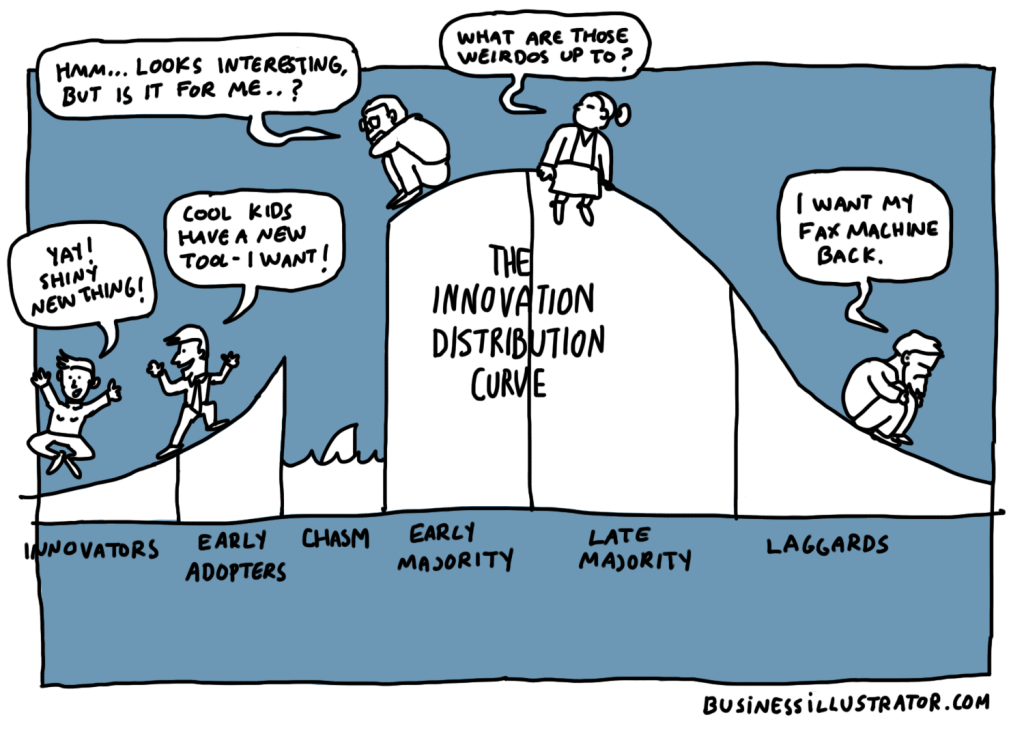
Whether its luck, perception or something else we find ourselves recognizing that the gap between what we think is valuable and useful and what others think (or are willing to consider) is large. The Chasm illustrated above is real and rather than engage in a futile effort to design around it, we need to recognize that there are sharks in those waters.

That’s what they did in the film Jaws. When we design for that, we design for humans (and sharks).

If you’re looking to create something more human in your work and need help, contact us and we can help make sure you don’t get eaten by the sharks you’re swimming with.

Images by Business Illustrator used under license.

The post Designing for Humans: Considerations for Innovators appeared first on Cense.

Written by cplysy · Categorized: cameronnorman

Jun 25 2021

Innovation Like An Epidemiologist

What if innovation was like epidemiology? What if we wanted to understand the source, scope, scale, and spread of an idea or product?

That’s one way that we think about the innovation process.

Innovation – like a virus — is similar to infectious disease epidemiology. Both of these areas look at the development of something, its effects, its spread, and how it scales over time. Both innovation and epidemiology require evaluation as well.

Viral Innovation

The parallels between infectious disease epidemiology and innovation are many. The first of these parallels is between a virus and an innovation.

A virus develops and mutates as it has more exposure to hosts. A virus ‘learns’ from what it does and adapts to fit a changing context. Innovation does the same thing only with an idea, product, or service. For innovators, the aim is for healthy development and the creation and distribution of the product or service. This is what research and development and marketing is all about.

Innovation and epidemiology are also both interested in the spread and scale of things. If an innovation works well in a context we might want it to spread to other contexts. Innovators often want their products to scale as far and as wide as possible. Sometimes innovations scale and sometimes they don’t.

The way we know this is through conducting detailed, systematic monitoring and evaluation.

Epidemiology, like innovation, is driven by evidence from the laboratory and the real world together.

Stages of Development

At Cense, we also look to another parallel between the two areas: research and development.

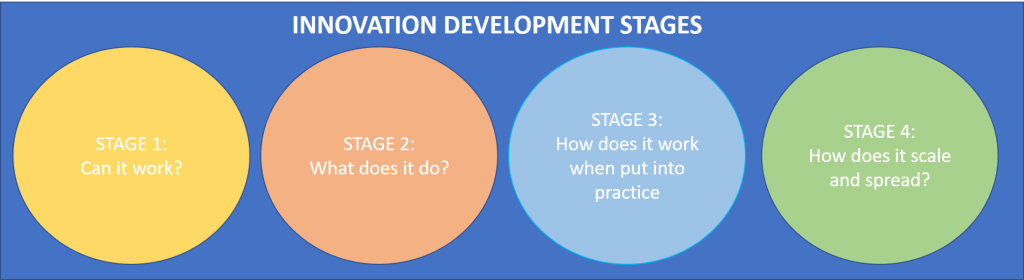
Innovation develops in four stages that are similar to phases of research trials.

The role of design and evaluation is different for each stage. At Stages 1 and 2 the emphasis is on working with innovators to align their intentions with their design to explore what it (the innovation) does and how it does it. This is where design thinking and strategy are most prominent.

At Stages 3 and 4, the aim is to build an evidence base and strategy to spread and scale the innovation. At these stages, the focus is on marketing, distribution, and amplification. Evaluation in these stages focuses on the larger impact and the means by which the innovation is implemented and adopted for use across contexts.

Like an epidemiologist, its important to collect data to support moving the innovation from each stage. It’s also important to explore what kind of effects — positive and harmful – are generated at each stage.

At Cense, we work with our clients to design the right evaluation and strategy for each stage of development. There are no ‘one-size fits all’ approaches to innovation. Much like with a virus, an innovator must know what their innovation does and what will change at each stage and scale of its development.

What is key is designing data collection and strategy that is fit for purpose.

Viruses aim to spread and survive just like innovations. By thinking like an epidemiologist you can help your innovation to survive and thrive like the best kind of virus.

Photo by Bill Oxford on Unsplash

The post Innovation Like An Epidemiologist appeared first on Cense.

Written by cplysy · Categorized: cameronnorman

Jun 01 2021

Multimedia Visualizations For Strategy and Impact

Multimedia visualizations are powerful ways to convey a lot of information in a small space and with little time. The use of a visual — a map, a drawing, a picture, sketch, or collage — provides layers of information beyond words. When dealing with complex situations, visualizations provide clear communication pathways.

Unlike some of our other posts, this is not pointing us to a specific tool or technique, rather a general approach to thinking about and engaging with content.

Let’s look at the benefits of adding more visuals to your work to help your strategy, evaluation, and program design efforts.

1. Relationships. One visuals can help you with understanding proportions, distance, and other relative characteristics. It is useful to position things next to one another – whether that is choice alternatives, network connections, or even contrasts. Seeing things in relation to one another on a visual canvas provides our brains with new information that is difficult or impossible to gain from more abstract thinking without visuals.

2. Colour and Texture. How something looks and feels can tell us a lot about what it means. By adding colour to something we apply a simple lens that can convey meaning. Colours like green invoke environmental imagery, red is well-known to have many meanings in different cultures, while blue can be relaxing. Texture can do the same thing. To illustrate, consider New Zealand-based Icebreaker who makes wool-based clothing and uses texture-rich images of sheep’s wool to highlight how its products are natural in composition. Use of texture in the imagery gives a sense of integrity, warmth, and a feel to fabrics even when the buyer might only see them online.

3. Variety. As more people work remotely and digitally than ever before, the visual landscape for many of us has changed in most workdays. We lack contrast in our environments and also in our digital screens. By increasing the visual constraint and variety by diverging from text and boxes toward photographs, graphic images, videos, or some other form of visual media we draw attention. When so much feels the same, few things are more valuable than attention.

4. Abstraction and Narrative. Words offer us a restricted set of options due to the need for us to be linear in our the way we speak. With a visual we can better draw abstract themes from an object and use things like metaphor to describe scenarios that allow us to transcend words.

There are many ways to use visuals and software tools like online whiteboards such as Miro and Mural, visual organizing tools like Milanote, and tools such as Jamboard or Trello to showcase information in ways that extend beyond text.

Consider bringing more details into your next project and discover what visuals can do for creating richer, more vibrant ideas and creative opportunities to your work.

The post Multimedia Visualizations For Strategy and Impact appeared first on Cense.

Written by cplysy · Categorized: cameronnorman

May 18 2021

Systems Mapping Cautions

A systems map is a useful means of visualizing connections between ideas, actors, institutions, and activities. Systems maps can be designed using many different conventions and methods, but the basics are the same. The point of mapping systems is to get a lot of information on a single page.

System maps can help generate insight into patterns that influence behaviour and outcomes. In short: they help us see things better.

A system map is also a potential trap. Maps can lead us into false beliefs about the subject of systems and what the real system is. It’s much like the Buddhist phrase about the finger pointing to the moon: we confuse the system map for the system itself.

Luke Craven, a designer and systems consultant, has remarked on the paradoxes found in system mapping. Among these paradoxes are the tendency toward generating a single, over-arching map. This article reminds us of many conventions we recommend in using system maps.

System Map Suggestions

  1. Diversity in Form. Systems Thinking has many different schools of thought and systems mapping often follows conventions generated from these schools. These forms or conventions are the visual languages of the system. For example, System Dynamics emphasizes causal loops and stocks-and-flows. Social Networks use nodes and links to represent a system.
  2. Awareness of Form. Merging forms together can be useful but must be done mindfully. When we deviate from a convention, we violate certain rules (while creating opportunities). A systems mapper needs to be aware of what is lost and gained when using multiple visual forms. Hybrid maps require coherence to be useful.
  3. Volume. Multiple maps using multiple forms can generate insights that can’t be found when using a singular approach. It’s important to create the time and space to generate multiple maps. Too often we find organizations fail to do this.
  4. Validation. Every map reflects the map-maker. Thus, the more map-makers involved the more the map reflects the diversity of the system and different realities. Show your maps – in any form – to others. Feedback is fuel for system diagrams.
  5. Continuation. A system map’s value changes over time. It’s important to recognize that as the context changes, so does the map’s utility. We recommend updating and revisiting a map over the life of the project.

Map-making can be a powerful way to learn, explore, and illuminate relationships and patterns in a system. It is because maps are so powerful that we must be cautious in making them.

Good map-making requires thoughtful consideration to what a map is and how it is to be used. When you have done this, you have a remarkable pathway for shaping change.

If you want to make system maps and see what they can do for your organization, contact us. We will help you chart a path toward insight and impact.

The post Systems Mapping Cautions appeared first on Cense.

Written by cplysy · Categorized: cameronnorman

  • « Go to Previous Page
  • Go to page 1
  • Interim pages omitted …
  • Go to page 10
  • Go to page 11
  • Go to page 12
  • Go to page 13
  • Go to page 14
  • Interim pages omitted …
  • Go to page 21
  • Go to Next Page »

Footer

Follow our Work

The easiest way to stay connected to our work is to join our newsletter. You’ll get updates on projects, learn about new events, and hear stories from those evaluators whom the field continues to actively exclude and erase.

Get Updates

Want to take further action or join a pod? Click here to learn more.

Copyright © 2026 · The May 13 Group · Log in

en English
af Afrikaanssq Shqipam አማርኛar العربيةhy Հայերենaz Azərbaycan dilieu Euskarabe Беларуская моваbn বাংলাbs Bosanskibg Българскиca Catalàceb Cebuanony Chichewazh-CN 简体中文zh-TW 繁體中文co Corsuhr Hrvatskics Čeština‎da Dansknl Nederlandsen Englisheo Esperantoet Eestitl Filipinofi Suomifr Françaisfy Fryskgl Galegoka ქართულიde Deutschel Ελληνικάgu ગુજરાતીht Kreyol ayisyenha Harshen Hausahaw Ōlelo Hawaiʻiiw עִבְרִיתhi हिन्दीhmn Hmonghu Magyaris Íslenskaig Igboid Bahasa Indonesiaga Gaeilgeit Italianoja 日本語jw Basa Jawakn ಕನ್ನಡkk Қазақ тіліkm ភាសាខ្មែរko 한국어ku كوردی‎ky Кыргызчаlo ພາສາລາວla Latinlv Latviešu valodalt Lietuvių kalbalb Lëtzebuergeschmk Македонски јазикmg Malagasyms Bahasa Melayuml മലയാളംmt Maltesemi Te Reo Māorimr मराठीmn Монголmy ဗမာစာne नेपालीno Norsk bokmålps پښتوfa فارسیpl Polskipt Portuguêspa ਪੰਜਾਬੀro Românăru Русскийsm Samoangd Gàidhligsr Српски језикst Sesothosn Shonasd سنڌيsi සිංහලsk Slovenčinasl Slovenščinaso Afsoomaalies Españolsu Basa Sundasw Kiswahilisv Svenskatg Тоҷикӣta தமிழ்te తెలుగుth ไทยtr Türkçeuk Українськаur اردوuz O‘zbekchavi Tiếng Việtcy Cymraegxh isiXhosayi יידישyo Yorùbázu Zulu