• Skip to main content
  • Skip to footer
  • Home

The May 13 Group

the next day for evaluation

  • Get Involved
  • Our Work
  • About Us
You are here: Home / Archives for allblogs / cameronnorman

cameronnorman

Oct 19 2021

Concept Scenarios + Storyboards for Service Design

If you are looking to generate a sense of what your planned service looks like in practice why not draw it out?

Filmmakers know the importance of the process of storyboarding.

A storyboard is simply a visual representation of what you expect might happen from moment to moment in a service encounter. Storyboards allow us to ‘see’ the service before it’s made and spot potential issues tied to use, resources, interactions, and possible touch-points.

A storyboard tells the ‘story’ of your customer or client and you and your staff as you walk through the service. Storyboards require that you start to develop a vision — literally because it’s being drawn — of who you are seeking to serve.

This builds on the use of personas (which we’ve discussed before) and allows us to visualize relationships between these imaginary participants using data and how they interact with our products and services.

As we can see from the image below when we storyboard we also start to sequence steps involved in the service. For example, when we think of getting a coffee it’s easy to look at the act of ordering and receiving it, yet so much more is going on.
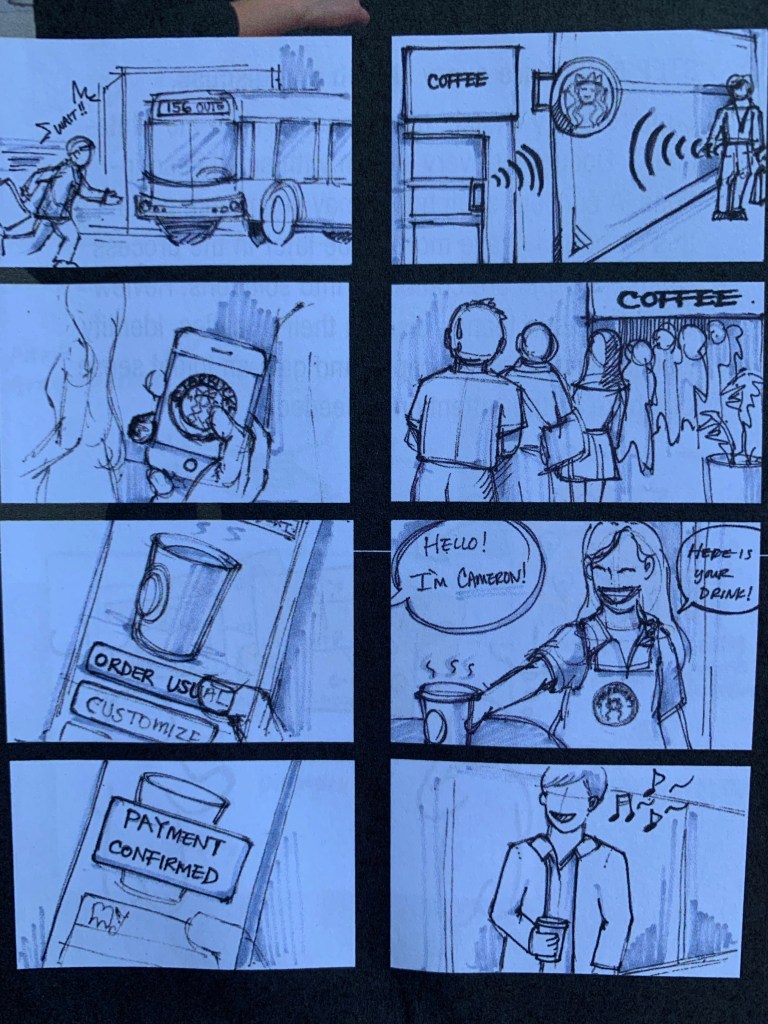
Kumar, V. (2013). 101 Design Methods. Hoboken, NJ: Wiley & Sons (p.239)

Concept Scenarios

A concept scenario is a form of storyboarding that begins with data collection and organizing ideas together — often through the use of a whiteboard or visual tool like Milanote. By pulling together ideas in discussion and through examination of concepts tied to your service or innovation, we develop the raw material to put it together with a narrative.

More traditional storyboarding starts with a story and pieces together the elements into a narrative and extracting concepts from it, concept scenarios are more of the inverse. Both yield storyboards. What concept scenarios do is help us to piece together concepts and identify where assumptions might need rethinking.

This method is participatory and involves a few days or weeks to fully undertake depending on the amount of detail you need, the availability of research opportunities, and the resources (human and otherwise) to come together and visualize ideas together.

Practice Notes

Concept Scenarios begin by doing background research and learning about what it is that you are looking to develop and eliciting the various concepts associated with that — asking who, what, where, when, and why. This involves research and then synthesis of this research and group-based discussion to pull concepts together.

A whiteboard or digital space to add those ideas together is a strong asset to support this work. Simple words on a sticky note can work to record concepts and allow for manipulation and movement when used on a tool like a whiteboard or tool like Miro, Mural, or Jamboard.

Next, select the concepts you are most attracted to and best fit with what you’re looking to do.

Step three is to begin imagining scenarios where you might put these concepts together. Consider the key interactions and relationships that are involved, the timing of what is to happen, and the actors involved.

The next step is to visualize these into a series of panels (see above) and illustrate the ideas in a narrative.

The last steps involve interrogating the scenarios to see how they hold up to assumptions and start asking questions about what might be missing and what else might be needed to make the scenarios more realistic or why or how they might be achieved if they are novel or innovative.

Reference: A great summary of this method can be found in the 2013 book 101 Design Methods by Vijay Kumar.

We do this work with our clients. If you want help to learn the method or to use it as part of your service design, strategy development, or evaluation contact us. We can help.

Cover photo by dix sept on Unsplash

The post Concept Scenarios + Storyboards for Service Design appeared first on Cense.

Written by cplysy · Categorized: cameronnorman

Oct 11 2021

Selecting a Coach: Lessons and Tips for Performance

An interesting thing happened to Emma Raducanu, the teen tennis star who came from being ranked 150th in the World to winning the U.S. Open in 2021, in the first tournament she competed in since that win: she lost in straight sets. Raducanu had steamrolled through the entire US Open seemingly out of nowhere to win the tournament by beating Layla Fernandez, another young woman also having a remarkable run from being almost unknown to the finals.

What happened? For starters, she fired her coach. This was the same coach that had helped her to get to the podium in New York. The reason? She believed she needed a coach to help her stay at the top, not just get there.

While it’s too early to tell what the implications of Raducanu’s decision was it seems to mirror what happened to another promising young tennis star, Eugenie Bouchard, who did something similar after tasting some early success and has since fallen far down the world rankings never to recapture that early success (yet). An effective coach can make a substantial difference in the performance of a person or an organization but only if there is a clear-eyed view to what a coach does and does not do.

The decision to fire or hire a coach can have lasting effects on performance and yet these effects are often misunderstood. Here we break down what you can expect from a good coach and what to look for when things don’t go well.

Knowledge

Coaches bring together three kinds of knowledge together in working with their clients: process knowledge (how to get things done), technical knowledge (specific knowledge about skills, tools, and their application), and content knowledge (knowledge about the topic that we’re trying to address).

Combined with praxis (creating learning through action loops) a coach weaves this all together with their client.

Knowledge Practice

Practically, knowledge involves having a coach with experience and an ongoing commitment to learning. It’s why we call it practice, it’s about ongoing work to keep up on the latest knowledge and sharpening skills. A strong coach should be doing this with their work and supporting you in doing this with yours.

Strategy

Coaching can involve a variety of factors that can facilitate performance. The first of these is strategy. It is here that we often see the tangible effects of coaching with athletes, other individuals, and organizations. Here, the coach is involved in developing a strategy or in its execution. If you change the coach, you may very well change the strategy. Good strategy is alignment of purpose, vision, resources, and execution and a coaching change might shift how any or all of these are realized in practice.

Strategic Design

Strategy is about design – it’s a conscious intentional plan made into reality. Good coaching is about ensuring that there is a plan, the plan is executed, that it is adaptive and developmental, and that there are sufficient evaluation mechanisms to help you learn and grow. You cannot have a strong strategy without an evaluation plan to know whether you’re moving closer or farther from your goal.

Focus

Related to strategy is focus. Coaches often help their clients focus on specific things and away from others. This is done often by learning about what is holding attention in the first place. What is an organization focused on — both fears and hopes? This is very much about training for a mindset, not just a skill set. There is a big difference in avoiding what you fear compared with moving toward what you want.

An organization with a defensive mindset might be more likely to focus on how to protect market advantages or the avoidance of risks.

An organization with a opportunity mindset may still acknowledge risks and fears, but may focus its energy on getting to where it wants to go in spite of the challenges.

Mindsets for Change

Assess your coach on their ability to build the kind of relationship that allows them to learn how best you learn, how you see the world, and to create a profile of your mindsets. No coach should assume you have any particular mindset or that you use it consistently in the situations that matter. Great coaches pay attention to what you do and why you do it.

Motivation & Systems

Another coaching issue is motivation. This is the soft-skill process of keeping someone energized and brings together all of the other components within a system or structure. Motivation is about cultivating a ‘spark’ or ‘fire’ in someone to encourage them to take action. Systems are in place to help create habits so you don’t have to rely on motivation. Motivation requires a lot of energy and the benefits are many, but good systems are even better because they make behaviour change easier to do because they scaffold and anchor behaviours on to habits.

For example, people don’t usually have to feel motivated to brush their teeth or drink water when they are thirsty.

Coaches put in good systems and create a means to motivate their clients when those systems aren’t in place or when they are not enough.

Motivational systems

Combining the right kind of inspiration with systems that sustain that energy over time so you don’t have to rely on it all the time is key. Avoid coaches who focus only on motivating without creating systems to reduce the reliance on high-energy things like motivation to carry you forward.

Selection

We lastly want to say that a coach is a partner in your success. A great coach succeeds when you succeed. They are to be partners in your success, not just a consultant. As such, relationships are very important as much as anything else in this list. Find the fit and recognize that it might take some time to find that fit and to put the practices into place.

For Emma Raducanu, this initial setback might be a bump in the road to finding the right coach and the right fit. It could also be the start of a fall backward like we saw with Genie Bouchard. Time and good care will tell.

Coaching is part of what we do and we take it seriously. If you’re looking for someone to help see things differently to better do things differently, we can be your partner. If that’s what you need as a leader or an organization, let’s talk.

Photo by Moises Alex on Unsplash, Josephine Gasser on Unsplash, and Hermes Rivera on Unsplash

The post Selecting a Coach: Lessons and Tips for Performance appeared first on Cense.

Written by cplysy · Categorized: cameronnorman

Oct 05 2021

Developmental Evaluation, Learning and Innovation

What does it mean to undertake a developmental evaluation (DE)?

DE is simply another way to say evaluation for learning and innovation. That’s really all it is in practice, although anyone looking to do DE might want to look a little closer to see if it really is the right approach for them.

In this post we look a little closer to help you understand what it means to do evaluation for innovation and what developmental evaluation has to do with it.

Understanding Innovation

Innovation is a word that can mean much and requires clarification when it’s used because of this. When we speak of innovation, we refer to this definition of learning transformed into value through design.

Developmental evaluation is a concept that was first put forward by Michael Quinn Patton through many books, articles, and other teachings. It’s now become a popular approach within social innovation and the public sector.

DE is often referred to as a means to strategic learning because rather than assume the conditions of whatever is being evaluated (e.g., program, policy) are stable, it assumes some level of complexity. This is dramatically different from what most other forms of evaluation do where the assumption is the ‘thing’ being evaluated is stable – it’s the users of that thing that might change.

Because DE is focused on learning it assumes that there will be some kind of change with the actual process of learning itself on the way from one state to the next. 

Understanding Design’s Role in Innovation

What DE does not do well is account for the role of design in supporting innovation. If we come back to the definition of innovation presented earlier, design is really the means by which innovation occurs. In most of the literature on DE the matter of design is not discussed much, if at all. 

With much of DE the assumption is that those doing DE know how to take what they learn and transform it into value. From our experience, this is an assumption that rarely holds up. The reasons are many, but most central to this is that most people think of design as beginning from a standing start when in practice much of what do when we innovate takes place from a moving position.

We sometimes refer to this as developmental design, but more appropriately expand how we see this relationship between DE and design as something called Design-driven Evaluation. In this case, design and evaluation are intimately connected and the processes of using both to mutually inform one another are embedded in the innovation process. 

Understanding Evaluation’s Role in Design & Innovation

Evaluation is the means to provide the necessary feedback to contribute to innovation. Evaluation determines the quality of the design in achieving its purpose. If your design is meant to change behaviour, evaluation is the means to assess whether that happens and to what degree.

Evaluation also is the means to document the circumstances in which this takes place to help you assess whether the implementation of your innovation goes as intended. Without evaluation, your innovation is a wish, not a result. Evaluation is the means to determine what the results of your innovation are. 

Evaluation is also the means to assess the quality of your design work. It’s one thing to develop something and put it out in the world, but is it any good? Is it fit for purpose? Many innovations fail to deliver value because they don’t provide the means to learn about the quality of the design itself. They don’t achieve a positive impact because they were never designed to in the first place. 

To innovate is to learn and to learn is to evaluate. Design is what ties them all together. 

Next time you’re looking to embark on a new program of activity, create a new product, it’s worth considering how these all go together and whether DE alone will help you to get there. 

For help in generating powerful design-driven approaches to innovation and evaluation, contact us. We can help

The post Developmental Evaluation, Learning and Innovation appeared first on Cense.

Written by cplysy · Categorized: cameronnorman

Jul 28 2021

Mind Maps For Complex Projects

A mind map is a powerful, simple organizing tool that features a lot of information on a single page. We use mind maps and other visual tools to communicate relationships between ideas, people, project components and topics with our clients and partners. We present a short introduction to how and why you might want to use mind maps in your work.

A mind map is a visual representation of a project that links actors and actions together. This article focuses on using mind maps, not creating them.

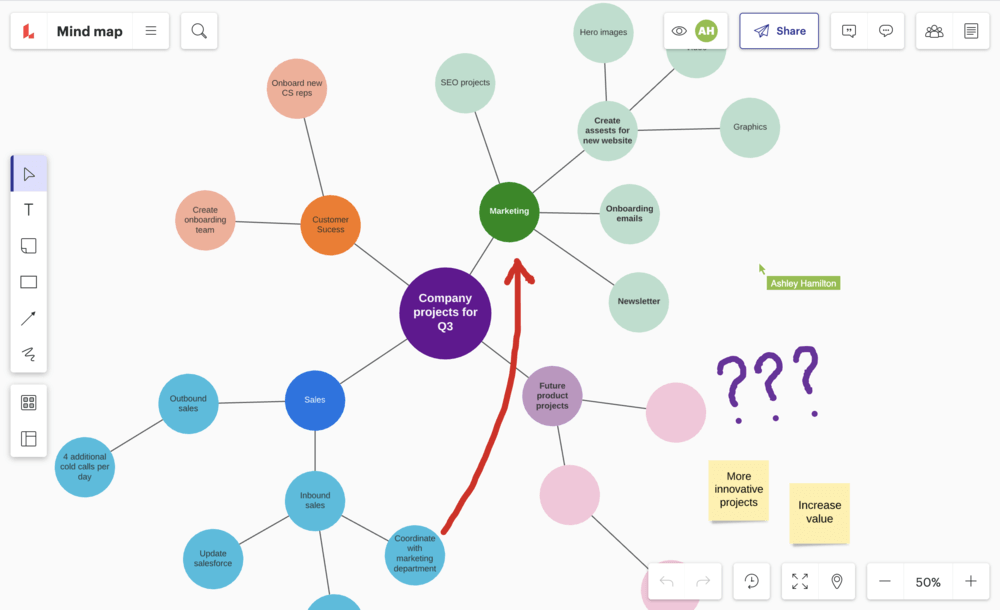
Below is an example from software provider Lucidspark (which is a tool for creating mindmaps) that illustrates what a mind map is and how it can connect ideas and actions together.

Visualizing our Relationships

A search of Google (or any other search engine) will find thousands of visual examples of what a mind map is. There are few ‘essentials’ for mind mapping, which is among its most attractive features.

A complex project is one where there are many things happening at the same time, at different time scales, and involving many interdependencies and actors. That’s just a way of saying: there’s a lot going on.

It doesn’t matter how you organize your mind map only that it is useful. That means it provides information that you can make decisions with and act on. If it does that, it’s a good mind map.

Once we have that in place, the mind map allows us to examine the relationships between the nodes and topics to assess their fit. The expression ‘getting on the same page‘ reflects an ability for all of those looking at the document to have a similar representation of what’s on that page. The mind map allows us to verify relationships between entities, determine gaps or inaccuracies, and explore different ways of connecting things together.

There may not be a single ‘master’ map that is better than all, but there may be a map that is more useful than others.

How to Use Mind Maps

When we use this with clients and partners on projects we aim for the following:

  • To examine the assumptions involved in the project
  • To explore alternative relationships of fit and see if the map is the best representation of what we are looking at
  • To guide the project and keep the topics on track
  • To provide a building block for connecting ideas together (in ways that weren’t done previously)
  • To map out a system of relationships
  • To use colour and visuals to surface feelings, thoughts, and other emotional aspects of the project that might influence the strategy or outcomes

By creating a visual representation we see the whole project and the relationship context. Relationships are the key in any complex system. When we visualize these relationships it allows us to see how the actions in one relationship can affect others. Visual maps can aid us in anticipating possible effects.

(Note: We don’t use the term ‘unintended effects’ – just effects because in complex systems it’s too hard to predict cause and effect with any degree of accuracy).

We continually refer back to our maps to help ensure we are accounting for all relationships of importance throughout the project and not just those that have the most amount of activity within them. It’s incredibly difficult to track this in our heads or in something like a spreadsheet or text document.

Mind maps can be great tools to visualize a lot of information and get you and your collaborators on the same page when it comes to understanding what is going on in a complex system and program. Try it out — they are easy to create and simple to use.

If you want to use this approach to visualizing your programs and using this to help you innovate, contact us – we’d love to hear from you.

The post Mind Maps For Complex Projects appeared first on Cense.

Written by cplysy · Categorized: cameronnorman

Jul 21 2021

Knowing Thyself: Colleagues, Coaches and Consultants

Self-knowledge is a great asset, however the reason we often hire an external consultant is because we know a part of ourself so well that it becomes difficult to see other parts of who we are.

We obviously have a bias toward the role of external consultants because that’s what we do, but we also recognize that part of role that we are often asked to play can be filled by different people or sometimes the same person playing many of them.

We refer to three C’s: Colleagues, coaches, and consultants. These are not mutually exclusive from one another and can be separate or combined. In each case, however, the role is focused on specific tasks that we want to highlight in helping you identify what best serves the particular situation or problem set you face.

Colleagues

Perhaps the most neglected role of the three are colleagues (or peers). A colleague is someone who works within the same field, department, team or organization as you and can provide feedback and perspective on the work you do and your performance. Because they know the work, they can speak to technical issues very well. However, because they are close to the work (and maybe you) they may include the same biases and limits to perspective as you do, too.

Colleagues offer the following:

  • Deep knowledge of the situation, context, and circumstances of the work. They know what you know and experience what you experience. There is little need to spend extra time empathizing with your situation.
  • This familiarity allows for more quick-to-start and nuanced conversations about issues.
  • Familiarity also allows for great compassion: it’s easy to talk with your peers about issues that might seem too far removed from others.
  • This familiarity also brings the same ‘blind spots’ and potential prejudices around actions, behaviours, policies, and possible outcomes. This can limit what is ‘seen’ and what is proposed.

Coaches

When you think of the highest performing athletes do you think about their coach? They all have one.

Athletes know the value of coaches because it’s only through that blend of expertise, motivational energy, and shared commitment through feedback that they can improve. The same is often true for organizations and individuals.

A good coach provides:

  • Someone on your team who is committed to the same project as you. Their success is yours.
  • Expertise in performance and how it relates to your specific industry or context.
  • A more intimate relationship in that they are focused on you (or your organization) and thus is more sensitive to its ‘moods’ and rhythms than someone who is more distant.
  • A coach has a separate role from who they support so, unlike with colleagues, there is less confusion and more clarity about what specific benefits a coach can and will provide without the potential for it to be conflated.

Consultants

A consultant is like a coach in that they bring an outside perspective – even more so.

A consultant is someone who is freed from the specific demands associated with the role, outcomes, and processes associated with your work and offers expertise and a different perspective on what you do. Many times we are so engrossed or familiar with what we are doing that we are unable to see new possibilities or consider alternative pathways for working.

Consultants provide many distinct benefits:

  • A consultant may not have specific domain expertise as your organization.
  • Alternatively, a consultant may have deep expertise in the domain you work in, but less in specific processes. They might also possess both. In every case, their value is in separation from the day-to-day activities of your work. This provides a more dispassionate view of your work. (Note: we don’t believe it’s necessarily more objective, just different — we all have biases).
  • Consultants can provide tactical and strategic advice much like a coach but without the closeness to their client and the same investment in the work. This isn’t to say that consultants care any less for the success of their clients, rather they are not part of the team and thus are not affected by the same fears of failure or concerns as a coach is.
  • Because consultants work at a distance they also are more likely to be versed in methods, tools, knowledge and practice skills that allow them to work well with groups who are unfamiliar to them (yet are similar in need or content expertise). This allows them to be bridge-builders within and across organizations and networks more easily.

The post Knowing Thyself: Colleagues, Coaches and Consultants appeared first on Cense.

Written by cplysy · Categorized: cameronnorman

  • « Go to Previous Page
  • Go to page 1
  • Interim pages omitted …
  • Go to page 9
  • Go to page 10
  • Go to page 11
  • Go to page 12
  • Go to page 13
  • Interim pages omitted …
  • Go to page 21
  • Go to Next Page »

Footer

Follow our Work

The easiest way to stay connected to our work is to join our newsletter. You’ll get updates on projects, learn about new events, and hear stories from those evaluators whom the field continues to actively exclude and erase.

Get Updates

Want to take further action or join a pod? Click here to learn more.

Copyright © 2026 · The May 13 Group · Log in

en English
af Afrikaanssq Shqipam አማርኛar العربيةhy Հայերենaz Azərbaycan dilieu Euskarabe Беларуская моваbn বাংলাbs Bosanskibg Българскиca Catalàceb Cebuanony Chichewazh-CN 简体中文zh-TW 繁體中文co Corsuhr Hrvatskics Čeština‎da Dansknl Nederlandsen Englisheo Esperantoet Eestitl Filipinofi Suomifr Françaisfy Fryskgl Galegoka ქართულიde Deutschel Ελληνικάgu ગુજરાતીht Kreyol ayisyenha Harshen Hausahaw Ōlelo Hawaiʻiiw עִבְרִיתhi हिन्दीhmn Hmonghu Magyaris Íslenskaig Igboid Bahasa Indonesiaga Gaeilgeit Italianoja 日本語jw Basa Jawakn ಕನ್ನಡkk Қазақ тіліkm ភាសាខ្មែរko 한국어ku كوردی‎ky Кыргызчаlo ພາສາລາວla Latinlv Latviešu valodalt Lietuvių kalbalb Lëtzebuergeschmk Македонски јазикmg Malagasyms Bahasa Melayuml മലയാളംmt Maltesemi Te Reo Māorimr मराठीmn Монголmy ဗမာစာne नेपालीno Norsk bokmålps پښتوfa فارسیpl Polskipt Portuguêspa ਪੰਜਾਬੀro Românăru Русскийsm Samoangd Gàidhligsr Српски језикst Sesothosn Shonasd سنڌيsi සිංහලsk Slovenčinasl Slovenščinaso Afsoomaalies Españolsu Basa Sundasw Kiswahilisv Svenskatg Тоҷикӣta தமிழ்te తెలుగుth ไทยtr Türkçeuk Українськаur اردوuz O‘zbekchavi Tiếng Việtcy Cymraegxh isiXhosayi יידישyo Yorùbázu Zulu