• Skip to main content
  • Skip to footer
  • Home

The May 13 Group

the next day for evaluation

  • Get Involved
  • Our Work
  • About Us
You are here: Home / Archives for allblogs / cameronnorman

cameronnorman

Mar 16 2022

Data Collection and Participation For Busy People

Among the greatest challenges of doing research and evaluation is ensuring you get participation from enough (and the right) people. Surveys are everywhere. It feels like everyone wants our feedback on just about everything. Yet, the more surveys out there the more we should be concerned about data quality, too.

On top of that, we are surrounded by media messages, distractions, and ‘noise’ that can make attention a very precious (and rare) commodity.

It can be daunting.

How do we get people to participate and get good quality data from that participation amongst the noise? We’re going to outline an approach to data collection that goes from methods to conversations.

From Methods to Conversations

There is a lot of research on improving existing methods like surveys or asking better questions. Tips like these can be useful, but they may also distract us from addressing other issues. For starters, consider the user case for doing research and evaluation.

Who benefits from the research? Is it those who are participating? If not, why would someone want to take time and spend energy answering your questions? We can no longer assume people will participate out of a sense of wanting to help. The deluge of research requests has made data gathering an imposition more than an opportunity for most people.

One of the ways that we deal with this is to shift the focus to creating conversations and learning opportunities. By thinking of data collection as part of a conversation we can change the way we gather data. This works for evaluation, design research, or any applied research context.

A great conversation is about creating exchange. That means some back and forth between the parties. What if you could do this with your data?

Data-Based Conversations

The concept of data-based conversations is all about using what you gather as the foundation for the exchange between people. This means gathering relevant information from people and then sharing what it is that you find. Individuals provide their thoughts, opinions, attitudes, and reflections and as researchers we provide the synthesis and opportunity to share what we’ve learned from others. It works because it creates exchange and value.

People choose to participate because they can both contribute and receive insights about their peers. Please keep in mind that this approach only works when people are interested in your topic.

We recommend that you design multiple, short engagements so you reduce response burden. Rather than use a single, large survey we suggest you break it into smaller batches of questions. In between each survey we provide rapid synthesis learning reports to share what we’ve learned from others.

Our rapid learning reports might be short summaries, infographics, or distilled tips gleaned from the data. Using visual media is particularly helpful because it’s simple and accessible. It says to our participants: “we heard you and here’s what others have said.”

Data collection can also include short interviews, social media exchanges, or panel feedback. The methods matter less than the way that we structure the engagement. This approach builds trust, familiarity and increases data quality.

Time to Talk?

People are busy and less invested in your product or service than you think. This approach to creating a conversation than just asking (and taking) from people changes the relationship. By enlisting people as partners and focusing on sharing what you learn in ways they can benefit, you serve others not use others.

As always, this must be done with transparency, ethics, respect, and commitment to delivering on your promises. We’ve found this approach works and it adds value to participants. People like to learn and know what’s going on with their peers. Gathering data this way is less intrusive, more natural, and less burdensome.

If you’ve got a big research question to ask, consider ways you can transform your data collection into a conversation. You might find that you get more participation, greater engagement, and better quality data.

Want to build this approach into your evaluations or research? We can help and share our experience using this approach to reach busy people. Contact us and let’s grab a coffee.

Image credits: Karen Lau on Unsplash, Jon Tyson on Unsplash, and Firmbee.com on Unsplash

The post Data Collection and Participation For Busy People appeared first on Cense Ltd. .

Written by cplysy · Categorized: cameronnorman

Mar 02 2022

Future Regrets

Have you ever thought: I wished I’d done [something] different?

We all have. Regrets are part of what defines us as humans.

Looking back over mistakes or missed opportunities can lead us forward into making better decisions about the future if we let it.

In our work, we’ve used the idea of Future Regrets as a strategy tool to help organizations envision possible future outcomes.

Here is how it works:

  1. Take an action that you’re currently seeking clarity on or debating as an organization (or individual). This can be an issue that you’re uncertain about and want to pursue.
  2. Pick a time point in the future when the results of your action (or inaction) will be likely known. To make things simple, we often use 6-months, 1 year, or 5 years as examples. The specific date isn’t that important – just enough to gain a frame on your activity.
  3. Inquire about those outcomes and whether you would have regretted not taking that initial action.

This approach allows us to see beyond short-term pain, struggle, and awkwardness to see long-term success (or possible failures). Rather than wait for regret to set in on a missed opportunity or failed venture we can learn about tomorrow, today. Try it with a variety of scenarios and give yourself time to consider different paths.

Power of Thought Experiments and Regret

Author Dan Pink has written about the role of regrets in shaping our lives and how we can benefit from them in dictating what we do. While this specific approach isn’t mentioned in his book, there are many others that are including the failure resume.

By bringing our future into our present we can regret less and succeed more.

If you’d like some help in using this approach in your work please contact us and let’s grab a coffee.

Photo by charlesdeluvio on Unsplash

The post Future Regrets appeared first on Cense Ltd. .

Written by cplysy · Categorized: cameronnorman

Feb 25 2022

Futures and Optimism Bias

Futures (thinking) and strategic foresight can be powerful tools to help us to plan and see opportunities and threats ahead of us. When we can imagine what might happen it’s easier for us to plan for it. Futures work allows us to anticipate what could be so we can adapt better to what is now.

Good strategic foresight involves drawing on trends and patterns to create scenarios, envision possible futures, and assess risks and benefits. It is, however, a product of our present. When we use futures and foresight we begin with stating our assumptions. As we wrote recently on Censemaking, it is the willingness of futurists to see preferred, positive, and optimistic futures that they often neglect things we dislike. Just listen to the assessment on the Globalist of the 2022 Russian invasion of Ukraine and you’ll hear how badly the West got its futures thinking wrong.

Assumption Building

The first step in any futures or strategic foresight project is assumption finding, building, and assessment. We begin by asking ourselves: what do we believe to be true about the situation?

We continue asking: what do we believe about the past, the present, and the future?

Another key tool we use is the Third Position Strategy where we begin asking questions about our beliefs from a ‘third’ position that is not us. Another is the What Went Wrong approach which is a post-hoc review of what we’ve already done. After-action Reviews are other ways to help assess what kind of beliefs we had about something and the effect of that thinking on action.

These two approaches combined with some exploratory design research help us surface assumptions.

Assumption Testing

We also advocate asking these questions and using these techniques ahead of engaging in futures work. There is no ‘correct’ answer to these questions and there may be multiple answers.

  1. Do we see the situation through a lens of optimism or pessimism?
  2. What would someone who is not like me to see in this situation?
  3. What are the fundamental beliefs about human nature that guide our thinking?
  4. How is the situation we are looking at (past, present, future) similar to what’s happened before?
  5. How might we see the situation differently?

By asking these questions and building narratives that can challenge and confirm the answers we can better ensure that our futures thinking is less prone to unhelpful bias.

Futures building is all about beliefs and assumptions. What’s important is that we recognize, acknowledge, and remember the ones we bring.

Futures and strategic foresight work is a means of seeing what might come before it does. It’s a big part of what we do at Cense. For help in bringing this perspective to your organization, contact us and let’s grab a coffee.

Photo by Alex wong on Unsplash

The post Futures and Optimism Bias appeared first on Cense Ltd. .

Written by cplysy · Categorized: cameronnorman

Feb 16 2022

The Role of Support in Innovation

The Beatles’ song made legendary by Joe Cocker speaks of getting by with a little help from our friends. The role of friends — associates, collaborators, trusted allies, partners — is vital to making innovation happen.

The myths about change-makers and innovators are many: The self-made woman/man, the great innovator, the great mind who works long and hard to succeed because of their own cleverness or ingenuity, the entrepreneur who transforms a market all by herself, a leader who takes an organization to new heights. Take your pick.

However, the evidence is clear: you need supporters to succeed. Whether it is early-stage support for ideas and potential or to deliver the finished product, support is critical to innovation. This was the topic that we recently covered on the latest episode of Censemaking: The Innovation Podcast.

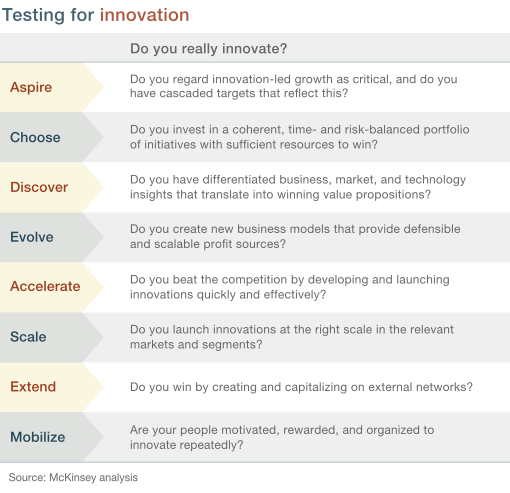
Look at the list below and you’ll see that most core items involve some kind of support mechanism either through teams, senior leadership, or markets.

Testing for innovation
https://www.mckinsey.com/business-functions/strategy-and-corporate-finance/our-insights/the-eight-essentials-of-innovation

Three Lessons for Support Generation

There are three core lessons from the literature on what to do:

  1. Find a tribe, build a community, join in with others. Whatever it takes, connect with those in your market, outside your market and those you wish to serve. Engage.
  2. Be a friend to have a friend. Share ideas, lessons learned, and assist your community however you define that. We see time and again that the best organizations are known and respected because they give from themselves. That also ensures that they receive just as much. You’re much more likely to attract the kind of knowledge that you need, the skills that you need when you share the knowledge and skills that you have. Creating a connected community of people who ‘get’ you is important.
  3. Leave the heroes to the comic books. Heroes make for great stories, but really lousy, real life models for change. What you need is a supportive structure. Mastermind group leadership teams, peer meetups – they all make a difference in reducing isolation and increasing the amount of contact points you have so that you can generate ideas and do so in a group that understands you. These can be internal or external — but they must allow for support to be gained and received.

You can’t do it alone. Find ways to connect with others who are doing something similar to what you’re doing, that support, which will be different for everybody, but that difference makes all the difference.

If you want to build a strategy to create connections within your organization contact us — we can help. We can also help you build the kind of internal structures to learn, share ideas, and innovate.

Photo by Neil Thomas on Unsplash

The post The Role of Support in Innovation appeared first on Cense Ltd. .

Written by cplysy · Categorized: cameronnorman

Feb 09 2022

The Role of Knowledge in Innovation

In this second in a short series on change-making fundamentals, we look at the role of knowledge. This was covered in the second episode of Censemaking: The Innovation Podcast.

Knowing and Doing

There is an unspoken assumption that ‘to know is to do‘ anchoring knowledge to change. Yet, as evidence shows all around us (just look at politics or COVID-19, to name just two) that what we say, believe, know, and do are all different.

To innovate is to take knowledge and create something new with it. While knowledge is almost always an ingredient of change, it isn’t always the main driver of change. To illustrate, consider that more than 1.3 billion people in the world regularly use tobacco products even though the science on the negative health consequences of cigarette use is overwhelming. At present, more than 8 million people every year die from cigarette use. So knowledge is important, but we know it’s not the only way to get someone to change.

What’s necessary are to focus our efforts on types of knowledge and their roles in facilitating change. There are three core areas of knowledge:

Types of Knowledge

Process knowledge is the kind of knowledge we have for how to get things done. Process knowledge might be how to organize a team, or how bring things about and deliver service value.

Technical knowledge is tied to the use of tools, frameworks and their application related to the specific means of accomplishing things. Technical knowledge might be how to use a particular piece of software

Content knowledge is focused on the topics of relevance to what you want to innovate or change. It may be knowledge about the market or the particular problem of which your innovation is looking to solve.

Research and Self Assessment

Innovation doesn’t require that we are experts in everything, but it does require that we know, a certain amount of what is important. This is where self-assessment like the personal inventory method and other tools can come in handy. It’s also where design research . If, for example, you’re looking into children’s mental health, you probably need to know a little bit about how children function and what services might already be in place.

Design research helps build content knowledge and helps us to fill gaps in skills or process knowledge that we may not have. However, we don’t recommend so much research that it is no longer easy to make sense of what you are doing. Sensemaking is a key stage of synthesis and strategy for dealing with large amounts of research data. It’s also important to also remember that innovation is about something new so we may not have all the data that we need to draw clear conclusions.

The key lessons are that we can’t assume that having knowledge leads to change. With research, sensemaking, and processes to ask questions about what we know we can better innovate.

Censemaking: The Innovation Podcast is available through most places you get your podcasts.

Photo by Gabriella Clare Marino on Unsplash

Doing Our Homework on our Research

The post The Role of Knowledge in Innovation appeared first on Cense Ltd. .

Written by cplysy · Categorized: cameronnorman

  • « Go to Previous Page
  • Go to page 1
  • Interim pages omitted …
  • Go to page 6
  • Go to page 7
  • Go to page 8
  • Go to page 9
  • Go to page 10
  • Interim pages omitted …
  • Go to page 21
  • Go to Next Page »

Footer

Follow our Work

The easiest way to stay connected to our work is to join our newsletter. You’ll get updates on projects, learn about new events, and hear stories from those evaluators whom the field continues to actively exclude and erase.

Get Updates

Want to take further action or join a pod? Click here to learn more.

Copyright © 2026 · The May 13 Group · Log in

en English
af Afrikaanssq Shqipam አማርኛar العربيةhy Հայերենaz Azərbaycan dilieu Euskarabe Беларуская моваbn বাংলাbs Bosanskibg Българскиca Catalàceb Cebuanony Chichewazh-CN 简体中文zh-TW 繁體中文co Corsuhr Hrvatskics Čeština‎da Dansknl Nederlandsen Englisheo Esperantoet Eestitl Filipinofi Suomifr Françaisfy Fryskgl Galegoka ქართულიde Deutschel Ελληνικάgu ગુજરાતીht Kreyol ayisyenha Harshen Hausahaw Ōlelo Hawaiʻiiw עִבְרִיתhi हिन्दीhmn Hmonghu Magyaris Íslenskaig Igboid Bahasa Indonesiaga Gaeilgeit Italianoja 日本語jw Basa Jawakn ಕನ್ನಡkk Қазақ тіліkm ភាសាខ្មែរko 한국어ku كوردی‎ky Кыргызчаlo ພາສາລາວla Latinlv Latviešu valodalt Lietuvių kalbalb Lëtzebuergeschmk Македонски јазикmg Malagasyms Bahasa Melayuml മലയാളംmt Maltesemi Te Reo Māorimr मराठीmn Монголmy ဗမာစာne नेपालीno Norsk bokmålps پښتوfa فارسیpl Polskipt Portuguêspa ਪੰਜਾਬੀro Românăru Русскийsm Samoangd Gàidhligsr Српски језикst Sesothosn Shonasd سنڌيsi සිංහලsk Slovenčinasl Slovenščinaso Afsoomaalies Españolsu Basa Sundasw Kiswahilisv Svenskatg Тоҷикӣta தமிழ்te తెలుగుth ไทยtr Türkçeuk Українськаur اردوuz O‘zbekchavi Tiếng Việtcy Cymraegxh isiXhosayi יידישyo Yorùbázu Zulu