• Skip to main content
  • Skip to footer
  • Home

The May 13 Group

the next day for evaluation

  • Get Involved
  • Our Work
  • About Us
You are here: Home / Archives for allblogs / engagewithdata

engagewithdata

Feb 11 2020

Resolving Data Fears in Education

I had some great conversations this week with colleagues about establishing a culture of data in organizations and training organizations who are new to evaluation and data. These conversations reminded me about one of my favorite old blog posts, that I originally wrote for the National Association for Family, School, and Community Engagement (NAFSCE) in 2017. Given this week’s discussions, it felt like a good time to bring it back into the rotation (with a few updates!). 

Don’t Be Scared of Data – How it Can Guide Family Engagement and Attendance Interventions

When I was a teacher, conversations around instructional data were baffling to me. Fresh out of policy school, I was eager to use what I had learned about data analysis to monitor how my students were performing, but as a social studies teacher, this task was more difficult than I had anticipated. I was required to keep a data binder, and administrators would periodically check to confirm that, well, it existed. However, I struggled to figure out what to put inside of it. My administrators did not help me understand how – absent standardized test data – I could track progress on specific standards outside of my grade book. It often felt like the conversation ended after the word “data” was uttered.

As I have focused my career on family engagement efforts, I have seen how conversations about using data to improve engagement are often greeted by the same blank stares I encountered as a teacher of a non-tested subject. On other days, talking about data elicits looks of panic or skepticism. At one particularly memorable training, community school coordinators were led in a debate about the utility of data. Sitting from my seat on the pro-data side of the room, I was amazed by arguments from the anti-data group. What resonated most is that these capable and talented colleagues understood data to simply be numbers on which their performance review was based, not as a tool to discover context and unlock insights about the families being served.

I think this belief system exists for a number of reasons. First, many educators are tired of increasing demands for data without sufficient training. Professionals need to understand how data can be collected, ways in which it should be analyzed, and how it can actually make their work easier. I have found that on-the-ground staff are often the last to receive the proper supports and professional development around understanding and using data. It becomes a symbol for all of the things we don’t like about accountability instead of the asset that it truly can be.

Perhaps more importantly, the work of engaging families – understanding needs, forming trusting relationships, and helping people when they are vulnerable – is incredibly difficult to quantify. Often, we know we have made progress or achieved results – not because of a spreadsheet or heat map – but because a family had enough food for the weekend or because a child stopped acting out as much in class. How do we tell those stories? How do we show our value as professionals when these important markers seem impossible to put into a spreadsheet? These are the critical questions we need to answer.

For these reasons, it is my mission to help educators and professionals realize that data does not have to be scary or intimidating. It does not require complex coding skills or mathematical know-how to track how clients are being served. If you would have been sitting across from me in the data debate, here are some tips to get you started:

  • Start with what you have. If you are trying to get more parents involved at the school, it’s helpful to know exactly who is already coming to events. Try making a spreadsheet of the information from your event sign-in sheets and see what patterns you find. For example, comparing the names on this list to a whole-school roster can help you figure out which kids have had little to no in-person parental involvement. Use this approach for other measures that you can track from the information and documents already sitting in your office.
  • Leverage the expertise around you. Everyone knows who the go-to person is at their workplace when they have a technology question. Maybe that person (or someone else) also has some knowledge of Excel or other tools. Anyone can fill in a template. See if a colleague can help you design the tracking tool you know you need but do not know how to create.
  • Do not be afraid to play around and make mistakes! The best way to learn how to manipulate and analyze data is to get your hands dirty and play around with it. Try different buttons, Google how to do things, and ask what colleagues at other schools and organizations are doing. This is why there is an “Undo” button! Of course, if you are unsure, you can always make a copy of your file so the original data is safe.

Using your organization’s qualitative and quantitative data can give you amazing insight into both the ongoing needs and continuing growth of the students and families you serve. With a little less reticence towards this approach, we can make a lot more progress in engaging families to help their children succeed.

Of course, if your organization is unsure of how to get started in this area, I’d love to be of assistance. Learn about the new Build Your Evaluation Capacity training package!
Written by cplysy · Categorized: engagewithdata

Jan 28 2020

Structured Solutions’ New Service Packages

You may notice that the website has gotten a bit of an overhaul. I wanted to better communicate what clients get from working with me and what makes Structured Solutions different from other small evaluation firms. 

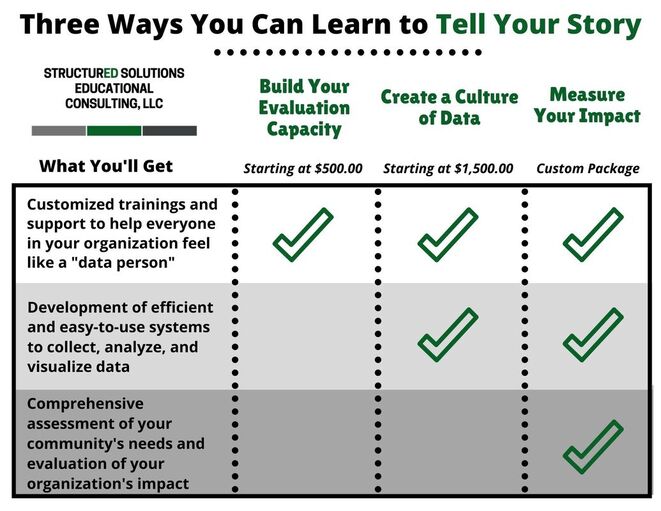
The biggest change is that I’ve restructured the services I provide. There are now three distinct packages that clients can buy — all still customizable, of course — that will help you achieve your data and evaluation goals. The graphic below gives a quick overview, but I go into more detail below:

Picture

All three packages are designed as steps that organizations can take towards telling a rich, compelling story about the work they do for students and families and the impacts they have on their clients. Here are the details about each package: 

BUILD YOUR EVALUATION CAPACITY
For organizations who are truly at the start of their data journey, this package is an ideal starting point. Your organization will get a customized training and follow-up technical assistance in the areas you need. The goal is for your entire team to leave the training with confidence that they can work with and use data like a pro. 

CREATE A CULTURE OF DATA
The second package builds on the first and will include the custom trainings and support from Build Your Evaluation Capacity. After your team has been trained, we will get to work on developing data systems and procedures that are accessible to all skill levels. Depending on your organization’s needs, we will create simple, customized systems for data collection, management, or visualization that allow for sustainability and continued attention to data in the future.

MEASURE YOUR IMPACT
In order to truly tell your organization’s story, you must first know what impact you’re actually having. The third package gives you all of the benefits of the first two but will culminate in a full-scale needs assessment or evaluation. As this type of work tends to be highly individualized and ongoing, we will work together to design a package that fits your needs and ensures that any evaluative requirements from funders or supervising organizations are met. 

If your organization is in the beginning stages of its data journey and could use some support, I’d love to set up a conversation with you. 

Written by cplysy · Categorized: engagewithdata

Jan 13 2020

My Most Powerful Reads of the Decade

I love to read. Curling up with a good book and getting lost in the story for hours is pure bliss for me. Of course, adulthood prevents this from being a regular occurrence, but I still treasure the time I spend reading and the lessons I learn from the books on my shelves. 

I was struggling to come up with a topic for this week’s post and decided to look at my notebook of what I’ve read over the years. Given that a new decade has officially commenced, I excitedly realized that I could reflect on my favorite and most inspiring reads from the past decade. If Barack Obama and Bill Gates can share their lists of favorite books, why can’t I? With much difficulty, I chose one book that I read each year that helped me understand the world – and why it is the way it is – with greater clarity and from other perspectives. 

2010: Half the Sky by Nicholas Kristof and Sheryl WuDunn

This book by two acclaimed reporters focuses on how empowering women in developing countries can bring about a reduction of poverty and an economic boost for all. Discussions on the impact of micro-finance – providing small loans to women (or men) to help them start a business, get an education, and/or support their families – and the stories of individual women who benefited it are compelling. The authors show how even minor investments can have a tremendous return – economically and emotionally – for women who have been abused, disenfranchised, or simply undervalued. 

2011: The Immortal Life of Henrietta Lacks by Rebecca Skloot 

As an alumna of Johns Hopkins and a longtime Baltimorean, the story of Henrietta Lacks intrigued me on many levels. Rebecca Skloot’s book talks about how a black woman in Baltimore in the 1950s inadvertently became the foundation of widespread and landmark medical research. Not only did I learn about the HeLa cells (which were removed from her when she was treated for cancer at Hopkins Hospital and used for research without consent) and the science they inspired, but I also got new insights into what Baltimore and Hopkins were like during segregation, how differently black patients experienced medical care than white patients, and how the Lacks family still struggles today. 

2012: The Jungle by Upton Sinclair 

I distinctly remember my 9th grade U.S. History teacher discussing this novel and its implication of the meatpacking industry in the early 1900s. I didn’t think I could stomach Sinclair’s descriptions of “how the sausage gets made” then, but when I read this classic as an adult, I was astonished to learn that this book is about so much more than horrifying practices of Chicago’s meatpacking plants. What struck me most were the immense challenges faced by immigrant communities at the time and the conditions they had no choice but to endure in order to support their families and survive.

2013: Fire in the Ashes by Jonathan Kozol

I would be remiss to not include a book by my hero, Jonathan Kozol. His compassionate and candid discussions of poverty and the unacceptable conditions of educational systems in America have inspired me since I was in college, and I was lucky enough to hear him speak and meet him many years ago. This book commemorates 25 years of his critically important work by following up with the children he befriended and wrote about through his impassioned research and storytelling. 

2014: Education and the Cult of Efficiency by Raymond Callahan 

Although this text was written in 1962, it is still incredible relevant to educational debates today. Callahan reflects on how the “efficiency movement” of the early 1900s influenced the structure of schooling in America. His book shares how the management of time and production efforts in American factories spawned everything from traditional school schedules and bell systems to accountability structures and the desire for measuring … well, everything. Since schools are human-serving organizations and therefore quite different from factories, this book made so much sense to me as a partial explanation for how our educational systems developed in a misguided way. 

2015: Black Boy by Richard Wright

My college professor (and my friend and mentor to this day), Dr. Floyd Hayes, is a Richard Wright scholar and first introduced me to his work. I’ve read many of Wright’s books over the years and in fact started 2020 with one of his masterpieces. Yet Black Boy stuck with me in a profound way. This is Wright’s autobiographical work, and his profoundly moving descriptions of hunger as a child made that phenomenon clear to me in a way that nothing else had. I am fortunate to have always had food on the table, but this book gave me a powerful understanding for those who struggle every day. 

2016: Five Miles Away, A World Apart by James Ryan

Ryan’s book about the differences between two large high schools – one in a suburb and the other in the neighboring city – and the political underpinnings of those differences was not a comfortable read. He describes in detail the way that local, state, and national governments and courts have historically and systematically “saved the cities and spared the suburbs” through damaging, discriminatory policies. These policies and legal decisions, made under the guise of being progressive and helpful, in fact helped to keep our schools and neighborhoods segregated and our non-white citizens disadvantaged. This book, among others read at the same time, completely transformed the way I think about our government, public institutions, and society in general.

2017: We Were the Mulvaneys by Joyce Carol Oates 

This novel follows the breakdown of a once tight-knit family after their only daughter experiences a significant trauma. While I have enjoyed many of Oates’ novels, this one was a particularly compelling illustration of how trauma not only affects the person who initially experiences it, but how it also impacts the entire family system. Told from the perspective of the youngest brother, this is a story that I could not put down and that kept me thinking.

2018: The New Jim Crow by Michelle Alexander

Anderson argues that our country’s horrifying system of mass incarceration is the newest iteration of the Jim Crow laws of the 20th century. She shares compelling parallels between the systems of control, containment, and oppression used during slavery, segregation, and in between, to maintain white superiority and the widespread incarceration of black men that began with the War on Drugs. Her discussion of racism and social control is informative and eye-opening and is a critical read for understanding the dynamics of our current society. 

2019: $2.00 a Day: Living on Almost Nothing in America by Kathryn Edin and Luke Shaefer

​​This had been on my reading list for a few years, after hearing author Kathryn Edin speak at a conference. I wish I had gotten to it sooner, as it was one of the most enlightening books I have read in a while. Edin and Shaefer tell the stories of a number of families who, through circumstances often beyond their control, effectively live without any income. In what seem like unfathomable situations, the parents highlighted in this book dispel stereotypes about people living in poverty or who receive/are eligible for public assistance. I was blown away by the sheer resilience and persistence that these families continually demonstrated, and I learned so much about just how little is done to support those who need it most.
Which books inspired you the most over the past decade? Share your recommendations in the comments!

Written by cplysy · Categorized: engagewithdata

Dec 29 2019

What I Learned from a Not-So-Great Year

I know I’m in good company when I say that I’m not sad to say goodbye to 2019. I also know that the challenges I faced this year pale in comparison to the experiences of so many others whom I have read or heard about throughout the year. Yet personally and professionally, this year seemed to have a never-ending supply of curveballs to throw my way. I am happy and thankful to report that 2019 has ended far better than it started, but looking back, I can admit that I learned a lot of important lessons over the past 12 months. 

Lesson 1: I’ve got a lot of good people in my corner. Here’s a short list of who I’m especially grateful for:

  • Jennifer McDowell, who shared her infinite wisdom with me through her life coaching practice and helped me clarify my professional aspirations and goals,
  • Brandon Roche, who helped me improve my website and online presence in simple ways I did not know were possible, 
  • Tracey Walterbusch, who consistently networks for me and has helped me get professionally acclimated in Columbus, 
  • Leah Neaderthal, for helping me to more effectively show the world what I have to offer, 
  • My husband and family, for picking me up on my bad days and jumping for joy with me on my good ones, 
  • And so many more!

Lesson 2: Sometimes you need a different perspective on the problem. Transitioning my business from Baltimore, where I lived for over a decade, to Columbus, where I didn’t know anyone, was more challenging than I anticipated. After a number of frustrating months, I realized that there were other ways to run my business than the few tried and true strategies I was using. I started reaching out to people from different fields and points in their career for new insights.

I learned about search engine optimization, value-based marketing, and customer relationship management software. I joined the Ohio Program Evaluators Group (OPEG) and went to my first American Evaluation Association Conference. I gained a huge network of like-minded and supportive people who have opened up a world of ideas and opportunities for me. I learned that there is always something I can try to reach new potential clients, expand my impact on schools and communities, and grow my business. These experiences lit a fire under me to continue trying new things to make Structured Solutions better than ever. 

Lesson 3: It’s never ALL bad. I can’t even tell you how many rejections I got this year. I felt so defeated and unclear about how to move forward. However, a lot of great things happened in 2019 too – they just get clouded by the discouraging events of this year. Here are some awesome things that happened for Structured Solutions in 2019: 

  • I got invited to present with NAFSCE on their April Effective Practices Webinar. Check out the recording here!
  • I worked with multiple recipients of the 21st Century Community Learning Centers grant to evaluate their impact on students and families — and participated in grant reviews to help other great programs get funded. 
  • I was able to share my work at OPEG’s Fall Exchange in Athens, Ohio and at the Corporation for National and Community Service’s 2019 Research Summit in Arlington, Virginia. 
  • Most recently, I got the amazing opportunity to do research at Ohio State University’s College of Social Work to learn more about vulnerable youth and families.

I’m glad to put 2019 behind me, but like all challenging experiences, I know that it has helped me grow as a person and as a business owner. I am optimistic that 2020 will be a better year (hopefully for everyone else too!), but I aim to continue the spirit of character-building, self-improvement, and continuous learning that 2019 necessitated.

​Happy New Year!

Written by cplysy · Categorized: engagewithdata

Dec 15 2019

Telling Community Stories to Affect Change

It’s funny where the most interesting and engaging conversations can happen. At the gym last week, I had a few random, but passionate conversations with other members of the educational (and martial arts!) community about youth experiencing trauma and how it impacts their ability to participate in school, learn effectively, and handle their emotions. 

Trauma is something I wish I had learned about when I became a teacher over ten years ago. Like many new teachers, I struggled with classroom management. It is probably not surprising to learn that as a 5’2″, 22 year-old woman, I did not have a natural authoritative presence. However, there were many other reasons for the challenges I faced — ineffective and harmful administrators, a lack of shared expectations among our middle school team, and my own battle with anxiety. These all contributed to what often felt like turmoil in my classroom. While I always empathized with the challenges my students faced in their own lives, I never fully understood the ramifications of the trauma and hardship they experienced — nor did I know where to connect them or their families for additional support. 

I was lucky because the school had a wonderful social worker and part-time psychologist to whom I could refer students. They also served as great supports and sources of advice and knowledge for me as a new educator. Yet, there was little capacity and no infrastructure at the school for understanding and responding to trauma. I remember being told that students were experiencing homelessness, hearing stories about families who were involved in gangs, and seeing that students were extremely impoverished, but I had no tools to process these situations or fully support my students. I felt anguish about the situations they were experiencing, but I know I did not always respond effectively. 

Years later, after working in a community school and supporting many others, I know what more effective and comprehensive supports can look like. I have seen the benefits of wraparound services for students and families, including a full mental health team; meaningful enrichment and engagement opportunities for students and adults; connections to resources for basic needs such as housing, food, clothing, and adult education; efforts to track and review data on engagement, attendance, and supports provided; and most importantly, a loving and affirming approach to working with students and families with the greatest needs. Community schools — schools that become a hub of the surrounding community and provide these wraparound services for students, families, and community members — are well-supported by research. This model has been shown to be beneficial in reducing chronic absenteeism, improving school climate, increasing student achievement, and more. One of the findings from a 2017 Learning Policy Institute report states that:

“The evidence base provides a strong warrant for using community schools to meet the needs of low-achieving students in high-poverty schools and to help close opportunity and achievement gaps for students from low-income families, students of color, English learners, and students with disabilities.”

​So when my friend at the gym, a high school guidance counselor, told me that his school effectively did not have any mental health clinicians available to students, I was taken aback. I talk to him frequently about his school and the amazing ways in which he supports his students, so I was shocked to learn that this large high school was so under-resourced in this area. The school seems to be on its way toward providing wraparound services, with a brand new food pantry and the dedication of counselors like my friend. Yet this conversation made me realize that the services I took for granted in Baltimore City schools — which were still often insufficient to meet the high level of need — did not exist everywhere.

This was a critical and humbling realization. Of course, if we could make students’ barriers disappear — or at least provide them with the resources that they need to overcome these barriers and thrive — we would. But in the absence of a magic wand, what can we do? From my lens, this is where needs assessments and data tracking can play a huge role. Imagine if we collected stories from students, families, and staff about the challenges faced by the school community, each stakeholder group’s perceived needs, and their recommendations for meeting those needs. Now think about if we used factual data about the community and student population to support those stories. What we would get is an intensely compelling, collective narrative about what this community needs and how its members feel those needs could be met.

Could a needs assessment or set of data instantly bring on a full slate of mental health workers at this school? Of course not. But when we tell our story effectively, people (read: funders, decision-makers, influencers) listen. And when people start listening, we can inspire them to make change. 

Written by cplysy · Categorized: engagewithdata

  • « Go to Previous Page
  • Go to page 1
  • Interim pages omitted …
  • Go to page 8
  • Go to page 9
  • Go to page 10
  • Go to page 11
  • Go to Next Page »

Footer

Follow our Work

The easiest way to stay connected to our work is to join our newsletter. You’ll get updates on projects, learn about new events, and hear stories from those evaluators whom the field continues to actively exclude and erase.

Get Updates

Want to take further action or join a pod? Click here to learn more.

Copyright © 2026 · The May 13 Group · Log in

en English
af Afrikaanssq Shqipam አማርኛar العربيةhy Հայերենaz Azərbaycan dilieu Euskarabe Беларуская моваbn বাংলাbs Bosanskibg Българскиca Catalàceb Cebuanony Chichewazh-CN 简体中文zh-TW 繁體中文co Corsuhr Hrvatskics Čeština‎da Dansknl Nederlandsen Englisheo Esperantoet Eestitl Filipinofi Suomifr Françaisfy Fryskgl Galegoka ქართულიde Deutschel Ελληνικάgu ગુજરાતીht Kreyol ayisyenha Harshen Hausahaw Ōlelo Hawaiʻiiw עִבְרִיתhi हिन्दीhmn Hmonghu Magyaris Íslenskaig Igboid Bahasa Indonesiaga Gaeilgeit Italianoja 日本語jw Basa Jawakn ಕನ್ನಡkk Қазақ тіліkm ភាសាខ្មែរko 한국어ku كوردی‎ky Кыргызчаlo ພາສາລາວla Latinlv Latviešu valodalt Lietuvių kalbalb Lëtzebuergeschmk Македонски јазикmg Malagasyms Bahasa Melayuml മലയാളംmt Maltesemi Te Reo Māorimr मराठीmn Монголmy ဗမာစာne नेपालीno Norsk bokmålps پښتوfa فارسیpl Polskipt Portuguêspa ਪੰਜਾਬੀro Românăru Русскийsm Samoangd Gàidhligsr Српски језикst Sesothosn Shonasd سنڌيsi සිංහලsk Slovenčinasl Slovenščinaso Afsoomaalies Españolsu Basa Sundasw Kiswahilisv Svenskatg Тоҷикӣta தமிழ்te తెలుగుth ไทยtr Türkçeuk Українськаur اردوuz O‘zbekchavi Tiếng Việtcy Cymraegxh isiXhosayi יידישyo Yorùbázu Zulu