• Skip to main content
  • Skip to footer
  • Home

The May 13 Group

the next day for evaluation

  • Get Involved
  • Our Work
  • About Us
You are here: Home / Archives for allblogs / engagewithdata

engagewithdata

May 04 2020

The COVID Slide

Last week, I watched a powerful webinar from Ohio State’s Wexner Medical Center about health inequity and COVID-19. One of the first speakers, Dr. Nwando Olayiwola, started to talk about vulnerable populations but quickly corrected herself. She called them, “populations that have been made vulnerable.” 

What a difference such a small change made. Instead of assuming that people in those populations are inherently vulnerable, her corrected phrase shows that inequity is the result of intentional decisions that negatively affect specific groups of people. Her quick self-correction stuck with me. 

This morning, I was reading the education news that comes to my inbox each day and saw a headline from the Wall Street Journal last week that read, “Some School Districts Plan to End the Year Early, Call Remote Learning Too Tough.” Another entry in the same newsletter suggested that based on a national poll of teachers and administrators, 65% want to start the school year as normal in the fall, without adjustments to the curriculum or schedule. My heart sank, and I instantly thought of Dr. Olayiwola’s revised phrase. 

Now, I am no longer a K-12 teacher, so it is unfair for me to pass judgment on educators, whose jobs were already difficult, and who had to do a 180-degree shift in their daily practices within days or weeks. That is an incredible challenge, and it will take time to adjust. I empathize with teachers and cannot imagine what I would have done if I had to shift my middle school instruction online in a heartbeat. However, we’re also faced with a growing educational crisis.

Evaluators and researchers have been doing some great work to illuminate the educational ramifications of COVID-19 on disadvantaged communities. Researchers have studied the concept of “summer slide” for many years and have shown students regress in math and reading skills without educational opportunities during the summer. There is even a National Center on Time and Learning, whose work revolves around reducing inequities related to the inflexible and insufficient school year schedules that predominate in our country. Recently, the Collaborative for Student Growth found that an even more significant “COVID slide” is likely to occur when students return to school in the fall, having retained only about 70% of the reading growth and 50% of the math growth they would have typically made in a school year. Recommendations to mitigate the COVID slide include summer school and additional learning time for students. 

Yet, the Wall Street Journal article discussed how districts across the country are choosing to end the school year up to three weeks early in order to have more time to prepare for the fall. One superintendent even stated, “It made sense to us to get rid of the stress and get ready for the following school year.”  We certainly need more supports for teachers and greater access to technology for students in order to make online learning more functional and effective. But does that justify giving up entirely?

Decades of research have shown that more time in school leads to better outcomes for students, especially those from low-income communities. In a time of increased risk for widening the achievement gap, is it ethical to throw in the towel? By justifying inaction with the feeling that it is too difficult to educate students from home, we are making our student populations — in many cases — more vulnerable than they already were. I hope that evaluators and researchers can come together with educators to study the data, fully understand the problem and its drivers, and develop policy recommendations that will not only support teachers but will also do right by students who need time with teachers to thrive.
Written by cplysy · Categorized: engagewithdata

Apr 20 2020

What Will Be Your Story?

It’s not always easy to measure the impact of family and community engagement efforts. Some aspects of education — like test scores or report card grades — (notwithstanding the wide variety of controversies around their use) are pretty straightforward to measure. They’re already quantified. They’re known entities. We can tell that story. But when we talk about measuring the impact of, say, a super successful family science night, our minds go blank. 

Thinking of our present situation, in which family and community engagement is more critical than ever, how can we tell the story of how a school or organization engaged and supported its students and families and even its neighbors during the pandemic? How do we collect and measure both the individual or personal impacts and the large-scale results?

Erica Green and Lola Fadulu did such an effective job of this in a recent New York Times story about how school cafeterias across the country have become “relief kitchens” for not only students and their families, but also community members in need. The cafeteria manager featured in the story effortlessly rattles off the incredible numbers of people she and her team have served and also shares stories of individuals she’s encountered. Not only is she a hero in her community, but she’s a perfect example of one of my core beliefs — that you don’t need to be a statistician to effectively use data in your work.

If your team is not sure how to start measuring your COVID-19 impact and telling its story, here are three steps to get started: 

  1. Brainstorm the different types of data you already have. There will be more than you thought! Traditional sources of school data, such as attendance records, event sign-in sheets, or academic data, may be less available right now, so get creative. For example, think about all that you can learn from a log of phone calls made to families. You’ll know which numbers worked and which didn’t (which is basically a list of hard-to-reach families who need additional support), you’ll know which staff members have made the most calls, you’ll know how the families who were reached are doing, and you’ll know where subsequent outreach is needed. Pop that information into a spreadsheet, add some labels or color-coding to indicate who needs what, and you’ve got yourself a working database for the students in your school. If you add in all of your other data sources, your team will be data-rich and able to act.
  2. Consider collecting other data that you need. There are many ways to collect information from students, families, and community members right now. Think of all of your touch points with your key stakeholders. Students may be logging in for online class, families may be checking social media for updates, and all of your stakeholders may be accessing meal sites, like the one I mentioned above. At all of these venues, you can easily ask about needs, satisfaction with the school’s efforts, or any other questions you may have. You could have teachers post a poll for their students on Zoom, you could post an online survey on social media (or on the district website, like my home district in Columbus has done), or you could have surveys on half-sheets of paper available at meal sites. For families you can’t reach in one of these ways, there are always mailed surveys or text message options. You could also invite families you do reach to virtual focus groups, to learn more about their experiences and collect their insights. 
  3. Make data analysis a team effort. Using these rich sources of data should not be the sole responsibility (or luxury!) of the principal or district evaluators. Building a culture of data means getting everyone involved and modeling for them how to use data and why it’s so important. Consider hosting virtual staff meetings to work together on this data. I’ve seen a lot of districts hosting virtual PTA or PTO meetings as well – that’s the perfect place to get families involved. You could even make posters of important data and hang it on the walls at your meal sites. If you need some ideas for how to engage stakeholders in data analysis and interpretation, here is a blog post from the American Evaluation Association and here is a great list of resources from Better Evaluation about hosting data parties. 

This is just a short list of ways to use data to measure your impact and involve your community in doing so. Of course, if your school or organization needs some guidance, I’m here for you. I offer three different packages to support schools, districts, and organizations with this work. I’m also happy to do phone consultations to help you brainstorm. 

Regardless of how you do it, this is the time to make data a priority. What will be your story?

Written by cplysy · Categorized: engagewithdata

Apr 06 2020

How COVID-19 is Bringing Inequality to the Forefront

For the past few weeks, one image has been recurring in my mind. I keep picturing the living conditions of a student whose home I visited a few times when I was working as a community school coordinator in Baltimore. This student had struggled at other schools but was thriving at ours. He had repeated second grade, so his maturity compared to his peers was notable, but overall, he was just a really sweet kid. We did a number of home visits for him that year because he missed a lot of school, and as a black child from a low-income home with documented learning disabilities, school was even more important for him than most.
​
Every time I get frustrated with having to stay home – in my very comfortable apartment, with my husband and dog, and with fairly steady work – I’ve been trying to check myself. I keep thinking of my former student and imagining how difficult it must be to be confined to a space that may not be healthy, safe, or developmentally appropriate. I keep thinking about all the students I’ve known who love coming to school because there are people there who love them, two to three meals a day, and a sense of community. I keep thinking that I wish I knew how to help them all right now. 

There is no question that low-income students struggle to get to school. (I wrote about this in my last blog post as well.) According to Attendance Works: 

“Children living in poverty are two to three times more likely to be chronically absent—and face the most harm because their community lacks the resources to make up for the lost learning in school. Students from communities of color as well as those with disabilities are disproportionately affected.”

Unfortunately, they’re struggling to access school online as well. The New York Times reported this week that large percentages of low-income students in districts across the country are absent from the virtual education being provided as a result of COVID-19. ​So not only are students from disadvantaged backgrounds missing out on the resources that many of them so desperately need and want to access, but they are also disconnected from their school communities. Since it is unclear when we will be able to return to work and school, there is the possibility that our highest-need children could be without school for many months, only exacerbating already-existing gaps in achievement and opportunity. 

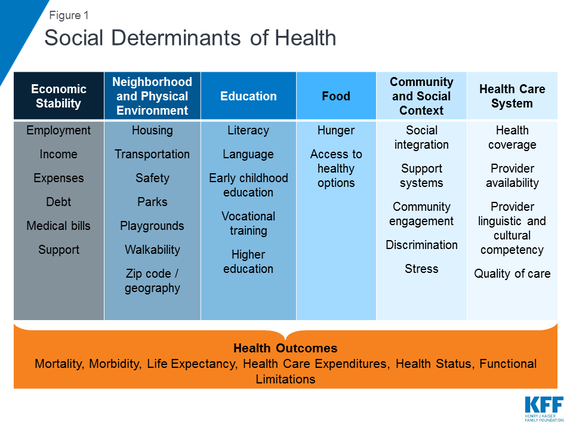
Making matters worse, black communities are disproportionately becoming victim to COVID-19. As one of the many social determinants of health, education joins other critical factors such as adequate housing, socioeconomic status, access to and coverage of healthcare, and more to comprise health outcomes for people and communities. As you can see in the chart below from the Kaiser Family Foundation, these factors have a profound impact on a person’s ability to live a healthy life. 

Picture

For low-income black communities in particular, the collective impact of these factors has not only disastrous outcomes but also clear roots. Dr. Camara Jones, a physician and epidemiologist, is cited in the article linked above about the disproportionate impact of COVID-19 on black communities:

“COVID is just unmasking the deep disinvestment in our communities, the historical injustices and the impact of residential segregation… This is the time to name racism as the cause of all of those things. The overrepresentation of people of color in poverty and white people in wealth is not just a happenstance.”

Our unequal and unfair society is how it is by design and not by chance. COVID-19 is showing us how this is even more urgently a matter of life or death. Other than overhauling our government systems and laws entirely, I struggle with not knowing how these issues can be fixed or what I as an individual can do to make things better for others. I just hope that opening up the dialogue about these issues will start to lead to changes for students like mine and the families and communities in which they live.

Written by cplysy · Categorized: engagewithdata

Mar 20 2020

Adapting for Improvement in Light of COVID-19

I naively said to my family a few weeks ago that I was lucky that my business wouldn’t be affected in the way that so many restaurants and other small businesses are by the pandemic. I couldn’t see then, but it has become incredibly clear since that every business and every industry have been and will be impacted on a massive scale by this pause in how we normally function. I am so fortunate that I can continue much of my work from home; yet every day, my heart breaks for other small business owners who are doing everything they can to keep their businesses afloat during this unprecedented time. 

I spoke to one of my former clients recently, and I expressed how badly I felt that the cancellation of schools would drastically affect his work. His response to me was this: “This is a time to pivot!“

All week, I’ve been thinking about what he said and what a resilient attitude he had. I’ve also been pondering how this affects not only my work but the organizations and communities I serve. Take the issue of chronic absenteeism in schools. Chronic absenteeism is typically defined as missing 10% of more of a given school year, and it has been empirically tied to a host of negative outcomes for students, including reading levels, special education identification, suspensions, dropout rates, and more. Students from vulnerable and underserved populations are at the highest risk. The good news about this issue is that it is both preventable and reversible, and I’ve found in my work that regular and collaborative data tracking on student absences and related interventions can make a huge difference for kids and schools. ​A recent article, Chronic Absenteeism in the Time of Coronavirus, discussed the implications of shuttered schools on how schools and systems typically address attendance issues, but also on what closed schools mean for the students themselves. ​

In thinking of how to pivot from the typical accountability measures associated with attendance, as Jordan’s article suggests, how can we in the education field work together during this time to address the root causes — the underlying reasons why so many students miss school? I am loving all of the positive news articles out there about school districts employing bus drivers to deliver meals, offering wifi hotspots to those without internet access at home, and teachers driving around students’ neighborhoods to help them feel connected. 

From my lens, I think this break from traditional schooling is an opportune time to go deep with our data and determine all that we can about which students are missing school the most and why. Once we’ve done that, we can get creative about our interventions for kids while they are in their homes and communities. I’ve got a few ideas in development for how my work can pivot to best serve our schools, districts, and non-profit organizations who have the most direct lines to children and families (more information on that to come!). In the meantime, if your organization is trying to better support its chronically absent students or more effectively engage with families during this time, let’s chat. Shoot me an email here so that we can set up a conversation. 

How are you planning to pivot? Share your ideas in the comments below – I’d love to start a conversation and channel our collective creativity!

Written by cplysy · Categorized: engagewithdata

Mar 05 2020

How Muay Thai Helped Me Re-Think Evaluation

I’ve been training in Muay Thai (kickboxing) for a few years. I am always learning something new and being pushed outside of my comfort zone … and I love it. However, I am and have always been a perfectionist. It’s something I’ve struggled with my whole life: sometimes, I’m really proud that I’ve been lenient with myself, and other times, the perfectionism rears its ugly head. Lately, I’ve noticed it manifesting at the gym. As I’m trying to apply a new skill in work with a partner or coach, I’ve been getting frustrated and self-critical. My self-protective instincts (ironically not working to appropriately block a punch or kick) have made me think, “I don’t like this aspect or that skill,” instead of allowing me to see that this is a process of growth and that there is no place for perfection in that process.

I think organizations (and the people within them) can be the same way when it comes to evaluation. We get used to our routines, we think we’ve perfected them, and then one of a few scenarios happen that push us out of our comfort zones. Maybe we are required to learn a new system or skill, or — even worse! — we get feedback that doesn’t match our own perceptions. Now at the gym, my feedback can be a simulated sparring round that doesn’t end so well for me. But in our workplaces, while we are focused on serving the people we care about, feedback that we’re not doing so well is upsetting to hear and painful to accept. That upset and pain is followed by questions — “What could we do differently?” Why is so-and-so doing well at this when we’re struggling?” or even “Is this feedback accurate or reliable?” Our self-protective instincts kick in.

The anticipation of negative feedback — in whatever form — is a huge barrier for people (including myself!) to try new things, reflect on their own performance, or seek help and other perspectives. Certainly, the accountability culture in education has only made these innate fears and insecurities worse. 

Today at the gym was different though. The past few days, I’ve been more reflective about why I’m getting so frustrated and how that is keeping me from truly learning and growing. So today, I tried to pay attention to the moments when I got frustrated (ie. I collected some data on myself!). I worked with my coach to talk through those negative feelings and develop some strategies I could try in those situations. Then, I practiced and stayed open to more feedback… and by the end of the session, I felt more resilient and confident in my skills than I had in awhile. 

Terms and methods like “continuous improvement” and “improvement science” get used a lot in both education and evaluation, and they are proven methods for making institutional (or personal) changes on all levels. I’m sure that what I did at the gym today was just a tiny Plan-Do-Study-Act cycle. Yet for me, these formal frameworks for self-assessment and reflection can sometimes be hard to grasp – and they can feel like another thing we’re accountable for doing. However, we can look at them more simply: sometimes, all we need to do is recognize that we’re passionate but not perfect, allow ourselves to be open to feedback, and develop an authentic plan for how we can improve. This is true for individuals and organizations.

As an evaluator, I love the moments when conversations about data lead to a-ha moments instead of feelings of defeat. (Data visualization is especially helpful here.) Sometimes, when we take a step back and think about why we’re assessing or evaluating, we can see that it’s not all about accountability and funding requirements (and not about our individual or collective insecurities either). Sometimes, it is just about putting our guard down (or up, if you’re at the gym), remembering that we can always do better, and learning to see our imperfections as a sign of growth in the making.

Written by cplysy · Categorized: engagewithdata

  • « Go to Previous Page
  • Go to page 1
  • Interim pages omitted …
  • Go to page 7
  • Go to page 8
  • Go to page 9
  • Go to page 10
  • Go to page 11
  • Go to Next Page »

Footer

Follow our Work

The easiest way to stay connected to our work is to join our newsletter. You’ll get updates on projects, learn about new events, and hear stories from those evaluators whom the field continues to actively exclude and erase.

Get Updates

Want to take further action or join a pod? Click here to learn more.

Copyright © 2026 · The May 13 Group · Log in

en English
af Afrikaanssq Shqipam አማርኛar العربيةhy Հայերենaz Azərbaycan dilieu Euskarabe Беларуская моваbn বাংলাbs Bosanskibg Българскиca Catalàceb Cebuanony Chichewazh-CN 简体中文zh-TW 繁體中文co Corsuhr Hrvatskics Čeština‎da Dansknl Nederlandsen Englisheo Esperantoet Eestitl Filipinofi Suomifr Françaisfy Fryskgl Galegoka ქართულიde Deutschel Ελληνικάgu ગુજરાતીht Kreyol ayisyenha Harshen Hausahaw Ōlelo Hawaiʻiiw עִבְרִיתhi हिन्दीhmn Hmonghu Magyaris Íslenskaig Igboid Bahasa Indonesiaga Gaeilgeit Italianoja 日本語jw Basa Jawakn ಕನ್ನಡkk Қазақ тіліkm ភាសាខ្មែរko 한국어ku كوردی‎ky Кыргызчаlo ພາສາລາວla Latinlv Latviešu valodalt Lietuvių kalbalb Lëtzebuergeschmk Македонски јазикmg Malagasyms Bahasa Melayuml മലയാളംmt Maltesemi Te Reo Māorimr मराठीmn Монголmy ဗမာစာne नेपालीno Norsk bokmålps پښتوfa فارسیpl Polskipt Portuguêspa ਪੰਜਾਬੀro Românăru Русскийsm Samoangd Gàidhligsr Српски језикst Sesothosn Shonasd سنڌيsi සිංහලsk Slovenčinasl Slovenščinaso Afsoomaalies Españolsu Basa Sundasw Kiswahilisv Svenskatg Тоҷикӣta தமிழ்te తెలుగుth ไทยtr Türkçeuk Українськаur اردوuz O‘zbekchavi Tiếng Việtcy Cymraegxh isiXhosayi יידישyo Yorùbázu Zulu