• Skip to main content
  • Skip to footer
  • Home

The May 13 Group

the next day for evaluation

  • Get Involved
  • Our Work
  • About Us
You are here: Home / Archives for allblogs / engagewithdata

engagewithdata

Jul 13 2020

Making the Most of Microsoft Excel

I love a good spreadsheet. I mean, I really get excited about it. You may have read on the About page how my business evolved from the development of a really fancy spreadsheet. True story. Now I get to help others learn to use Excel to improve their work and watch them get excited about it too.

One positive thing to come out of the pandemic is an increased appetite for online professional development. Recently, I’ve gotten to connect with old friends and colleagues by providing a three-part Excel workshop series for the Family League of Baltimore. So on top of hanging out with my old network, I’ve gotten to teach them about all the fun stuff Excel can do. Win-win!

Here’s an overview of the series:

Part 1: Excel Basics
A lot of educators just haven’t been trained in how to use data. They may be consumers of it, using someone else’s spreadsheet to glean information, but often, they just don’t know how to utilize Excel’s features for themselves. The Excel Basics workshop starts from the top and discusses formatting, functions, and formulas that beginners can use to build their Excel capacity. 

Part 2: Creating and Using Templates in Excel
In the engagement world, there is so much to track! This session built on what was covered in the Basics session and walked participants through the process of designing their own customized tracking sheets. We used breakout rooms to discuss how to track different topics, and we walked through some more advanced features and functions to make these tools as automated as possible.

Part 3: Reporting and Visualizing Data in Excel
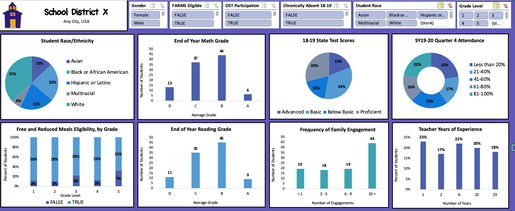
Data visualization is a hot topic in evaluation right now, and I get why. When you’re able to effectively show your data graphically, you can make your results accessible for a much wider audience. In this session, we talked about so many fun parts of Excel – PivotTables, creating charts and tables for reporting, and … drumroll, please … creating interactive dashboards! Did you know you can create dashboards like the one below to share with your team? 
Picture

Here’s what some of my past workshop participants had to say about their experience: 

  • “Practical examples applicable to daily work. Presented at the right pace. Great content.”
  • “My approach will be to allow my understanding of the various features to help me work smarter not harder. I am encouraged to continue to use excel, not run away from it.”
  • “I feel more aware of how to efficiently organize my data! This will be helpful for reporting, and analyzing data for my own outreach strategies.”
  • “I really enjoyed this session. They did a great job reaching participants of many levels.”

​
Besides my obvious bias towards using Excel for … well, everything … I think it is even more important now for schools and districts to be effectively tracking their work. As we navigate through so many unknowns with school reopening, it will be critical to keep an eye on students who are at risk of falling through the cracks.

​Good news – Excel can help (and so can I!). 

I’d love to bring this workshop series to more places, so if your team could use a bit of an Excel boost, let’s talk! 
Written by cplysy · Categorized: engagewithdata

Jun 29 2020

Why is it so hard to get a survey translated?

I admit: I didn’t think it was that hard to get a survey translated. 

Over the past few weeks, I learned just how wrong I was — and ate a big piece of humble pie in the process. 

With colleagues, I’m working on a landscape analysis of how families and educators in California feel about family engagement and the state’s requirements for incorporating stakeholder feedback into district plans for improvement. We’re designing a training program around these topics, but to make sure our program will be relevant, we wanted to hear from the people who would be participating in it. We designed a survey and planned for focus groups, and I naively thought we were good to go.

Although Baltimore has a growing — but fairly localized — population of English Language Learners, the families at the schools where I worked were predominately Black and English-speaking.  When I worked at the district, we had a cadre of interpreters we regularly contracted with for events, and we used large-scale survey software that easily facilitated (mostly adequate) translations. 

So when we decided to translate the California survey into nine additional languages, I didn’t anticipate just how difficult that would be. 

Our survey was fairly basic and brief, so I built it out in Google Forms … only to learn that despite the widespread availability of their free translation technology, there was no mechanism for translating surveys in their tool. (I’m honestly still scratching my head about this.) The most straightforward (ha!) way I found to create a multilingual survey in Google was to independently translate the survey into each language, build a separate page in the survey for each language, copy and paste each line of the translated surveys, and then use skip logic to direct people to the page with the language they selected. 

Umm what?

We gave up on Google. We found out that our client had a Survey Monkey account that included the ability to create multilingual surveys. I was excited. Finally – a logical way to complete this seemingly simple task! 

Nope. I was still wrong.

​While this platform at least offers a dropdown menu of languages on the survey page (thereby making it easier for respondents and avoiding the skip logic silliness on the back end), it turns out that this paid feature was just as cumbersome to use as the Google option. What I ended up having to do was download a coded text file for each language, pay to independently translate each of the languages (Thank you, Stepes Translation, for coming to our rescue!), copy and paste each line of the translations into specific sections of the text file, and then upload the translated file to the system. NINE TIMES.

With my hand cramping from all of that Ctrl-C and Ctrl-V action, I was stunned by how technically difficult and frankly, inaccessible the survey translation process was. Who is actually going to go through all this? More importantly, what does this mean for the voices of those who are not native English speakers? Without access to a large, institutional subscription to a powerhouse survey software, my gut tells me that very little translation is likely to happen. As a result, many important voices are being silenced. 

I don’t have a solution to offer here, but I’m glad that this is a lesson I learned. This has opened my eyes to the institutional roadblocks that prevent equitable language access in our country… and I know I’ve just scratched the surface. Translation services, albeit not 100% reliable, are widely accessible and free online, yet they are not integrated into lower-cost survey platforms. This not only causes a huge headache for survey designers, but it inhibits the ability to hear from non-English speakers about important issues. As I seem to say in a lot of my blog posts, we have to do better. 

If anyone has a better solution than the relay race I just ran, please share in the comments! I do hope that a more accessible and user-friendly option exists.

Written by cplysy · Categorized: engagewithdata

Jun 15 2020

Lifting Up All Families’ Voices Around School Reopening

It’s easy to feel discouraged and upset when you turn on the news these days. So much is happening to progress the fight for racial equity and justice in this country that even a global pandemic seems to have taken the backseat. The truth is that without a precedent for our current events, we are all making sense of them as they come. We face tremendous uncertainty in the days and months ahead, especially in the education sector. No one knows what school should or will look like when the 2020-2021 year begins in the fall. And that is scary. 

But here’s why I’m feeling encouraged. Without a doubt, the Black Lives Matter movement is bringing critical and often unheard voices to the forefront. I’m also starting to see this happening in schools, with many districts really lifting up the voices of parents and families as they make decisions for what reopening schools will look like. I’ve seen multiple districts just this past week sharing surveys with families about reopening. How can we truly serve children and families if we don’t know what they fear, what they want, or what they need?

So if your school, organization, or district is trying to imagine what school will look like in August, and you haven’t talked to families and students, now’s the time to use some simple evaluation strategies to give power to their perspectives. Here are a few tips to get started. 

Think about what you really need and want to know from your stakeholders. Make a list of what your team is wondering about or what the impact of proposed plans might be before you draft your survey questions. For example, many districts are considering alternate schedules to accommodate all students in socially distant ways. Here are a few things to think about: 

  • Do families have access to childcare and meals for when their kids would not be in school?
  • How do their work schedules align or conflict with proposed school schedules?
  • Would entire families be on the same schedule, or would parents and guardians have to juggle multiple schedules?
  • What are their fears and concerns (and those of their children) about returning to school?

We can turn these internal questions into survey questions for students and families to share their thoughts and influence these critical decisions. 

Encourage your survey respondents to commit to an answer. Whenever I take a survey, and I don’t really know or care about the answer, I always select the non-committal, middle option. Most people do – it’s human nature. However, during this especially important time, we can’t risk having a whole bunch of middle of the road responses. Consider using a four-point (instead of a five-point) scale that encourages respondents to indicate if they’re feeling negatively or positively about what you’re asking. Instead of a neutral/not sure answer choice in the middle, have them choose from a scale like this: Strongly Disagree, Disagree, Agree, or Strongly Agree. Include a “not applicable” option if you feel that’s relevant – we don’t want to force answers that don’t make sense – but this type of scale will give your team a better sense of which way your stakeholders are leaning and help you make more informed decisions.

Make it equitable and accessible. Hopefully it goes without saying that not all students and families can access a survey that is online and only in English. To embrace and reflect the diversity of our nation’s school districts, we must try to reach our stakeholders in multiple ways. Of course, an online survey is the easiest way to collect information, and many families can at least access the internet on their phones. However, some families cannot, and to truly understand what your families and students are feeling about reopening, we need to try to reach them as well. Think about mailing surveys or distributing them at food giveaways or other local gathering places. Or, if you’re unable to translate the survey into every language spoken in your district, hire a few bilingual staff members or outside interpreters to do brief phone surveys with families whose native language isn’t English. 

For the most successful reopening possible in the fall, districts need to know what families and students are thinking now. Brief surveys are an easy, cost-effective way to reach a large percentage of your stakeholders. Schools and districts need to think creatively to hear from as many families as they can and make their understanding of student and family needs as inclusive and diverse as possible. You’ll be amazed at how much more informative your results can be!

Written by cplysy · Categorized: engagewithdata

May 31 2020

We have to do better.

I still remember how scared I was during the 2015 riots/uprising in Baltimore after the death of Freddie Gray. 

I understood the pain and outrage in the black community over the death of a young, black man in police custody, but looking back, I didn’t really get the depth of the collective trauma that was at the heart of it. 

At the time, I was a Community School Coordinator at a predominately black elementary school about two miles down the road from Mondawmin Mall, the epicenter of the protests. As word spread of a student-led protest at Mondawmin that afternoon, staff and families began to fear for the safety of our students as they left school for the day. I had to take a different route on my way home, since I always passed the mall on my drive. On my detour, I passed armored National Guard tanks and heavily armed soldiers. It was clear that this was much more than a student-led protest. I was rattled.

That night, I holed up in my apartment and spent the entire evening glued to the news, unable to do anything but watch my city burn. Living close to downtown, I heard a lot of noise outside that night, but I was shocked to wake up and find buildings across the street boarded up, having been broken into the night before. 

I felt that same initial shock this weekend when I saw images of my new city – Columbus, OH – on fire. While still frightening, I had a different understanding of the situation than I did five years ago. 

In the five years since that night, I have continued to study, listen, and learn about the deeply institutionalized racism in this country and the violence that still accompanies it in modern-day America. I now have a better understanding of how intensely traumatized our black communities are from centuries of oppression, discrimination, and brutality, and I also know that I can never truly know that pain for myself.

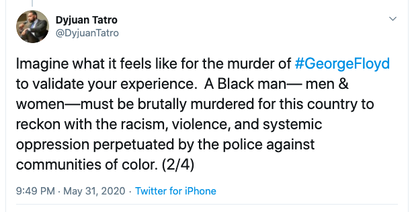
So the recent surge in senseless and hate-fueled killings of black men and women in this country has rested heavy on my heart. I’ve felt sick over the horrific and unnecessary deaths of Ahmaud Arbery, Breonna Taylor, and George Floyd in recent weeks … and so many others before them. I’ve heard the friends and colleagues I love question their own self-worth and the safety of their children just because of the color of their skin. Dyjuan Tatro, featured in the moving series College Behind Bars, about the Bard Prison Initiative, summed this up so eloquently: 

Picture

And yet, police brutality has only proliferated this week. I’ve watched videos of officers driving their cars into crowds of protesters, pulling down a young man’s mask and pepper spraying him, and shooting protesters and journalists in the face with “non-lethal” bullets. 

There is no reason for it, and there is no excuse. The blatant racism and hate crimes in our country must be prosecuted and condemned. 

But let’s think for a moment about our country’s black youth. On top of this historical and racial trauma that so many of them carry before they are old enough to understand it, they also attend under-resourced, hyper-segregated schools … and yet, we expect them to learn and function like those who are lucky enough to live without these burdens. 

It doesn’t make sense. We have to do better.

​I’m still grappling with my role in all of this and how I can try to make the world a bit better. I will continue to serve and support communities and school districts serving black and brown youth, but somehow that doesn’t feel like enough. I hope that as a nation, we can collectively remember that there is a common good, and that it is far easier to stand for that than to stand for hate. ​

Written by cplysy · Categorized: engagewithdata

May 17 2020

Evidence for Engagement

Picture

It’s funny how things work out sometimes. 

Tamara Hamai and I have been sowing the seeds for our new program, Evidence for Engagement, for months. Our partnership happened so organically – a meeting of the minds for two evaluators who have experience with and a passion for organizations that serve youth and families. We’d been toying with the best way to support the organizations that we serve and help them use evaluation to improve their access to funding and the children and families they serve. 

Then COVID hit. 

The pandemic has caused all of us to pause and re-evaluate how our work fits into a very new, very different reality. Tamara and I know that small organizations, especially those who work in schools, are struggling right now. Their access to the people they serve has been essentially cut off. We realized that organizations may need our help even more than before. 

Our solution: We’re running a totally free, three-week email series that will help small youth- and family-serving organizations build their evidence base (which is required under the Every Student Succeeds Act for any organization receiving federal education funds). Through videos, worksheets, frameworks, and success stories, Tamara and I will walk participants through the process of becoming evidence-based organizations and help them see this as an opportunity, not a burden. 

The goal: We want to help vital, community-based organizations plan for the future, open themselves up to new opportunities, and become more sustainably funded. We’re hoping that this opportunity will help them better serve youth and families, not only during this difficult period of time, but also for a long time afterward. 

For us, this is also about equity. We know that for many community-based, minority-owned organizations, budgeting for evaluation is out of the question. We also know that these grass-roots organizations are having a profound impact on their communities — and that their communities need all the support we can give. We’re hoping that we can get more small, local organizations approved as evidence-based programs in their districts and begin to level the playing field. 

If you think this program will benefit you and your organization, sign up! If you know of someone else who could use this support, encourage them to join. Feel free to share this link widely: bit.ly/evidence4engagement ​

Written by cplysy · Categorized: engagewithdata

  • « Go to Previous Page
  • Go to page 1
  • Interim pages omitted …
  • Go to page 6
  • Go to page 7
  • Go to page 8
  • Go to page 9
  • Go to page 10
  • Go to page 11
  • Go to Next Page »

Footer

Follow our Work

The easiest way to stay connected to our work is to join our newsletter. You’ll get updates on projects, learn about new events, and hear stories from those evaluators whom the field continues to actively exclude and erase.

Get Updates

Want to take further action or join a pod? Click here to learn more.

Copyright © 2026 · The May 13 Group · Log in

en English
af Afrikaanssq Shqipam አማርኛar العربيةhy Հայերենaz Azərbaycan dilieu Euskarabe Беларуская моваbn বাংলাbs Bosanskibg Българскиca Catalàceb Cebuanony Chichewazh-CN 简体中文zh-TW 繁體中文co Corsuhr Hrvatskics Čeština‎da Dansknl Nederlandsen Englisheo Esperantoet Eestitl Filipinofi Suomifr Françaisfy Fryskgl Galegoka ქართულიde Deutschel Ελληνικάgu ગુજરાતીht Kreyol ayisyenha Harshen Hausahaw Ōlelo Hawaiʻiiw עִבְרִיתhi हिन्दीhmn Hmonghu Magyaris Íslenskaig Igboid Bahasa Indonesiaga Gaeilgeit Italianoja 日本語jw Basa Jawakn ಕನ್ನಡkk Қазақ тіліkm ភាសាខ្មែរko 한국어ku كوردی‎ky Кыргызчаlo ພາສາລາວla Latinlv Latviešu valodalt Lietuvių kalbalb Lëtzebuergeschmk Македонски јазикmg Malagasyms Bahasa Melayuml മലയാളംmt Maltesemi Te Reo Māorimr मराठीmn Монголmy ဗမာစာne नेपालीno Norsk bokmålps پښتوfa فارسیpl Polskipt Portuguêspa ਪੰਜਾਬੀro Românăru Русскийsm Samoangd Gàidhligsr Српски језикst Sesothosn Shonasd سنڌيsi සිංහලsk Slovenčinasl Slovenščinaso Afsoomaalies Españolsu Basa Sundasw Kiswahilisv Svenskatg Тоҷикӣta தமிழ்te తెలుగుth ไทยtr Türkçeuk Українськаur اردوuz O‘zbekchavi Tiếng Việtcy Cymraegxh isiXhosayi יידישyo Yorùbázu Zulu