• Skip to main content
  • Skip to footer
  • Home

The May 13 Group

the next day for evaluation

  • Get Involved
  • Our Work
  • About Us
You are here: Home / Archives for allblogs / engagewithdata

engagewithdata

Aug 27 2021

A gut check

A gut check

While I am lucky that I get to consult with schools and districts in their work with families, it isn’t often that I get to engage with students and families directly (especially since COVID derailed my weekly mentoring sessions at a high school here in Columbus).

So I was especially delighted this week, when, through my part-time work at Ohio State, I got the opportunity to begin a series of focus groups with kinship caregivers (grandparents, aunts/uncles, and other relatives or close friends who are the primary guardians for their relatives’ children).

Through this study, we are trying to learn how the pandemic has impacted kinship families and how we can advocate for the resources and supports they really need to improve the quality of life of the children in their care and themselves.

To me, this study is a great example of engaging with data – using our conversations with key stakeholders to guide future interventions and advocacy efforts. 

Well, the first focus group was last night, and what I heard really impacted me. 

I talk a lot about telling your story and how using qualitative data with numbers and stats can amplify the effect of our analysis.

This focus group reminded me of just how powerful that effect can be. 

You see, for my work at OSU, I’ve done a lot of digging into the literature about kinship care and the national statistics about how children in and around the child welfare system fare in different settings. 

Yet hearing a particular focus group participant share their story last night made it all come to life for me, in a way I haven’t experienced since my time working in schools. 

This caregiver shared the raw, painful emotions they were experiencing as a result of caring for multiple children with few supports but plenty of challenging family dynamics, fears, and frustrations. It was impossible to not be moved by their story.

From reading other studies about kinship care or even reviewing survey data from this and other studies, I knew that all of these factors were common for kinship caregivers. 

Yet this qualitative data – this person’s actual experiences shared in their own voice – helped me better understand just how real these phenomena are and just how important it is to use our findings to help improve lives.  

This was a gut check for me – a reminder to always seek the stories in our data, connect them to real people, and use my place of privilege to try to make their world a bit better. 

As we re-enter schools this fall in a once-again scary and uncertain time, remember that the lines in your spreadsheets and the names on your event sign-in sheets are real people, often living difficult lives in an especially challenging time. 

Thankfully, as educators, we have the ability to connect our students and families with resources and supports, if only we are able to hear their stories.
For more information on using qualitative data in your engagement work, check out some past posts here, here, and here.

Written by cplysy · Categorized: engagewithdata

Jul 30 2021

Preparing for Another Uncertain Year

Preparing for Another Uncertain School Year

I think we had all hoped that after two school years disrupted by COVID-19, the 2021-2022 school year could be a return to “normal.” 

Yet with the Delta variant surging throughout the country and children under 12 still unvaccinated, it’s becoming clear that educators and families are in for another year of uncertainty.

The theme of this summer’s blog posts has been to figure out the meaning behind the data we collect and track – what’s the “so what?”

We’re all wishing that the taste of “normalcy” that we’ve gotten in early summer could stick around –  we’re exhausted from the constant worry and grief that the pandemic has wrought on us as individuals, families, and communities. 

But if there’s one good thing to come from how long we’ve been dealing with the pandemic, it’s this: it’s not an unknown anymore. We have data to help us navigate it.

This is true on the medical and public health sides of the issue, and it’s also true for education. 

Let’s think about all of the information we already have about how to handle whatever comes our way this school year:


  • We know how to keep our schools clean and help students follow good hygiene practices.


  • We know what challenges our families have been facing and how we can engage and support them, even remotely.


  • If we need to, we know how to provide high-quality remote and hybrid learning opportunities for students to keep them engaged.

Plus, we’ve got a ton of documentation to remind us of what we know if we feel overwhelmed. 

We’ve got logs of when and how the building was cleaned, we’ve got past family surveys and chat transcripts/recordings from family Zoom meetings to tell us what their needs and concerns were, and we’ve got lesson plans and other records of the teaching and learning strategies we tried and felt successful with. 

… and many other sources of data and information too!

As we turn our calendars from July to August and get ready to embrace the new year, we can look back on our data from the past two years and figure out what the “so what” was. 

Now is the time to dig deep with the information we do have – even as we await more information about what this year will hold. 

As we look back at the “what” from the past two years, think about the impact that each of those things had:

Which routines and practices helped students comply with safety measures and made the community feel safer? Which really didn’t work?

What were our families’ greatest needs, and how did we work to meet them? Did our supports and referrals help mitigate the challenges they faced?

What did our students really enjoy about remote or hybrid learning? How can we replicate those practices? What strategies really did not work and should be avoided this year?

What did we do in a remote or hybrid environment that we might want to keep when we’re in person full-time because they were really effective for family engagement (i.e., Zoom PTO meetings and conferences)?

With some review of your data and reflection on what those data points actually meant for students, families, and staff, I hope that you’ll have a sense of reassurance.

Even though we are about to enter another uncertain year, our data can teach us a lot about how prepared we actually are.

Written by cplysy · Categorized: engagewithdata

Jul 16 2021

Reframing data analysis as meaning-making

Reframing data analysis as meaning-making

This summer on the Engage with Data blog, I’m exploring different ways to answer the question: “So what?” 

My goal is to remind us of the human element of data — we are in the field of student and family engagement, after all! 

But I do get it – data analysis can be a pretty technical and sometimes overwhelming to educators who haven’t been formally trained in using it.

I want to help you see that 1) technical doesn’t have to be scary, and 2) even if you hated your stats in college, you can be successful in collecting, analyzing, and using data to guide your work with kids and families. 

So let’s remind ourselves about WHY we ultimately use data. 

It’s not to simply check a box or satisfy some compliance measure. 

We really use data to: 

  – understand the needs of the people we serve and how well we are or aren’t meeting them. 

 – make meaning of the experiences our colleagues and stakeholders are having and to find ways to make those experiences even better for all involved. 

 – discern our impact on the people and communities we truly care about. 

When you get overwhelmed by those report requests or compliance measures, I challenge you to think about each row in your spreadsheet as the child, family, teacher, or classroom it represents. What does this collection of numbers tell us about them?

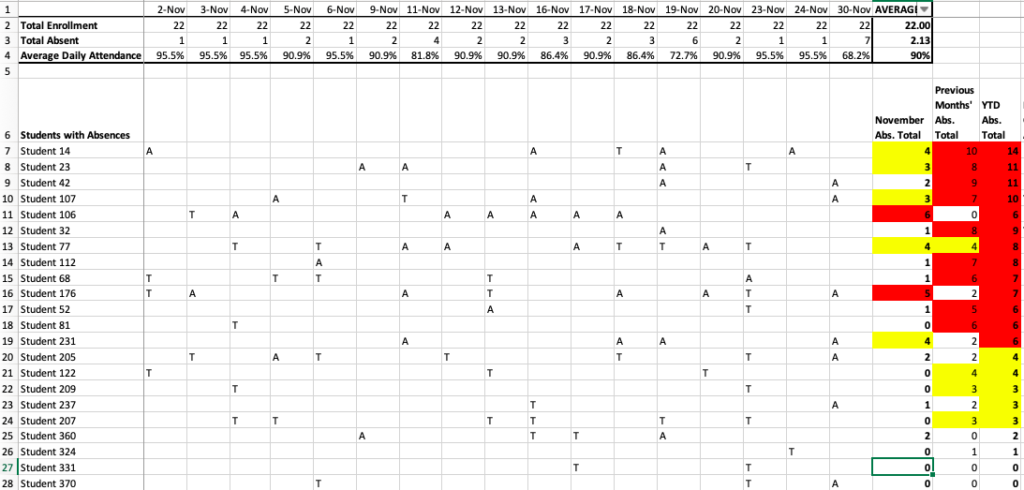
Let’s look at some sample data to practice finding meaning in it. Take a look at the attendance data for the fictional Ms. Hoffman’s first-grade class below. 


Screenshot of attendance tracker spreadsheet

At first glance, the conditional formatting that I used shows me that there are quite a few students who have missed more than five days by November of this school year — a warning that I need to do some kind of attendance intervention, like a letter, phone call or meeting. 

We can also start to think about what might be happening in Ms. Hoffman’s class — are the students excited about learning? Do they feel safe there? Is she engaging their families regularly?

We can also consider what outside influences may impact this particular group of students — did they struggle with attendance in previous years? Are there other barriers, such as transportation or having enough school uniforms, that might get in the way of them getting to school? 

Now let’s go a little deeper.

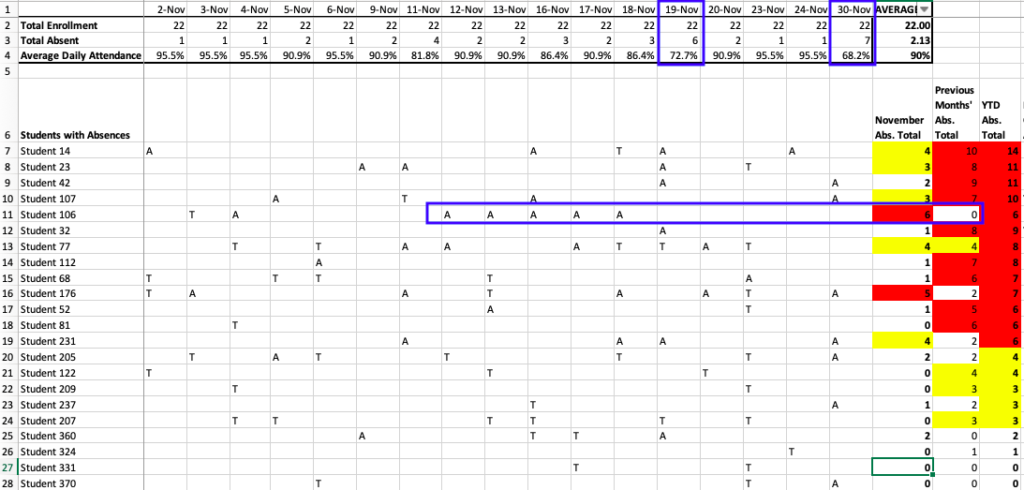
Screenshot of attendance tracker with patterns highlighted

We can look at both the individual and class levels to try to figure out what’s happening with the attendance in Ms. Hoffman’s class and what to do about it.

First, take a look at the student record in the blue box above.

This student hadn’t missed a single day of school in previous months and then missed five in a row!

(Hopefully the student is just on a pre-Thanksgiving vacation, but we certainly want to know if there’s something more concerning or preventable going on.)

Looking at student-level patterns can show us that something is clearly going on here that we need to learn more about through authentic family engagement. 

We can also look at anomalies — in this case, the days in which the class average daily attendance is way below the monthly average. 

Look at the two dates highlighted in the blue boxes. These attendance averages clearly stand out from the other days’ averages and have brought the monthly average down. 

It might take some investigating to figure out why attendance was so low those days – did it rain or snow? Was there an early release day? The 30th may even have been the day after Thanksgiving break when families are still traveling. 

Noting these anomalies helps us see things that our averages and totals don’t tell us and help us troubleshoot how to prevent similar trends in the future. 

By thinking about the human aspects of our data — what is happening to the people those spreadsheet rows represent — we can start to make meaning of the data we collect and position ourselves to positively impact their experiences and lives.

Written by cplysy · Categorized: engagewithdata

Jun 30 2021

Summarize, visualize, Analyze

Summarize, visualize, analyze

In my last post, I asked for feedback about what you’d like to learn about in our summer of figuring out the “so what?” of our data.

To my amusement, a longtime colleague and friend replied to my LinkedIn post with the following topic: 

“How to turn raw data into meaningful information to make decisions. AKA how to think about data like Amanda does.”

So today’s post will give you a glimpse into the inner workings of my brain (just kidding, that’s kind of scary) and how I think through data once I’ve tracked it. 

There are three main steps I take when I want to figure out what’s going on in a dataset: Summarize, Visualize, and Analyze. We’re going to talk through each.

1. Summarize it

Even with a nice, clean dataset that I’ve formatted it’s still hard to tell what’s REALLY going on there.

I need to use some formulas and functions to get a sense of the big picture.

I mean, look at the screenshot below (all fake data, don’t worry!) … this is like a blank canvas. I’ve got all my data in place, but I really couldn’t tell you anything about the trends or patterns that exist for my students. 


Written by cplysy · Categorized: engagewithdata

Jun 15 2021

Looking for the “So What?” In Our Data

Looking for the “so what?” in our data

If you’ve read this blog for any period of time, you’ve probably figured out that data tracking is kind of my thing. 

My super Type-A personality gets a lot of satisfaction from crossing every “t” and dotting every “i” and making sure that I can quickly access all of the data at my disposal in an organized, visually-appealing way. 

I started my business largely because I saw that many school-based staff struggled to get started with this process, and I knew I could help.  

But here’s the thing: no matter how beautiful and meticulous your data tracker is, it is still just the start — not the end — of your data journey.

I’ve had some great opportunities lately to talk about tracking family engagement data and use logic models 


“Let’s Get Tracking” session information from IEL National Family and Community Engagement conference

Written by cplysy · Categorized: engagewithdata

  • « Go to Previous Page
  • Go to page 1
  • Go to page 2
  • Go to page 3
  • Go to page 4
  • Interim pages omitted …
  • Go to page 11
  • Go to Next Page »

Footer

Follow our Work

The easiest way to stay connected to our work is to join our newsletter. You’ll get updates on projects, learn about new events, and hear stories from those evaluators whom the field continues to actively exclude and erase.

Get Updates

Want to take further action or join a pod? Click here to learn more.

Copyright © 2026 · The May 13 Group · Log in

en English
af Afrikaanssq Shqipam አማርኛar العربيةhy Հայերենaz Azərbaycan dilieu Euskarabe Беларуская моваbn বাংলাbs Bosanskibg Българскиca Catalàceb Cebuanony Chichewazh-CN 简体中文zh-TW 繁體中文co Corsuhr Hrvatskics Čeština‎da Dansknl Nederlandsen Englisheo Esperantoet Eestitl Filipinofi Suomifr Françaisfy Fryskgl Galegoka ქართულიde Deutschel Ελληνικάgu ગુજરાતીht Kreyol ayisyenha Harshen Hausahaw Ōlelo Hawaiʻiiw עִבְרִיתhi हिन्दीhmn Hmonghu Magyaris Íslenskaig Igboid Bahasa Indonesiaga Gaeilgeit Italianoja 日本語jw Basa Jawakn ಕನ್ನಡkk Қазақ тіліkm ភាសាខ្មែរko 한국어ku كوردی‎ky Кыргызчаlo ພາສາລາວla Latinlv Latviešu valodalt Lietuvių kalbalb Lëtzebuergeschmk Македонски јазикmg Malagasyms Bahasa Melayuml മലയാളംmt Maltesemi Te Reo Māorimr मराठीmn Монголmy ဗမာစာne नेपालीno Norsk bokmålps پښتوfa فارسیpl Polskipt Portuguêspa ਪੰਜਾਬੀro Românăru Русскийsm Samoangd Gàidhligsr Српски језикst Sesothosn Shonasd سنڌيsi සිංහලsk Slovenčinasl Slovenščinaso Afsoomaalies Españolsu Basa Sundasw Kiswahilisv Svenskatg Тоҷикӣta தமிழ்te తెలుగుth ไทยtr Türkçeuk Українськаur اردوuz O‘zbekchavi Tiếng Việtcy Cymraegxh isiXhosayi יידישyo Yorùbázu Zulu